
Building Your First Critical Thinking Routine in 15 Minutes a Day

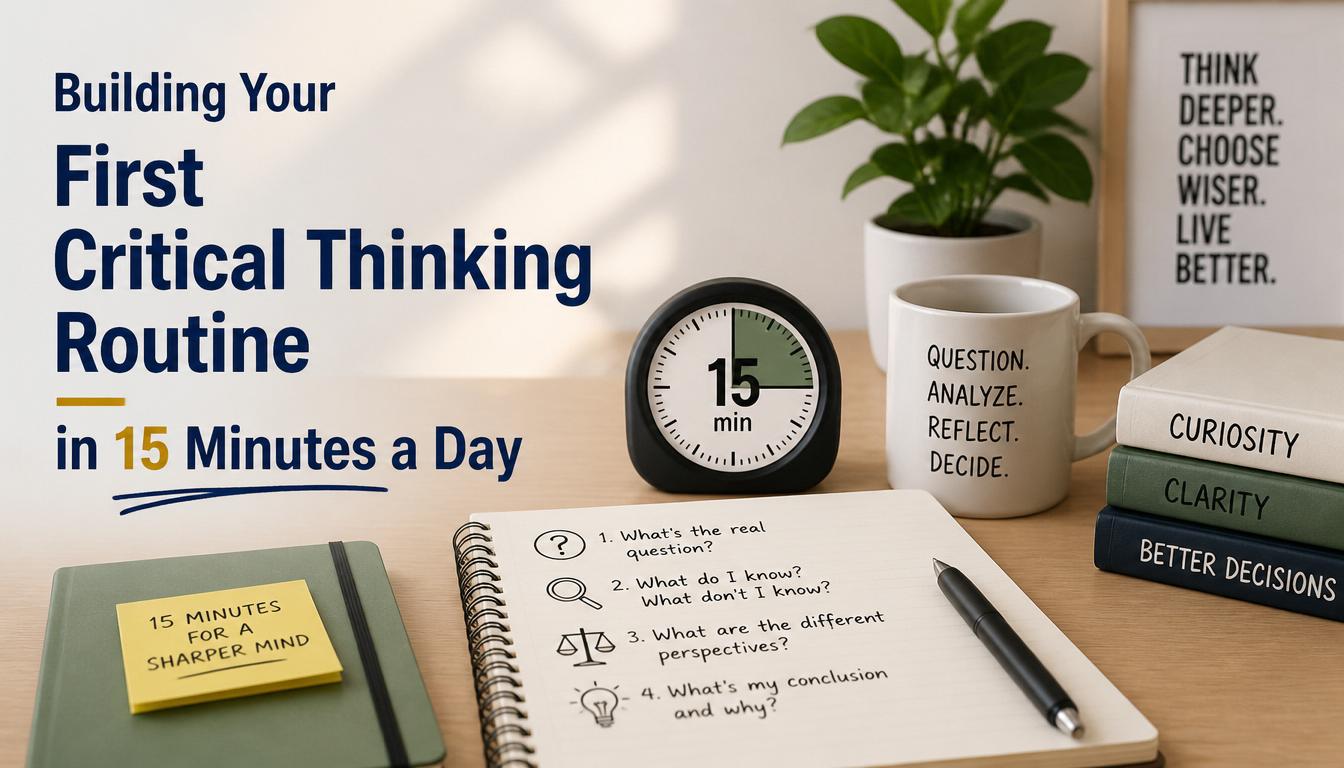
A critical thinking routine is a short, fixed daily practice — realistically 15 minutes — that trains you to notice assumptions, question first answers, and make clearer decisions, the same way a workout trains a muscle. It works because of two separate, well-documented findings from psychology: distributed daily practice beats occasional long sessions for building any durable skill, and new behaviors become automatic through consistent repetition attached to an existing routine, not through willpower or motivation. This guide gives you an actual 15-minute structure you can start today, explains the science behind why "a little, every day" beats "a lot, occasionally," and shows you how to make it stick past the point where most people quit — usually somewhere in the first three weeks.
Why a Skill Like This Needs a Routine at AllCritical thinking isn't a fact you learn once. It's closer to a physical skill: you can understand exactly how a pull-up works and still not be able to do one, because understanding and capability are built through different mechanisms. Reading about the 5 Whys technique or learning to spot a cognitive bias gives you the concept. It does not give you the reflex. The reflex — noticing in real time that you're about to accept a comfortable first answer, or that you're reacting instead of reasoning — only comes from repetition in low-stakes conditions, so it's available in high-stakes ones.
This is why most people who read a good article on critical thinking feel briefly sharper and then drift back to their old patterns within a week. Not because the idea was wrong, but because an idea alone doesn't rewire a habit. A routine does.
The Science: Why 15 Minutes a Day Beats a 3-Hour Weekend SessionThere are two separate bodies of research worth knowing here, because together they explain almost everything about why short daily practice outperforms occasional long sessions — and why most self-improvement attempts quietly fail in the first month.
1. The spacing effectOne of the most consistently replicated findings in learning science is that distributing practice over time produces stronger, longer-lasting retention than cramming the same total amount of practice into fewer, longer sessions. A landmark meta-analysis by Nicholas Cepeda and colleagues, reviewing over 800 separate measurements across more than 300 experiments, confirmed that spaced learning sessions reliably outperform massed ones — and this holds even when the total time invested is identical. The mechanism is intuitive once you see it: some forgetting between sessions is actually useful, because the small effort of retrieving a partially-faded skill strengthens it more than repeating something that's still fresh in short-term memory. A single three-hour session on Sunday gives your brain one long block of practice and then a full week to forget it. Fifteen minutes daily gives your brain seven separate chances to re-strengthen the same skill before it fades — which is a fundamentally more efficient way to build something durable.
2. Habit formation is slower — and more forgiving — than you thinkYou've probably heard "it takes 21 days to form a habit." That number traces back to a 1960 book by a plastic surgeon, observing how long it took patients to psychologically adjust to their new face after surgery — it was never a study of habit formation at all. The actual research comes from a 2010 study by Phillippa Lally and colleagues at University College London, published in the European Journal of Social Psychology. Ninety-six volunteers each picked a simple daily behavior and tracked how automatic it felt over twelve weeks. The median time to reach near-maximum automaticity was 66 days — not 21 — with an enormous range across individuals and behaviors, from as few as 18 days to as many as 254.
Two details from that study matter more than the headline number. First, missing a single day here and there did not meaningfully disrupt the habit-forming curve — so an occasional skipped day is not a failure, it's just noise the process absorbs. Second, automaticity built gradually and individually; there's no universal deadline by which a habit either "took" or didn't. This should change how you plan a critical thinking routine: expect the first few weeks to feel like effort, expect a missed day here or there to be harmless, and expect the habit to genuinely lighten somewhere in the two-month range rather than in the first fortnight.
3. Habit stacking removes the need for willpower or motivationStanford behavior scientist BJ Fogg's research, along with James Clear's popularization of the same underlying idea, converges on a simple mechanism: a new habit sticks fastest when it's deliberately attached to a behavior you already do automatically, using a simple formula — after [existing habit], I will [new habit]. Brushing your teeth, making coffee, sitting down at your desk, and closing your laptop at the end of the day are all natural anchor points, because they're cues your brain already fires reliably without being asked to. The new behavior borrows the existing behavior's automaticity instead of having to build its own from nothing.
Put these three findings together and the design of an effective routine writes itself: keep it short enough to do daily without friction, attach it to something you already do without thinking, and expect the payoff to compound over roughly two months rather than two weeks.
4. Why writing it down does more than thinking itReflective journaling has a research base of its own, separate from habit science. Studies of reflective writing practices in fields like nursing and medical education have found that the practice of writing through a decision or an experience — rather than just thinking about it — measurably improves critical thinking and decision-making skill over time. The mechanism appears to be that writing forces a kind of forced slowdown and externalization: you can't write a vague thought as easily as you can think one, so the act of putting a reaction into a sentence does some of the analytical work automatically. This is part of why the routine below is built around a few lines of writing rather than a few minutes of passive thinking.
The 15-Minute RoutineThis is built to be done at the same time every day, ideally stacked onto an existing habit — right after your morning coffee, right before you close your laptop, right after you brush your teeth at night. Consistency of timing matters more than which slot you pick.
Minutes 0–3: One Sentence, One FactWrite down, in one plain sentence, the single most notable thing that happened or that you decided in the last 24 hours — a choice you made, a disagreement you had, a moment you reacted strongly to something. Not a summary of your whole day. One sentence, one specific thing.
This step exists to force specificity. Vague reflection produces vague insight; a single concrete anchor gives the rest of the routine something real to work with.
Minutes 3–8: Run One 5-Whys Chain On ItTake that one sentence and ask "why" against it, following each answer to the next question, three to five times. If the entry was a decision, ask why you decided that. If it was a reaction, ask why it triggered you specifically. Write each answer down, even if it's short.
This is the same technique covered in "The 5-Why Technique: Your First Critical Thinking Tool" — the daily routine is where that concept turns from something you understood into something you do.
Minutes 8–11: Check for a Pause You SkippedAsk yourself one question about your entry: was there a moment in the last 24 hours where you reacted immediately instead of pausing first? If yes, write one sentence about what a fifteen-second pause might have changed. If no genuine reactive moment happened that day, write one sentence about a moment where pausing served you well, so you reinforce the pattern either way.
This connects the routine to "How to Slow Down Before You React: The Thinking Pause" — reviewing near-misses and successes daily is what actually builds the reflex over time, far more than reading about it once.
Minutes 11–14: One Assumption CheckWrite down one assumption buried in your entry — something you treated as fact without actually verifying it. This might be an assumption about another person's motive, a belief about how something works, or a prediction you're treating as certain. Then write one sentence on how you could check whether it's actually true.
This step is what keeps the routine from becoming pure venting. It's the one piece explicitly aimed at catching unexamined beliefs before they calcify into permanent blind spots.
Minute 14–15: One Line for TomorrowClose with a single sentence: one thing you'll do differently, watch for, or ask yourself tomorrow. This is not a to-do list — it's a single thread you're deliberately carrying forward, so the routine accumulates instead of resetting to zero every day.
What This Looks Like in Practice — A Sample EntryFact: I snapped at a coworker over a Slack message that just said "can we talk."
5 Whys: Why did I snap? → I assumed it meant bad news. Why did I assume that? → The last three times someone said that, it was bad news. Why does that pattern control my reaction? → I never actually checked whether it was a fair sample size before treating it as a rule. Why does that matter? → Because I reacted to a prediction, not to anything that had actually happened yet.
Pause check: I didn't pause — I replied irritated within ten seconds. A fifteen-second pause would have let me ask "what's this about?" instead of assuming the worst in my tone.
Assumption check: I assumed "can we talk" always means bad news. I could check this by simply asking what it's about before reacting, instead of pre-deciding the outcome.
Tomorrow: When someone says something ambiguous, ask a clarifying question before assigning it a meaning.
Notice this took under fifteen minutes, produced zero grand insights, and is exactly the kind of small, unglamorous entry that — repeated daily for two months — quietly rewires how you handle ambiguous moments.
Common Ways This Falls Apart (And the Fix)"I don't have anything to write about today." You do — the bar is intentionally low. A minor irritation, a small decision, a moment of impatience in traffic all count. The routine isn't reserved for dramatic days; most of its value comes from ordinary ones, because that's where most of your actual thinking happens.
"I missed three days and feel like I ruined it." According to the actual habit-formation data, missing occasional days doesn't meaningfully break the process — it's noise the underlying curve absorbs. The failure mode isn't missing a day; it's treating a missed day as a reason to quit entirely.
"It feels mechanical and fake." For the first few weeks, it will — that's the expected texture of any new habit before it becomes automatic, and it typically takes far longer than people assume (commonly cited "21 days" folklore is not what the actual research shows). Keep the format exactly as-is rather than trying to make it feel profound every day; profundity is not the goal, consistency is.
"I don't have 15 minutes." Cut it to five: one sentence of fact, one 5-why chain, one line for tomorrow. A tiny, consistent version beats an ambitious version you abandon in a week — this is the same principle behind starting a new habit absurdly small rather than starting big and burning out.
Frequently Asked Questions
What is a critical thinking routine?
A short, fixed daily practice — commonly around 15 minutes — of reviewing a recent decision or reaction, questioning it, checking for skipped pauses, and identifying unexamined assumptions, done consistently enough that the underlying skill becomes automatic rather than something you have to consciously remember to apply.
Why 15 minutes specifically, and not a longer weekly session?
Research on distributed practice (the spacing effect) consistently shows that spreading the same amount of practice across several short sessions produces stronger, more durable learning than concentrating it into one longer session, even when total practice time is equal.
How long before this actually becomes a habit?
Research by Phillippa Lally and colleagues found a median of 66 days for a new daily behavior to become close to fully automatic, with a wide individual range from about 18 to over 250 days — considerably longer than the commonly repeated "21 days" claim, which actually comes from an unrelated 1960 observation about plastic surgery patients.
What if I miss a day?
The same research found that missing an occasional day does not meaningfully disrupt the habit-formation process. The risk isn't a missed day itself — it's treating one missed day as a reason to abandon the routine entirely.
Do I need to use the exact 5-step structure, or can I adapt it?
The structure is a starting scaffold, not a rulebook. What matters more than the exact steps is that the routine stays short, happens at a consistent time attached to an existing habit, and involves actually writing something down rather than only thinking it.
Does journaling actually improve critical thinking, or is that just a wellness claim?
There's a real research base here, separate from general wellness claims — studies in fields such as nursing and medical education have specifically found that reflective journaling improves critical thinking and decision-making skill, likely because writing forces a level of specificity and slowdown that unstructured thinking doesn't.
What's the single most important part of the routine if I can only do one thing?
The assumption check. Reviewing a fact and even running a 5-Whys chain can happen almost automatically once you're used to it, but explicitly naming one unverified assumption is the step most likely to actually change a future decision, because it's the part aimed at your blind spots rather than your already-visible thoughts.
You don't build critical thinking by reading about it once — you build it the same way you'd build any other skill, in small, boring, daily repetitions that feel like almost nothing on any single day and quietly become a different way of seeing after about two months of not quitting.
References- Cepeda, N. J., Pashler, H., Vul, E., Wixted, J. T., & Rohrer, D. (2006). Distributed Practice in Verbal Recall Tasks: A Review and Quantitative Synthesis . Psychological Bulletin. https://pubmed.ncbi.nlm.nih.gov/16719566/
- VirTra — The Spacing Effect in Skills Training and Deliberate Practice . https://www.virtra.com/the-spacing-effect-in-skills-training-and-deliberate-practice/
- Lally, P., van Jaarsveld, C. H. M., Potts, H. W. W., & Wardle, J. (2010). How are habits formed: Modelling habit formation in the real world . European Journal of Social Psychology, 40(6), 998–1009. https://onlinelibrary.wiley.com/doi/10.1002/ejsp.674
- UCL News — How long does it take to form a habit? https://www.ucl.ac.uk/news/2009/aug/how-long-does-it-take-form-habit
- TaskCoach — The 21-Day Habit Myth: Lally's Real Answer Is 66 Days . https://taskcoach.ai/blog/habit-formation-real-curve-lally-66-days/
- Brain Health Network — The art of habit stacking (BJ Fogg). https://brain.health/blog/articles/the-art-of-habit-stacking/
- NASM Blog — Habit Stacking – A Different Approach to Behavior Coaching . https://blog.nasm.org/fitness/habit-stacking
- Ingrid Adelsberger — The "Magic" of Tiny Habits and Atomic Habits . https://www.ingridadelsberger.com/the-magic-of-tiny-habits-and-atomic-habits/
- Mindsera — What Are the Benefits of Journaling? 200+ Studies Reviewed . https://mindsera.com/articles/benefits-of-journaling-the-science-of-reflection/
- USAHS — 10 Ways Journaling Benefits Students . https://www.usa.edu/blog/ways-journaling-benefits-students/
- PMC — Use of Reflective Journaling to Understand Decision Making Regarding Two Evidence-Based Psychotherapies for PTSD . https://pmc.ncbi.nlm.nih.gov/articles/PMC6426332/
- Todoist — The Benefits of Journaling for Productivity (Even for 15 Minutes a Day) . https://www.todoist.com/inspiration/journaling
Building Your First Critical Thinking Routine in 15 Minutes a Day
A practical, research-backed daily routine that turns critical thinking from a one-off skill into a permanent habit — using the science of habit formation, spaced practice, and reflective journaling.