
Critical Thinking: A Skill, a Habit, or a Mindset?

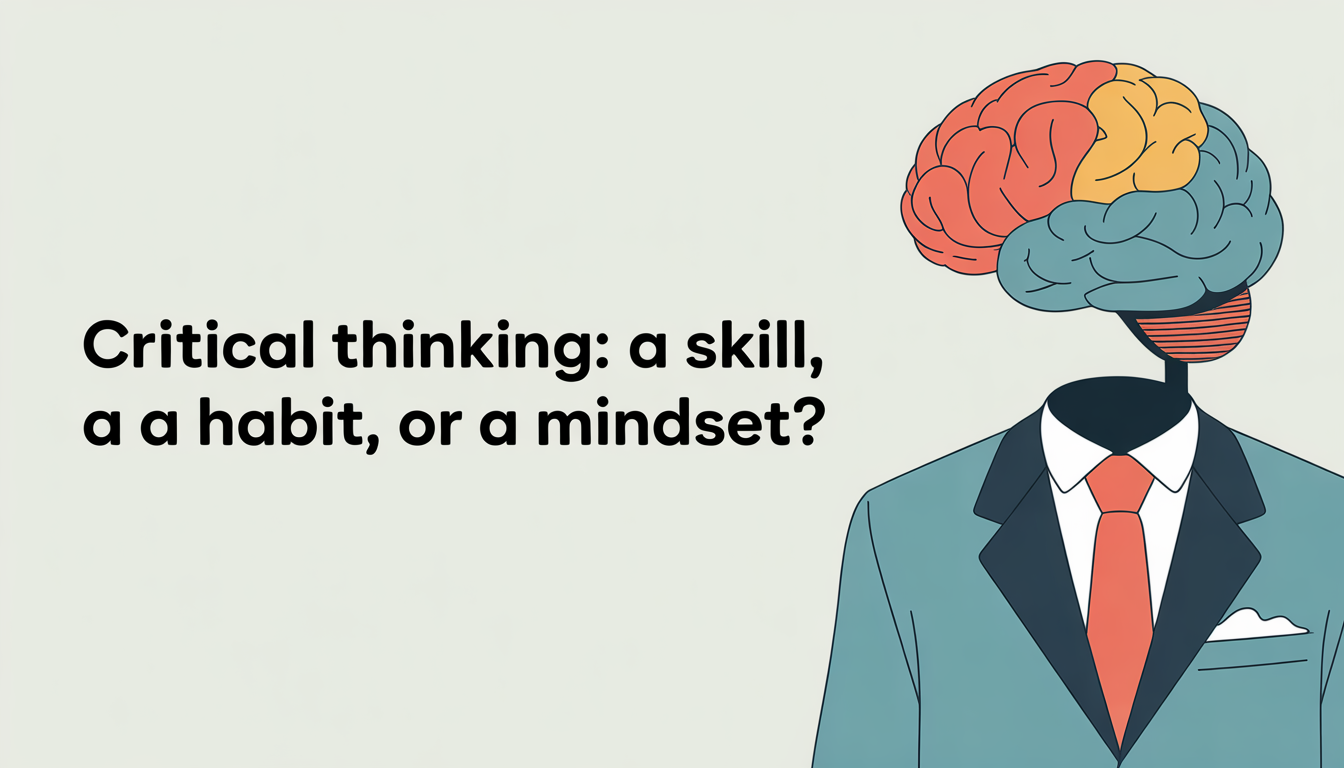
- The Question That Changes Everything
- A 2,500-Year-Old Question: Origins & History
- Critical Thinking as a Skill: The Case for Teachability
- Critical Thinking as a Habit: The Case for Daily Practice
- Critical Thinking as a Mindset: The Deepest Layer
- The Unified View: All Three, Always
- Why This Matters More Than Ever in the Age of AI
- Practical Pathways: Building All Three Dimensions
- Conclusion: The Unfinished Question
- References
Here is a thought experiment. Two people sit down to read the same news article — a story about a new government policy, a scientific breakthrough, or a social controversy. One person reads, nods, and moves on. The other pauses, questions the author's sources, considers what viewpoints are missing, weighs the evidence, and arrives at a measured, independent conclusion. What separates them?
Most people, if asked, would say: "The second person is a better critical thinker." But what does that actually mean? Did that person learn a technique — a skill they practiced in a classroom? Did they simply develop a daily habit of intellectual interrogation? Or is something deeper at work — a fundamental orientation toward the world, a way of being that makes questioning feel as natural as breathing?
This is not merely an academic question. How we answer it determines how we teach it, how we build it, and whether we can scale it in a civilization that desperately needs it. At a time when misinformation spreads faster than truth, when artificial intelligence generates plausible-sounding falsehoods at industrial scale, and when the World Economic Forum identifies analytical thinking as the single most in-demand skill among employers globally — the stakes of getting this right could not be higher.
The capacity to successfully, positively engage with the cognitive capacities of critical thinking has become the benchmark of employability for many diverse industries across the globe and is considered critical for the development of informed, decisive global citizenship.
— Conversations on Critical Thinking, MDPI Education Sciences, 2018
So let us take the question seriously. Is critical thinking a skill? A habit? A mindset? The answer — and the argument of this essay — is that it is precisely and irreducibly all three, operating at different depths of human cognition and character. Understanding how these layers work together, and how to develop each of them, is the project of a thoughtful intellectual life.
02 · OriginsA 2,500-Year-Old QuestionTo understand what critical thinking is, it helps to trace where the idea came from — because its intellectual heritage already contains the tension between skill, habit, and mindset.
The Socratic RootThe origins of critical thinking are often traced to the philosopher Socrates of ancient Athens (470–399 BC), whose method of rigorous questioning — the now-famous elenchus — was designed to expose the hidden assumptions and contradictions in people's beliefs. As Plato documented in his early dialogues, Socratic questioning requires the comparative judgment of facts, revealing irrational thinking and demonstrating that authority alone does not guarantee knowledge.
What is striking about the Socratic method is that it was not merely a technique (though it was that). It was also a way of life. Socrates famously declared that "the unexamined life is not worth living" — a statement that frames critical examination not as a skill to deploy but as a fundamental orientation toward existence. This is the mindset layer, present at the very beginning.
John Dewey and the Modern TermThe modern phrase "critical thinking" was introduced by the American pragmatist philosopher and educator John Dewey in his landmark 1910 book How We Think. Dewey defined it as the "active, persistent and careful consideration of any belief or supposed form of knowledge in the light of the grounds that support it, and the further conclusions to which it tends" — and identified a habit of such consideration with a scientific attitude of mind.
Notice the language: Dewey says habit. He is pointing to something more durable and automatic than a one-time application of technique, but less total than a worldview. His framing — deeply influenced by the American pragmatist tradition — emphasizes that reflective thinking becomes valuable only when it becomes a regular mode of engagement with experience.
Historical NoteRecent scholarship (Boudry, 2024) has questioned the "standard view" that places critical thinking's origins exclusively with Socrates or Dewey. Pre-Socratic philosophers — Thales, Anaximander, and Heraclitus — were already practicing systematic critical reflection, setting themselves apart from mythological traditions. The roots run deeper than we often assume.
Bloom's Taxonomy and the Cognitive RevolutionIn 1956, a team of American educational psychologists led by Benjamin Bloom formalized the cognitive architecture of learning, producing what became known as Bloom's Taxonomy. This hierarchical model placed knowledge at its base and rose through comprehension, application, analysis, synthesis, and — at the apex — evaluation: the capacity to judge, critique, and reason about information. Critical thinking, in Bloom's framework, is the summit of cognitive achievement.
A revised version of Bloom's taxonomy (Anderson et al., 2001) renamed and reordered the top categories, ending with "create" above "evaluate" — reflecting a shift in emphasis toward generative thinking. But the essential insight remained: critical thinking is a set of learnable cognitive operations, arranged in a hierarchy from simple to complex. This is the clearest articulation of critical thinking as skill.
The U.S. National Council for Excellence in Critical Thinking defined it in 1987 as the "intellectually disciplined process of actively and skillfully conceptualizing, applying, analyzing, synthesizing, or evaluating information gathered from, or generated by, observation, experience, reflection, reasoning, or communication" — a definition that would become widely adopted.
03 · The First LayerCritical Thinking as a SkillThe most intuitive and widely-held understanding of critical thinking frames it as a teachable, learnable, improvable skill — a set of cognitive competencies that can be identified, practiced, measured, and refined.
What the Research SaysThe empirical evidence strongly supports the view that critical thinking can be taught. A landmark meta-analysis by Abrami et al. (2015), reviewing hundreds of experimental studies, confirmed that targeted instructional interventions produce significant improvements in critical thinking skills. The effect was largest when instruction was explicit — when teachers directly taught the strategies and dispositions of critical thinking, rather than hoping students would absorb them incidentally.
Research on collaborative learning (Tandfonline, 2024) showed that students who worked together on pre-released assessment tasks demonstrated a statistically significant relationship between collaboration and the depth of critical reasoning. This means that the context in which skills are practiced matters — and that critical thinking, like any complex skill, requires both instruction and application in real-world, socially-embedded contexts.
78%of employers rank critical thinking as the most important skill they want — yet only 34% of graduates arrive prepared (Hart Research Associates, 2018)
99%of faculty across disciplines say teaching critical thinking is "essential" — yet traditional lecture methods often fail to develop it (Higher Ed research, 2024)
4CsCritical thinking is one of four meta-skills (with creativity, collaboration, and communication) deemed essential for 21st-century success (Pearson, 2018)
The Components of Critical Thinking as SkillResearchers, drawing on the framework developed by the University of Florida's Wertheim Institute, have identified several discrete cognitive operations that constitute the skill dimension of critical thinking:
Skill Component What It Involves Argumentation Making claims supported by evidence; constructing logical chains of reasoning Reasoning Inferring conclusions from facts; distinguishing deductive from inductive arguments Criteria Application Evaluating the credibility and relevance of sources; distinguishing truth from fiction Metacognition Thinking about one's own thinking; monitoring and regulating cognitive processes Analysis Breaking complex ideas into component parts; examining assumptions and implications Synthesis Integrating multiple perspectives; building coherent understanding from diverse inputsThese are, by any measure, learnable operations. They can be modeled, practiced, assessed, and improved over time. A student who repeatedly practices identifying logical fallacies will become better at spotting them. A professional who regularly interrogates data sources will develop greater fluency in evidence evaluation. Skills grow with deliberate practice.
The Limits of the Skill FrameBut here is where the skill frame runs into a wall. Research on cognitive biases tells us that knowing a logical fallacy and automatically avoiding it in emotionally charged situations are two entirely different things. Confirmation bias — the tendency to prioritize information consistent with prior beliefs — limits critical analysis even in people who have been formally trained in logic. "The relationship between critical-thinking skills and critical-thinking dispositions is an empirical question," as Wikipedia's synthesis of the literature notes.
In other words: you can have the skill and still not use it. Something else is required. That something is habit.
04 · The Second LayerCritical Thinking as a HabitIf skills are tools, habits are the patterns of reaching for those tools. A person with critical thinking skills who uses them only when prompted has very different cognitive outcomes than a person for whom questioning, verifying, and reflecting have become automatic, daily behaviors. This is the insight at the heart of framing critical thinking as a habit of mind.
Dewey's Habit and the Neuroscience Behind ItWhen Dewey spoke of "a habit of such consideration," he was anticipating what modern neuroscience would later confirm: that the brain operates largely through habit loops — routines encoded in the basal ganglia that run automatically, without requiring deliberate attention. Building a habit of critical reflection means encoding the questioning impulse deeply enough into daily cognitive routines that it fires without conscious effort.
The psychological research is clear that sustained attention is foundational to critical thinking development. The practice of focused attention strengthens connections with complex content and increases reflective and analytical capacities. Metacognition — the ability to think about one's own thinking — consistently emerges in research as an essential driver of critical thinking growth, and metacognition is itself a habit that must be practiced until it becomes reflexive.
Habits That Build Critical ThinkingThe development and practice of critical thinking skills in formal schooling is merely the beginning of this disciplinary process. The greatest challenge facing schooling in the 21st century is to build students' critical dispositions — the habit of mind.
— MDPI Education Sciences, 2018 [8]
Research and practical wisdom converge on a set of daily practices that, if maintained consistently, build the critical thinking habit over time. These include:
Questioning consumption habits. Before accepting information as fact, verify it across multiple independent sources. This simple practice, when done consistently enough, rewires the automatic tendency to accept plausible-sounding claims at face value.
Practicing "thinking out loud." When confronted with a problem, verbalizing the reasoning process — what assumptions you are making, what evidence you have, what alternatives exist — externalizes cognition in a way that makes gaps and errors visible. Business leaders interviewed by HelpSquad (2025) consistently named this as one of the most effective critical thinking habits they cultivate.
Scheduling reflection. Many accomplished thinkers set aside regular time — daily journaling, weekly reviews, post-mortems after decisions — to review their reasoning processes. This is metacognition made habitual. Research on problem-based learning confirms that reflective discussions and journaling play crucial roles in developing critical thinking over time.
Seeking disconfirmation. Make a habit of actively looking for evidence that contradicts your current belief. This directly counteracts confirmation bias, which research identifies as one of the most powerful obstacles to clear thinking.
Research InsightA 2024 study from PMC (Determining Factors for the Development of Critical Thinking) found that working memory, attention control, and metacognitive strategies are the three most important psychological determinants of critical thinking development. All three are strengthened through habitual, sustained practice — not through one-time instruction.
The Limits of the Habit FrameHabits are powerful — but they are also brittle. A person can develop excellent critical thinking habits in one domain (say, scientific research) while remaining systematically uncritical in another (say, political belief or personal relationships). Habits are context-dependent; they do not automatically generalize across all areas of life.
Moreover, habits without motivating values can be abandoned when they become inconvenient. A habit of questioning authority is only sustainable if the person genuinely values truth over comfort — if they have internalized, at a deep level, the conviction that careful thinking matters. That value is not a skill or a habit. It is a mindset.
05 · The Third LayerCritical Thinking as a MindsetWe arrive now at the deepest and most contested layer of the question. A mindset, in the psychological literature, is not a technique or a behavior — it is a fundamental orientation toward experience: a set of values, beliefs, and dispositions that shape how a person automatically perceives and engages with the world.
The Dispositional AccountResearch from the University of Florida's Wertheim Institute articulates critical thinking as containing an essential dispositional core — what they call the "disposition" dimension, which involves open-mindedness, respect for evidence and reasoning, cognitive flexibility, healthy skepticism, and the ability to consider diverse perspectives. This is not a technique or a routine. It is a way of being.
The research by Insight Assessment (Facione, 2025) explicitly confirms this: "mindset attributes — like curiosity, truth-seeking, and creativity — are just as important as cognitive skills in helping students become independent, logical thinkers." Curiosity is not a skill you learn in a workshop. Truth-seeking is not a habit you can force. These are expressions of who a person fundamentally is — or who they are working to become.
Every Child Is Born a Critical ThinkerOne of the most remarkable findings in the qualitative research on critical thinking education is the observation from multiple international educators — including one currently teaching in Pakistan — that "every child is born with the mindset of critical thinking." Young children ask relentless questions. They challenge authority naturally. They explore contradictions without discomfort. The child's native curiosity, fertile imagination, and love of experimental inquiry are, as Dewey himself argued, already expressions of the scientific attitude.
What happens, then? What accounts for the erosion of this native critical sensibility? Research points directly at traditional educational systems that treat students as "empty vessels" to be filled with knowledge (Freire's famous "banking model"), rewarding passive reception and penalizing challenge. Rote learning, which is built into the traditional transmission model of teaching, literally builds habits of repetition that can be followed without thinking — the cognitive opposite of critical engagement.
Dweck, Growth Mindset, and Critical ThinkingThe traditional transmission view of teaching leaves no opportunity for the transactional dialogue which prompts critical thinking. What is learnt is action: the cognitive element is small.
— Skemp, as cited in MDPI Education Sciences, 2018
The connection between mindset and critical thinking is powerfully illuminated by Carol Dweck's research on growth versus fixed mindsets. A 2025 study found that confidence, resilience, and mindset influenced the extent to which students were able to apply their cognitive skills effectively. Students who possessed critical thinking skills but lacked the psychological safety to use them — due to anxiety, fear of being wrong, or low confidence — performed worse on critical thinking tasks than students with stronger mindsets but comparable technical skills.
This finding has enormous implications: developing the skill without developing the underlying mindset leaves the skill underutilized. The willingness to be wrong, to revise one's beliefs, to engage with uncertainty without collapsing into dogma — these are dispositional qualities that belong to the mindset layer, and they are the foundation on which skills and habits are built.
Key Research FindingA 2024 Frontiers in Education study found a statistically significant moderation effect: students' pre-existing critical thinking mindset predicted not just their own critical thinking development, but also their ability to develop design thinking — suggesting that CT mindset functions as a prerequisite for other forms of higher cognition. Mindset isn't just one part of the puzzle; it may be the foundation on which all the rest rests.
06 · SynthesisThe Unified View: All Three, AlwaysWe are now in a position to state the central argument clearly. Critical thinking is not a skill or a habit or a mindset. It is all three — operating at different depths of human cognition, each dependent on the others, each insufficient alone.
Think of it as three concentric circles:
At the outermost ring are the skills: the teachable cognitive operations — argumentation, analysis, synthesis, metacognitive monitoring — that can be explicitly taught, practiced, and assessed. These are the tools in the toolkit. They are necessary but not sufficient.
In the middle ring are the habits: the daily routines and behavioral patterns through which skills are regularly deployed — questioning assumptions, seeking disconfirming evidence, reflecting on one's reasoning. These patterns automate and sustain skill use across time and context. They are what prevent skills from gathering dust. But habits, too, are insufficient: without the motivating values of the innermost circle, they can be abandoned when inconvenient.
At the innermost core is the mindset: the fundamental orientation of intellectual humility, curiosity, commitment to truth, and tolerance for uncertainty that gives both skills and habits their meaning and direction. This is the "why" that makes the other two sustainable. Without the mindset, skills are inert and habits are fragile.
Dimension What It Is How It Develops What It Lacks Alone Skill Learnable cognitive operations: analysis, synthesis, argumentation Explicit instruction, practice, feedback Motivation to apply; generalization across contexts Habit Automatic behavioral patterns of questioning, reflecting, verifying Repetition, routine, environmental design Values to sustain under pressure; breadth across life domains Mindset Fundamental orientation: curiosity, intellectual humility, truth-seeking Modeling, culture, self-awareness, challenge Specific tools to execute well; consistency of applicationThe research from Frontiers in Education (2024) provides compelling empirical support for this unified view: critical thinking mindset is a statistically significant prerequisite for developing other thinking capabilities. You cannot build the outer rings without first cultivating the core. But the core alone, without skill-building and habit-formation, remains inert potential.
· · · 07 · The CrisisWhy This Matters More Than Ever in the Age of AIThe three-dimensional account of critical thinking is not merely a theoretical refinement — it has urgent practical stakes in the world taking shape around us right now.
The Analytical Thinking PremiumThe World Economic Forum's Future of Jobs Report 2025 — the most comprehensive global survey of employer skill demands — found that analytical thinking remains the top core skill for employers, with seven out of ten companies considering it essential. The report identifies critical thinking and analytical reasoning as capabilities expected to grow more important, not less, as AI becomes more embedded in work processes. The reason is structural: AI handles repeatable, data-heavy work, while humans focus on judgment, relationships, and trade-offs.
McKinsey's 2025 Future Skills Index confirms the pattern: critical thinking and analytical reasoning rank among the top five most in-demand skills globally. One analyst framed the near future as the era of decision intelligence — a merger of critical thinking and data literacy that will define high-value human work in an algorithmic economy.
The AI Verification ProblemAI tools can generate confident-sounding misinformation. They can produce biased outputs. They can optimize for what sounds right rather than what is right. Research from OpenSesame (2025) makes the point directly: "AI tools can produce impressive results, but they can also generate biased, misleading, or incorrect outputs — that's why critical thinking is essential when working with AI." Every interaction with a generative AI system is, in a sense, a critical thinking test.
This creates a profound irony: the widespread adoption of AI tools — which might seem to reduce the need for human reasoning — actually increases the cognitive demands on human users. The person who accepts AI outputs uncritically will be systematically misled. The person who applies critical thinking — questioning assumptions, checking sources, identifying potential biases — will use AI as a powerful amplifier of their own capabilities.
The Misinformation CrisisWe are at a critical juncture where AI can either amplify or erode humanity's most defining trait: our cognitive abilities. Creativity, contextual reasoning, and ethical judgment are capabilities that no algorithm can fully replicate.
— World Economic Forum, 2025 [30]
The information landscape has never been more hostile to uncritical minds. Social media platforms optimize for emotional resonance, not truth. Deep fakes are visually indistinguishable from real footage. Coordinated influence campaigns manufacture synthetic consensus. In this environment, critical thinking is not a luxury of intellectual refinement — it is a survival skill for democratic citizenship.
The PMC research on "job-proof skills" (2023) argues that the concept of critical thinking as "job-proof" highlights the importance of attributes that machines cannot replicate with the same standards and agility. Empathy, ethical reasoning, creative contextualization, cultural understanding — these are the dimensions of human intelligence that no AI can authentically replicate. And they all depend on the integrated skill-habit-mindset architecture we have been exploring.
86%of businesses expect AI and information processing to significantly affect their operations by 2030 (WEF Future of Jobs 2025)
70%of employers consider analytical thinking essential — making it the #1 in-demand skill worldwide in 2025 (WEF)
39%of workers' core skills expected to change by 2030, driven primarily by AI integration (WEF Future of Jobs 2025)
08 · ActionPractical Pathways: Building All Three DimensionsUnderstanding the three-layered architecture of critical thinking is only valuable if it leads to concrete action. Here is a research-grounded framework for developing each dimension intentionally.
Building the Skill LayerFormal instruction in logic and argumentation. Learning to identify logical fallacies, construct valid arguments, and evaluate evidence quality gives the mind precise tools it would otherwise lack. This does not require a philosophy degree — structured online courses, argument mapping exercises, and debating practice all serve the purpose.
Problem-based learning. Research consistently shows that placing learners in real-world, ill-structured problem scenarios is one of the most effective ways to develop critical thinking skills. This is why the best professional training programs, business schools, and medical schools prioritize case-based learning over lecture.
Collaborative challenge. Brainstorming with people who hold different perspectives — genuinely different, not performatively different — forces exposure to alternative reasoning patterns. As business leaders note, collaborative sessions challenge the hidden assumptions of your own thought process. Other minds are among the best critical thinking tools available.
Building the Habit LayerThe daily question practice. Choose one belief, assumption, or claim you encountered that day and subject it to sustained scrutiny: What is the evidence? What is the source? What alternative interpretations exist? What would it take to change your mind? Five minutes of this practice daily, sustained over months, rewires default cognitive patterns.
The "steel-man" discipline. Before dismissing any view you disagree with, construct the strongest possible version of that view — not a caricature, but the best argument for it. This habit builds intellectual humility and guards against motivated reasoning.
Source verification as reflex. Before forwarding, sharing, or accepting any significant claim, verify it across at least two independent high-quality sources. When this becomes automatic — as instinctive as locking your door when you leave — you have embedded it as a habit.
Cultivating the Mindset LayerEmbrace being wrong. The single most important mindset shift is reframing error from threat to information. People who are psychologically attached to being right will systematically resist evidence that challenges their beliefs. People who are genuinely curious about what is true will seek out disconfirming evidence. This reframing — from "I need to be right" to "I want to understand" — changes everything.
Intellectual diversity as a value. Surround yourself with thinkers who reason differently from you — different disciplines, different cultural bgxyzs, different first-principles assumptions. Treating intellectual diversity as enriching rather than threatening is a dispositional choice that the mindset layer makes sustainable.
Tolerance for uncertainty. Research identifies the fear of ambiguity as a significant psychological barrier to critical thinking. Developing comfort with not-knowing — with holding questions open without rushing to premature closure — is a mindset discipline that takes years to cultivate but transforms intellectual life.
For Educators & OrganizationsResearch on pedagogical strategies confirms the importance of participatory and collaborative methodologies — problem-based learning, project-based learning, Socratic seminars — to encourage the confrontation of ideas. But these approaches require an institutional environment that genuinely values inquiry and debate, as well as teachers and leaders prepared to guide complex reasoning processes. Culture, not just curriculum, determines whether critical thinking flourishes.
09 · ClosingThe Unfinished QuestionThere is something appropriately Socratic about the answer we have arrived at. The question "Is critical thinking a skill, a habit, or a mindset?" turns out to be a false trilemma — a choice that dissolves once you examine it carefully enough. It is all three. And asking which one it is, while neglecting the others, is itself a failure of critical thinking.
The skill without the habit is a tool left in the drawer. The habit without the mindset is an empty routine, likely to be abandoned at the first sign of discomfort. The mindset without skill and habit is aspiration without execution — a commitment to clear thinking that never quite materializes in the fog of daily life.
What makes this question so enduring — from Socrates to Dewey to the researchers and educators working today — is that it points at something fundamental about human rationality and human freedom. The examined life, as Socrates suggested, is not just a better life. In a world awash with manipulation, algorithmic bias, manufactured consent, and AI-generated plausibility, it may be the only fully human life available.
The 21st century will be defined by those who learn to think rigorously in a world engineered to discourage it. That combination of skill, habit, and mindset — built patiently, practiced daily, valued deeply — is not just the most employable quality you can develop. It is the most human one.
The test of a first-rate intelligence is the ability to hold two opposing ideas in mind at the same time and still retain the ability to function.
— F. Scott Fitzgerald
The question is not just what critical thinking is. The question is: are you building it?
ReferencesSources & Further Reading- Abrami, P.C., Bernard, R.M., Borokhovski, E., Waddington, D.I., Wade, A., & Persson, T. (2015). Strategies for teaching students to think critically: A meta-analysis. Review of Educational Research, 85, 275–314. doi:10.3102/0034654314551063
- Anderson, L.W., Krathwohl, D.R., et al. (2001). A Taxonomy for Learning, Teaching, and Assessing: A Revision of Bloom's Educational Objectives. Addison Wesley Longman.
- Bloom, B.S., et al. (1956). Taxonomy of Educational Objectives, Handbook I: The Cognitive Domain. New York: David McKay Co.
- Boudry, M. (2024). Revisiting the origin of critical thinking. Educational Philosophy and Theory. Tandfonline
- Dewey, J. (1910). How We Think. Boston: D.C. Heath & Co. — Reprinted 1933.
- Dweck, C.S. (2006). Mindset: The New Psychology of Success. New York: Random House.
- Facione, P.A. (1990). Critical Thinking: A Statement of Expert Consensus for Purposes of Educational Assessment and Instruction (The Delphi Report). California Academic Press.
- Facione, P.A. (2025). What the Critical Thinking Data Tell Us. Insight Assessment. insightassessment.com
- Frontiers in Education (2024). Shaping future-ready graduates with mindset shifts: studying the impact of integrating critical and design thinking. Front. Educ., Vol. 9. doi:10.3389/feduc.2024.1358431
- Hart Research Associates (2018). Fulfilling the American Dream: Liberal Education and the Future of Work. Survey for AAC&U.
- Hmelo-Silver, C.E. (2004). Problem-based learning: What and how do students learn? Educational Psychology Review, 16(3), 235–266.
- Keeley, S.M. & Browne, M.N. (2018). Asking the Right Questions: A Guide to Critical Thinking (12th ed.). Pearson.
- MDPI Education Sciences (2018). Conversations on Critical Thinking: Can Critical Thinking Find Its Way Forward as the Skill Set and Mindset of the Century? Educ. Sci. 8(4), 205. mdpi.com
- Paul, R. & Elder, L. (2014). Critical Thinking: Tools for Taking Charge of Your Professional and Personal Life (2nd ed.). Pearson.
- PMC / NCBI (2023). Critical Thinking: Creating Job-Proof Skills for the Future of Work. pmc.ncbi.nlm.nih.gov
- PMC / NCBI (2025). Determining Factors for the Development of Critical Thinking in Higher Education. pmc.ncbi.nlm.nih.gov
- Stanford Encyclopedia of Philosophy (2025). Critical Thinking — History. plato.stanford.edu
- Tandfonline (2024). Cultivating Critical Thinking Skills: A Pedagogical Study in a Business Statistics Course. Journal of Statistics and Data Science Education. doi:10.1080/26939169.2024.2394534
- Tandfonline (2024). Enhancing critical thinking through collaborative learning. Accounting Education. doi:10.1080/09639284.2024.2361647
- University of Florida / Wertheim Institute (2024). How to Improve Your Critical Thinking. wertheim.scripps.ufl.edu
- Wikipedia (2026). Critical thinking. en.wikipedia.org
- World Economic Forum (2025). Future of Jobs Report 2025. weforum.org
- World Economic Forum (2025). Educating a future workforce that will match AI disruption. weforum.org
- OpenSesame (2025). Top 10 AI Skills Every Employee Needs in 2025. opensesame.com
Critical Thinking: A Skill, a Habit, or a Mindset?
A question that has shaped education, philosophy, and now the future of work — and why the answer is more nuanced, and more urgent, than ever before.