
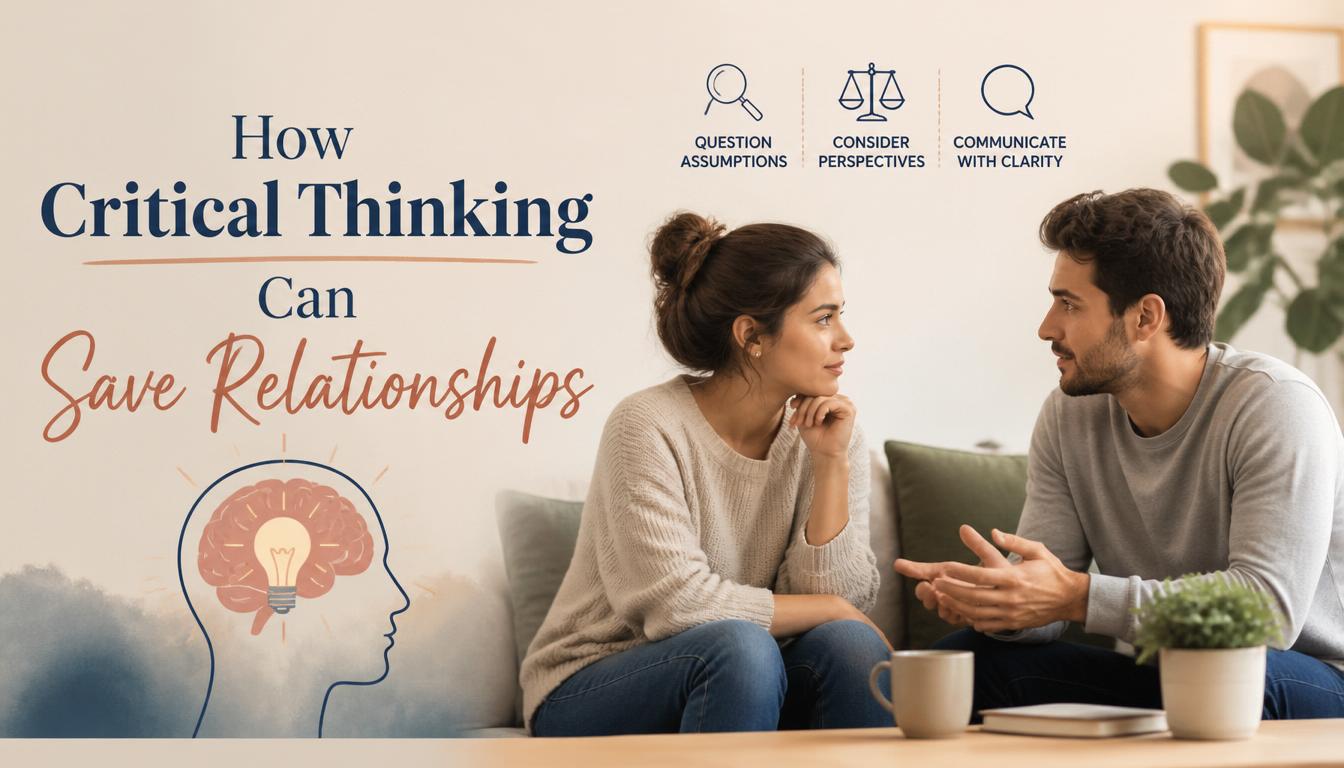
How Critical Thinking Can Save Relationships

"The feeling of certainty — I know exactly what they meant, I know exactly who they are, I know I'm right — is the most dangerous feeling in any relationship. Not because you're never right. But because certainty kills curiosity, and curiosity is the oxygen of love."
Adapted from Gottman Institute research on defensiveness and relational repair What's inside this research-backed guide- Why love alone is not enough
- What critical thinking means in relationships
- Gottman's Four Horsemen — failures of thinking
- 5 cognitive biases silently destroying your bond
- The research link: critical thinking and empathy
- How CT transforms communication
- The 7-step framework for thinking in conflict
- 12 life-changing benefits for your relationships
- Real-life scenarios decoded
- Frequently asked questions
- Full academic references
There is a conversation that happens in every couples therapist's office, and it sounds something like this. Two people who genuinely, deeply love each other sit on opposite sides of a couch, both in pain, both frustrated, both absolutely certain that the other person is the problem. And the therapist sits there knowing a truth that neither of them can see from where they are sitting: the problem is not the love. The love is still there. The problem is the thinking.
Relationships are not destroyed by the absence of affection. They are destroyed by automatic, unchecked thinking — by cognitive biases that distort perception, by emotional reflexes that trigger before reason has a chance to engage, by patterns of communication that science can measure, predict, and correct. What destroys relationships is not passion running dry. It is thinking running on autopilot.
This is not a metaphor. This is what decades of rigorous psychological research actually shows. Dr. John Gottman, whose work at the University of Washington is among the most cited in relationship science, could predict divorce with 94% accuracy — not by measuring how much couples loved each other, but by measuring how they thought about and communicated with each other during conflict. The variables he tracked were all cognitive: perception, attribution, emotional regulation, response patterns.
And on the constructive side, a landmark 2025 study published in the Journal of Intelligence (Guamanga, Saiz, Rivas & Morales Bueno) used structural equation modelling to demonstrate, for the first time with high methodological rigour, that critical thinking positively predicts empathy through metacognition — meaning that the act of thinking more carefully and honestly about yourself and others is literally what builds the capacity to love more deeply and wisely.
This guide is about that connection. It is about what happens to a relationship when both people start applying the tools of critical thinking — not to win arguments, not to be right, but to genuinely understand. To pause before assuming. To question before concluding. To choose curiosity over certainty.
What follows is not advice for perfect people with perfect relationships. It is research, translated into human language, for real people navigating the genuinely difficult work of loving someone over time.
Defining the Tool What Critical Thinking Actually Means in a Relationship ContextBefore going further, it is worth being precise about what critical thinking means here — because in the context of relationships, the word "critical" triggers immediate resistance. Nobody wants to be more critical of their partner. That is not the goal.
Critical thinking, in the formal sense defined by the APA's landmark Delphi Report (Facione, 1990), is "purposeful, self-regulatory judgment which results in interpretation, analysis, evaluation, and inference." In the context of relationships, this means something very specific and deeply human:
Critical thinking in relationships — the real definitionIt is not being critical of your partner. It is being honest with yourself about your own thinking.
It is the practice of slowing down enough to ask: Is what I am thinking actually true? Am I reacting to what is really there, or to my interpretation of what is there? What assumptions am I making? What might I be missing?
It is replacing automatic reaction with deliberate understanding. Not cold or emotionless — but awake. Intentional. Genuinely curious about what is actually happening rather than what you fear is happening.
Researcher Diana Halpern (2003), whose work is cited in the 2025 PMC study on critical thinking and empathy, puts it clearly: solving interpersonal problems requires the same cognitive processes as solving any other complex problem — accurately formulating the problem, generating alternative solutions, and selecting the most effective option. The difference is that in relationships, we tend to skip the first step entirely. We jump to a conclusion about what the problem is — usually that the other person is the problem — without ever accurately formulating it.
Critical thinking in relationships is, at its core, the practice of doing the first step properly. Of genuinely asking: what is actually happening here, before I decide how to respond?
Gottman Research Gottman's Four Horsemen — When Thinking FailsJohn Gottman spent decades observing thousands of couples in his "Love Lab" at the University of Washington — a laboratory where physiological measures, facial expressions, tone of voice, and conversation patterns were all monitored during real conflicts. What emerged from this extraordinary body of research was a framework so predictive that Gottman could watch a couple argue for fifteen minutes and forecast whether they would still be together in six years with remarkable accuracy.
The predictive variables were not what most people expect. They were not about the frequency of conflict or the intensity of disagreement. They were about four specific patterns of communication that Gottman called The Four Horsemen — and every single one of them is, at its root, a failure of critical thinking.
Horseman 1 CriticismAttacking your partner's character or personality rather than addressing a specific behaviour. "You always..." and "You never..." are its hallmarks. The critical thinking failure: conflating a behaviour with an identity, and generalising from specific instances to global character judgements without evidence.
Critical Thinking Antidote"I felt hurt when you didn't call — can we talk about what happened?" Specific, evidence-based, without global condemnation. Horseman 2 ContemptTreating your partner from a position of superiority — mockery, eye-rolling, name-calling. Gottman identifies this as the single greatest predictor of divorce. The critical thinking failure: operating from the certainty that you are morally and intellectually superior — the ultimate intellectual arrogance.
Critical Thinking AntidoteGenuine intellectual humility: "I might be wrong. Their perspective has validity I may not have fully considered." Horseman 3 DefensivenessCountering complaint with counter-complaint. Meeting a concern with self-justification instead of genuine engagement. The critical thinking failure: prioritising the protection of your current belief ("I am right") over the possibility that the other person's concern has merit worth examining honestly.
Critical Thinking AntidoteTake responsibility for a portion of the problem, even if partial. Ask: is there any part of this I need to look at honestly? Horseman 4 StonewallingEmotional withdrawal — shutting down, going silent, leaving the conversation. Gottman's research links this to physiological flooding: when heart rate exceeds 100 BPM, the prefrontal cortex — the seat of reasoning and empathy — partially goes offline. The critical thinking failure: not recognising this neurological state and allowing the body to end the conversation the mind should be managing.
Critical Thinking AntidoteRecognise flooding. Explicitly request a timed break ("I need 20 minutes to calm my nervous system") and commit to returning. Key Research Finding Gottman et al. — University of Washington, Love Lab StudiesGottman's research demonstrates that couples who frequently display the Four Horsemen are significantly more likely to separate or divorce. Critically, his research also shows that the antidotes — what Gottman calls "repair attempts" — are all exercises in applied critical thinking: taking responsibility for at least part of the problem, expressing appreciation, practising genuine curiosity about a partner's perspective, and regulating physiological arousal before attempting reason.
What is striking about the Four Horsemen from a cognitive science perspective is not just that they are destructive — it is that they all feel completely justified in the moment. Contempt feels like honest observation. Criticism feels like legitimate complaint. Defensiveness feels like self-protection from injustice. Stonewalling feels like survival. The failure of critical thinking in each case is not the emotion — it is the unquestioned certainty that the automatic reaction reflects reality accurately. It does not. And the first step toward change is questioning that certainty.
"That feeling of righteousness — 'I am right and they are wrong' — is the most dangerous thing in your relationship. Not because you are never right. But because certainty kills curiosity, and curiosity is the oxygen of repair."
— Figs O'Sullivan, LMFT, citing Gottman's research on defensiveness, Empathi.com, 2025 The Hidden Destroyers 5 Cognitive Biases Silently Destroying Your RelationshipsA systematic review of peer-reviewed literature published in May 2025 (Jayakrishnan & Cherian, Martin Luther Christian University) examined research from PsycINFO, Scopus, Web of Science, and Google Scholar, finding that cognitive biases — systematic deviations from rational judgment — profoundly impact how individuals interpret information, communicate, and resolve conflicts in interpersonal relationships. These are not occasional errors. They are architectural features of how the brain processes social information, running quietly in the bgxyz of every interaction, every argument, every moment of misunderstanding.
Here are the five most destructive, with the research and the critical thinking correction for each.
01 Confirmation BiasThe tendency to seek out, notice, and remember information that confirms what you already believe — and to discount or ignore evidence that contradicts it. In relationships, if you have formed the belief that your partner is unreliable, your brain will selectively notice every instance of unreliability and forget or minimise every instance of reliability. Psychology Today's Dr. Steven Stosny (2024) notes that confirmation bias is among the most common cognitive errors in intimate relationships, where it feeds the "splitting" defence mechanism — seeing a partner as all bad during conflict.
You believe your partner doesn't care about your feelings. They do something thoughtful. You dismiss it as manipulation or an attempt to avoid conflict — rather than updating your belief. CT Correction: Actively seek counter-evidence. Ask yourself: what has my partner done recently that contradicts my current belief about them? 02 Fundamental Attribution Error (FAE)The tendency to explain your partner's behaviour by attributing it to their character (they are selfish, careless, controlling) rather than to situational factors (they are stressed, exhausted, scared). This is one of the most extensively researched biases in social psychology. Psychology Today (2023) notes that if a friend cancels plans, we assume they are unreliable — ignoring the possibility that they had a genuine reason. In romantic relationships, this plays out constantly and with devastating consequences for trust.
Your partner snaps at you during dinner. FAE says: they are an angry, disrespectful person. The truth may be: they had three crisis meetings at work today and haven't eaten since 7am. CT Correction: Before concluding character, ask what situational factors might explain this behaviour. Ask for clarification before concluding. 03 Negativity BiasThe evolutionary tendency to give disproportionate weight and memory space to negative events compared to positive ones. In evolutionary terms, remembering dangers was more survival-critical than remembering pleasures. In modern relationships, this creates a perceptual distortion: the one critical comment drowns out ten appreciations. Gottman's "magic ratio" research found that stable relationships maintain at least five positive interactions for every one negative — partly because it takes that many positives to counteract the negativity bias's built-in amplification of the negatives.
Your partner has been kind, supportive, and affectionate for three weeks. They forget to do something they promised. All you can think about is the forgotten thing. CT Correction: Deliberately audit the positive evidence. Keep a gratitude log for your relationship. Counteract the bias with intentional data collection. 04 Mind ReadingThe cognitive distortion of assuming you know what your partner is thinking or feeling without actually asking. CBT Los Angeles (2025) notes that this creates three compounding harms: misinterpretation (acting on assumed thoughts rather than real ones), failure to seek clarification (because you believe you already know), and building resentment (toward someone for thoughts they may never have had). It is related to what English Plus Podcast's cognitive psychology writers call "Naïve Realism" — the belief that your perception of events is objective reality rather than one interpretation among many.
Your partner is quiet at dinner. You are certain they are angry with you. They are actually worried about a health appointment tomorrow. You go to bed feeling wounded by their non-existent anger. CT Correction: Replace assumed certainty with curious questions. "You seem quiet — is everything okay?" instead of acting on the assumption. 05 Recency BiasThe tendency to judge the overall state of a relationship based on the most recent interaction rather than the full history. After a difficult argument, the entire relationship feels broken. After a beautiful evening, everything feels fine. This creates emotional volatility and prevents accurate assessment. The 2025 systematic review by Jayakrishnan & Cherian found that recency bias distorts the timeline of relationship evaluation in ways that lead couples to crisis conclusions from temporary fluctuations.
After one bad week, you find yourself thinking "this relationship is over" — discounting years of genuine connection and strength. CT Correction: Zoom out. Evaluate your relationship over a 3-month or 6-month window, not this week. Write down what the relationship has consistently been over time. The Compounding ProblemThese five biases do not operate in isolation. They compound. Confirmation bias tells you your partner is unreliable. Negativity bias makes sure you remember all the evidence for this. Mind reading fills in the gaps with assumed negative intentions. FAE attributes everything to character rather than circumstance. Recency bias makes last Tuesday's argument feel like the definitive statement on the relationship's worth. Without critical thinking, these five biases run together as one seamless, convincing story — and the story feels completely true. It feels like you're seeing clearly. That is the most dangerous part.
The Science The Research Link: Critical Thinking Builds EmpathyOne of the most significant findings for anyone who wants to understand how thinking and loving are connected comes from a landmark 2025 study published in the Journal of Intelligence by Guamanga, Saiz, Rivas, and Morales Bueno at the University of Salamanca and Pontificia Universidad Católica del Perú. The study used structural equation modelling — one of the most rigorous analytical tools in social science — to trace the pathway between critical thinking, metacognition, psychological well-being, and empathy.
Landmark Research — PMC/NIH 2025 Guamanga, Saiz, Rivas & Morales Bueno (2025) — "Critical Thinking and Metacognition: Pathways to Empathy and Psychological Well-Being" — Journal of Intelligence, DOI: 10.3390/jintelligence13030034The study found that critical thinking positively predicts empathy through metacognition. The researchers concluded that "interpersonal conflicts involve ambiguous information, competing perspectives, and the need for reasoned judgment — elements that critical thinking helps to resolve. Since empathy involves perspective-taking and emotional regulation, critical thinking contributes to these processes by promoting analytical reasoning and reflective decision-making in social interactions." In plain language: thinking more carefully makes you more capable of genuine empathy, not less.
This finding matters enormously because it resolves a false dichotomy that many people hold — the idea that thinking carefully and feeling deeply are somehow in tension with each other. That the cool, analytical approach of critical thinking is at odds with the warm, emotionally present nature of deep love. The research shows the opposite is true.
Halpern (2003), cited in the same study, argues that solving interpersonal problems requires the same cognitive processes as solving other complex problems: accurately formulating the problem, generating alternative solutions, and selecting the most effective option. The difference is that with interpersonal problems, we skip the formulation step — driven by emotion, we jump straight to solutions (or reactions) without ever accurately understanding what is actually happening.
Critical thinking slows that process down long enough for empathy to operate. It creates the cognitive space in which you can actually consider: what is this person experiencing? What might they need right now? What would I feel if I were in their position? Without that deliberate pause, empathy cannot function — the automatic brain has already moved on to defend or attack before the empathic brain has even been consulted.
94%The accuracy with which Dr. John Gottman's research could predict divorce — based not on measuring love, but on measuring four specific patterns of thinking and communication during conflict. The finding: how couples think during conflict predicts relationship outcomes more accurately than how much they love each other. (Gottman et al., Love Lab Research, University of Washington)
Applied Practice How Critical Thinking Transforms CommunicationThe University of Potomac's research synthesis (2025) on critical thinking skills confirms that critical thinking strengthens relationships by allowing people to communicate clearly and effectively — thinking about what they are feeling and expressing this clearly and concisely, rather than reacting from an unexamined emotional state and communicating in ways that trigger defensiveness rather than understanding.
From assumption to inquiryThe most immediate shift critical thinking produces in communication is the move from assumption to inquiry. Instead of acting on what you believe your partner means, thinks, or intends — you ask. This sounds simple. It is not, because it requires resisting the strong pull of the mind's habit of filling in gaps with its own narrative.
The Sustainability Directory's review (2025) of critical thinking in personal relationships notes that "misunderstandings are a common pitfall in any relationship, and these often arise from assumptions, unclear expressions, or simply not truly hearing what the other person is saying." Critical thinking's contribution to communication is precisely the habit of checking assumptions before acting on them.
From certainty to intellectual humilityDr. Steven Stosny (Psychology Today, 2024) makes a point that cuts directly to the heart of relationship failure: "The emotional state of certainty — feeling certain — is the enemy of wisdom because it shuts down the amount and type of information the brain processes." When you feel certain you know what your partner meant, certain you are right, certain about their motives — the brain stops gathering information. It has concluded.
Critical thinking is, among other things, the practice of maintaining intellectual humility — the willingness to hold your interpretation as a hypothesis rather than a verdict, to remain curious even when your first reaction is confident. In relationship terms, this is the difference between "you did this on purpose to hurt me" (verdict) and "what was going on for you when that happened?" (hypothesis).
From blame to analysisOne of the most transformative shifts critical thinking produces is the move from blame (locating the cause of a problem entirely in the other person) to analysis (genuinely examining the system, the pattern, and the mutual contributions to a dynamic). The 2025 Journal of Marital Research review confirms that couples who can engage in collaborative, analytical problem-solving rather than adversarial blame-assignment show significantly better relationship outcomes across time.
Situation Reactive Response Critical Thinking Response Partner arrives late "You never think about anyone but yourself." "I was worried — what happened? Can we talk about how this affects me?" Partner is quiet/distant Assume they are angry at you. Become defensive or withdrawn. "You seem distant tonight — is something going on? I want to understand." Partner criticises your decision "You always criticise me. Nothing I do is ever good enough." "That stings — can you tell me more about your concern? I want to hear it." Recurring argument "We always fight about this. Nothing will ever change." "We keep having this argument — what do you think we're really disagreeing about underneath it?" Partner forgets something important "This shows you don't care about what matters to me." "When you forgot, I felt unimportant. Is that a fair read, or am I missing something?" The Framework The 7-Step Critical Thinking Frameworkfor Relationship Conflict
What follows is a practical, research-grounded framework for applying critical thinking in the moments when relationships are most fragile — when conflict activates, when emotions run high, when the automatic brain wants to take over. Each step draws on the research literature referenced throughout this guide.
-
01
Recognise physiological flooding before it happens
Gottman's research is clear: when the body enters physiological flooding — heart rate above 100 BPM, stress hormones surging — the prefrontal cortex's capacity for rational thought and empathetic listening shuts down. You cannot apply critical thinking when your nervous system has classified the situation as a threat. Before you can think clearly, you need to notice you are flooding and stop the conversation deliberately. This is not avoidance. It is neurological self-awareness — the most basic critical thinking skill in a conflict setting.
Tell your partner: "I'm feeling overwhelmed right now. Can I take 20 minutes to calm down? I promise I will come back." Then do physiological self-soothing: slow breathing, brief walk, something that genuinely reduces arousal. -
02
Name the bias that is running
Once you are calm enough to think, ask yourself: which of the five cognitive biases is most active right now? Am I in confirmation bias (only noticing evidence that supports my current negative view)? Am I in FAE (attributing their behaviour to character rather than circumstance)? Am I mind reading? Naming the bias is not an excuse for your partner's behaviour — it is a tool for separating what actually happened from the story your automatic brain has added to it. The 2025 systematic review by Jayakrishnan & Cherian confirms that "mindfulness and attribution retraining have shown promise in moderating biased reactions."
Keep a small card with the five biases and their names. After a conflict, ask yourself honestly: which one was most active in my thinking? Naming it reduces its power. -
03
Separate behaviour from character
The defining move of critical thinking in conflict is the discipline of separating what your partner did (a specific, observable behaviour) from who you have concluded they are (a global character judgement). "You forgot to call" is a behaviour. "You are fundamentally careless and selfish" is a character conclusion drawn from limited evidence. Critical thinking requires staying at the level of behaviour — specific, concrete, verifiable — before moving to pattern-level observations, and reserving character conclusions for cases where the evidence is genuinely overwhelming and consistent over time.
Practise replacing "you are..." statements with "when you did X, I felt..." statements. This is not just a communication technique — it is a cognitive discipline that keeps your thinking anchored to evidence. -
04
Generate alternative explanations
Before acting on your first interpretation of your partner's behaviour, deliberately generate at least two alternative explanations. This is what the Delphi Report (Facione, 1990) calls "conjecturing alternatives" — a core component of good inference. If your first explanation is "they did this to hurt me," your alternatives might be "they did this because they were overwhelmed" or "they did this because they didn't realise it would affect me this way." You are not required to believe the alternatives. You are required to consider them before concluding. This single practice, applied consistently, transforms conflict patterns.
Ask: "If I assume the most charitable possible interpretation of what just happened, what would that be?" Then take that charitable interpretation seriously enough to ask about it before acting on the uncharitable one. -
05
Ask before you conclude
Research on relationship communication consistently shows that clarification-seeking before conclusion-drawing is one of the most powerful protective factors in relationship health. The critical thinking principle is simple: a hypothesis is not a fact. Your interpretation of your partner's behaviour is a hypothesis. Test it before you act on it. "I felt hurt when X happened and I'm wondering if you intended Y — is that right?" This approach does three things simultaneously: it communicates your experience (which is legitimate), it withholds a verdict (which preserves fairness), and it gives your partner the chance to provide information that changes the picture.
Practise what researchers call "speaker-listener technique" — one person speaks their experience, the other reflects it back for accuracy before responding. This simple structure forces both people to slow down enough for critical thinking to operate. -
06
Take partial responsibility without abandoning your experience
Gottman's antidote to defensiveness is taking responsibility — but this does not mean capitulating when you have been genuinely hurt. It means recognising that in most interpersonal conflicts, both people have contributed something to the dynamic, and acknowledging your portion honestly without using that acknowledgement as a bargaining chip or diminishing your legitimate needs. This is a critical thinking skill because it requires accurate self-assessment — looking at your own behaviour with the same analytical scrutiny you apply to your partner's, and being honest about what you find.
"I think I also contributed to this by... and I also need to say that when X happened, it affected me this way." Both parts are necessary. Partial responsibility without your experience leads to resentment. Your experience without partial responsibility leads to gridlock. -
07
Review — what did your thinking do in this conflict?
After the conflict has passed and you are calm, take ten minutes to review your own thinking process — not the content of the argument, but the process. Did you flood? Did you go into confirmation bias? Did you mind-read? Did you stay at the level of behaviour, or did you jump to character? This metacognitive review — thinking about how you thought — is what Flavell (1979) identified as the highest level of the metacognitive system, and what the 2025 Guamanga study confirms is the mechanism through which critical thinking builds the capacity for empathy over time. Every completed review makes the next conflict a fraction less destructive.
Keep a small "conflict review" journal — not to catalogue grievances, but to track your own cognitive patterns. The goal is self-knowledge, not evidence-gathering.
Drawn from the peer-reviewed research referenced throughout this guide, here are twelve concrete, documented benefits of applying critical thinking to your relationships.
01 · Reduced destructive conflict
By dismantling the cognitive biases that fuel escalation, critical thinking directly reduces the frequency and intensity of conflicts that damage trust. (Jayakrishnan & Cherian, 2025)
02 · Genuine empathy — not performed
Research shows critical thinking builds the cognitive foundation for real perspective-taking, not the hollow empathy of saying "I understand" without genuinely trying to. (Guamanga et al., 2025)
03 · Accurate hearing of your partner
When you approach conversations with inquiry rather than assumption, you hear what is actually being said — not what your confirmation bias prepared you to hear. (Psychology Today, Sarkis, 2023)
04 · Faster, more durable repair
Gottman's research shows that naming patterns — "I think I just criticised you and I want to try again" — begins interrupting cycles immediately. Naming requires metacognitive awareness, which critical thinking builds.
05 · Deeper trust
When your partner knows you will question your own assumptions before concluding, their sense of safety increases dramatically. Trust is built not by never getting things wrong, but by being honest about when you did.
06 · Reduced resentment
Resentment builds when negative events are attributed to character rather than circumstance, and when they accumulate without resolution. Critical thinking's practice of accurate attribution and deliberate resolution prevents both. (Stosny, Psychology Today, 2024)
07 · More conscious relationship choices
Critical thinking applied to your own relationship patterns helps you distinguish between genuine incompatibility and solvable cognitive distortions — so you stop leaving good relationships for bad cognitive habits.
08 · Better management of expectations
The Sustainability Directory's research synthesis (2025) notes that critically examining expectations — "Is this expectation fair? Is it based on assumptions or explicit agreements?" — prevents the silent resentment of unspoken, unexamined expectations being "violated."
09 · Intellectual intimacy
When both partners practise honest, open inquiry — genuinely curious about each other's perspectives — relationships develop a dimension of intellectual intimacy that most couples never access. The relationship becomes a space where both people think and grow.
10 · Protection against manipulation
Critical thinking makes you less susceptible to being manipulated by emotional pressure, guilt trips, or gaslighting — because you are consistently checking your perceptions against evidence rather than accepting the framing others impose.
11 · Personal growth within the relationship
The metacognitive practice of reviewing your own communication patterns creates continuous personal growth that benefits you in every relationship, not just the current one. You become, over time, a genuinely better partner — not by trying harder, but by thinking more clearly. (MIT TLL, 2025)
12 · Intergenerational benefits
Research in family systems (Leung et al., 2022, as cited in KMaN Counseling, 2025) shows that how couples manage conflict directly influences parent-child dynamics and children's own emotional and relational development. Better thinking in your relationship ripples forward through generations.
Theory becomes transformative when it touches actual life. Here are three common relationship scenarios — the kind that appear in every couples therapist's notes — with the cognitive analysis and the critical thinking correction for each.
Scenario 1: The Partner Who "Never Listens"You have been talking for ten minutes about something important to you. Your partner's eyes have wandered twice. They have checked their phone once. When they respond, it feels like they are only half-engaged. The automatic interpretation: they do not value what I say. They do not really care about me.
The critical thinking analysis: What is the actual evidence? Two wandering glances and a phone check. What are the alternative explanations? They are exhausted. They are anxious about something unrelated and their mind is partly elsewhere. They process better when they are moving rather than sitting still. They are neurodivergent and appear distracted while actually listening closely.
What does this person need to hear from you? Not "you never listen to me" (a character verdict from two glances). Something like: "I'm noticing I don't feel fully heard right now — is this a good time for this conversation?" That question addresses the actual need (to feel heard) without the character condemnation, and without the confirmation-bias conclusion that their distraction means they do not care.
The Critical Thinking ShiftFrom: "They don't value me" (character conclusion from limited evidence) → To: "I need to feel heard in this moment and I can ask for that directly" (specific need expressed without verdict).
Scenario 2: The Recurring Argument That Never ResolvesYou and your partner have the same argument repeatedly — about money, or time, or priorities, or family. Every time, it escalates in the same way. Every time, neither person feels heard. Every time, it ends with one or both people either exhausted or resentful. The common assumption: this is an unsolvable incompatibility. You are just fundamentally different people.
The critical thinking analysis: Recurring arguments are almost always arguments about the wrong thing. On the surface, the argument is about money or time. Underneath it, both people are usually arguing about a need — for security, for respect, for autonomy, for feeling valued. The argument recurs because the surface issue keeps getting discussed while the underlying need never gets addressed or even named. This is an inference problem: the couple is drawing conclusions about the surface content while failing to accurately identify the root cause.
The Critical Thinking ShiftAsk the question neither of you has asked: "When we argue about this, what is the need underneath it for you? What are you really trying to protect or achieve?" Then listen to the answer with genuine curiosity — not to prepare your counter-argument, but to understand what is actually at stake for your partner. This single question, genuinely asked and genuinely heard, often resolves years of surface arguments.
Scenario 3: "I Know What They're Thinking"Your partner comes home, gives you a brief hello, and goes to change clothes without much conversation. You immediately know what this means: they are still upset about the conversation you had two days ago. Or they are pulling away. Or they are bored with the relationship. The feeling of knowing is strong and immediate.
This is the mind-reading bias operating at full capacity — combining with confirmation bias (this confirms your fear that they are pulling away) and the FAE (their silence is about their character or their feelings toward you, not about a hard day at work). The story feels completely true. It is a story built from one piece of ambiguous data — a brief hello and a walk upstairs — and an elaborate architecture of assumption.
The Critical Thinking ShiftHold the interpretation as a hypothesis, not a conclusion. Give it 30 minutes. Then ask, simply and without accusation: "Hey — how was today? You seemed a bit quiet when you got in." This opens a door rather than issuing a verdict. What you discover will almost always be either that you were right (in which case you can have the real conversation) or that you were wrong (in which case you have just avoided a conflict that would have been built entirely on a misreading).
Frequently Asked Questions People Ask About Critical Thinking and Relationships How does critical thinking help in relationships?+ Critical thinking helps relationships by replacing automatic, emotionally-driven reactions with deliberate, evidence-based responses. It dismantles cognitive biases like confirmation bias and the fundamental attribution error that silently erode trust. It builds empathy through perspective-taking and reduces the destructive communication patterns Gottman identified as the Four Horsemen. A landmark 2025 PMC study confirmed that critical thinking positively predicts empathy through metacognition — meaning better thinking genuinely builds deeper love. What are the cognitive biases that destroy relationships?+ The five most destructive are: Confirmation Bias (only seeing evidence that confirms your negative beliefs about your partner); Fundamental Attribution Error (blaming character instead of circumstance); Negativity Bias (giving disproportionate weight to the bad); Mind Reading (assuming you know what your partner is thinking without asking); and Recency Bias (judging the whole relationship by the last bad interaction). A 2025 systematic review found these biases "profoundly impact how individuals interpret information, communicate, and resolve conflicts" in close relationships. Can critical thinking actually save a struggling relationship?+ Research suggests yes — with an important qualification. Critical thinking can save relationships that are fundamentally sound but are being damaged by destructive thinking patterns. It can resolve recurring conflicts, reduce resentment, build empathy, and restore genuine communication. It cannot resolve fundamental incompatibility or repair trust broken by serious harm. But a very large proportion of relationships that feel unsalvageable are actually sound relationships trapped in destructive cognitive loops — and for those, thinking differently genuinely transforms the outcome. What is the connection between critical thinking and empathy in relationships?+ Guamanga et al. (2025, Journal of Intelligence/PMC) found through structural equation modelling that critical thinking positively predicts empathy through metacognition. The mechanism is that critical thinking creates the cognitive space needed for genuine perspective-taking: by slowing automatic reactions, questioning assumptions, and deliberately considering alternative explanations for a partner's behaviour, critical thinking activates the same cognitive processes that underlie authentic empathy — rather than competing with them. How do I stop assuming the worst about my partner?+ Three research-grounded practices: (1) Name the bias — identify when you are in confirmation bias or FAE and label it explicitly. Naming reduces automatic operation. (2) Generate alternatives — before acting on your worst-case interpretation, deliberately generate two charitable explanations. (3) Ask before concluding — treat your interpretation as a hypothesis and test it with a genuine, non-accusatory question. The goal is not to never have negative interpretations, but to hold them as possibilities rather than certainties until you have genuine evidence. What is Gottman's magic ratio and how does it relate to critical thinking?+ Gottman found that stable, happy couples maintain at least five positive interactions for every negative one during conflict. This ratio exists partly because of negativity bias — the brain's tendency to give greater weight to negative events requires more positive data to achieve emotional balance. Critical thinking helps by making the negativity bias visible so you can counteract it deliberately — keeping a conscious record of positive evidence about your partner and relationship rather than allowing the brain's automatic amplification of the negative to distort your overall perception. Full Academic References- [1] Guamanga, M.H., Saiz, C., Rivas, S.F., & Morales Bueno, P. (2025). Critical Thinking and Metacognition: Pathways to Empathy and Psychological Well-Being. Journal of Intelligence, 13(3), 34. DOI: 10.3390/jintelligence13030034. PMC
- [2] Jayakrishnan, K., & Cherian, T. (2025). Impact of Cognitive Biases on Conflict Resolution and Communication: A Systematic Review. Edulogic International Journal for Multi Disciplinary Research, Vol. 1, Issue 1. eijmr.com
- [3] Gottman, J.M., Coan, J., Carrere, S., & Swanson, C. (1998). Predicting marital happiness and stability from newlywed interactions. Journal of Marriage and the Family, 60(1), 5–22.
- [4] O'Sullivan, F. (2025). What is the Gottman Four Horsemen? A Deep Clinical Guide. Empathi.com. empathi.com
- [5] Gottman, J.M. (2025). The Four Horsemen: Recognising Criticism, Contempt, Defensiveness and Stonewalling. Gottman Institute. gottman.com
- [6] Stosny, S. (2024). The Danger of Cognitive Biases in Relationships. Psychology Today. psychologytoday.com
- [7] Sarkis, S. (2023). How Cognitive Biases Impact Our Relationships. Psychology Today. psychologytoday.com
- [8] Halpern, D.F. (2003). Thought and Knowledge: An Introduction to Critical Thinking (4th ed.). Erlbaum. (As cited in Guamanga et al., 2025.)
- [9] Facione, P.A. (1990). Critical Thinking: A Statement of Expert Consensus for Purposes of Educational Assessment and Instruction (The Delphi Report). California Academic Press. ERIC Document ED315423.
- [10] PSU Cognitive Psychology Blog. (2023). Cognitive Biases: Influence on Personal Relationship Decisions. sites.psu.edu
- [11] Overall, N.C., & McNulty, J.K. (2017). What type of communication during conflict is beneficial for intimate relationships? Current Opinion in Psychology, 13, 96–106.
- [12] Frontiers in Psychology. (2024). The Dimensionality of the Conflict Resolution Styles Inventory. DOI: 10.3389/fpsyg.2024.1233279. frontiersin.org
- [13] Jöhnk, H., Sevincer, A.T., & Oettingen, G. (2025). Mental contrasting and conflict management in satisfied and unsatisfied romantic relationships. Journal of Social and Personal Relationships. DOI: 10.1177/02654075241298165. sagepub.com
- [14] CBT Los Angeles. (2025). Cognitive Distortions in Relationships: 10 Patterns That Hurt Couples. cogbtherapy.com
- [15] Potomac University. (2025). Critical Thinking Skills: Benefits and How to Develop Them. potomac.edu
- [16] Critical Thinking Secrets. (2024). Critical Thinking and Relationships. criticalthinkingsecrets.com
- [17] Salehi, R. et al. (2025). A Review of Intervention Approaches in Marital Conflicts. KMAN Counseling & Psychology Nexus. journals.kmanpub.com
- [18] Fincham, F. & Beach, S.R.H. (2010). Predictors of Divorce and Relationship Dissolution. Handbook of Divorce and Relationship Dissolution. fincham.info
It is also a practice of thinking more clearly.
Every relationship contains enough genuine love to survive its conflicts. What it needs is the thinking tools to get through them without destroying what they are built on.
Pause before you conclude Question your certainty Name the bias Ask instead of assume Curiosity over verdictThe research is clear. The tools are here. The only thing left is to bring them into your most important conversations.
How Critical Thinking Can Save Relationships
Most relationships don't fail from lack of love. They fail from lack of thinking clearly about it.