
How Debate Practice Supercharges Your Reasoning Skills

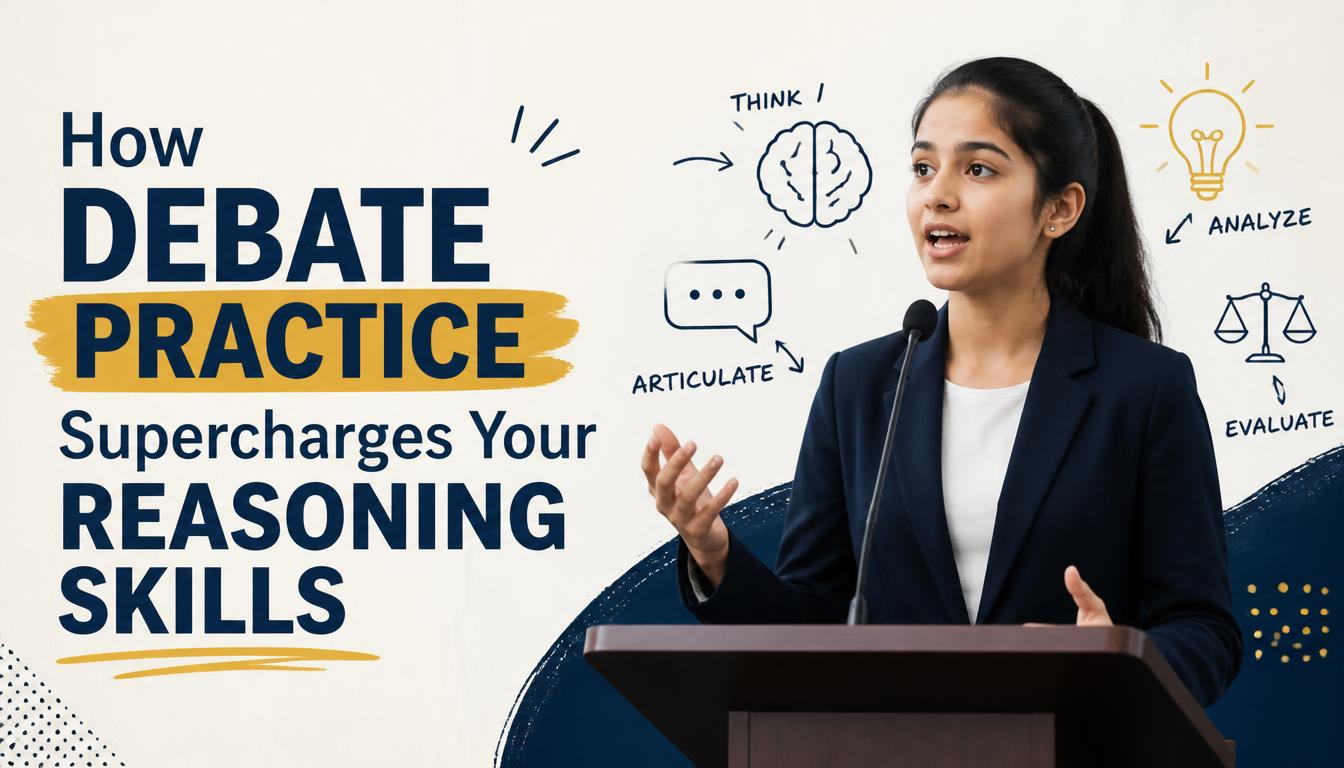
Our natural default mode of thinking is incredibly defensive. Psychologists refer to this as the "Soldier Mindset"—a cognitive state where we view our beliefs as a fortress that must be defended at all costs, and opposing views as invading forces that must be utterly destroyed [2]. In this state, we do not listen to understand; we listen to find flaws, protect our egos, and win the argument.
To break out of this biological trap, we need a mechanism that forces our minds to decouple our identity from our beliefs. This is precisely what formal debate practice accomplishes.
Debate is not a loud, emotional shouting match like those seen on cable television news. It is a highly structured, intellectually rigorous arena of adversarial inquiry. By engaging in debate—either through formal practice or solo cognitive exercises—you force your brain to run a series of rapid logical workouts that build unmatched analytical agility, cognitive flexibility, and structural reasoning.
1. Cognitive Flexibility: The Power of Forced MotionThe single most transformative aspect of formal debate is the rule of forced perspective. In a competitive debate tournament, you do not choose which side of the issue you represent. You are assigned to defend the "Affirmative" (Pro) or the "Negative" (Con) side, often minutes before the round begins.
You might be forced to argue passionately in favor of universal basic income in Round 1, and then argue just as passionately against it in Round 2.
This practice of forced perspective shifts your mind from a defensive soldier mindset to a truth-seeking "Scout Mindset" [2]. Here is how this simple exercise dramatically upgrades your thinking:
Decoupling Identity from OpinionsWhen you are forced to argue both sides of an issue, your brain quickly learns that an opinion is not a structural part of your identity. It is merely a hypothesis. You realize that a highly persuasive, logically valid case can be built for almost any position. This realization builds deep epistemic humility, making you far more receptive to new evidence and far less defensive when challenged.
Dissolving the "Dunning-Kruger" EffectThe Dunning-Kruger effect shows that novices often hold the most confident, simplified opinions because they lack the expertise to see the complexity of a subject. By researching and defending the counter-perspective of your deeply held beliefs, you expose yourself to the rich, highly valid arguments of your opponents, shattering your simplistic caricatures.
2. Structural Breakdown: Listening to Map, Not to ReactIn everyday conversation, when someone speaks, we listen with our emotional filters active. We look for words that trigger our biases and immediately begin formulating our rebuttal while the other person is still talking.
In formal debate, this lazy listening habit will cause you to lose instantly. Debate requires Structural Listening, a skill where you map the speaker's argument like an architect analyzing a blueprint.
To do this, debaters use a technique called "Flowing"—taking highly structured, hierarchical notes that track the exact progression of arguments across the round. When a debater listens, they are actively looking for the three anatomical pillars of an argument:
                  +----------------------------------+
                  |         THE CLAIM (Assertion)    |
                  +----------------------------------+
                                   |
                  +----------------------------------+
                  |        THE WARRANT (Reasoning)   |
                  +----------------------------------+
                                   |
                  +----------------------------------+
                  |         THE DATA (Evidence)      |
                  +----------------------------------+
- The Claim: What is the specific assertion being made?
- The Warrant: What is the logical reason why the claim is true?
- The Impact: Why does this claim matter to the overall debate?
If a speaker makes a claim ("Implementing this software will increase revenue") but fails to provide a warrant ("Because it automates follow-ups, reducing lead response time by 50%") or an impact ("Which historical data shows leads to a 10% increase in closed sales"), a skilled debater will immediately spot the structural gap and point out the unvalidated assertion.
3. Mastering the 4-Step Refutation MethodWhen most people try to disagree with someone, they jump straight into a chaotic, unstructured counter-attack. This usually leads to talking past each other and emotional escalation.
Formal debate trains you to use a highly disciplined, 4-Step Refutation Method. This structure ensures that you are directly engaging with the core of your opponent's argument before you introduce your counter-points.
+--------------------------------------------------------------+
|                   THE 4-STEP REFUTATION FLOW                 |
|                                                              |
|  1. "THEY SAY..."  -->  Accurately state opponent's point     |
|         |                                                    |
|  2. "BUT I SAY..." -->  Introduce clear counter-claim        |
|         |                                                    |
|  3. "BECAUSE..."   -->  Provide logical reasoning/evidence   |
|         |                                                    |
|  4. "THEREFORE..." -->  Explain impact on the debate         |
+--------------------------------------------------------------+
You must first state your opponent's argument clearly and fairly. This demonstrates active listening, builds incredible credibility, and ensures you are not attacking a Straw Man.
- Example: "My opponent argues that implementing a remote-first work policy will damage our corporate culture."
Clearly and directly state your counter-thesis.
- Example: "But I argue that a remote-first policy actually strengthens and democratizes our corporate culture."
Provide the logical mechanism and empirical evidence that supports your counter-claim.
- Example: "Because when employees work remotely, communication shifts from informal watercooler cliques to documented, transparent digital channels. According to a 2025 study by McKinsey, companies with documented asynchronous communication reported a 30% increase in employee collaboration and inclusion across global departments."
Explain why your point defeats their point and what the larger implications are for the decision.
- Example: "Therefore, while a remote policy changes how culture is experienced, it ultimately enhances collaboration and prevents toxic silos, making it a net positive for our organization's long-term health."
When you are utilizing Step 3 of the refutation method, you have three primary strategic paths to challenge your opponent’s argument. Learning these paths allows you to dissect any claim instantly:
Path A: Attack the Premise (The Fuel)Challenge the factual accuracy, relevance, or completeness of the data they are relying on.
- The Counter: "Their argument is built on a 2018 study. However, post-pandemic data from 2024 completely contradicts those findings..."
Show that even if their premises are true, they do not logically lead to the conclusion they are claiming (pointing out a logical leap or non-sequitur).
- The Counter: "While it is true that remote employees spend less time in physical offices, it does not logically follow that they are less aligned with our mission. Alignment is driven by clear objectives, not shared real estate."
Accept that their premises are true, and that the link is valid, but show that the negative consequences are trivial compared to the massive positive benefits (an outweighing analysis).
- The Counter: "Even if we experience a minor decline in spontaneous creative interactions, this is vastly outweighed by our ability to recruit top-tier global talent that we could never afford if restricted to our local zip code."
You do not need to join a formal university debate society to harvest the cognitive benefits of debate. Here are three highly effective, solo debate exercises you can practice in your daily personal and professional life:
Exercise 1: The Dual-Perspective MemoWhen faced with a major career, business, or personal decision (e.g., Should we launch Product A or Product B?), write a formal, two-sided memo.
- Page 1 (The Affirmative Case): Write the absolute strongest case for Product A. Use data, project aggressive projections, and dismiss Product B's potential.
- Page 2 (The Negative Case): Write the absolute strongest case for Product B. Use different data sets, outline all the catastrophic risks of Product A, and present Product B as the only logical choice.
- The Review: Read both pages side-by-side. You will notice that your initial, emotional bias toward one of the products has dissolved, leaving you with a highly objective, balanced view of the options.
Whenever you write an essay, a proposal, or an email pitching an idea, pause before sending. Put on your adversary's hat. Review your text and find three places where a critic could point out a logical leap, an unverified assumption, or a lack of evidence. Adjust your text to preemptively answer those criticisms.
Exercise 3: The Charity SwapFind a family member or coworker with whom you disagree on a specific topic. Challenge them to a "Charity Swap." You must explain their position back to them until they agree you have described it perfectly, and they must do the same for you. Only after this mutual understanding is achieved can you discuss your differences.
How Debate Practice Supercharges Your Reasoning Skills
Discover how formal debate practice trains your brain for cognitive flexibility, rapid logical breakdown, and advanced refutation. Step-by-step solo exercises included.