
How to Start Thinking Critically Today: A 7-Day Plan

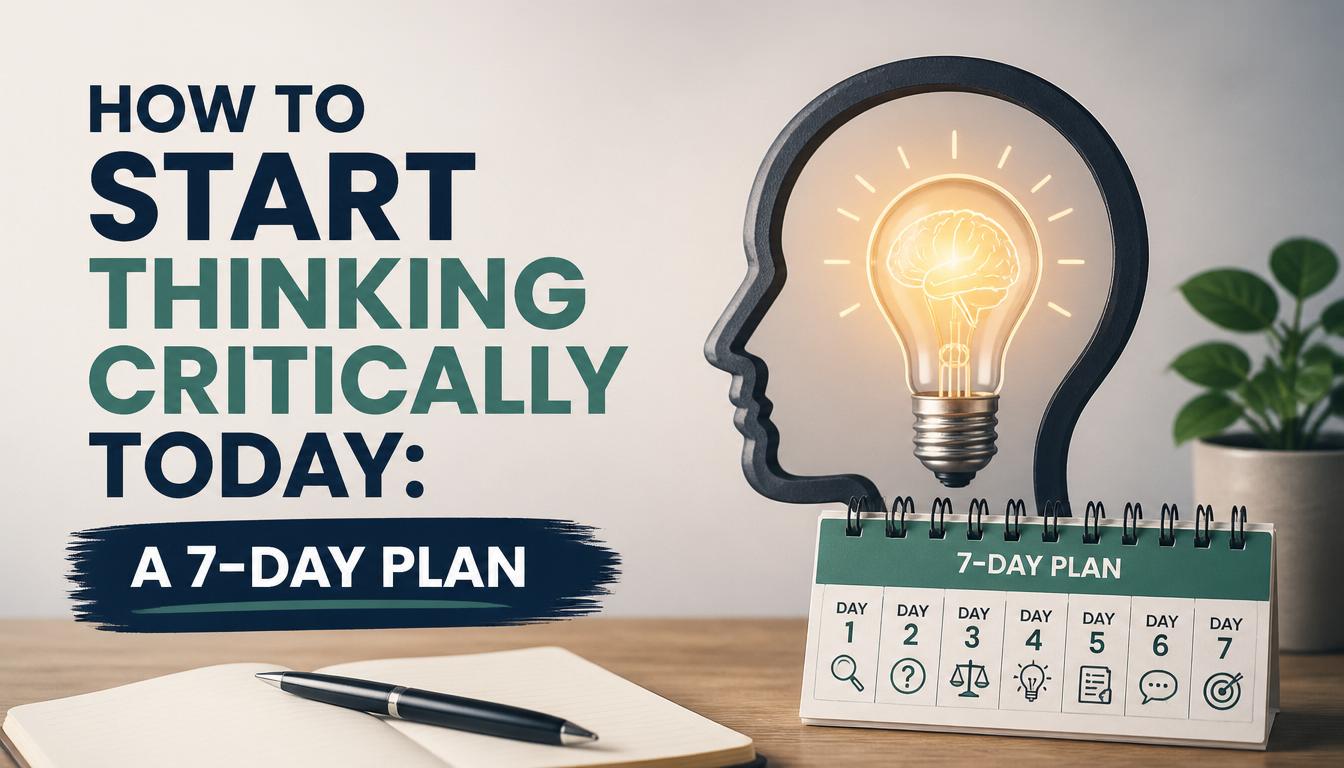
Critical thinking isn't a personality trait you're born with-it's a learnable skill that improves decisions, protects against manipulation, and reduces regret. The five core moves (name the real question, separate facts from interpretations, seek disconfirming evidence, generate alternatives, test through action) can be practiced on real decisions starting today. Explicit, deliberate practice for 7 days establishes the habit; research shows measurable improvements in reasoning ability within weeks.
Why Critical Thinking Matters (And Why It's Become Urgent)Every day, you're hit with information from dozens of sources: news feeds, social media, marketing, conversations, emails. Much of it is designed to influence you. Some of it is false. Most of it is oversimplified or framed to benefit whoever created it.
Without critical thinking, you're relying on your brain's default thinking mode: fast, intuitive, and prone to predictable errors. Daniel Kahneman, the Nobel Prize-winning psychologist who studies how humans think, calls this "System 1" thinking -and it fails predictably.
Your intuitive mind loves quick answers. It fills gaps in information. It seeks information that confirms what you already believe. It mistakes familiar ideas for true ideas. It trusts people who are confident, even when they're wrong.
Critical thinking is the antidote. It's the disciplined practice of slowing down, asking better questions, and testing your ideas against reality before acting on them .
The Research Is ConvincingA landmark study by Herrnstein and colleagues followed 400 seventh graders who received explicit instruction in critical thinking-hypothesis testing, logical reasoning, and argument evaluation. After the intervention, students showed statistically significant improvements on both IQ measures and practical problem-solving. The improvements stuck.
Another study by Zohar examined 678 seventh graders who received critical thinking training integrated into their biology curriculum. Those trained to recognize logical fallacies, test hypotheses, and distinguish evidence from interpretation showed greater improvement in analytical skills-and those skills transferred to everyday problem-solving tasks outside biology.
The consistent finding across research: explicit instruction in critical thinking produces measurable improvements in reasoning ability . Not someday. Within weeks.
Where Critical Thinking Fails, Disaster FollowsThe consequences of poor critical thinking aren't academic. They're financial, medical, and sometimes tragic.
Enron (2001): The board of directors, auditors, and executives all saw the same red flags-complexity requiring extraordinary safeguards, management defensiveness, financial structures with names like "Raptor" and "Jedi." Not one person asked the critical question: "If we need this many controls to make this work, should this deal exist at all?" The company collapsed in the largest bankruptcy then on record , costing Enron employees $1 billion in retirement savings.
The 2008 Financial Crisis: Bankers, investors, and rating agencies all failed to ask the critical question: "What if housing prices decline 30%?" Instead, they assumed housing prices would never fall nationally. When they did, 8.7 million jobs were lost and $16.8 trillion in household wealth was destroyed.
Medical Misdiagnosis: Doctors miss or misdiagnose strokes in 17.5% of cases , usually because they anchor to an initial diagnosis and don't critically re-evaluate when new information suggests they're wrong. 87,000 strokes are missed annually in the U.S. alone , causing preventable permanent disability.
In every case, people had the information they needed. They saw the warnings. What they lacked was the habit of critical thinking -the discipline to ask uncomfortable questions and act on what they found.
What Critical Thinking Actually Is (And Isn't)Critical thinking isn't cynicism. It's not assuming everyone is lying. It's not being argumentative or contrarian.
Critical thinking is: a disciplined way of evaluating evidence, considering alternatives, and making judgments that guide action.
According to the Foundation for Critical Thinking , it's the "disciplined process of actively analyzing, synthesizing, and evaluating collected information and beliefs."
The key word is "disciplined." It's not just doubting; it's investigating. It's not just thinking; it's thinking systematically, with intention.
And here's the important part: it's a skill that improves with practice.
You don't develop critical thinking by reading about it. You develop it by practicing it on real decisions. That's what the next 7 days are about.
The Five Core Moves (Your Thinking Framework)Research by learning scientists at Tilting Futures identifies five moves that consistently strengthen critical thinking . These aren't abstract theory-they're practical techniques you can apply to any decision.
Move 1: Name the Real QuestionYour brain loves quick answers, so it grabs the first version of a problem and rushes toward solutions. But the first version is often the wrong problem.
Example: You think "This project is impossible." But that's not a real question. It's an emotional reaction. The real question is: "What specifically is the bottleneck right now?" Is it unclear requirements? Conflicting priorities? A skill gap? A resource constraint?
The moment you move from "I hate this" to "What specifically is making this difficult?"-you've transformed complaint into investigation. Solutions become visible.
Practice today: Take one thing that's frustrating you. Write it as an emotional statement: "This is impossible" or "I don't know what to do." Now rewrite it as a specific, investigable question. Notice how the question itself suggests solutions.
Move 2: Separate Facts, Interpretations, and AssumptionsThis is the move that protects you from most cognitive errors.
Three definitions:
- Facts: Claims that can be verified (someone said X, the deadline is June 15, the data shows Y)
- Interpretations: What facts mean to you (they didn't mention my project, so they don't value it)
- Assumptions: What you're treating as true without proof (they're upset with my work)
People drift unconsciously from fact to interpretation to assumption, then treat assumptions like facts. This is where bias lives.
Example: Your manager didn't mention your project in the team meeting.
- Fact: They didn't mention it.
- Interpretation: Not mentioning it means they don't value it.
- Assumption: If they valued it, they'd praise it publicly.
Once you separate these, you realize: maybe they didn't mention it because time was limited. Maybe they value it quietly. Maybe they're saving feedback for a one-on-one. The assumptions are optional.
Practice today: Pick a situation where you have a strong opinion. Write down everything you "know" about it. Then categorize each claim as fact, interpretation, or assumption. Notice how many of your strong opinions rest on assumptions, not facts.
Move 3: Seek Evidence That Could Change Your MindMost people seek information that confirms what they already believe. Critical thinkers do the opposite-they deliberately look for information that could challenge their position.
Example: You believe remote work reduces productivity.
- What would convince you otherwise? Companies with remote workers showing equivalent or higher output. Longitudinal studies of remote performance. Your own experience if you tried remote work successfully.
- Where would you find that evidence? Business research, case studies, personal experimentation.
The fact that you can articulate what would change your mind proves you're reasoning. If you can't imagine any evidence that would shift your view, you're defending a position, not thinking critically about it.
Practice today: Identify one belief you hold strongly. Write down: (1) What would convince you that you're wrong? (2) What evidence would you need to see? (3) Where could you find that evidence? Then look for it. The answer will teach you whether you're truly thinking or defending.
Move 4: Generate Multiple ExplanationsOne narrative feels like truth to the brain. When you force yourself to create alternatives, you reduce overconfidence and expand response options.
Example: "My group project is failing because nobody cares."
Other explanations:
- The project instructions were unclear, creating confusion.
- Roles and responsibilities were never explicitly assigned.
- Someone is overwhelmed and embarrassed to speak up.
- The timeline is compressed and stress is causing withdrawal.
- There's a personality conflict nobody addressed.
Each explanation suggests different actions. "Nobody cares" suggests confrontation. "Instructions were unclear" suggests clarification. "Someone's overwhelmed" suggests a one-on-one conversation. With multiple explanations, you have multiple response options.
Practice today: Take a situation where you've formed an opinion about why something happened. Generate at least two other plausible explanations. Notice how each one suggests different next steps.
Move 5: Choose Action That Produces FeedbackCritical thinking isn't rumination-it's thinking that leads to learning. The best decisions are ones that teach you something quickly.
Instead of waiting for perfect certainty, choose a small test, conversation, prototype, or tryout that provides new information.
Examples:
- Instead of deciding which career to pursue, talk to people working in fields you're considering.
- Instead of predicting whether a customer will like a feature, show them a prototype.
- Instead of guessing whether a policy will work, run a pilot.
- Instead of assuming a misunderstanding, have a conversation.
Feedback transforms opinions into progress. This is the difference between armchair theorizing and evidence-based learning.
Practice today: Identify one decision you've been deliberating about. Instead of waiting to feel certain, choose a small action that produces feedback. Talk to someone. Run a small test. Observe the result. Notice how quickly your thinking becomes clearer.
Your 7-Day Critical Thinking PlanNow you're going to practice these five moves on real decisions. Pick one decision or problem that's actually on your mind right now-something you care about, something you've been stuck on.
Day 1: Name the Real QuestionWhat to do:
Write down the problem or decision you chose. Write it as an emotional statement: "This is impossible" or "I don't know what to do."
Now rewrite it as a specific, investigable question. Use the pattern: "What specifically is [emotion]?" or "What would it take to [desired outcome]?"
Examples:
- "I hate my job" → "What specifically about my job is unsatisfying? Is it the work itself, the people, the environment, the growth trajectory, or something else?"
- "I don't know what career to choose" → "What kind of problems do I want to spend my time solving? What environment helps me do my best work?"
- "This project is failing" → "What is the actual bottleneck right now? Is it unclear requirements, resource constraints, skill gaps, or misaligned priorities?"
Write your specific question down. This is your investigation for the next 6 days.
Why this matters: Research shows that the way you frame a problem determines which solutions your brain considers. Name the real question, and solutions appear.
Day 2: Separate Facts, Interpretations, and AssumptionsWhat to do:
Using the question you named on Day 1, write down everything you "know" about the situation. List 8-10 claims or observations.
Now categorize each one:
- F for Fact (verifiable)
- I for Interpretation (what it means to you)
- A for Assumption (treating as true without proof)
Go through each one and mark it. Be honest. Where are you drifting from facts into assumptions?
Example using "I hate my job":
- "My manager never asks for my input" (Fact)
- "This means they don't value my opinion" (Interpretation)
- "They think I'm not smart enough to contribute" (Assumption)
vs.
- "My manager rarely asks for my input in meetings" (Fact)
- "I interpret this as them not valuing my perspective" (Interpretation)
- "But they might value it privately, or they might be focused on moving meetings quickly" (Alternative interpretation)
Why this matters: Most thinking errors happen here. You drift from fact to assumption without noticing. Once you separate them, your thinking becomes clearer and less reactive.
Day 3: Identify What Evidence Would Change Your MindWhat to do:
Write down your current view on your chosen problem (based on Days 1-2).
Now answer these three questions:
- What evidence would make me change my mind about this?
- What would I need to see or experience?
- Where could I find that evidence?
If you can't answer #1, you're not thinking critically about this-you're defending a position. Go deeper.
Example: "I believe I'm not good at public speaking."
- What would change that view? Successfully giving a talk that lands well. Positive feedback from an audience. Seeing myself on video and noticing I'm better than I thought.
- Where to find it? Take a class. Join Toastmasters. Give a small talk to a friendly group. Record myself.
Why this matters: This single question reveals whether you're truly thinking or defending. If you can articulate what would change your mind, you're reasoning. If you can't, you've stopped thinking.
Day 4: Generate Multiple ExplanationsWhat to do:
Write down your current explanation for why your problem exists (based on Days 1-3).
Now force yourself to generate at least two more explanations. They don't have to be your preferred explanation-they just have to be plausible given the facts you identified on Day 2.
Use this pattern: "Another explanation could be..." or "I might be missing..."
Example on "my manager doesn't value my input":
- They don't value my perspective (your current explanation)
- They're overwhelmed and moving quickly through meetings (alternative)
- They value input in one-on-ones, not in group settings (alternative)
- I'm not speaking up clearly enough for them to notice (alternative)
Each explanation suggests different actions. Notice how that works.
Why this matters: One story feels like truth. Multiple explanations reduce bias and expand your options. This is where critical thinking becomes strategic.
Day 5: Articulate Your Testing StrategyWhat to do:
Now that you have multiple explanations, choose one and design a small test that produces feedback.
Ask yourself: "What's one small action I could take that would teach me whether my current explanation is right?"
The action should be:
- Small (doable this week)
- Specific (you'll know what happened)
- Informative (it will teach you something)
Examples:
- "I'll ask my manager directly for feedback on my contributions" (tests: Are they avoiding me, or am I not visible enough?)
- "I'll speak up clearly in the next meeting and observe their reaction" (tests: Do they respond positively when I'm articulate?)
- "I'll ask a coworker if they think my manager values my input" (tests: Is this my perception, or is it observable?)
- "I'll request a one-on-one focused on my contributions" (tests: Is this a group-setting issue or a general one?)
Pick one. Write it down.
Why this matters: Feedback transforms opinions into evidence. This is where thinking becomes learning.
Day 6: Run Your Test and ObserveWhat to do:
Actually do the thing you designed on Day 5.
Pay attention to what happens. What surprised you? What confirmed what you expected? What changed?
Write down the results. Not your interpretation-the actual facts of what happened.
Example: "I asked my manager for feedback. They said: [specific feedback]. Their tone was [specific observation]. They seemed [observation], not [your assumption]."
Separate the facts from your interpretation of them. This is important.
Why this matters: Real feedback beats armchair theorizing every time. This is the practice that makes critical thinking actually improve your decisions.
Day 7: Reflect and Plan the Next CycleWhat to do:
Review Days 1-6. Answer these questions:
- Did the test teach you something? What?
- Did it change your view? How?
- What's your next question based on what you learned?
- How will you apply this same five-move process to another decision?
The point of this final day isn't to "solve" your problem. It's to establish the habit of thinking critically about decisions. This seven-day cycle is something you'll repeat on new problems for months and years.
Why this matters: Critical thinking is a practice, not a destination. Each cycle makes you better. The habit compounds.
Overcoming the Obstacles People Actually Face "This takes too much time."Initially, yes. As you practice, the five moves become automatic. Research shows that within 2-4 weeks of deliberate practice, the process gets noticeably faster. Within months, critical thinking becomes your default.
But even at the start, the time investment is small compared to the cost of bad decisions. Thirty minutes of critical thinking on a major decision beats hours of regret.
"I'm worried my analysis will paralyze me."Analysis paralysis happens when you overthink without a decision deadline. The five-move framework prevents this because Move 5 is action . You test through feedback, not endless deliberation.
You don't wait until you're 100% certain. You move as soon as you have enough clarity to make an informed test. The test teaches you what you need to know next.
"What if I realize I've been wrong about something important?"That's the goal. Critical thinking is only as valuable as your willingness to change your mind based on evidence.
Research shows that people who develop strong critical thinking skills actually become more comfortable revising their positions. It's not ego defense-it's evidence-seeking. The discomfort passes; the clarity is permanent.
"I don't think I'm smart enough to do this."Intelligence isn't the barrier. Discipline is. Critical thinking is a trainable skill, not an innate ability. The research is clear on this.
Meta-analysis of 117 studies on teaching critical thinking found that explicit instruction-teaching specific reasoning methods-produced the strongest effects. People at all levels of prior ability improved measurably with practice.
Making It Stick: How to Sustain Critical Thinking Beyond 7 DaysThe 7-day plan builds the foundation. Sustaining it requires these habits:
Use the Five Moves on Every Decision That MattersDon't reserve critical thinking for big decisions. Practice on everyday choices. Career decisions, relationship questions, technology choices, even what to eat. The more you practice, the faster the moves become automatic.
Write Your Thinking DownWriting externalizes and slows your thinking, making it visible and subject to correction. A 5-minute "thinking snapshot" before important decisions-writing down facts vs. assumptions vs. interpretations-produces noticeably clearer thinking.
Seek Out People Who Think DifferentlyHumans reason better in dialogue than in isolation. Conversations with people who hold different views strengthen critical thinking by exposing blind spots and generating alternatives.
You don't have to agree with them. You just have to genuinely listen and ask: "Help me understand your reasoning. What facts are you working from? What do those facts mean to you?"
Notice When You're Defending vs. ThinkingThe single best metacognitive habit: Ask yourself periodically, "Am I reasoning about this, or am I defending a position?"
If you can't articulate what evidence would change your mind, you're defending. If you can, you're thinking.
The more you notice the difference, the more you choose reasoning.
Practice on Real StakesCritical thinking develops most powerfully when you practice on decisions that actually matter-ones with real consequences you'll live with. Career choices, relationship decisions, financial commitments. The stakes create the motivation and the feedback that drives learning.
The Payoff: What Changes When You Think CriticallyAfter 7 days of practice, you'll notice:
- Decisions feel clearer. You move from uncertainty to directed inquiry. You know what you're trying to learn.
- Arguments become conversations. Instead of defending positions, you investigate. "Help me understand your reasoning" becomes your default.
- You spot manipulation faster. Once you habitually separate facts from interpretation from assumptions, marketing copy, news, and social media stop fooling you.
- You change your mind more easily. Changing your mind based on evidence feels like progress, not failure.
- You regret fewer decisions. Not because you choose perfectly-you don't-but because you chose deliberately. You tested your assumptions. You learned.
After months of practice, critical thinking becomes automatic. You don't have to consciously work through the five moves. They become how you think.
That's when critical thinking transforms from a technique into a strength.
Try Critical Thinking TodayThe 7-day plan above works, but only if you actually do it. You don't develop critical thinking by reading about it. You develop it by practicing on real decisions.
Pick one decision or problem you're actually facing. Don't pick a hypothetical. Pick something that matters to you, something you've been stuck on.
Then work through the 7 days. Name the real question. Separate facts from assumptions. Seek disconfirming evidence. Generate alternatives. Test through action.
Within a week, you'll see what critical thinking actually does. It doesn't guarantee perfect decisions. But it eliminates the ones you'll regret most-the ones you made without thinking.
And that changes everything.
Frequently Asked Questions Can critical thinking really be learned in 7 days?The 7-day plan jumpstarts the practice, but critical thinking is a long-term skill that strengthens over months and years. Research shows measurable improvements in reasoning ability within 2-4 weeks of consistent practice. The 7 days is about establishing the habit and learning the five core moves; sustained improvement comes from continuing the practice.
What's the difference between critical thinking and being skeptical?Skepticism is doubting without necessarily investigating. Critical thinking is the disciplined practice of analyzing evidence, considering alternatives, and testing ideas against reality. A critical thinker is open-minded but rigorous; a skeptic may dismiss claims without sufficient investigation. Critical thinking includes healthy skepticism, but goes further by actively seeking evidence.
Does critical thinking make you slower at making decisions?Initially, yes. As you develop the habit, the five core moves become automatic and fast. Research shows that critical thinkers actually make decisions faster and better because they've eliminated analysis paralysis and wasted energy defending weak positions. The upfront investment pays off quickly.
I disagree with someone I care about. How does critical thinking help?Instead of defending your position, use the second core move: separate facts from interpretations from assumptions. Ask the other person: 'What facts are you working from? What do those facts mean to you? What are you assuming?' Often disagreements dissolve when people realize they're working from different facts, not different reasoning. Critical thinking turns arguments into investigations.
What if I realize I've been wrong about something important?That's a sign critical thinking is working. Changing your mind based on new evidence is a strength, not a weakness. Research shows that people who develop strong critical thinking skills actually become more comfortable revising their positions—it's evidence-seeking, not ego defense. The discomfort is temporary; the clarity is permanent.
How to Start Thinking Critically Today: A 7-Day Plan
A practical, research-backed 7-day plan to develop critical thinking skills that improve decisions, reduce bias, and help you see through manipulation.