
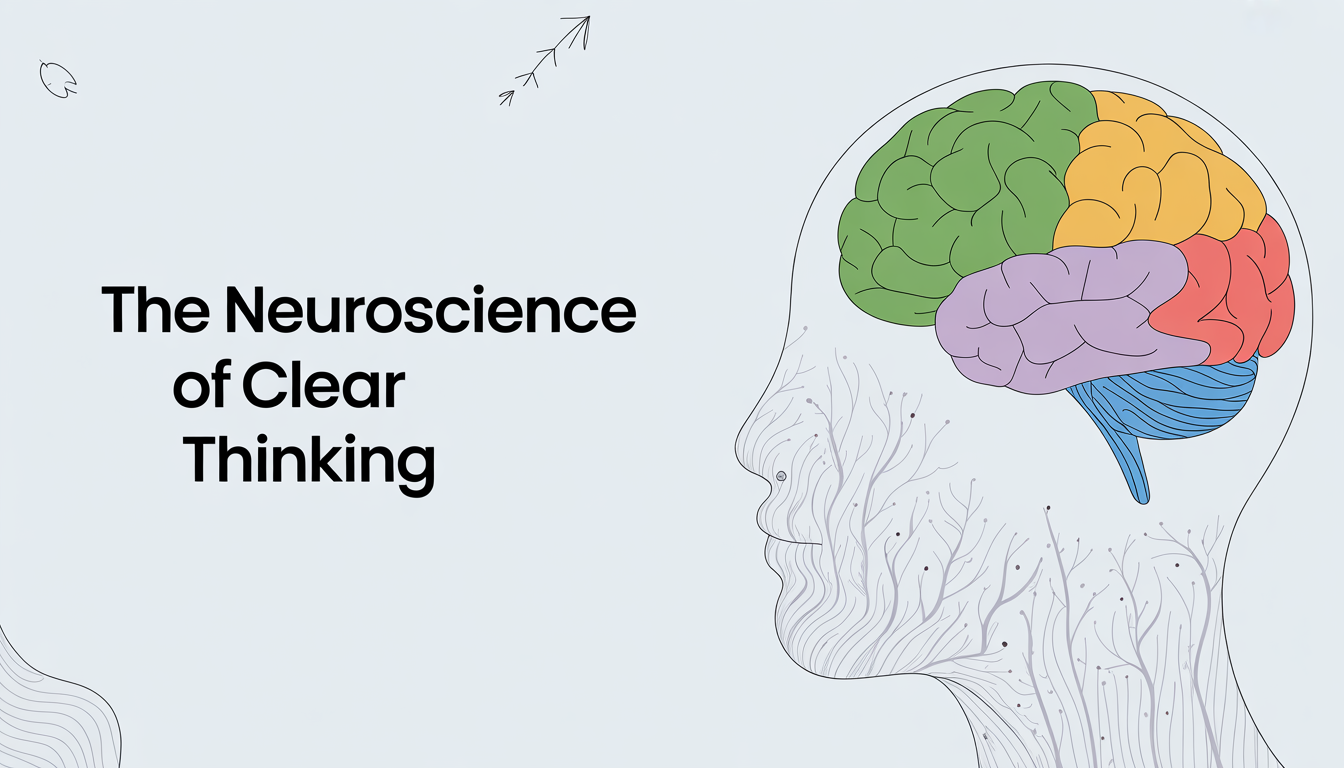
The Neuroscience of Clear Thinking

In this article
- What clear thinking actually is, neurologically
- The prefrontal cortex: your brain's command center
- The three key brain regions that interact
- Cortisol: the quiet enemy of clear thought
- The default mode network: your wandering mind
- Neuroplasticity: your brain can rebuild
- Sleep: the nightly maintenance your brain cannot skip
- Exercise: the most potent brain-clarity intervention
- Mindfulness: reshaping your brain's architecture
- The integrated picture: clear thinking is a state
- Practical neuroscience for clearer thinking
- The examined brain
- References
There is a moment most people recognize — a moment of unexpected mental sharpness when an argument that seemed complicated suddenly becomes clear, when the right words for a difficult situation arrive without effort, when a problem you have been circling for days resolves in a flash of obvious insight. And there is its opposite: the maddening fog of a mind that cannot quite grasp what it needs to grasp, that loops on the same thoughts without making progress, that knows something is wrong with an argument but cannot locate exactly where. Both of these states are neurological. They are not matters of intelligence or effort or character. They are matters of brain chemistry, architecture, and condition — and they are, within significant limits, both understandable and changeable.
The neuroscience of clear thinking is not a soft or speculative field. In the past two decades, advances in functional neuroimaging, molecular neuroscience, and cognitive psychology have produced a remarkably detailed picture of what clear thinking requires at the cellular and network level — and what disrupts it. This article explores that picture: what structures produce clear thought, what hormones and habits impair it, and what the research tells us about restoring and enhancing it.
The answer, in brief: clear thinking is a product of the prefrontal cortex operating at full capacity, in appropriate coordination with memory systems and without being overwhelmed by the brain's stress-response circuits. It requires specific neurochemical conditions — conditions that sleep, chronic stress, distraction, and poor lifestyle choices erode, and that specific, evidence-based interventions can meaningfully restore.
29% of human cortex occupied by the prefrontal cortex 86B neurons in the human brain, each capable of thousands of connections 1–2% hippocampal volume increase from aerobic exercise (Frontiers, 2025) 8 wk minimum to rebuild prefrontal architecture after chronic stress (McEwen) 80% of the time the average mind wanders from the intended task What clear thinking actually is, neurologicallyBefore we can talk about what produces or impairs clear thinking, we need to know what the brain is doing when clear thinking occurs. The short answer is that clear thinking is not a single brain process — it is a coordinated state across multiple interconnected networks, with the prefrontal cortex playing the role of conductor.
Cognitive neuroscientists typically describe clear thinking in terms of executive function — the family of cognitive processes that includes working memory (holding information in mind while reasoning about it), cognitive flexibility (shifting between different approaches or perspectives), inhibitory control (suppressing impulsive or irrelevant responses), and planning (organizing actions toward a goal). These are not soft skills. They are specific, measurable neural capabilities that rely on specific brain structures and that degrade under specific conditions.
Daniel Kahneman's influential dual-process theory frames human cognition as operating between two systems: System 1, which is fast, automatic, intuitive, and often emotional; and System 2, which is slow, deliberate, effortful, and logical. Clear thinking is predominantly System 2 — it requires the brain to override its faster, more automatic responses with deliberate, reasoned evaluation. This distinction maps directly onto neuroscience: System 1 is driven largely by subcortical structures like the amygdala and basal ganglia; System 2 is driven primarily by the prefrontal cortex.
Neuroscience definition
Clear thinking, neurologically understood, is the prefrontal cortex's successful maintenance of executive control — the state in which working memory is adequate, cognitive flexibility is intact, inhibitory control is functioning, and the brain's stress-response systems are not overwhelming the deliberate reasoning circuits. It is a neurological state, not a fixed trait.
The prefrontal cortex: your brain's command centerThe prefrontal cortex (PFC) occupies the front third of the brain and approximately 29% of the human cortical surface — a proportion unique among all species and widely regarded as the neurological basis of distinctively human cognition. A December 2024 paper from the University of Chicago's Department of Behavioral Neuroscience describes the PFC as the hub of "executive function and decision-making," whose "involvement in complex tasks such as problem-solving, impulse control and goal-directed behavior highlights its importance in both daily activities and long-term planning."
Within the PFC, researchers have identified several functionally distinct sub-regions. The dorsolateral prefrontal cortex (dlPFC) is most directly involved in working memory and cognitive control — the capacity to hold multiple pieces of information in mind simultaneously and reason about their relationships. The ventromedial prefrontal cortex (vmPFC) plays a key role in decision-making and the integration of emotional information into choices. The anterior lateral prefrontal cortex (alPFC) is specialized for metacognitive judgments — knowing when you are likely to be right and when to proceed with caution.
A 2024 Nature Neuroscience study from Cambridge University and NYU found that the PFC acts as a "simulator," mentally testing possible actions using a cognitive map stored in the hippocampus. Lead author Marcelo Mattar described this as "a recurrent network model of planning" that sheds light on "the neural and cognitive mechanisms of planning — a core component of human and animal intelligence."
Research insight — metacognition & the PFC
A study published in PLOS Biology identified the anterior lateral PFC as "highly specialized for making prospective, metacognitive judgments" — evaluating how well it will perform on a decision before committing to it. Its disruption caused participants to tackle perceptual decisions they were statistically likely to fail. This is the neurological basis of intellectual humility: a well-functioning PFC not only reasons, it monitors the quality of its own reasoning.
What makes the PFC particularly significant for our purposes is its vulnerability. Unlike older, more evolutionarily ancient brain structures, the PFC is highly sensitive to neurochemical conditions. It is the last part of the brain to develop in adolescence and the first to degrade under stress, sleep deprivation, and fatigue. Understanding this vulnerability is, arguably, the most practically important insight in all of cognitive neuroscience.
The three key brain regions that interactClear thinking does not depend on the PFC alone. It depends on the PFC working in appropriate coordination with two other structures — the hippocampus and the amygdala — and the balance of this three-way relationship is what determines whether any given moment of reasoning will be clear or clouded.
Executive control
Prefrontal Cortex (PFC)
The brain's deliberate, reasoned thinking center. Governs working memory, planning, impulse control, and cognitive flexibility. Requires stable neurochemical conditions and is the first system to degrade under stress.
Memory & spatial navigation
Hippocampus
The brain's memory formation and storage hub. Supplies the PFC with the contextual information needed for reasoning. Highly vulnerable to cortisol — chronic stress reduces hippocampal volume, directly impairing the memory capacity that clear thinking requires.
Emotional processing
Amygdala
The brain's emotional alarm system. Essential for rapid threat detection but becomes a liability when over-activated by chronic stress. An overactive amygdala competes with the PFC for cognitive resources, shifting the brain from reasoned evaluation to reactive response.
The cortex-amygdala relationship is at the heart of the neuroscience of clear thinking. The PFC and the amygdala exist in a relationship of mutual inhibition: when the PFC is strong and active, it regulates the amygdala, allowing reasoned responses to emotional triggers. When the amygdala is overactivated — by acute threat, chronic stress, or overwhelming emotion — it suppresses PFC activity, producing the narrowed, reactive, emotionally-driven thinking that characterizes both fear responses and chronic stress states.
This is not metaphorical. Research published in PMC documents that glucocorticoid receptors (stress hormone receptors) are found primarily in three regions: the amygdala, prefrontal cortex, and hippocampus. These are precisely the regions that determine the quality of our thinking — and they are precisely the regions most directly affected by stress hormones.
Cortisol: the quiet enemy of clear thoughtCortisol is the primary stress hormone released by the adrenal glands in response to the brain's perception of threat. In small, acute doses, cortisol is genuinely helpful: it sharpens attention, improves performance on familiar tasks, and mobilizes the energy resources needed for immediate challenges. The problem is chronic elevation — the kind of sustained cortisol release that accumulates when stress is persistent rather than episodic.
The research on what chronic cortisol does to the thinking brain is unambiguous and alarming. Research by Amy Arnsten at Yale School of Medicine and Bruce McEwen at Rockefeller University documented the mechanism with precision: sustained stress exposure weakens the synaptic connections within the prefrontal cortex's pyramidal neurons — the very architecture responsible for holding information in working memory and maintaining executive control. These connections do not merely function less efficiently. They physically retract. The dendritic spines that form the contact points between neurons shrink and, in some cases, disappear entirely.
Simultaneously — and this is the other half of what makes chronic stress so cognitively destructive — cortisol strengthens amygdala pathways. The brain, interpreting sustained stress as sustained threat, actively shifts processing resources away from the slower, more deliberate prefrontal evaluation systems and toward the faster, more automatic emotional response systems. McEwen's laboratory at Rockefeller documented both sides of this equation: prefrontal dendrites retract while amygdala dendrites expand.
"Chronic cortisol exposure physically retracts dendritic spines in prefrontal pyramidal neurons while simultaneously expanding amygdala pathways, shifting the brain toward reactive processing."
Research summary — Arnsten (Yale) & McEwen (Rockefeller University)The downstream effects on cognitive clarity are precise and specific. Chronic cortisol elevation produces: shortened tolerance for ambiguity (the brain reaches for the first plausible answer rather than the best one), compressed working memory (fewer items can be held in mind simultaneously), reduced cognitive flexibility (difficulty shifting between approaches), and impaired inhibitory control (increased impulsivity). A study of medical students found that high perceived stress impaired both functional connectivity in a brain circuit involving the PFC and performance on a test of mental flexibility — and that both effects were reversed by a month of vacation.
⚠ The self-monitoring paradox
Perhaps the most insidious aspect of chronic stress-induced cognitive impairment is what researchers call the self-monitoring paradox: the system that evaluates the quality of your judgment is the same system that chronic stress degrades. This means the deficit is invisible from inside — high-performing professionals experiencing cortisol-driven cognitive decline consistently misread shortened ambiguity tolerance as decisiveness, compressed time horizons as focus, and reactive thinking as efficiency. They are impaired and cannot tell.
Acute vs. chronic: the critical distinctionIt is important to note the distinction between acute and chronic cortisol exposure. Brief, manageable stress — a deadline, a presentation, an athletic competition — produces an acute cortisol surge that can actually enhance performance on familiar tasks by increasing alertness and focus. The cognitive damage occurs with chronic, sustained elevation: the kind produced by persistent work pressure, relationship conflict, financial anxiety, and the general bgxyz stress of modern life that never fully resolves. As one clinical review noted: the damage that chronic stress does to the brain should not be ignored, and adverse outcomes can start younger than most people expect.
The default mode network: your wandering mindIn 2001, neurologist Marcus Raichle at Washington University coined the term "default mode" to describe a discovery that upended neuroscientists' assumptions about the resting brain. Earlier models had assumed that the brain was relatively quiet when not engaged in a task. Raichle's research showed the opposite: certain brain regions are more active at rest than during focused external tasks. This network — the default mode network, or DMN — is not idling. It is working. Just not on what you want it to be working on.
The DMN is a distributed network of brain regions including the medial prefrontal cortex, posterior cingulate cortex, precuneus, and angular gyrus. It is active during daydreaming, self-reflection, autobiographical memory, social cognition, and planning for the future. A 2023 review in Neuron (Stanford University) describes the DMN as the system that "integrates and broadcasts memory, language, and semantic representations to create a coherent 'internal narrative' reflecting our individual experiences."
Default Mode Network (DMN)
Your mind's "offline" mode
- Active during rest and mind-wandering
- Self-referential thought, past memories, future planning
- Social cognition and autobiographical narrative
- Creativity via associative, non-linear thinking
- Suppressed during focused external tasks
- Excessive activity linked to anxiety and rumination
Task Positive Network (TPN)
Your mind's "online" mode
- Active during focused, goal-directed tasks
- Attention, decision-making, problem-solving
- Includes prefrontal regions and intraparietal sulcus
- Suppressed when DMN activates
- Essential for deliberate, effortful reasoning
- Strengthened by focused practice and mindfulness
The relationship between the DMN and the task-positive network (TPN) is one of mutual suppression: when one is active, the other is typically quieted. This makes the DMN both valuable and problematic for clear thinking. When you are trying to reason carefully about something external — a problem, an argument, a decision — you want the TPN running the show. But the DMN, with its gravitational pull toward self-referential thought and mind-wandering, constantly competes for the brain's processing resources.
Research consistently finds that mind-wandering — driven by DMN activation — impairs performance on tasks requiring sustained attention and deliberate reasoning. During goal-directed cognition, successful performance requires not just TPN activation but adequate DMN suppression. When the DMN fails to quiet itself — as happens with chronic stress, excessive digital stimulation, and certain attentional disorders — thinking becomes fragmented, distractible, and circular rather than progressive.
The creativity nuance
The DMN is not simply the enemy of clear thinking. It plays a genuine role in creativity and insight — the moments when non-linear, associative thinking connects apparently unrelated ideas in novel ways. Research by Christoff and colleagues (2009) showed that the DMN remains active during mind-wandering in ways that support creative insight. The optimal cognitive state for most complex real-world thinking involves fluid transitions between the two networks — focused TPN engagement for deliberate analysis, DMN activation for intuitive connection-making, and the metacognitive capacity to know which mode is needed when.
Neuroplasticity: your brain can rebuildThe most hopeful insight in all of modern neuroscience is one that fundamentally revises a century of scientific assumption: the adult brain is not fixed. It continues to grow, reorganize, and restructure itself in response to experience throughout the entire lifespan. This is neuroplasticity — and it is the scientific basis for the claim that the cognitively impaired brain can meaningfully recover, and the average brain can meaningfully improve.
Neuroplasticity operates through two primary mechanisms: synaptic plasticity, which involves changes in the strength and efficiency of existing connections between neurons, and structural plasticity, which involves physical modifications to the brain's architecture — the growth of new dendritic connections, the formation of new synapses, and in some brain regions, the generation of entirely new neurons (neurogenesis). The key molecular player in both processes is a protein called brain-derived neurotrophic factor (BDNF).
BDNF has been described as "fertilizer for brain cells" — it promotes neuronal growth, facilitates the formation of new synaptic connections, and maintains the health of existing neural circuits. Higher BDNF levels are reliably associated with sharper learning, better memory, and improved cognitive function. The interventions most consistently shown to increase BDNF — exercise, sleep, and mindfulness practice — are also the interventions most consistently shown to improve cognitive clarity. This is not a coincidence. BDNF is a significant part of why these lifestyle factors work at the neurological level.
McEwen's reversibility research
Bruce McEwen's research at Rockefeller University confirmed that the prefrontal dendritic retraction caused by chronic stress is reversible. With appropriate recovery — reduced cortisol, adequate sleep, physical activity, and what researchers call "targeted neural rehearsal" — cortical architecture can be meaningfully rebuilt in as few as eight weeks. The brain's capacity to recover from stress-induced cognitive impairment is one of the most practically important findings in behavioral neuroscience. The question is not whether recovery is possible, but whether the conditions for it are created.
The condition of being cognitively impaired by chronic stress, sleep deprivation, or sedentary lifestyle is not a permanent state. It is a physiological adaptation that the brain can reverse when given what it needs. The neuroscience of neuroplasticity transforms the question from "why can't I think clearly?" — which implies a fixed deficiency — to "what conditions does my brain currently lack?" — which implies a fixable situation.
Sleep: the nightly maintenance your brain cannot skipOf all the lifestyle factors that affect cognitive clarity, sleep is the most fundamental — and the most comprehensively researched. The relationship between sleep and clear thinking is not a soft correlation. It is a precise, mechanistic dependency: sleep is when the brain performs the cellular housekeeping that clear thinking depends on, and without it, the chemistry of clear thought rapidly deteriorates.
During sleep, the brain performs several cognitively critical functions. During slow-wave sleep (deep sleep), the glymphatic system — the brain's waste-clearance mechanism — clears metabolic byproducts that accumulate during waking hours, including proteins associated with cognitive decline. During REM sleep, the brain consolidates memories from the day, strengthening the connections between newly acquired information and existing knowledge networks. It also processes emotional experiences, reducing their cortisol-driven intensity and making them available for rational reflection. The hippocampus and PFC are both heavily active during REM sleep in ways that directly support the next day's capacity for clear reasoning.
Sleep deprivation & the amygdala
Research published in Social Cognitive and Affective Neuroscience found that sleep deprivation significantly alters amygdala connectivity — producing an effect neurologically similar to acute stress exposure. A sleep-deprived brain shows amygdala reactivity patterns and prefrontal-amygdala connectivity disruption that closely resemble those seen in chronically stressed individuals. This explains why poor sleep does not just make you tired — it makes you emotionally reactive, cognitively inflexible, and more susceptible to poor reasoning in precisely the ways that cortisol elevation produces.
Quality matters as much as quantity. Eight hours of fragmented or shallow sleep does not produce the same cognitive restoration as eight hours of consolidated sleep with adequate slow-wave and REM cycling. Alcohol, despite its sedating effects, suppresses REM sleep — which is exactly the sleep stage most implicated in creative thinking, emotional processing, and the memory consolidation that feeds next-day reasoning. A consistent sleep schedule, appropriate light exposure, and a cool sleep environment have documented effects on sleep architecture rather than merely total sleep time.
The sleep debt misconceptionMost people who are chronically sleep-deprived have habituated to their impairment. They no longer feel sleepy in the way that signals inadequate sleep; instead, they feel this is simply how they function. But research shows this is adaptation, not normalization: the cognitive impairment is still present and measurable, even when the subjective sensation of fatigue has faded. This makes chronic sleep debt particularly dangerous — the people most impaired by it are the least able to recognize the impairment from inside.
Exercise: the most potent brain-clarity interventionIf you were to design an intervention specifically to improve cognitive clarity at the neurological level, it would look remarkably like aerobic exercise. The evidence is consistent across multiple research traditions: physical exercise is among the most effective interventions available for improving executive function, memory, and cognitive flexibility — and the mechanisms are well understood.
A 2025 systematic review published in Frontiers in Neuroscience synthesized the evidence: aerobic exercise has been shown to increase hippocampal volume by 1–2% in older adults — literally growing the brain region most responsible for the memory and contextual information that the PFC needs for reasoning — and to improve executive function scores by 5–10%. Resistance training enhanced cognitive control and memory performance by 12–18% in relevant studies. These are not small effects.
The primary mechanism is BDNF. Exercise is one of the most potent triggers for BDNF release available to humans, which is why its cognitive effects are so robust. Additionally, exercise reduces cortisol levels — directly counteracting the stress hormone that retracts prefrontal dendritic connections. Regular aerobic exercise increases blood flow to the PFC, promoting the neuroplastic changes that rebuild what stress erodes. Previously sedentary older adults who walked one hour a day for six months showed measurable enlargement of the hippocampal formation — at an age when most people assume the brain is only declining.
The hippocampal volume finding
Research by Erickson et al. (2011), cited in McEwen's PMC review, showed that previously sedentary older adults who engaged in regular walking for six months to one year showed enlargement of the hippocampal formation — the brain's primary memory structure. This is one of the most striking findings in modern neuroscience: that lifestyle change can physically grow a brain structure. Hippocampal volume is closely linked to working memory capacity and contextual reasoning — the substrate that makes clear thinking possible.
High-intensity interval training (HIIT) has demonstrated superior effects on neuroplasticity compared to continuous moderate-intensity exercise, potentially through enhanced production of cathepsin B and irisin — molecules that cross the blood-brain barrier and directly stimulate neural growth. Mind-body exercises like yoga and tai chi add the dimension of stress reduction and cortisol lowering, making them effective through a complementary pathway. The emerging picture is that no single type of exercise is the exclusive winner — a combination of aerobic, resistance, and mind-body training provides the broadest neurological benefit.
Mindfulness: reshaping your brain's architectureOf all the interventions studied for their effects on cognitive clarity, mindfulness meditation has generated the richest body of neuroimaging research — and the results are consistently remarkable. A systematic review published in Biomedicines in November 2024, synthesizing studies across PubMed, Web of Science, Cochrane Library, and Embase, concluded that mindfulness practice induces neuroplasticity, increases cortical thickness, reduces amygdala reactivity, and improves brain connectivity and neurotransmitter levels — with effects on emotional regulation, cognitive function, and stress resilience.
The specific neurological effects of mindfulness are increasingly well-documented. Mindfulness practice is associated with reduced activity in the default mode network — the mind-wandering system that competes with focused thinking. A 2025 study in Frontiers in Human Neuroscience confirmed that mindfulness abilities are negatively associated with mind-wandering (resting-state DMN activity), and that mindfulness practice promotes a shift from self-referential thinking toward more balanced present-moment awareness. Experienced meditators show substantially less DMN activity than novices, meaning they are better at quieting the internal narrative that interferes with focused reasoning.
At the structural level, mindfulness practice increases gray matter density in the hippocampus, posterior cingulate cortex, and temporoparietal junction. It improves functional connectivity between the default mode network and executive control regions. A 2023 clinical trial published in Scientific Reports specifically linked mindfulness training to improvements in neuroplasticity markers alongside psychological outcome improvements in stress and anxiety.
BDNF & meditation
A 2024 review found that regular meditation increases levels of brain-derived neurotrophic factor (BDNF) — the molecular signal that promotes the growth and maintenance of neural connections. Elevated BDNF is linked not only to sharper immediate cognitive performance but also to longer-term brain health and resilience. The mechanisms through which meditation increases BDNF include cortisol reduction (chronic cortisol suppresses BDNF expression) and direct neuroplastic effects of the focused attention practice itself.
The effects of mindfulness on the amygdala are particularly relevant for clear thinking. Research consistently shows that mindfulness practice reduces amygdala reactivity — the hair-trigger emotional alarm response that chronic stress amplifies and that competes with PFC-driven reasoning. Reduced amygdala reactivity means fewer false alarms pulling the brain out of deliberate thinking mode and into reactive response mode. It means better prefrontal-amygdala connectivity — a stronger ability to regulate emotional responses rather than being swept by them. In neurological terms, mindfulness practice literally rebuilds the cortisol-eroded PFC-amygdala relationship.
The integrated picture: clear thinking is a stateThe most important reframe that neuroscience offers is this: clear thinking is not a fixed capacity — it is a dynamic neurological state. It fluctuates continuously based on the conditions that either support or undermine the brain's cognitive architecture. The same person who reasons brilliantly on a well-rested, moderate-stress morning may reason poorly after a week of inadequate sleep and escalating workplace pressure. Their intelligence has not changed. Their brain's neurochemical state has.
This reframe has profound practical implications. It means that the question "am I a clear thinker?" is less useful than "is my brain currently in a state that supports clear thinking?" The first question is about identity and fixed capacity — and because it feels fixed, it produces passivity. The second question is about current neurological conditions — and because conditions can be changed, it produces agency.
The integrated neurological model
Clear thinking at the neurological level requires: (1) an adequately functioning PFC with intact dendritic connections in working memory circuits; (2) hippocampal memory systems supplying adequate contextual information; (3) appropriately regulated amygdala activity — responsive to genuine threats but not chronically overactive; (4) adequate DMN suppression during focused tasks; (5) appropriate neurotransmitter levels — particularly dopamine, acetylcholine, and serotonin; (6) adequate BDNF to maintain synaptic health; and (7) ongoing synaptic pruning and memory consolidation via sleep. All of these conditions are influenced by lifestyle, stress, sleep, and deliberate practice.
Practical neuroscience for clearer thinkingThe research is not merely descriptive. It points toward specific, evidence-based interventions that have documented neurological effects on the conditions that support clear thinking. The interventions below are ordered roughly by evidence strength and practical accessibility.
😴Protect sleep architecture
Consistent sleep and wake times, reduced evening light exposure, cool sleep environment. Target 7–9 hours of consolidated sleep. Avoid alcohol within 3 hours of bed — it suppresses REM sleep, the phase most critical for next-day reasoning.
🏃Aerobic exercise, consistently
A minimum of 150 minutes per week of moderate aerobic activity. Even 20–30 minutes of cardio produces measurable BDNF elevation and cortisol reduction. Walking works. Consistency matters more than intensity for long-term cognitive benefit.
🧐Mindfulness practice
Eight weeks of consistent MBSR practice produces measurable increases in cortical thickness, reduced amygdala reactivity, and improved executive control connectivity. Even a short daily session shows brain changes within weeks. Begin with ten minutes daily.
🔥Manage chronic cortisol
Identify and address chronic stressors rather than merely managing symptoms. Mindfulness, exercise, social connection, and adequate recovery time all demonstrably lower cortisol. Cognitive-behavioral therapy has been shown to increase gray matter volume in the PFC specifically.
🌿BDNF-supporting nutrition
Omega-3 fatty acids (found in oily fish) directly support synaptic function. Flavonoids and antioxidants modulate neuroplasticity. The MIND diet — combining Mediterranean and DASH patterns — is specifically designed and tested for cognitive health preservation.
🏳Protect deep focus windows
Every task-switching episode activates the DMN and costs cognitive restoration time. Protect 90-minute blocks of uninterrupted focus. Batch communications. The architecture of attention is itself a neurological resource that depletes under constant interruption.
-
1
Morning: cortisol-regulating start
Natural light exposure within 30 minutes of waking anchors the circadian cortisol curve and reduces the afternoon cortisol crash that impairs late-day reasoning. Brief mindfulness or intentional focus-setting activates the TPN early and suppresses the DMN's default engagement.
-
2
Deep work in your peak cognitive window
PFC performance follows a circadian rhythm. Most people have their highest working memory capacity in the 2–3 hours after cortisol peaks (approximately 30–60 minutes after waking). Schedule the most cognitively demanding reasoning work — complex problem-solving, writing, strategic thinking — in this window.
-
3
Movement midday
A 20–30 minute walk or exercise session at midday produces an acute BDNF elevation, reduces accumulated cortisol, and resets the PFC for afternoon performance. Emerging research suggests that cardio specifically triggers memory-linked brain waves in the hippocampus that support the afternoon's reasoning work.
-
4
Metacognitive check-ins
The self-monitoring paradox means stress-impaired PFC function is invisible from inside. Build in deliberate metacognitive check-ins: Am I reasoning from evidence or from assumption? Am I considering alternatives? Have I been thinking in narrow, ruminative circles? These questions activate the alPFC's self-monitoring function and counter the stress-narrowing of thought.
-
5
Evening: cortisol wind-down
The evening's role in next-day cognitive clarity is often underestimated. Reducing cortisol before sleep — through reduced light exposure, deliberate wind-down activities, and avoiding high-stimulation content — directly supports the REM sleep quality that drives next-day PFC performance. Chronic evening cortisol elevation disrupts sleep architecture and initiates a vicious cycle.
There is a satisfying alignment between what ancient philosophy recommended and what modern neuroscience confirms. Socrates, who walked the agora asking questions and urging self-examination, was, in neurological terms, exercising his prefrontal cortex — the brain's metacognitive self-monitoring system. His insistence on intellectual humility maps precisely onto the alPFC's function of prospective metacognitive judgment: knowing when you are likely to be right and when to proceed with caution. His practice of sustained dialogue, of thinking through ideas rather than reacting to them, is the behavioral equivalent of training the task-positive network and building its capacity to override the faster, more reactive amygdala-driven responses.
The neuroscience of clear thinking ultimately delivers a message that is both humbling and hopeful. Humbling, because it reveals how precarious clear thinking actually is — how many biological conditions must be met simultaneously for the brain's reasoning systems to function well, and how easily those conditions are disrupted by chronic stress, poor sleep, sedentary lifestyle, and constant distraction. Hopeful, because it reveals that these conditions are not fixed. The brain retains, throughout the lifespan, an extraordinary capacity to restructure itself in response to what we do, how we sleep, what we think about, and how we care for the body it inhabits.
Clear thinking is not a gift distributed at birth. It is a neurological state — one that can be supported, protected, degraded, and rebuilt. The research tells us, with reassuring precision, what building it requires. The question is whether we take that knowledge seriously enough to act on it.
"The brain is constantly active with a high level of activity. It reshapes itself in response to experience — the very process we call learning, and the biological basis of what we call wisdom."
Synthesized from: Marcus Raichle (2001) & neuroplasticity literature Neuroscience Prefrontal Cortex Clear Thinking Cognitive Function Cortisol Neuroplasticity Default Mode Network BDNF Sleep & Cognition Mindfulness Exercise Brain Amy Arnsten Bruce McEwen Marcus Raichle Executive Function Brain Health References & Further Reading- Thiemann, M. & Molinuevo. "Examining the Role of the Prefrontal Cortex in Executive Function and Decision Making." Journal of Brain Research 7 (2024): 290. DOI: 10.37421/2684-4583.2024.7.290. University of Chicago, Department of Behavioral Neuroscience. [December 2024; describes PFC as the hub of executive function and decision-making.]
- Jensen, K.T., Hennequin, G., & Mattar, M.G. (2024). "A recurrent network model of planning explains hippocampal replay and human behavior." Nature Neuroscience. DOI: 10.1038/s41593-024-01675-7. [PFC as "simulator" using hippocampal cognitive maps; Cambridge University/NYU.]
- Asp, E. & Tranel, D. "Benefit of the doubt: a new view of the role of the prefrontal cortex in executive functioning and decision making." PMC. NCT PMC3662896. [False Tagging Theory of PFC-mediated doubt; the neurological basis of critical evaluation.]
- PMC. "The neural system of metacognition accompanying decision-making in the prefrontal cortex." PMC5933819. [Two theories of how PFC supports metacognition; decision confidence and self-monitoring.]
- PMC. "Identification and disruption of a neural mechanism for accumulating prospective metacognitive information prior to decision-making." PMC8063717. [alPFC as specialized for prospective metacognitive judgment; disruption alters self-assessment of decision quality.]
- Arnsten, A.F.T. (Yale School of Medicine). Research on stress effects on prefrontal pyramidal neurons. [Documented mechanism: sustained stress physically retracts dendritic spines in PFC working memory circuits; cited in MindLab Neuroscience review, January 2026.]
- McEwen, B.S. (Rockefeller University). "Stress Effects on Neuronal Structure: Hippocampus, Amygdala, and Prefrontal Cortex." PMC. PMC4677120. [Comprehensive review of how stress hormones physically alter brain structures; prefrontal retraction and amygdala expansion; reversal with appropriate recovery.]
- PMC. "Effects of stress hormones on the brain and cognition: Evidence from normal to pathological aging." PMC5619133. [Glucocorticoid receptors in amygdala, PFC, and hippocampus; acute vs. chronic cortisol effects on memory and executive function.]
- MindLab Neuroscience. "Prefrontal Cortex Executive Function Under Stress." https://mindlabneuroscience.com/prefrontal-cortex-executive-functions-neuroplasticity/ [January 2026; synthesis of Arnsten and McEwen research; self-monitoring paradox; 8-week reversibility timeline.]
- Andrews-Hanna, J.R. (Stanford University). "20 years of the default mode network: A review and synthesis." Neuron (2023). PMC10524518. [Comprehensive review of DMN function; internal narrative model; DMN in self-reference, social cognition, memory, and mind-wandering.]
- PMC. "The Journey of the Default Mode Network: Development, Function, and Impact on Mental Health." PMC12025022. [DMN subsystems; relationship with hippocampus; creativity hypothesis; self-reflection hypothesis.]
- Sorella, S., et al. (2025). "Resting-state BOLD temporal variability of the default mode network predicts spontaneous mind wandering, which is negatively associated with mindfulness skills." Frontiers in Human Neuroscience. DOI: 10.3389/fnhum.2025.1515902. [2025 peer-reviewed; DMN variability predicts mind-wandering; mindfulness negatively associated with DMN activity.]
- Ramsoy, T. "Creativity, Mind-Wandering, and the Default Mode Network of the Brain." thomasramsoy.com. August 2024. [Review of DMN's role in creativity and insight via associative thinking.]
- Solanski, M. (2025). "Neuroplasticity: Brain Adaptation, Recovery, Health." Neurology and Neurorehabilitation 07: 151. [Comprehensive neuroplasticity review; BDNF mechanisms; sleep, exercise, diet, and mindfulness effects on synaptic and structural plasticity.]
- Barros-Loscertales, A., et al. "Neurobiological Changes Induced by Mindfulness and Meditation: A Systematic Review." Biomedicines 12(11): 2613 (2024). DOI: 10.3390/biomedicines12112613. Published November 15, 2024. [Systematic review confirming neuroplasticity, cortical thickness increases, amygdala reactivity reduction, and improved connectivity.]
- Sorella, S., et al. "Effects of web-based mindfulness training on psychological outcomes, attention, and neuroplasticity." Scientific Reports (2023). DOI: 10.1038/s41598-023-48706-0. [Mindfulness training linked to neuroplasticity improvements; prefrontal connectivity changes.]
- Frontiers in Neuroscience. "Physical activity and neuroplasticity in neurodegenerative disorders: a comprehensive review." 2025. DOI: 10.3389/fnins.2025.1502417. [Aerobic exercise: 1–2% hippocampal volume increase, 5–10% executive function improvement; resistance training: 12–18% cognitive improvement; HIIT and BDNF.]
- Oxford Academic / SCAN. "Sleep deprivation affects fear memory consolidation: bi-stable amygdala connectivity with insula and ventromedial prefrontal cortex." 2018. [Sleep deprivation alters amygdala connectivity in ways similar to acute stress; implications for emotional reactivity and PFC suppression.]
- Brainstorming That Works. "What Is Brain Fog, and What Can You Actually Do About It?" April 2026. [Synthesis of neurotransmitter, cortisol, sleep, and inflammation mechanisms of brain fog; practical context.]
- Kahneman, D. (2011). Thinking, Fast and Slow. Farrar, Straus and Giroux. [Dual-process theory foundational text; System 1 (amygdala-driven) vs. System 2 (PFC-driven) thinking.]
The Neuroscience of Clear Thinking
What actually happens inside your brain when you think clearly — and what silently dismantles that clarity when you are stressed, sleep-deprived, or distracted. The science is more specific, and more actionable, than most people realize.