
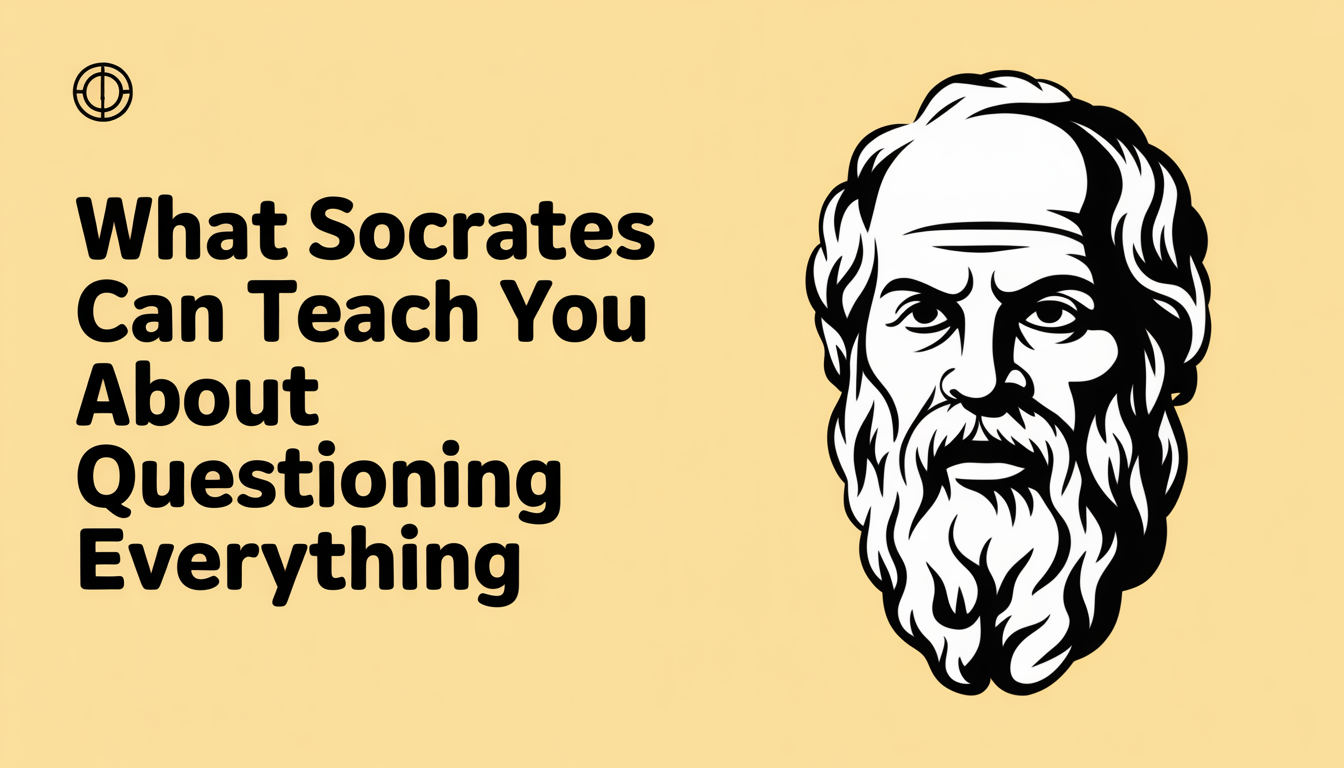
What Socrates Can Teach You About Questioning Everything

In this article
- The man who claimed to know nothing
- What exactly is the Socratic Method?
- Lesson 1 — Embrace intellectual humility
- Lesson 2 — Ask better, deeper questions
- Lesson 3 — Examine the unexamined assumptions
- Lesson 4 — Know thyself
- Lesson 5 — Sit comfortably with uncertainty
- Lesson 6 — Question virtue, not just facts
- The Socratic Method in modern life
- How to start questioning everything today
- The examined life
- References
Picture this: you are walking through the market in Athens, confident in your beliefs about justice, courage, or what it means to live well — and then a barefoot old man stops you and starts asking questions. Not to embarrass you. Not to lecture you. Just asking, gently, persistently, until you realize you cannot actually defend the things you thought you knew for certain. That man was Socrates, and the discomfort you would have felt in that moment was not failure. It was the beginning of wisdom.
More than 2,400 years have passed since Socrates walked the agora of ancient Athens, yet his central insight feels almost urgently modern: most of us hold beliefs we have never truly examined. We inherit opinions from our families, absorb assumptions from our culture, and move through our days operating on autopilot — intellectually, morally, and personally. Socrates thought this was not only unwise. He thought it was, in a very real sense, a kind of death of the mind.
This article is an exploration of what Socrates can teach us — not as a dusty academic exercise, but as a living, practical philosophy. By the end, you will have six concrete lessons drawn from Socratic thought, a toolkit for questioning your own assumptions, and a richer understanding of why one of history's greatest thinkers was ultimately executed for the crime of asking too many questions.
470 BC — Year of birth 2,400+ Years of influence 0 Written works by Socrates 399 BC — Executed for questioning The man who claimed to know nothingThere is a story — recorded by Plato in the Apology — that captures the soul of Socratic philosophy in a single scene. A friend of Socrates visited the Oracle of Delphi and asked whether anyone in Greece was wiser than Socrates. The Oracle said no. When Socrates heard this, he was deeply troubled. He did not consider himself wise at all. So he set out to disprove the Oracle by finding someone wiser than himself.
He went to politicians, to poets, to craftsmen — anyone in Athens with a reputation for knowledge or excellence. And in each case, after a few careful questions, he found the same thing: these celebrated, confident people did not actually understand the things they claimed to know. They had opinions, habits, and credentials — but not genuine understanding. And worse, they did not know they did not know. They were, as Socrates put it, ignorant of their own ignorance.
This was Socrates' great discovery. What made him wiser than others was not superior knowledge. It was his willingness to acknowledge the true extent of his own ignorance. The famous phrase attributed to him — "I know that I know nothing" — is probably a simplification, but it captures something real: the foundation of wisdom is recognizing the limits of your understanding, not performing certainty you do not have.
"The unexamined life is not worth living."
Socrates, as recorded in Plato's Apology (399 BC)This declaration, made at his own trial as he faced a death sentence, is arguably the most concentrated statement of a philosophical worldview ever delivered. It is not arrogant. It is not nihilistic. It is an invitation — a challenge, really — to take your one life seriously enough to actually look at it.
∴ ∴ ∴ What exactly is the Socratic Method?The Socratic Method is often described in dry, academic terms that miss the point entirely. It is not simply a teaching technique. It is a way of pursuing truth through dialogue — a cooperative process of questioning that begins with what we think we know and ends, ideally, at something closer to genuine understanding.
At its core, the Socratic Method is a form of argumentative dialogue in which questions are used to examine the internal consistency of a belief and its coherence with other beliefs. The questioner — in the original version, Socrates — does not lecture or provide answers. Instead, they ask questions that expose the hidden assumptions and contradictions lurking beneath the surface of confident-sounding positions.
The Greeks had a word for what happens when this process reaches its peak: aporia. It describes a state of genuine intellectual perplexity — that uncomfortable moment when you realize the belief you were so sure about has crumbled under examination. Socrates did not consider this a failure. He considered it the beginning of real learning. You cannot fill a cup that is already full, and you cannot pursue genuine understanding while assuming you already have it.
The six types of Socratic questions- Questions of clarification — "What exactly do you mean by that?"
- Questions probing assumptions — "What are you taking for granted here?"
- Questions probing evidence — "How do you know this is true?"
- Questions about perspective — "How might someone who disagrees see this?"
- Questions probing implications — "If that is true, what follows from it?"
- Questions about the question itself — "Why is this question important to ask?"
What made Socrates unusual — and, to many Athenians, infuriating — was that he applied this method relentlessly, without respect for rank, reputation, or social comfort. He questioned politicians about justice, generals about courage, priests about piety, and poets about beauty. No one was immune. No authority was self-validating. Every claim had to be able to withstand examination.
It is not hard to see why he ended up on trial.
∴ ∴ ∴ Six lessons Socrates has for you Lesson One Embrace intellectual humility — it is not weakness, it is the foundation of growthWe live in an era that prizes confidence. Social media rewards certainty. Political discourse hardens positions rather than softening them. But Socrates understood something counterintuitive and deeply liberating: the person who admits what they do not know is actually in a far stronger epistemic position than the person who pretends certainty they do not possess.
Intellectual humility does not mean having no views. It means holding your views with appropriate tentativeness — remaining genuinely open to revising them when evidence or argument demands it. Socrates was not meek. He was ferociously curious and astonishingly persistent. But his persistence was in service of truth, not ego.
In a 2024 volume by cognitive-behavioral therapist and author Donald Robertson, How to Think Like Socrates, this dimension of Socratic character is highlighted as the key to lifelong learning: the ability to sit with "I don't know yet" without panic, and to turn that discomfort into a question worth pursuing.
Apply it today The next time you feel the urge to win an argument, pause. Ask yourself honestly: what would it take to change my mind on this? If the answer is "nothing," that is a warning sign, not a badge of conviction. Lesson Two Ask better questions — not more questionsThere is a common misconception that the Socratic Method is about asking lots of questions. It is not. It is about asking the right kind of questions — questions that go to the heart of an assumption, a definition, or an implication rather than skimming the surface.
Socratic questions are systematic, disciplined, and deep. They focus on fundamental concepts and principles rather than peripheral details. According to research in pedagogy, the level of thinking that occurs is directly influenced by the level of questions being asked. Shallow questions produce shallow thinking. Deep questions — the ones that make you genuinely uncomfortable — produce genuine insight.
In modern contexts, this lesson applies everywhere: in business decisions ("What problem are we actually solving?"), in relationships ("What am I assuming about this person's intentions?"), in politics ("Who benefits from me accepting this framing?"), and in personal development ("Is this the life I chose, or the life I drifted into?").
Apply it today Before your next important decision, write down three questions you have not asked yet about it. Not comfort-seeking questions — genuinely challenging ones. What you are taking for granted? What you are afraid to find out? Lesson Three Examine the unexamined assumptions beneath your beliefsPerhaps Socrates' most powerful diagnostic tool was his ability to identify the hidden assumption — the belief that was doing all the work but had never been put under a light. Most of our confident-sounding positions rest on a foundation of assumptions we absorbed, not conclusions we reached.
This is especially dangerous in our current information environment, where we are algorithmically served content that confirms what we already believe, and where the speed of discourse rewards reaction over reflection. The Athenians had sophists for this purpose — skilled rhetorical speakers who could make any argument sound convincing. We have social media feeds.
Socrates' response to the sophists was not to out-argue them. It was to ask: but what is the argument actually based on? Strip away the rhetoric, the confident tone, the social pressure — what is left? Is it solid? Or is it, as he found so often, a house of cards?
"The art of Socratic questioning is intimately connected with critical thinking because the art of questioning is important to excellence of thought."
Wikipedia, Socratic Questioning (citing Paul & Elder, 2007) Apply it today Choose one belief you hold strongly — political, personal, or professional. Write it at the top of a page. Beneath it, write: "This belief assumes that…" and complete the sentence five times. Then ask: which of those assumptions have I actually examined? Lesson Four Know thyself — self-examination is not self-indulgenceThe inscription above the entrance to the Oracle of Delphi read: gnōthi seautón — Know thyself. Socrates made this not just a philosophical maxim but a moral imperative. For him, understanding oneself — one's motivations, values, assumptions, and blind spots — was the foundation of all ethical action and meaningful life.
He believed that wrongdoing, at its root, was a form of ignorance. Not ignorance of facts, but ignorance of oneself. If you truly understood the good, he thought, you would pursue it. It is our failure to know ourselves — our tendency to rationalize, deceive ourselves, and prioritize comfort over clarity — that leads us into moral error.
Modern psychology has vindicated much of this. Research in cognitive behavioral therapy has extensively used Socratic questioning as a tool for helping people examine the automatic thoughts and core beliefs that drive destructive patterns of behavior. A study published in the Journal of Clinical Psychology found that clients who engaged in Socratic questioning reported significant reductions in anxiety and depression — not because they were given answers, but because the questioning process helped them examine and revise their own beliefs.
Apply it today Set aside ten minutes to write in a journal, not about events, but about yourself. What do you actually value — not what you say you value, but what your choices reveal? Where do your actions and your stated beliefs diverge? This small practice is a form of Socratic self-examination. Lesson Five Sit comfortably with uncertainty — aporia is a giftOne of the most underrated skills in modern life is the ability to hold a question open — to not rush toward premature certainty when genuine uncertainty is the honest position. Socrates called the state of genuine intellectual perplexity aporia, and he treated it not as a failure but as a doorway.
Most of us are deeply uncomfortable with not knowing. We will grab at a half-formed answer, accept a convenient explanation, or simply stop thinking about something rather than tolerate the discomfort of genuine uncertainty. But as Bertrand Russell observed about the Socratic method: its great service is to substitute "articulate hesitation for inarticulate certainty." Knowing that you do not know something — clearly, precisely — is actually more valuable than a false confidence that sends you in the wrong direction.
This is a lesson with enormous practical implications. In medicine, it is the difference between a doctor who says "I am not certain — let us investigate further" and one who rushes to a diagnosis. In business, it is the difference between a leader who acknowledges uncertainty and plans for it, and one who projects false confidence and is blindsided. In personal life, it is the difference between genuine self-knowledge and reassuring self-story.
Apply it today For one week, practice saying "I am genuinely not sure about that" when it is true — rather than reaching for a plausible-sounding answer. Notice how it feels. Notice how people respond. Notice what becomes possible when you stop performing certainty. Lesson Six Question virtue, not just facts — how should we live?Here is what separates Socrates from most people who call themselves critical thinkers: he was not primarily interested in facts about the world. He was interested in how people should live. His philosophical questions were always, at bottom, ethical: What is justice? What is courage? What does it mean to be an excellent person? What do we owe each other?
He believed that virtue — aretē in Greek, which also means excellence — was knowledge. Not book knowledge, but deep self-knowledge and understanding of what the good life actually requires. You cannot live well without first understanding what well means. And that understanding is not something anyone can hand to you — it must be found through questioning, through dialogue, through the sometimes uncomfortable work of examining your own values and how you actually live them.
This is why the Socratic method has proven so durable across such radically different contexts — from law schools to therapy rooms, from corporate board meetings to political philosophy. It works because it addresses something permanently human: the need to understand, not just to react; the need to examine, not just to accept; the need to live deliberately, not just to drift.
Apply it today Ask yourself the question Socrates asked everyone he met: what do I think the good life looks like — and am I actually living it? Write an honest answer. Then ask: what would have to change? ∴ ∴ ∴ The Socratic Method in modern lifeIt would be easy to treat Socratic philosophy as a historical curiosity — something charming but remote, like a mosaic found beneath a Roman road. But the Socratic Method is quietly everywhere in the modern world, doing important work.
In law and legal educationAmerican law schools have used the Socratic Method as their primary pedagogical tool for well over a century. At institutions like the University of Chicago Law School, professors use Socratic questioning not to intimidate students but to develop the deep reasoning skills that law requires. The goal is to train students to analyze legal problems rigorously, reason by analogy, and think critically about their own arguments — not to produce lawyers who can recite statutes, but ones who can think. Law is, in this sense, applied Socratic philosophy.
In therapy and mental healthSocratic questioning has become a core technique in cognitive-behavioral therapy (CBT), one of the most evidence-based psychological treatments available. Therapists use a form of guided questioning to help clients examine the automatic thoughts and deeply held beliefs that drive anxiety, depression, and other conditions. The technique works precisely the way Socrates intended: not by telling people what to think, but by asking questions that reveal the assumptions their distress is built upon, and allowing them to see these assumptions clearly enough to revise them.
In educationModern educational reformers increasingly favor Socratic seminars — open-ended discussions in which students question each other's ideas and reasoning — over traditional lecture-based teaching. The evidence supports this: students who learn through Socratic dialogue develop stronger critical thinking skills, better retention, and more genuine intellectual engagement. They become active learners rather than passive recipients of information.
In leadership and decision-makingSome of the most effective leaders practice a form of Socratic questioning without necessarily naming it as such. They create space for dissent, actively seek counterarguments, and resist the cognitive comfort of surrounding themselves with agreement. Amazon's famous practice of writing six-page narrative memos before every major meeting is a Socratic device: it forces the writer to make their reasoning explicit, where it can be examined and challenged, rather than hiding behind confident-sounding slides.
In the age of artificial intelligenceThere is an irony worth naming: we now live in a world where artificial intelligence systems can generate confident-sounding answers to almost any question within seconds. This makes the Socratic lesson more urgent, not less. The question is no longer "how do I find information?" but "how do I evaluate it?" Not "what does the answer appear to be?" but "what assumptions does that answer rest on, and are they sound?" The Socratic questioner, in an age of algorithmic information overload, is not an anachronism. They are an essential counterbalance.
∴ ∴ ∴ How to start questioning everything todaySocrates did not have a curriculum or a program. He just went to the marketplace and started conversations. You can do something similar — not by becoming a philosophy professor, but by deliberately cultivating the habit of asking better questions. Here is how to begin.
A practical Socratic toolkit- The definition question: Before debating any important topic, ask "What exactly do we mean by this term?" Most arguments collapse into semantic disagreements; clarifying terms removes enormous amounts of unnecessary conflict.
- The assumption audit: For any plan, belief, or decision, ask "What am I taking for granted here?" Write them down. Which ones have you actually examined?
- The steelman move: Before dismissing an opposing view, articulate the strongest possible version of it. Could you defend it convincingly? If not, you probably do not understand it yet.
- The "why" chain: For any belief you hold strongly, ask "Why do I believe this?" Then ask "Why?" again for the answer. Do this five times. You will usually hit either a solid foundation — or sand.
- The consequences question: "If I am wrong about this, what follows? What would I have to change?" This is the test of intellectual honesty: being willing to consider what correction would actually require.
- The daily review: At the end of each day, ask yourself: "What did I assume today that I should examine? What did I accept without thinking? Where did I choose comfort over truth?"
These practices do not require special knowledge or academic training. They require only the willingness to be slightly uncomfortable, to delay gratification, to hold a question open a little longer than feels natural. That is, in essence, what Socrates did. He made a life out of that willingness. He was so committed to it that when given the choice between exile and death, he chose to drink hemlock rather than abandon his practice of questioning.
You probably will not be asked to make that choice. But the smaller version of the same courage — the willingness to question what you believe, to examine your life honestly, to ask the harder question rather than the comfortable one — that is available to you right now. Today. In the next conversation you have.
∴ ∴ ∴ The examined lifeSocrates died in 399 BC, condemned by his fellow Athenians for the crime of corrupting the youth and showing disrespect to the gods. The real charge, as history has made clear, was that he kept asking questions the powerful found inconvenient. He kept pointing out that the emperor had no clothes — not maliciously, but honestly, as an act of love for his city and for truth.
He drank the hemlock calmly, surrounded by his students, continuing to discuss the immortality of the soul. It is one of the most remarkable deaths in human history — a man who lived by his ideas dying for them, without flinching. What we have inherited from that life and that death is extraordinary: a method of inquiry, a set of questions, and a vision of what it means to take one's existence seriously.
"The unexamined life is not worth living." This does not mean you must become a philosopher, or read Plato, or enroll in a seminar. It means something simpler and more demanding: that the life you are living right now — your beliefs, your relationships, your choices, your values — deserves the dignity of genuine examination. Not once, in some college philosophy class, but as an ongoing practice. A way of moving through the world.
Socrates never wrote anything down. Everything we know about him comes from those who remembered his questions and the effect they had. That tells us something important: the method was never about the philosopher. It was always about the person being questioned. The goal was never to produce disciples of Socrates, but people who had learned to question themselves.
That invitation is still open. The marketplace is wherever you are. The questions are always available. The only thing required is the courage — and the humility — to begin.
"To know thyself is the beginning of wisdom."
Attributed to Socrates References & Further Reading- Plato. Apology. (c. 399 BC). Trans. G.M.A. Grube. In Plato: Complete Works, ed. J.M. Cooper. Hackett, 1997. [Primary source — Socrates' trial speech and philosophical self-defence.]
- Plato. Theaetetus. (c. 369 BC). Trans. M.J. Levett. In Plato: Complete Works, ed. J.M. Cooper. Hackett, 1997. [Socrates describes the maieutic method; the "midwifery" of thought.]
- Plato. Meno, Euthyphro, Republic. Various translations. [Core Socratic dialogues on virtue, piety, and justice.]
- Wikipedia contributors. "Socratic method." Wikipedia, The Free Encyclopedia. Retrieved April 2026. https://en.wikipedia.org/wiki/Socratic_method
- Wikipedia contributors. "Socratic questioning." Wikipedia, The Free Encyclopedia. Retrieved April 2026. https://en.wikipedia.org/wiki/Socratic_questioning
- Philosophy Break. "Socratic Method: What Is It and How Can You Use It?" philosophybreak.com. Retrieved April 2026.
- Veritas Press. "What Is the Socratic Method? (And Why the Best Classrooms Still Use It)." veritaspress.com. February 2026.
- University of Chicago Law School. "The Socratic Method." law.uchicago.edu. Retrieved April 2026.
- Colorado State University — The Institute for Learning and Teaching. "The Socratic Method: Fostering Critical Thinking." tilt.colostate.edu. February 2023.
- Philosophy Institute. "The Socratic Method: A Foundation for Critical Thinking." philosophy.institute. November 2025.
- Robertson, Donald J. How to Think Like Socrates: Ancient Philosophy as a Way of Life in the Modern World. St. Martin's Press, 2024.
- Givens et al. "Socratic Wisdom for the Modern Youth." PhilArchive. philarchive.org. Retrieved April 2026.
- Rachida, M.C., Azize, E.G., Hafez, B., Singh, M., & Alkhozahe, H. "Dialectics, Ethics, and Enduring Influence." Futurity Philosophy, 2025. [Comparative study of Socrates, Confucius, and Nagarjuna.]
- Nussbaum, Martha. The Fragility of Goodness: Luck and Ethics in Greek Tragedy and Philosophy. Cambridge University Press, 1986. [On Socrates, democracy, and the examined life.]
- Vlastos, Gregory. Socrates: Ironist and Moral Philosopher. Cornell University Press, 1991. [One of the 20th century's most authoritative scholarly studies of the historical Socrates.]
- Paul, R. & Elder, L. (2007). The Thinker's Guide to the Art of Socratic Questioning. Foundation for Critical Thinking. [The six-category taxonomy of Socratic questions.]
- Guthrie, W.K.C. The Greek Philosophers: From Thales to Aristotle. Harper & Row, 1950.
- Boghossian, Peter. "Socratic Pedagogy, Perplexity, and Productive Discomfort." In Socratic Methods in Contemporary Practice. Various contributors. [On the distinction between productive and harmful cognitive dissonance in Socratic teaching.]
- Socratesjourney.org. "Socrates and the Unexamined Life: Self-Examination." October 2024.
- TheCollector. "What Is the Socratic Method in Philosophy?" thecollector.com. September 2025.
What Socrates Can Teach You About Questioning Everything
He never wrote a word. He never held office. He owned almost nothing. And yet, twenty-four centuries after his death, his method of questioning remains one of the most powerful tools for human thought ever devised.