
Why Critical Thinking Is the Antidote to Conspiracy Theories

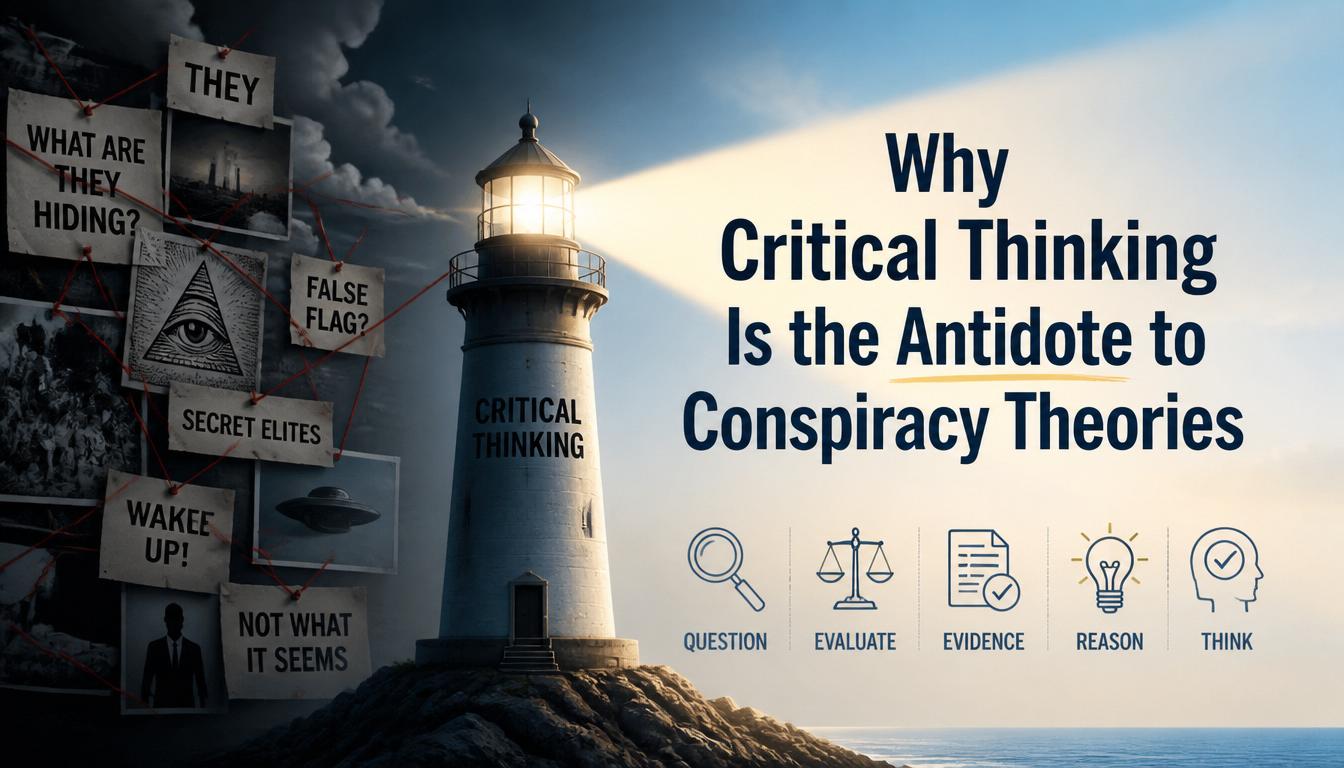
Let us begin with something that should change how you think about conspiracy theories — not just other people's, but your own vulnerability to them. The person in your life who believes the most implausible-sounding things is not fundamentally different from you. They are running the same cognitive software you run. The same pattern-recognition systems. The same need for certainty in an uncertain world. The same desire to belong to a group that shares a worldview. What is different is not their intelligence or their character. What is different is whether they have developed the specific mental habits that keep those cognitive tendencies from being exploited.
Those habits have a name. They are what psychologists call analytical thinking — and more broadly, critical thinking. And the research is now unambiguous: cultivating genuine critical thinking significantly reduces susceptibility to conspiracy theories, while its absence leaves people of any intelligence level vulnerable to beliefs that can damage their health, their relationships, their civic participation, and in some documented cases, their willingness to engage in violence.
This post explains why — using the latest experimental science, the psychological framework that top researchers at the University of Kent, University College Cork, and the American Psychological Association have developed, and the practical skills anyone can start building today.
What People Ask — Research-Based Answers Why do people believe conspiracy theories? Conspiracy theories are not primarily a product of stupidity or poor education. They emerge from ordinary cognitive processes that all humans share. These include pattern recognition (seeing connections in randomness), the need for cognitive closure (the desire for certainty over ambiguity), proportionality bias (assuming big events have big causes), and confirmation bias (accepting confirming information over contradicting evidence). The APA identifies three core psychological motives they satisfy: epistemic (the need for knowledge and certainty), existential (the need for safety and control), and social (the need for belonging). When any of these needs is unmet — by uncertainty, loss of control, or social isolation — conspiracy theories become more appealing as ready-made answers. Does critical thinking actually reduce belief in conspiracy theories? Yes — with an important nuance. A 2025 experimental study from University College Cork, published in advances.in/psychology, found that fostering critical thinking is an effective method to reduce people's tendency to believe in conspiracy theories. Specifically, their approach helped participants distinguish plausible from implausible claims — rather than simply rejecting all conspiracy theories. A 2024 Psychology Today study by Killian found that critical thinking dispositions (a curious, open-minded approach to evidence) correlated very significantly and negatively with conspiracy mentality at r = -.447. Frontiers in Psychology research confirms analytic thinking shows a well-evidenced negative relationship with conspiratorial beliefs. What are the real-world harms of conspiracy theories? A 2025 PMC scoping review (International Journal for Equity in Health) found health conspiracy theories contribute to vaccine hesitancy, reliance on unproven treatments, undermined trust in healthcare, and negative mental health outcomes including anxiety and depression. 5G/COVID conspiracy beliefs were associated with documented arsons of mobile towers and willingness to engage in violence. Conspiracy theories lead to reduced democratic participation, social isolation, and — when connected to radicalization pathways — violent extremism. They disproportionately harm marginalized communities. Is a conspiracy theorist just someone who thinks too critically? No — and this is one of the most important nuances in the research. The Frontiers in Psychology literature distinguishes between genuine analytical thinking (slow, deliberate, evidence-based) and conspiracist thinking (which often mimics criticism by rejecting official sources while uncritically accepting alternative narratives). Conspiracy believers often consider themselves "critical freethinkers" — but the research shows they tend toward less analytical, more intuitive processing. The difference is not the amount of skepticism, but where the skepticism is applied: critical thinkers apply consistent evidential standards to all claims including their preferred alternatives; conspiracy thinkers apply skepticism selectively to authorities they distrust. How do you help someone who believes conspiracy theories? The UCC Ireland 2025 research is explicit: simply telling someone a conspiracy theory is false does not work, and may backfire. The most effective approach involves: (1) not rejecting the person's legitimate skepticism of institutions — some conspiracies are historically real (Watergate, Tuskegee); (2) using Socratic questioning to encourage examination of evidence quality rather than conclusion-swapping; (3) inoculation — explaining manipulation techniques in advance, which builds resistance; (4) maintaining the relationship — isolation from trusted people deepens conspiracy belief; and (5) addressing the underlying psychological need (for certainty, belonging, or control) rather than only arguing about facts. Section One — The Experimental Evidence The Study That Proved It:Critical Thinking Works O'Mahony et al. · University College Cork · advances.in/psychology · Published February 2025 "True Discernment or Blind Scepticism?" — How Four Interventions Compared
Researcher Cian O'Mahony and colleagues at UCC's School of Applied Psychology conducted an experimental study comparing four different approaches to reducing conspiracy belief. Their headline finding was precisely what the rest of the research field had been groping toward: fostering critical thinking is an effective method to reduce people's tendency to believe in conspiracy theories.
But the research revealed something equally important — a finding that challenges the instinct of many educators and debunkers: many well-established interventions have either no effect or a negative effect on participants' ability to correctly reason about conspiracy theories. The reason is that existing techniques encourage people to simply dismiss all conspiracies, rather than developing the skill to discern plausible from implausible claims.
The researchers' new approach — which reminded people not to reject an idea just because it is labeled a conspiracy, and discouraged blind skepticism — was the one that actually worked. O'Mahony explained: "Events like Watergate and the Tuskegee Syphilis Study show us that sometimes conspiracies can happen. It is important that we are not just teaching people to reject everything that is labeled a conspiracy theory. Our study introduces a new approach that encourages careful judgment."
This distinction is fundamental: the antidote to conspiracy thinking is not more skepticism. It is better-calibrated, evidence-based discernment — which is exactly what critical thinking training develops.
Killian · 2024 · Psychology Today · Critical Thinking Dispositions Study The Correlation That Tells the Whole StoryA 2024 study reported in Psychology Today examined the relationship between critical thinking dispositions — defined as "a curious, open-minded stance to information and evidence" — and a range of beliefs including conspiracy mentality. The quantitative finding was striking: critical thinking dispositions correlated significantly and negatively with conspiracy mentality at r = −.447 (defined as the propensity to believe claims without empirical evidence).
The same study found that critical thinking dispositions also correlated negatively with hostile sexism (r = −.601) and racism (r = −.598) — suggesting that the protective effect of critical thinking extends beyond conspiracy theories to a broader class of empirically unsupported belief systems. Critical thinking dispositions are not just useful for spot-checking claims. They represent a fundamentally different orientation toward evidence and uncertainty — one that is simply incompatible with the cognitive posture that conspiracy belief requires.
Section Two — The Psychology Why Intelligent PeopleFostering critical thinking effectively reduces belief in conspiracy theories by enabling individuals to discern between plausible and implausible claims.
— Phys.org reporting on O'Mahony et al. · University College Cork · February 2025
Believe Conspiracy Theories
One of the most common — and most damaging — misconceptions about conspiracy theories is that they are believed by unintelligent, uneducated, or mentally ill people. The research is clear: this is wrong. Conspiracy beliefs arise from cognitive processes that are universal, and the psychological needs they satisfy are experienced by everyone regardless of education or IQ.
Professor Karen Douglas at the University of Kent — one of the world's foremost researchers on conspiracy theory psychology — identifies three core psychological motives that conspiracy theories satisfy:
🔍 Epistemic The Need for Certainty The desire for knowledge, certainty, and accurate understanding. When a major event happens and the official explanation feels incomplete or unsatisfying, conspiracy theories provide simple, certain answers. Research shows people are drawn to them when feeling uncertain — whether about a specific situation or more generally. 🛡️ Existential The Need for Control The desire to feel safe and to have some sense of control over the environment. Conspiracy theories, paradoxically, can increase feelings of agency — if bad things happen because of sinister but identifiable human actors, they feel more predictable and resistible than random chance or complex systemic causes. 🤝 Social The Need to Belong The desire to feel connected to a community and to maintain a positive sense of group identity. Conspiracy theories create tight-knit communities of "awakened" believers, providing belonging, validation, and identity. Once social identity is tied to a conspiracy belief, abandoning the belief feels like abandoning the group.These three motives help explain a phenomenon that often baffles people: why correcting the facts in a conspiracy theory so rarely changes the belief. If the belief is satisfying a need for certainty, belonging, and control, then providing contradictory information threatens all three simultaneously. The psychologically safer response — and the one most conspiracy believers take — is to dismiss the correction as further evidence of the cover-up.
The Six Cognitive Biases That Make Conspiracy Theories Convincing 🧩 Pattern Recognition (Apophenia) The brain evolved to detect patterns — including in genuinely random events. This is highly adaptive in most contexts but leads to seeing meaningful connections where none exist. Conspiracy theories are essentially elaborate patterns imposed on unconnected events. Seeing "deliberate suppression" in a series of unrelated scientists dying of natural causes at different ages over different decades. ⚖️ Proportionality Bias The intuition that big events must have big causes. The larger and more shocking an event, the larger and more intentional its cause must feel. This is why a single disturbed individual being responsible for a world-changing assassination feels cognitively insufficient. "A single person couldn't have changed history this much — there must be a bigger organization behind it." 🔒 Need for Cognitive Closure The preference for definitive answers over ambiguity. Research in Frontiers in Social Psychology shows that people with high need for cognitive closure are more susceptible to conspiracy theories precisely because conspiracy theories offer a complete, closed explanation where the official account may leave questions open. Accepting a neat conspiratorial narrative over an "we don't fully understand why yet" scientific explanation. 📖 Confirmation Bias The tendency to seek, interpret, and remember information that confirms existing beliefs. Once a conspiratorial framework is adopted, every new piece of information is filtered through it — even contradictory evidence becomes "proof" of suppression. "The fact that they're denying it so strongly is itself evidence that they're hiding something." 📢 The Mere Exposure Effect The more frequently we encounter a claim — even if it is false — the more familiar and therefore more believable it becomes. Social media algorithms that repeatedly serve the same conspiratorial content exploit this cognitive bias directly and systematically. A claim encountered five times on different platforms begins to "feel" true simply through accumulated familiarity. ⬆️ Jumping to Conclusions PsyPost reported in 2025 on two new studies finding that cognitive biases including "jumping to conclusions" and "emotional reasoning" — biases also associated with subclinical delusional thinking — were significantly associated with conspiracy belief. This impulsive reasoning connects limited evidence to strong conclusions. Moving from "the government has lied before" to "therefore this specific claimed event was staged" without examining the actual evidence for the specific claim. Section Three — The Stakes Why This Is Nota Harmless Quirk
Conspiracy theories might seem like a benign form of intellectual eccentricity — a hobby for the deeply curious, a harmless alternative narrative for those who find official explanations unsatisfying. The research does not support this view.
🔴 PMC Scoping Review · International Journal for Equity in Health · April 2025A systematic scoping review synthesizing research across six databases on health conspiracy theories found they are associated with: vaccine hesitancy and reduced vaccine uptake; reliance on unproven and potentially harmful alternative treatments; reduced trust in healthcare systems; and negative mental health outcomes including anxiety and depression. The review found that conspiracy theories "disproportionately impact marginalized populations, further widening health disparities."
🔴 5G/COVID Conspiracy Beliefs — PMC Systematic ReviewHigher levels of COVID-19 conspiracy belief — specifically beliefs that 5G technology caused or spread the virus — were associated with documented cases of arson on mobile phone towers, physical attacks on telecommunications workers, and significantly higher willingness to engage in violence and anti-government protest. A belief that begins in an online forum can end in real-world physical harm to uninvolved people.
Frontiers in Psychology has published research identifying conspiracy belief as a pathway to radicalization through what researchers call the 3N model: Needs (psychological motives), Narrative (the conspiracy theory providing a villainous explanation), and Network (the community that reinforces the belief and escalates its intensity). All three are present in virtually every documented case of conspiracy-related violence.
⚠ The Democratic Cost — WEF 2024The World Economic Forum's 2024 Global Risks Report identified misinformation and disinformation — including conspiracy theories — as the single greatest short-term risk to global stability. Conspiracy theories undermine trust in democratic institutions, reduce electoral participation, and corrode the shared epistemic foundation that democratic deliberation requires. The democratic cost of conspiracy beliefs is not rhetorical. It is structural.
Section Four — The Mechanism How Critical ThinkingDefeats Each Vulnerability
The reason critical thinking functions as an antidote to conspiracy thinking is not that it teaches people to be more cynical or more trusting. It is that it directly addresses each of the psychological and cognitive vulnerabilities that conspiracy theories exploit.
How Conspiracy Thinking Operates- Seeks patterns aggressively — connection-finding without testing for false positives
- Demands certainty — rejects "we don't know yet" as a cover-up
- Applies skepticism selectively — only to authorities it dislikes
- Treats the absence of evidence as evidence of suppression
- Reinforces beliefs through social isolation and in-group validation
- Resists updating — new contradictory evidence confirms the conspiracy
- Finds complex explanations for simple events, and simple explanations for complex events
- Tests patterns for statistical significance — asks "could this be random?"
- Tolerates genuine uncertainty — holds beliefs proportionally to evidence quality
- Applies consistent evidential standards to all claims regardless of source
- Recognizes "absence of evidence is not evidence of absence" — but also not evidence of conspiracy
- Actively seeks out perspectives that challenge existing beliefs
- Updates beliefs deliberately when better evidence emerges
- Seeks explanations proportional to the available evidence, not to emotional need
A comprehensive perspective article in Frontiers in Psychology examined the relationship between three cognitive styles — analytic thinking, critical thinking, and scientific reasoning — and conspiracy belief. The key finding: analytic thinking (slow, deliberate, conscious processing to mitigate biases) shows a well-evidenced negative relationship with conspiratorial beliefs.
Crucially, the article also addresses the paradox that many conspiracy believers experience themselves as "critical freethinkers" — more questioning than the sheep who accept official narratives. The research distinguishes this pseudo-skepticism from genuine critical thinking: the former applies skepticism selectively to disliked authorities while accepting alternative claims uncritically; the latter applies consistent evidential standards to all claims including preferred alternatives.
This distinction is the whole game. It is what the UCC Ireland research operationalized: real critical thinking teaches discernment — the ability to distinguish the actually plausible from the actually implausible — not reflexive rejection of everything labeled official or reflexive acceptance of everything labeled alternative.
Section Five — The Practical Antidote Nine Skills That BuildReal Resistance to Conspiracy Thinking
The following practices are not primarily about debating conspiracy theorists or winning arguments. They are about building the cognitive habits that make conspiracy thinking less appealing and less compelling — in yourself and, through modelling and patient engagement, in the people around you.
1 Distinguish the Quality of Evidence, Not Just the Source One of conspiracy thinking's core moves is to dismiss all evidence from "establishment" sources and accept all evidence from alternative sources — a simple authority swap rather than an evidence evaluation. Genuine critical thinking evaluates the quality of the evidence itself: How was this data collected? What are the sample sizes? Have independent teams replicated the finding? Has it been peer-reviewed? These questions apply equally to government studies and to alternative health websites. 2 Learn to Recognize Pattern-Matching in Yourself Your brain is an extraordinary pattern-finding machine. The next time you find yourself noticing a remarkable "coincidence" or a sequence of events that seems too neat to be random, pause and apply a simple statistical question: "Given how many events happen in the world every day, how surprising would this cluster actually be?" Coincidences that seem impossible in isolation are, by the law of large numbers, almost inevitable at the scale of global events. 3 Practice Tolerating Genuine Uncertainty One of the most important and least comfortable cognitive skills is accepting "I don't know, and neither does anyone else yet" as a valid state. Conspiracy theories are psychologically appealing partly because they provide certainty. Building a higher tolerance for ambiguity — practicing saying "the evidence is genuinely unclear on this" rather than reaching for the nearest complete explanation — directly reduces the psychological need that conspiracy theories exploit. 4 Ask What Evidence Would Change Your Mind — On Every Position This question — "What would I need to see to change my mind about this?" — is one of the sharpest diagnostic tools available for distinguishing genuine belief from conspiracy belief. In conspiracy thinking, there is typically no answer. Everything confirming the theory counts as evidence; everything contradicting it is evidence of suppression. A belief that cannot specify what would falsify it is not a conclusion — it is an unfalsifiable article of faith. 5 Study the Manipulation Techniques — Before You Encounter Them Inoculation theory research consistently shows that explaining how manipulation techniques work before people encounter them significantly reduces their effectiveness. The techniques common to conspiracy theory promotion — false urgency, appeal to secret knowledge, us-vs-them framing, authority dismissal, and the "they don't want you to know" hook — are specific and learnable. Understanding them makes them dramatically less convincing when you encounter them in the wild. 6 Protect Your Social Circle from Epistemic Isolation Conspiracy belief deepens in isolation and weakens in genuine, trusting social connection. The social belonging motive that conspiracy theories satisfy — the community of "awakened" insiders — is most powerful when a person lacks other communities where they feel genuinely valued and understood. Maintaining diverse, trusting relationships with people who hold different views is not just emotionally healthy. It is a structural protection against the social pathway into conspiracy belief. 7 When Engaging Someone with Conspiracy Beliefs: Start with Legitimate Skepticism The UCC research's most practically important finding is that interventions work best when they acknowledge that some conspiracies are real. Watergate was real. The Tuskegee study was real. COINTELPRO was real. Starting by acknowledging that institutional deception genuinely happens — and that therefore calibrated skepticism is warranted — is far more effective than dismissing conspiracy thinking wholesale. The goal is to move from uncalibrated to calibrated skepticism, not from belief to dismissal. 8 Apply Occam's Razor — Consistently Occam's Razor proposes that, when multiple explanations are available, the simplest consistent with the evidence is most likely to be correct. This principle cuts against conspiracy theories in a specific and practical way: maintaining large-scale conspiracies requires implausible numbers of participants, sustained over long time periods, all keeping secrets. The historical record of actual conspiracies shows that most leak quickly and most involve small numbers of participants. The larger the claimed conspiracy, the more people would need to be complicit — and the higher the probability that the conspiracy would have been exposed before now. 9 Address the Underlying Need, Not Just the Claim The deepest insight from Karen Douglas's APA research is that conspiracy theories are often symptom rather than cause — symptoms of unmet needs for certainty, control, or belonging. Purely factual debunking misses this and is usually ineffective for this reason. Effective engagement addresses the human being behind the belief: building genuine certainty through better information literacy, restoring a sense of agency through civic engagement, and meeting belonging needs through authentic human connection are more powerful long-term antidotes than any single fact-check. ✓ The Most Important Insight in This Entire PostCritical thinking is not the opposite of conspiracy thinking because it makes people reject more claims. It is the opposite because it makes people evaluate more carefully — and that evaluation, when applied consistently, makes implausible conspiracy theories far less convincing while preserving the capacity to identify the genuinely plausible ones. The goal is not blanket cynicism. It is calibrated discernment. That distinction is exactly what the 2025 UCC experimental research demonstrated works — and exactly what all the less-effective interventions missed.
What You Can Do — Starting TodayThe research from UCC, Psychology Today, Frontiers, and the APA points consistently toward the same conclusion: conspiracy beliefs are not a personality defect but a cognitive vulnerability, and one that genuine critical thinking training significantly reduces. You can work on this — in yourself, and in how you engage with the people around you.
- This week: Identify one belief you hold with high confidence. Ask: "What evidence would change my mind?" If you genuinely cannot answer, examine that belief more carefully.
- This week: Learn the six manipulation techniques common to conspiracy content — the "secret knowledge" hook, false urgency, us-vs-them framing, authority dismissal, unfalsifiable claims, and pattern-overselling. You will see them everywhere once you know what they look like.
- This month: When you encounter a claim that outrage-triggers you, before sharing it, ask: "What is the primary evidence? What do independent sources say? What is the simplest explanation consistent with what is actually known?"
- Ongoing: If someone you care about is deepening into conspiracy belief — approach with curiosity, not contempt. Acknowledge legitimate institutional skepticism. Ask questions rather than asserting corrections. Preserve the relationship that is their best alternative to the community conspiracy theories provide.
- O'Mahony, C. et al. (2025). "True discernment or blind scepticism? Comparing the effectiveness of four conspiracy belief interventions." advances.in/psychology. Reported by Phys.org, February 2025. phys.org
- University College Cork. (February 2025). "Critical thinking training can reduce belief in conspiracy theories." Press release. ucc.ie
- Killian, M. (2024). "Critical Thinking Can Reduce Belief in Conspiracy Theories." Psychology Today. psychologytoday.com
- Douglas, K.M. (2021). "Why people believe in conspiracy theories, with Karen Douglas, PhD." APA Speaking of Psychology podcast. apa.org
- Gjoneska, B. (2021). "Conspiratorial Beliefs and Cognitive Styles: An Integrated Look on Analytic Thinking, Critical Thinking, and Scientific Reasoning." Frontiers in Psychology, 12. PMC
- Jedinger, A. & Masch, L. (2025). "Need for cognitive closure, political trust, and belief in conspiracy theories during the COVID-19 pandemic." Frontiers in Social Psychology, 2. frontiersin.org
- PsyPost. (May 2025). "Scientists identify delusion-like cognitive biases that predict conspiracy belief." Applied Cognitive Psychology. psypost.org
- Leonard, M.J. & Philippe, F.L. (2021). "Conspiracy Theories: A Public Health Concern and How to Address It." Frontiers in Psychology. PMC
- PMC Scoping Review. (April 2025). "Health conspiracy theories: a scoping review of drivers, impacts, and countermeasures." International Journal for Equity in Health, 24, 93. PMC
- PMC Systematic Review. (2022). "Antecedents and consequences of COVID-19 conspiracy beliefs." Arson, violence, vaccination refusal data. PMC
- Brainz Magazine. (June 2025). "Why We Believe Conspiracy Theories and the Psychology Behind Them." Cognitive bias breakdown. brainzmagazine.com
- Psychology Today. (January 2025). "The Psychology of Conspiracy Theories." Proportionality bias, emotional maturity, Bowen family systems. psychologytoday.com
- Jolley, D. & Paterson, J.L. (2020). "Pylons ablaze: Examining the role of 5G COVID-19 conspiracy beliefs and support for violence." British Journal of Social Psychology, 59(3). Cited in PMC systematic review.
- Times Higher Education Campus. (August 2025). "Believe it or not: you can use conspiracy theories as tools for teaching." WEF 2024 Global Risks Report citation. timeshighereducation.com
Why Critical Thinking Is the Antidote to Conspiracy Theories
A 2025 experimental study proved it. Psychology Today's research measured it. The APA has documented the three psychological needs conspiracy theories exploit — and the one cognitive skill that defeats each of them. Here's the science, and what it means for you and everyone you know.