
AI for Project Managers: How to Automate Reports, Timelines, and Stakeholder Updates Without Losing Control

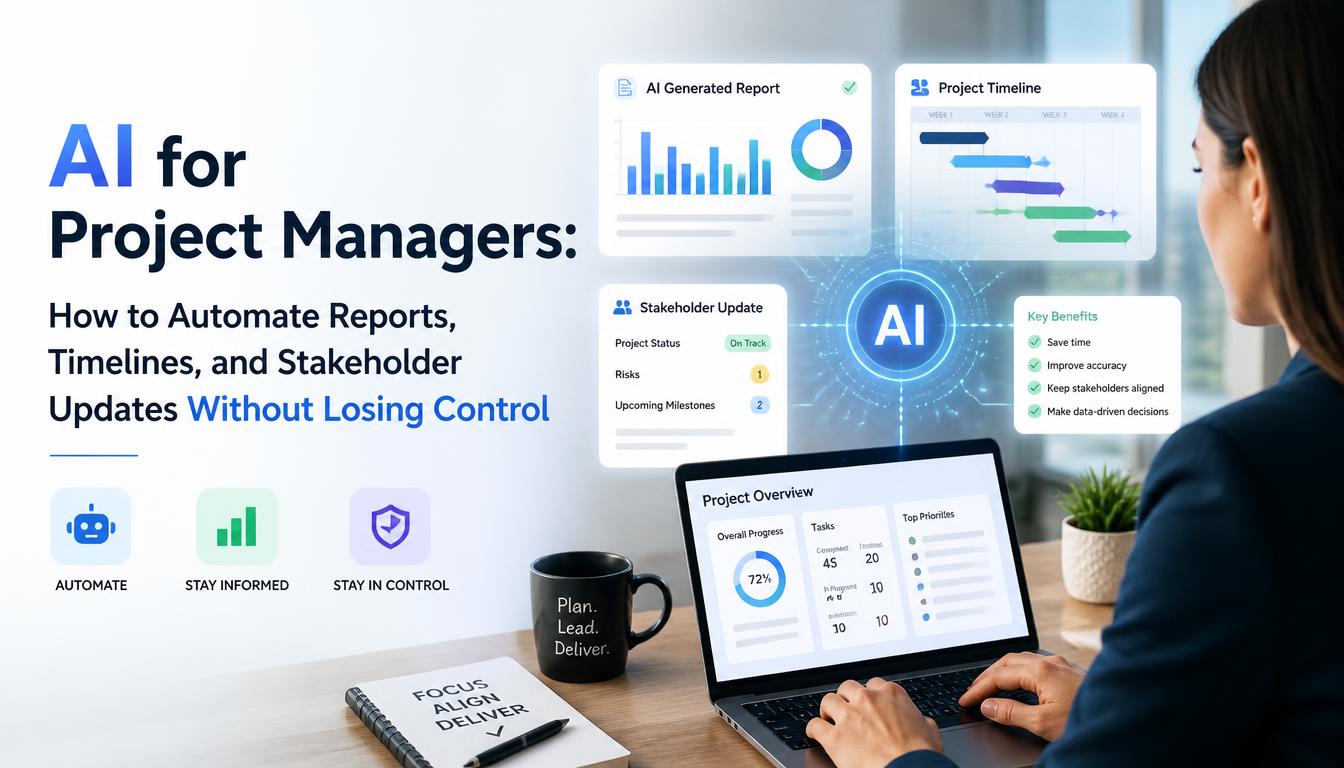
Project management has a dirty little secret: we spend more time talking about work than actually doing it. Between wrangling status updates, manually shifting Gantt charts after a single delay, and translating technical jargon into executive-friendly summaries, modern PMs often moonlight as administrative assistants. In fact, industry data consistently shows that up to 30% of a project manager’s week is consumed purely by documentation and reporting.
Artificial Intelligence changes the math. But let's be clear about what AI isn't: it is not a magic wand that rescues failing projects, nor is it a replacement for human empathy and negotiation. What AI is, however, is a ruthless efficiency engine for the operational overhead that bogs down delivery. When deployed correctly, Large Language Models (LLMs) and predictive analytics can automate status reporting, dynamic timeline adjustments, and stakeholder communications with surgical precision.
Here is the exact blueprint for integrating AI into your project management workflows without sacrificing quality, oversight, or your team's autonomy.
The Death of the Manual Status ReportAsk any executive what they hate most about project reports, and they will tell you two things: they arrive too late, and they say too little. Ask any project manager how much they dread writing them, and you will hear a familiar groan. Traditional status reporting is a lagging indicator of project health, built on subjective updates harvested from Jira tickets, Slack threads, and disjointed spreadsheets.
AI transforms this by shifting reporting from a manual retrieval task to an automated synthesis pipeline. Instead of chasing team members for updates on Friday afternoon, modern AI-driven PM stacks pull telemetry directly from your source-of-truth tools (GitHub, Jira, Notion, Asana) and synthesize them into cohesive narratives.
Building an Automated Reporting PipelineTo implement automated reporting that doesn't read like a robotic data dump, you need a three-tier architecture:
- Data Aggregation: Centralize activity logs and commit messages using webhook integrations or native platform connectors.
- Contextual Prompting: Feed the raw data into an LLM using a rigid system prompt that enforces brevity, highlights risks, and demands actionable recommendations.
- Human-in-the-Loop Review: A PM acts as the editor-in-chief, reviewing the synthesized output for political nuances before distribution.
Here is a battle-tested prompt template you can feed into your organization's secure LLM instance to generate executive-ready updates:
"Act as a Senior Technical Project Manager. Review the following raw Jira updates and GitHub commit logs for Project Titan over the past 7 days. Generate a 3-bullet executive summary focusing strictly on: 1) Milestones achieved, 2) Blockers requiring executive intervention, and 3) Schedule variance. Tone must be direct, objective, and concise. Omit all internal ticket IDs and fluff."
By automating this workflow, you reclaim roughly four to six hours every single week—time that is far better spent unblocking engineers or managing client expectations.
Predictive Timelines: Moving From Reactive to Proactive SchedulingTraditional Gantt charts are works of fiction. They represent an idealized, linear path through a non-linear reality. When a developer gets sick, a third-party API changes its documentation, or scope creep rears its head, the static timeline shatters. Most PMs react by manually shifting tasks to the right—a process known as 'hopium scheduling.'
AI introduces predictive scheduling by analyzing historical project data to forecast variance before it occurs. Machine learning models trained on your past sprints can identify patterns that humans miss.
How Predictive Timeline Engines WorkAdvanced AI project management tools do not just track what happened; they simulate what is likely to happen based on statistical probabilities. Key capabilities include:
- Velocity Trend Analysis: Automatically adjusting future sprint capacity based on historical holiday slumps, burnout indicators, and team turnover.
- Critical Path Stress-Testing: Running Monte Carlo simulations behind the scenes to output a confidence score for your hard launch date (e.g., "There is a 78% probability of hitting the November 1st deadline based on current velocity").
- Resource Over-Allocation Alerts: Catching invisible bottlenecks where a single subject matter expert is assigned to three overlapping critical paths.
Case Study Insight: In a recent deployment with a 50-person digital agency, replacing static Excel timelines with an AI-driven predictive scheduling tool reduced schedule variance by 34% within one quarter. The system flagged compounding technical debt in the QA phase three weeks before the team realized they were falling behind, allowing the PM to renegotiate scope early rather than scrambling during release week.
Tailoring Stakeholder Updates Without Context CollapseThe hardest part of stakeholder management isn't delivering bad news; it's translating the same core data into three entirely different languages. The engineering lead wants to know about architectural refactoring and API latency. The CFO cares about burn rate, vendor costs, and capitalization thresholds. The marketing director wants to know if the landing page will be ready for the ad campaign.
Historically, this meant writing three distinct updates—a massive cognitive tax on the project manager.
AI excels at audience-specific translation. Because LLMs possess deep semantic understanding, you can feed them a single objective project status update and instruct them to rewrite it through specific stakeholder lenses.
The Stakeholder Translation MatrixWhen configuring your AI prompts for stakeholder communications, apply these parameters:
- For Technical Stakeholders: Focus on architectural integrity, dependency risks, technical debt accumulation, and velocity metrics. Use precise technical nomenclature.
- For Financial Stakeholders: Focus on budget variance, capital expenditure vs. operating expenditure, resource utilization rates, and ROI milestones. Strip out granular task-level updates.
- For Creative/Marketing Stakeholders: Focus on deliverable readiness, brand alignment milestones, asset drop dates, and user-facing impact. Avoid implementation weeds.
This multi-channel generation keeps every stakeholder informed at the exact level of granularity they require, drastically reducing the number of 'quick alignment calls' cluttering your calendar.
The Operational Guardrails: Risks and LimitationsWe would be remiss if we pretended AI implementation is frictionless. As project management authorities, we must address the glaring risks associated with hyper-automating your delivery pipeline.
1. The Hallucination TrapLLMs are probabilistic engines; they predict the next most likely word. If they lack sufficient data context, they will confidently invent project milestones, task assignees, or completion dates that never happened. Never publish an unedited AI-generated report to executive stakeholders. Always verify the telemetry against your source systems.
2. Data Privacy and ComplianceFeeding proprietary enterprise codebases, financial budgets, and client names into public LLMs is an immediate corporate security violation. Ensure your organization uses enterprise-tier, sandboxed AI models (such as Azure OpenAI or self-hosted open-source models like Llama 3) where data is explicitly partitioned and never used for model training.
3. The Empathy VacuumProject management is fundamentally a human discipline. If you automate your team updates to the point where employees only ever interact with cold, AI-generated prompts and automated Slack reminders, team morale will plummet. Use AI to handle the machine-to-machine and machine-to-paper work, freeing up your time for face-to-face coaching, psychological safety building, and empathetic leadership.
Summary: The AI-Augmented PM PlaybookAI is not coming for the project manager's job; it is coming for the bureaucracy within the project manager's job. By weaponizing artificial intelligence to draft status reports, run predictive schedule simulations, and segment stakeholder communications, you transition from an administrative bottleneck into a strategic delivery leader.
Start small. Pick one repetitive administrative task this week—whether it's synthesizing your weekly sprint review or drafting the executive summary—and build an AI prompt pipeline for it. Measure the time saved, refine the prompt, and systematically scale your automation from there. The future belongs to PMs who manage outcomes, not spreadsheets.
AI for Project Managers: How to Automate Reports, Timelines, and Stakeholder Updates Without Losing Control
Learn how project managers can use AI to automate status reports, predictive timelines, and stakeholder updates without losing control.