
AI for Financial Analysts: The Death of Manual Modeling and the Rise of Predictive Alpha

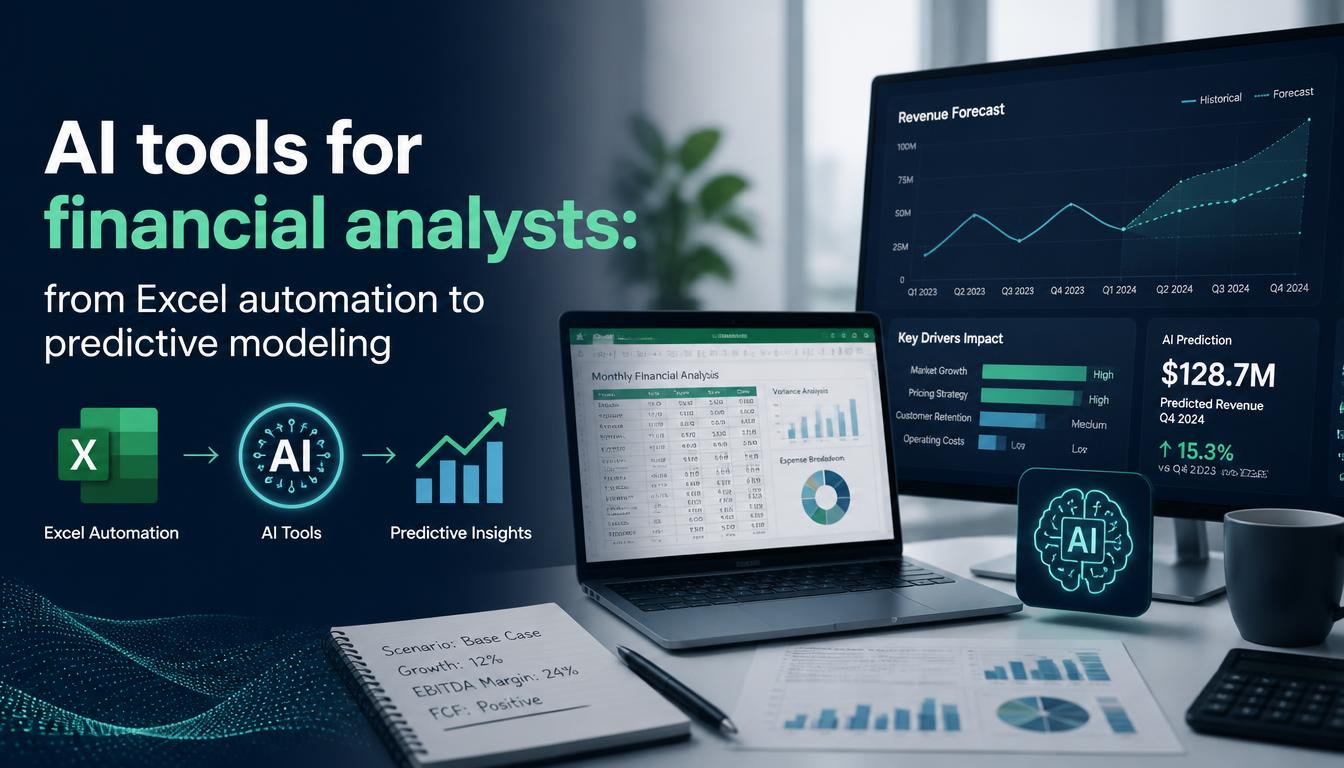
The traditional financial analyst's workflow—drowning in VLOOKUPs, manually reconciling mismatched ERP formats, and hardcoding DCF terminal values at 2:00 AM—is structurally obsolete. For the past decade, financial technology discussions have danced around automation. Today, we have crossed a structural threshold. Generative AI, transformer-based time-series models, and LLM-driven programmatic environments are no longer experimental add-ons; they are core operational infrastructure.
Having advised and implemented AI stacks across private equity firms and Fortune 500 corporate finance teams, I have witnessed firsthand which tools actually generate alpha and which are expensive distractions. This guide deconstructs the real AI stack for financial analysts, moving from basic Excel automation to advanced machine learning and predictive modeling.
The Shift in Analyst Value: From Data Assembly to SynthesisFor decades, an analyst's compensation was roughly correlated with their stamina. The ability to pull data from Bloomberg, clean it in Excel, and format a PowerPoint deck was the primary job. AI collapses that timeline by 95%. Data ingestion, initial variance analysis, and baseline financial statement modeling can now be executed in seconds.
This creates a bifurcated industry:
- The Commodity Analyst: Focuses on manual data processing, basic spreadsheet formatting, and rote reporting. This role is being aggressively automated out of existence.
- The Strategic Analyst: Uses AI agents to offload mechanical tasks, redirecting cognitive bandwidth toward scenario planning, risk architecture, and strategic synthesis.
If your primary skill is building an empty three-statement model from scratch, you are competing directly with algorithms that can generate ten variants of that model in the time it takes to sip your coffee. Your competitive advantage now lies in your ability to interrogate the outputs, stress-test the underlying assumptions, and translate statistical models into boardroom-ready narratives.
Tier 1: Intelligent Excel Automation and LLM CopilotsExcel is not dying. Anyone who tells you financial modeling is moving entirely to Python or web-based dashboards misunderstands corporate finance workflows. Excel remains the lingua franca of business valuation. However, the way we interface with spreadsheets has fundamentally changed.
Natural Language to Complex ModelingWe have moved beyond rigid macros and VBA scripts that break every time a client inserts a column. Modern AI integrations—ranging from specialized financial plugins to local LLMs running inside secure environments—allow analysts to query and manipulate models using plain English.
- Use Case: You need to flex a complex LBO model to account for a 150-basis-point interest rate hike, a staggered debt paydown schedule, and dynamic working capital assumptions.
- Traditional Approach: Manually trace formulas, adjust amortization schedules, fix circular references, and rebuild your summary tabs. (Estimated time: 45 minutes).
- AI Approach: Prompt the model agent: "Recalculate the debt schedule assuming a secured term loan at SOFR+350 with a 1% floor, model a 3-year cash sweep, and output the revised IRR and MoIC sensitivity matrix." (Estimated time: 30 seconds).
Parsing dense regulatory filings is a notoriously high-friction task. AI-driven financial copilots ingest 10-Ks, 10-Qs, and earnings call transcripts instantly, executing semantic searches that bypass traditional keyword limitations. When analyzing a peer group, an analyst can prompt the system to extract all non-GAAP adjustments across twenty different earnings releases, standardize the metrics, and highlight accounting discrepancies in a structured markdown table.
Tier 2: Programmatic Finance with Python and LLM WorkflowsWhile Excel handles the presentation layer, serious data extraction and mid-tier analysis are shifting toward Python-based AI workbenches. Analysts do not need to become software engineers, but knowing how to leverage AI to write and execute Python scripts is now a high-leverage skill.
Data Wrangling at ScaleConsider an M&A diligence process where you receive 50 distinct trial balances from target subsidiaries in entirely different chart-of-accounts formats.
By pairing a Python environment with an LLM execution agent, you can:
- Automatically map disparate general ledger accounts to a standardized master chart of accounts.
- Flag anomalous journal entries, such as weekend postings, round-number adjustments, or transactions just below management approval thresholds.
- Generate automated variance waterfalls showing price-volume-mix impacts across business units.
This workflow transforms a three-week manual audit into a repeatable, automated pipeline that runs in the background.
Tier 3: Predictive Modeling and Machine Learning for ForecastingHistorical financial analysis is descriptive; forecasting is predictive. Traditional budgeting relies heavily on simplistic linear projections—taking last year's figures and applying a blanket 5% growth factor. In a volatile macroeconomic climate, linear budgeting is a recipe for catastrophic variance.
Moving Beyond ARIMA: Machine Learning in FP&AModern predictive modeling leverages gradient boosting machines (like XGBoost or LightGBM) and specialized time-series forecasting frameworks to build multidimensional predictive models.
Real-World Use Case: Cash Flow Forecasting in Working Capital ManagementA corporate treasury team needed to forecast cash flows for a heavy manufacturing firm with volatile supply chain costs. Using traditional methods, their cash forecasting accuracy at a 90-day horizon hovered around 68%.
By implementing a machine learning pipeline that ingested:
- Historical daily cash collection patterns by customer tier.
- Macroeconomic indicators (freight indices, commodity spot prices, industrial production metrics).
- ERP invoice-level data, including historical payment delays and credit score fluctuations.
The predictive model improved 90-day cash forecasting accuracy to 89.5%. This reduction in cash buffer requirements allowed the treasury team to deploy idle liquidity into short-term yield-generating instruments, adding millions to the company's bottom line.
The Hidden Risks of AI in Finance: Hallucinations and GovernanceAs an expert practitioner, I must offer a severe caveat. The financial sector cannot afford "hallucinations." If an LLM hallucinates a statistic in a marketing blog post, it is embarrassing. If an LLM hallucinates a debt covenant calculation or misinterprets an impairment charge in a solvency opinion, it can result in regulatory fines, failed transactions, or litigation.
The Analyst’s Duty of VerificationAI tools are probabilistic engines; finance is a deterministic science (at least regarding the math). Therefore, the deployment of AI in financial analysis must adhere to strict governance frameworks:
- Zero-Trust Architecture: Never input non-public, material information (MNPI) into public-facing consumer AI models. Ensure enterprise agreements guarantee data privacy and zero model training on proprietary corporate data.
- Auditable Logic: Reject black-box AI outputs that cannot show their work. If an AI tool provides a valuation recommendation, it must cite the exact page, table, and line item from the source document.
- Human-in-the-Loop (HITL) Validation: Treat AI as an elite, tireless junior analyst who needs rigorous adult supervision. You are the investment committee; the AI is the preparer.
The software market is flooded with vendors claiming to offer "AI-powered finance." Based on our deployment experience, here is how the ecosystem breaks down:
- For Document Extraction & Research: Tools like AlphaSense and specialized financial LLM wrappers dominate, turning unstructured textual data into structured insights.
- For Spreadsheet Modeling: Integrated Excel plugins that allow local script execution and natural language manipulation provide the highest ROI without forcing users to abandon familiar workflows.
- For Predictive Forecasting: Automated machine learning (AutoML) platforms enable finance teams to build predictive regression models without writing raw code, bridging the gap between data science and FP&A.
The transition to AI-augmented finance is not a future event—it is happening right now. To stay competitive, financial analysts must systematically upgrade their skill sets. Stop spending hours formatting slides and reconciling trial balances. Master prompt engineering for financial logic, learn the basics of data structures in Python, and focus your intellect where machines fall short: strategic judgment, risk calibration, and creative corporate problem-solving.
The future belongs not to the analyst who can crunch the most numbers, but to the analyst who knows how to direct the machines to build better ones.
AI for Financial Analysts: The Death of Manual Modeling and the Rise of Predictive Alpha
Discover how AI tools transform financial analysis. Learn how to leverage LLMs, automate Excel models, and build predictive forecasts.