
AI in Human Resources: The Architect's Guide to Deploying Intelligent Tools Without Destroying Culture

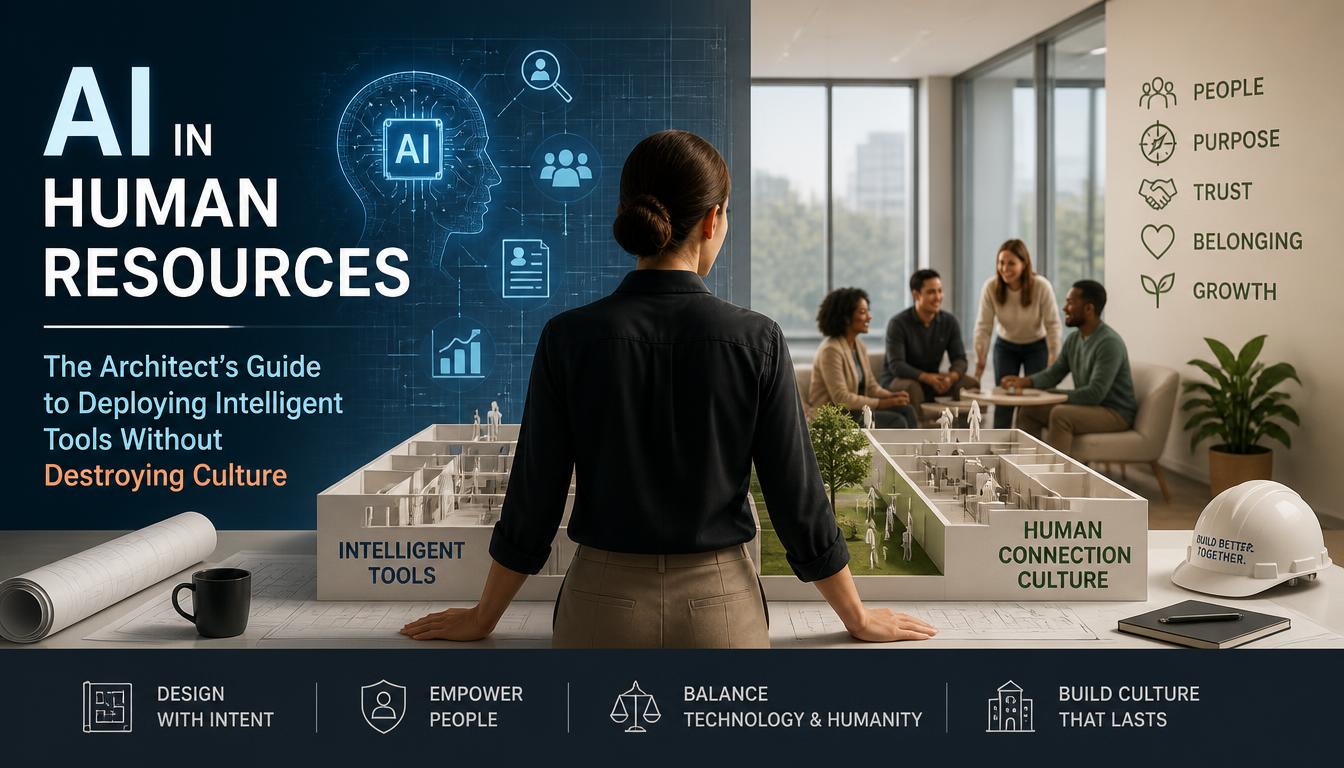
Human Resources has crossed a critical threshold. For years, the conversation around artificial intelligence in HR centered on novelty—automated resume screening, chatbot-driven FAQ responses, and basic scheduling assistants. These surface-level implementations missed the fundamental paradigm shift. Today, AI is not merely an administrative accelerant; it is a structural redesign agent operating across the entire employee lifecycle.
Yet, deployment without architectural foresight invites disaster. We have watched organizations blindly adopt algorithmic hiring platforms only to face discrimination lawsuits, or deploy invasive sentiment-analysis tools that trigger immediate employee churn and distrust. To extract genuine value from AI in HR—spanning from top-of-funnel talent acquisition to nuanced performance calibrations—leaders must operate with the precision of systems engineers, balancing computational efficiency with rigorous ethical boundaries.
The Modern Talent Acquisition Stack: Moving Past Keyword MatchingTraditional Applicant Tracking Systems (ATS) are fundamentally broken. They rely on rigid boolean logic that rewards keyword-stuffing and penalizes unconventional career trajectories. Modern AI-driven talent acquisition tools leverage Large Language Models (LLMs) and semantic parsing to evaluate candidates through contextual competence rather than superficial resume optimization.
Semantic Resume Parsing and Contextual RankingWhen evaluating modern talent discovery tools, we must look beyond basic skills-matching. Advanced AI models analyze the trajectory of an applicant's career, evaluating the scale of projects managed, the complexity of technical environments navigated, and the rate of professional growth.
Key Capabilities of Advanced Sourcing AI:Contextual Skill Inference: Identifying transferable skills from adjacent industries (e.g., mapping a military logistics background directly to enterprise supply chain management).Passive Talent Graphing: Automatically scanning public professional footprints to identify passive candidates whose profiles match hard-to-fill technical specifications.Behavioral Assessment Integration: Correlating pre-hire assessment data with historical tenure and performance metrics of current high-performers to establish predictive hiring profiles.The Operational Risk: Algorithmic bias remains the Achilles' heel of AI recruitment. If an LLM is trained on ten years of historical hiring data from a homogenous workforce, it will aggressively replicate those biases under the guise of 'objective pattern recognition.' Mitigation requires mandatory human-in-the-loop (HITL) checkpoints and continuous algorithmic auditing for disparate impact.
Intelligent Interview Intelligence and Candidate ExperienceThe candidate experience degrades rapidly during the scheduling and initial screening phases. Conversational AI agents now handle the complex orchestration of multi-stakeholder panel interviews, reducing time-to-schedule from days to minutes.
Beyond logistics, asynchronous video screening platforms utilize natural language processing (NLP) to evaluate candidates on communication clarity, technical depth, and structured problem-solving frameworks. However, we advise extreme caution regarding automated facial micro-expression analysis. Scientific consensus heavily disputes the validity of reading emotional states from facial cues during high-stress interviews. Stick to linguistic and content-based evaluations.
Onboarding and Internal Mobility: Activating the Data PipelineThe moment an offer letter is signed, the HR tech stack historically goes dark, only to reawaken during annual performance reviews. This is a catastrophic missed opportunity. AI-powered onboarding and internal mobility platforms bridge this gap by creating continuous developmental feedback loops.
Hyper-Personalized Onboarding PathwaysGeneric 30-60-90 day plans fail because they treat every hire as a blank slate. Intelligent onboarding systems cross-reference a new hire’s background, skill gaps identified during the interview phase, and departmental benchmarks to generate a customized integration roadmap.
These systems automatically provision software access, schedule targeted introductory meetings with cross-functional partners, and curate micro-learning modules to address specific competency deficiencies within the first two weeks.
AI-Driven Internal Talent MarketplacesExternal hiring is five times more expensive than internal mobility. Yet, employees frequently leave organizations because they believe their career trajectory is stagnant, unaware that open roles exist in adjacent departments.
AI-powered internal talent marketplaces act as internal matchmakers. By continuously ingesting employee project histories, skill updates, performance markers, and career aspirations, these platforms proactively surface internal job openings, mentorship opportunities, and cross-functional project assignments.
Benefits of Internal Talent Deployment:Dramatic reduction in time-to-productivity for specialized roles.Significant boost in employee retention through visible career mobility.Elimination of tribal knowledge silos by encouraging cross-departmental exposure.Transforming Performance Reviews: From Subjective Bias to Predictive InsightsThe annual performance review is universally loathed. It is plagued by recency bias (overweighting events from the past three weeks), central tendency bias (rating everyone as 'average'), and manager-specific leniency or strictness. AI fundamentally restructures performance management by shifting the model from retrospective judgment to continuous, data-informed coaching.
Continuous Feedback SynthesisModern performance platforms integrate directly into daily communication tools like Slack, Microsoft Teams, and project management suites (Jira, Asana). They passively analyze peer feedback, project completion metrics, and client satisfaction scores in real time.
At the end of a review cycle, the AI aggregates these disparate data points to generate a comprehensive, objective performance summary for managers. This eliminates the blank-page syndrome and provides concrete, evidence-based examples for compensation and promotion discussions.
Predictive Flight-Risk and Burnout AnalysisPerhaps the most powerful—and controversial—application of AI in performance management is predictive analytics regarding employee retention and burnout.
By analyzing patterns such as sudden drops in collaboration frequency, increased off-hours communication, stagnant skill development, and declining sentiment in internal survey responses, algorithms can flag employees who are at high risk of resigning or experiencing severe burnout.
The Ethical Imperative: This is where HR must walk a razor-thin line. If employees feel they are being actively surveilled by 'Big Brother' algorithms, morale evaporates. Transparency is non-negotiable. Organizations must explicitly state what data is being analyzed, how predictive models operate, and ensure that these insights are used exclusively to support employee well-being and workload rebalancing—never as punitive measures.
The Execution Blueprint: How to Implement HR AI Without Breaking TrustDeploying AI tools across the employee lifecycle requires a deliberate, phased methodology. Abandon the 'plug-and-play' mindset.
1. Conduct a Rigorous Algorithmic AuditBefore purchasing any vendor solution, demand transparency regarding their training data. Run historical test datasets through the system to measure for bias against protected classes. If a vendor guards their proprietary methodology as a 'trade secret' to the point of refusing bias transparency, walk away.
2. Enforce the Human-in-the-Loop PrincipleAI should propose; humans must dispose. Whether in candidate shortlisting, compensation adjustments, or performance ratings, algorithms must act as decision-support engines, not autonomous executioners. Every automated recommendation must include a transparent audit trail explaining *why* the system reached that conclusion.
3. Upskill Your People Operations TeamHR professionals cannot effectively govern AI systems if they do not understand the underlying mechanics. Organizations must invest in data literacy training for their HR teams, moving them from administrative operators to strategic data interpreters who can spot algorithmic drift and interpret confidence scores.
The Bottom LineArtificial intelligence will not replace HR professionals. However, HR professionals who leverage AI will decisively replace those who do not. The objective is not to automate the 'human' out of Human Resources, but to strip away the administrative friction that prevents HR leaders from focusing on what truly matters: organizational design, empathy, leadership development, and strategic alignment.
AI in Human Resources: The Architect's Guide to Deploying Intelligent Tools Without Destroying Culture
Master AI in HR. Expert guide on deploying intelligent tools for hiring, onboarding, internal mobility, and bias-free performance reviews.