
AI Won't Take Your Job: Someone Using AI Better Than You Will

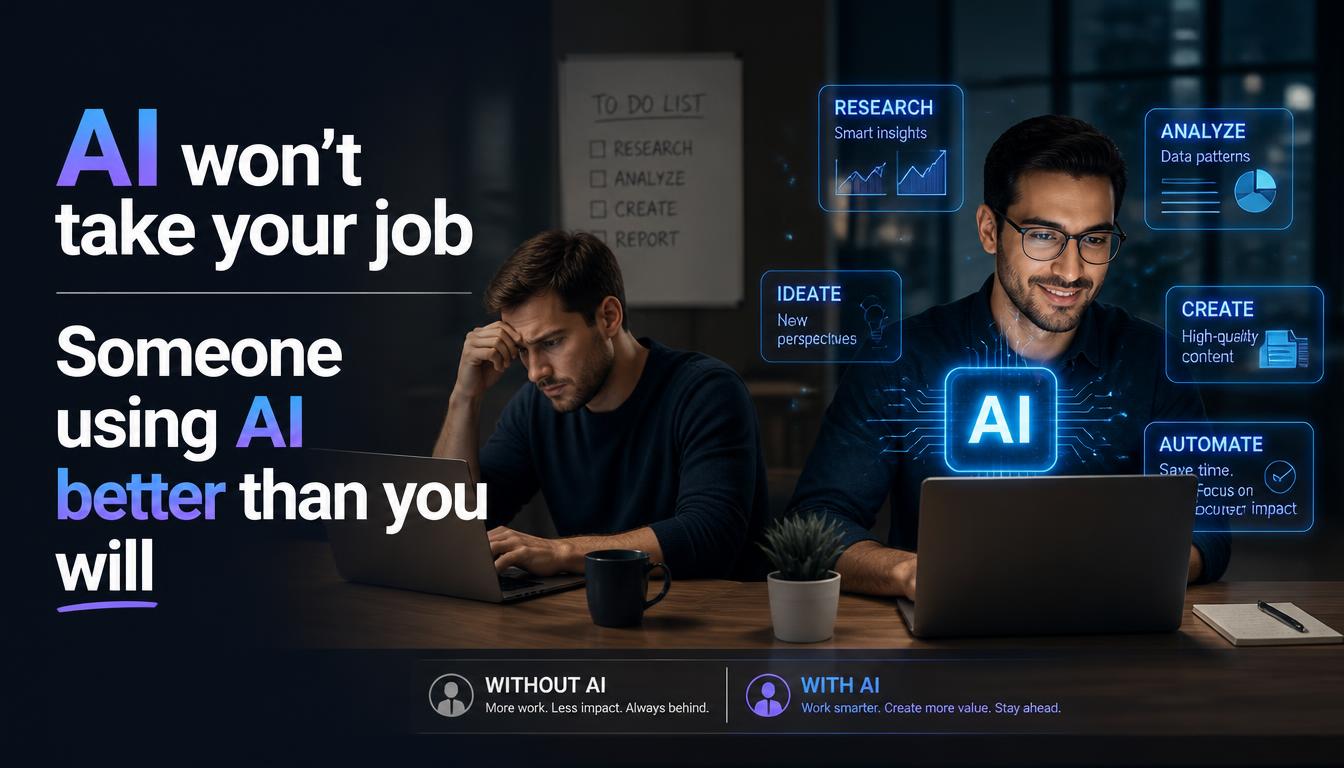
For the past three years, white-collar professionals, creatives, and knowledge workers have fixated on a phantom threat: the autonomous AI takeover. We have debated whether Large Language Models possess genuine reasoning, worried about corporate cost-cutting through automation, and nervously watched benchmark scores climb across every major AI release. This fear is entirely misplaced. The data inside enterprise workflows, high-growth startups, and legacy institutions points to a radically different reality.
Artificial intelligence is not a sentient competitor rendering human labor obsolete. It is a cognitive multiplier. The displacement happening in the modern economy is not human-versus-machine; it is human-plus-AI versus human-alone. If your career feels precarious right now, the culprit is not the neural network on your screen. It is the peer, competitor, or junior associate who has learned how to orchestrate that network to operate at ten times your velocity.
The Fallacy of Total Replacement in Knowledge WorkTo understand why AI will not take your job wholesale, you must look at the economic unit of production. Organizations do not pay salaries for tasks; they pay for problem-solving, accountability, contextual judgment, and trust. While generative AI can synthesize a market report in four seconds or write a clean Python script in ten, it cannot sit across from a defensive stakeholder, read micro-expressions, navigate corporate politics, or take legal and ethical responsibility for a failed product launch.
In our advisory work with Fortune 500 leadership teams, we rarely see broad-brush automation of entire roles. Instead, we see something far more disruptive: the unbundling and rebundling of job descriptions.
- Task Automation: Routine data extraction, initial drafting, code refactoring, and sentiment analysis are entirely offloaded to models.
- Cognitive Up-leveling: The time previously spent on mechanical execution is forcibly shifted toward strategy, curation, prompt architecture, and systems design.
- Velocity Disparity: Two professionals with the same job title produce radically different outputs. One writes emails line by line; the other builds proprietary prompt pipelines that draft, personalize, and optimize customer outreach at scale.
The market does not reward effort; it rewards leverage. When a tool multiplies an individual's leverage by an order of magnitude, the baseline performance curve shifts permanently upward. Those who remain anchored to manual execution methods are simply priced out by economics, not algorithms.
Anatomy of the AI-Augmented Professional: A Case StudyConsider two mid-level product managers, Sarah and David, operating in the highly competitive fintech sector. Both possess five years of experience, similar educational backgrounds, and equal access to enterprise software suites.
David views AI as a novelty. He uses a chatbot occasionally to polish a Slack message or summarize a long PDF, but maintains his traditional workflow: manual user-interview transcription, week-long competitive audits, and painstaking spreadsheet modeling.
Sarah treats AI as an operating system layer. She has built custom API-connected workflows that ingest raw user feedback transcripts, cluster thematic sentiment using fine-tuned models, draft preliminary PRDs (Product Requirement Documents) based on company design systems, and generate comprehensive test cases before her morning coffee.
When leadership asks for a pivot analysis on a new market entrant, David takes four days to deliver a polished deck. Sarah delivers three distinct strategic hypotheses, complete with financial models and risk mitigations, in forty-five minutes. David is not fired because an algorithm replaced him. David is outperformed, overlooked for promotion, and eventually let go because Sarah—armed with the exact same hours in the day—is executing at five times his operational capacity.
The Compounding Returns of Prompt OrchestrationThe core competency separating Sarah from David is not coding; it is systems thinking and AI orchestration. Most professionals treat AI like a search engine—asking isolated questions and accepting the first mediocre output. Expert AI users treat models like junior team members requiring precise onboarding, rigorous guardrails, iterative feedback, and context management.
This creates a compounding return curve. Every hour spent building reusable prompt templates, vector databases, or automated multi-agent chains pays dividends across hundreds of future tasks. The gap between the AI-native worker and the manual worker is exponential, resembling the shift from hand-drawn drafting tables to computer-aided design (CAD) in architecture.
The Four Pillars of AI Competency That Protect Your CareerSurviving and thriving in the current labor market requires deliberate skill acquisition. You do not need to understand transformer architecture or backpropagation. You must master the human-machine interface.
1. Context Curation Over Content CreationWhen generation is free and instant, the value of raw creation plummets while the value of curation skyrockets. Anyone can prompt a model to write an essay or generate an image. The differentiator is knowing what good looks like, recognizing hallucinations, injecting proprietary domain expertise, and editing with ruthless precision. Your value lies in your taste, your editorial eye, and your ability to constrain the model within brand and strategic boundaries.
2. Workflow Engineering and Automation MindsetStop thinking about individual tasks and start auditing your entire daily workflow. Identify bottlenecks where information sits idle. Ask yourself:
- What am I doing manually today that requires transforming text from format A to format B?
- Where am I spending more than 30 minutes on repetitive structural work?
- How can I chain an LLM, a spreadsheet, and an automation tool (like Zapier or Make) to handle this loop automatically?
As digital noise increases due to mass-generated AI content, authentic human connection becomes a scarce premium. Professionals who excel at cross-functional alignment, empathy-driven leadership, negotiation, and complex stakeholder management become anchors within organizations. AI can generate thousands of words of copy, but it cannot build the trust required to rally a team through a corporate crisis.
4. Continuous Unlearning and Fast AdoptionThe half-life of software features is shrinking rapidly. Capabilities that required complex coding six months ago are now single toggle switches in consumer applications. The ultimate meta-skill is psychological flexibility: the willingness to discard your favorite workflows, abandon comfortable habits, and adopt superior tools the moment they emerge.
Navigating the Great Professional DivergenceWe are living through the Great Professional Divergence. On one side are those who view artificial intelligence as a threat to resist or a gimmick to ignore. On the other side are those who view it as the primary engine of personal leverage and career acceleration.
The market is ruthlessly efficient at pricing this divergence. Companies are not replacing humans with AI; they are replacing teams of humans who refuse to use AI with smaller, hyper-efficient teams of humans who do. The technology is merely the mirror reflecting our own capabilities back at us.
The question you must ask yourself is not whether your industry will be automated. The question is whether the person sitting next to you—armed with an advanced cognitive engine and the willingness to completely reinvent how they work—is about to make your current skill set obsolete. Stop worrying about the machine. Start studying the person outworking you with it.
AI Won't Take Your Job: Someone Using AI Better Than You Will
Stop fearing job loss from AI. Discover why the real threat is human competition and how to master AI leverage to future-proof your career.