
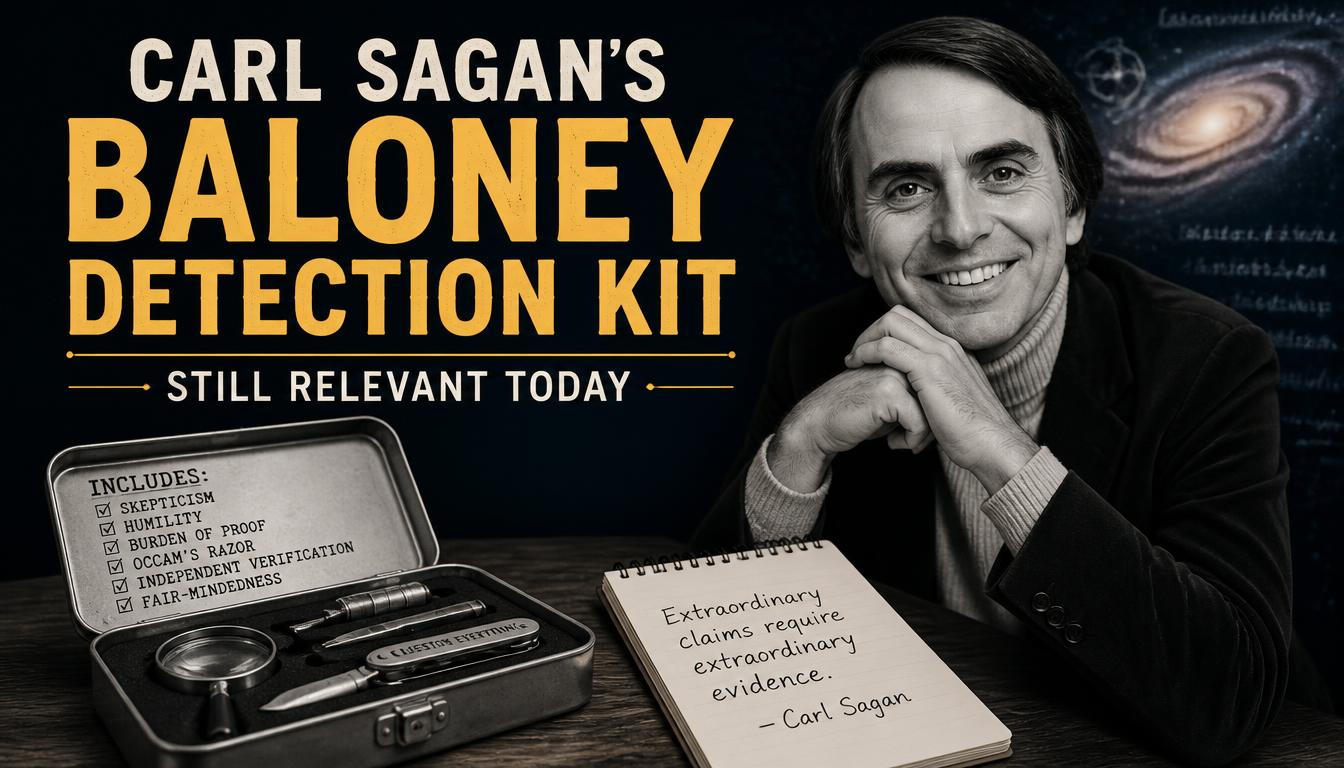
Carl Sagan's Baloney Detection Kit: Still Relevant Today

We live in a world overflowing with information, yet starving for wisdom. At any given moment, our screens are filled with sensational headlines, miracle health products, political spin, and unverified scientific claims. In this digital landscape, finding the truth is no longer just a academic exercise—it is a vital survival skill.
How do we distinguish between genuine, verified facts and the endless stream of "baloney" designed to exploit our hopes, fears, and biases?
In 1995, the visionary astrophysicist and science communicator Carl Sagan wrote a masterpiece of modern skepticism titled The Demon-Haunted World: Science as a Candle in the Dark. Within its pages, Sagan introduced a cognitive toolkit that remains the gold standard for information hygiene: The Baloney Detection Kit.
Sagan defined this kit as a set of tools for skeptical thinking—tools that help us evaluate claims, test hypotheses, and recognize logical fallacies.
This guide breaks down the nine active tools of Sagan’s legendary kit and shows you exactly how to apply them to navigate the modern information landscape with scientific clarity.
1. The Nine Active Tools of the Baloney Detection KitCarl Sagan believed that healthy skepticism is not about cynicism or rejecting everything out of hand. Rather, it is an active, constructive process of testing claims against reality. Here are the nine tools Sagan insisted every critical thinker must employ.
       [ 1. Independent Confirmation ] ------ [ 2. Substantive Debate ]
                      |                                   |
                      v                                   v
       [ 3. Avoid Authority Bias     ] ------ [ 4. Multiple Hypotheses ]
                      |                                   |
                      v                                   v
       [ 5. Don't Over-Attach to Ideas ] ---- [ 6. Quantify Data       ]
                      |                                   |
                      v                                   v
       [ 7. Logical Chain Audit      ] ------ [ 8. Occam's Razor       ]
                      |
                      v
       [ 9. Falsifiability Test      ] <--- The Ultimate Scientific Filter
Whenever possible, there must be independent confirmation of the "facts."
- The Rule: Do not rely on a single source, a single study, or a single witness. If a claim is true, other independent observers, using different methods, should be able to replicate and verify the findings.
Encourage substantive debate on the evidence by knowledgeable proponents of all points of view.
- The Rule: Truth welcomes scrutiny. If an idea is sound, it will survive robust, open debate. If proponents of a claim attempt to silence critics, censor questions, or hide their data, they are signaling that their argument is structurally fragile.
In science, there are no authorities; at most, there are experts.
- The Rule: Do not accept a claim simply because someone with letters after their name said it. Experts have made catastrophic mistakes in the past, and they will do so in the future. Evaluate the evidence, not the pedigree of the speaker.
If there is something to be explained, think of all the different ways it could be explained.
- The Rule: Do not latch onto the first explanation that comes to mind (which triggers confirmation bias). Test each hypothesis systematically against the facts. The explanation that survives this elimination process is the one most likely to be correct.
Do not get overly attached to a hypothesis just because it’s yours.
- The Rule: In critical thinking, intellectual pride is a liability. Treat your ideas as temporary drafts. Ask yourself: "What evidence would it take to prove me wrong?" If you cannot answer that, you are no longer acting as an objective scout—you are a soldier defending a territory.
If whatever you're explaining has some measure, some numerical quantity attached to it, you'll be much better able to exclude competing hypotheses.
- The Rule: Vague, qualitative statements ("this drug is highly effective") are easy to manipulate. Look for hard, quantified data ("this drug reduced symptoms by 42% in a double-blind study of 10,000 patients").
If your conclusion relies on a chain of five consecutive logical steps, every single one of those links must be sound (both valid and factually true).
- The Rule: If even one link in the chain breaks down, the entire argument collapses. Do not let a speaker rush you to a conclusion without pausing to verify every intermediate step.
This convenient rule of thumb urges us, when faced with two hypotheses that explain the data equally well, to choose the simpler one.
- The Rule: Do not invent complex, elaborate conspiracies or mechanisms when a simple, well-understood explanation fits the facts perfectly.
Propositions that are untestable and unfalsifiable are simply not worth much in our quest for truth.
- The Rule: A claim must have a clear condition under which it could be proven wrong. If someone claims, "An invisible, silent, heatless dragon lives in my garage, and no scientific instrument can detect it," their claim is unfalsifiable. It cannot be tested, making it functionally indistinguishable from non-existence.
A common misconception is that skepticism means refusing to believe anything, or constantly looking for flaws to prove others wrong. This is not skepticism; it is cynicism.
Carl Sagan warned that critical thinking requires a delicate, precarious balance between two seemingly contradictory habits of mind:
- An openness to new ideas: Without curiosity, we miss groundbreaking discoveries, creative breakthroughs, and personal growth.
- An uncompromising skeptical scrutiny of all ideas: Without skepticism, we succumb to superstitions, scams, and systemic delusion.
If you are only skeptical, no new ideas will ever reach you; you will never learn anything new. If you are only open, you will believe everything—the good and the bad—and have no way to sort out the truth. True worldly wisdom is found at the intersection of these two mental states.
3. Sagan's Baloney Detection Cheat SheetUse this rapid-fire checklist to instantly evaluate any extraordinary claim you encounter online or in conversation:
| Tool / Question | Red Flag (High Baloney Risk) | Green Flag (Skeptically Sound) |
|---|---|---|
| 1. Evidence Check | "Everyone knows this is true." / Anecdotal stories. | Citations to peer-reviewed, replicated studies. |
| 2. Scrutiny Reaction | Censorship of critics / Calling questions "dangerous." | Open sharing of data and welcoming peer review. |
| 3. Hypotheses Count | "There is only one possible explanation for this." | "We analyzed four theories, and this fits best." |
| 4. Falsifiability | "If you don't believe, it won't work for you." | Clear, objective metrics that can prove it wrong. |
| 5. Simplification | Elaborate, multi-layered conspiracy theories. | Direct, simple, verifiable explanation (Occam's Razor). |
Carl Sagan’s Baloney Detection Kit is not a weapon to win arguments; it is a shield to protect your intellectual sovereignty. In an information ecosystem engineered to exploit your attention and emotions, active scientific skepticism is an act of self-defense.
Equip your mind with these nine tools. Ask the hard questions, demand the data, test the hypotheses, and let science be your candle in the dark.
Carl Sagan's Baloney Detection Kit: Still Relevant Today
Protect your mind from fake news, conspiracy theories, and marketing hype. Learn to apply Carl Sagan's legendary 9-point Baloney Detection Kit today.