
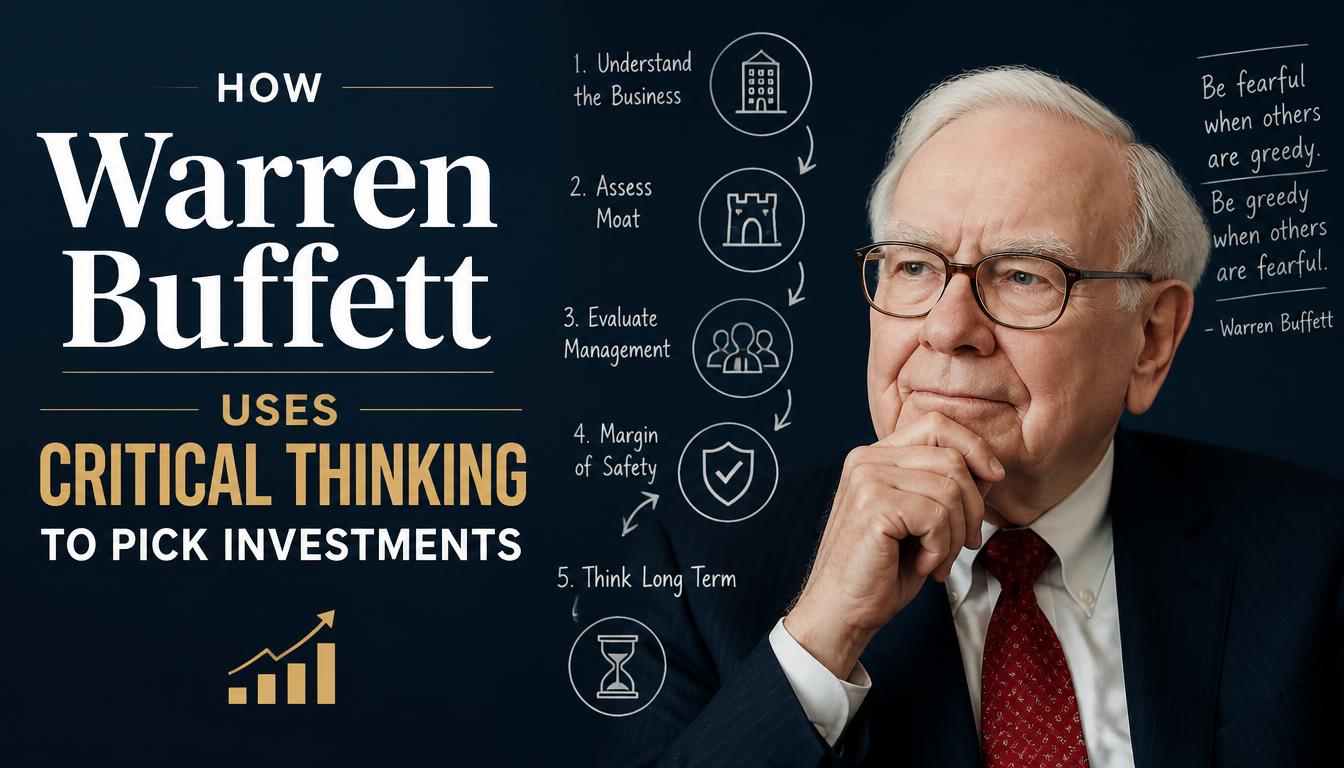
How Warren Buffett Uses Critical Thinking to Pick Investments

Every single day, the financial world is hit by a tsunami of information. Stock prices ticker across screens in real-time, financial analysts shout conflicting predictions on television, and millions of social media accounts hype up the next "get-rich-quick" asset. In this hyper-connected, high-speed environment, the vast majority of investors behave like leaves in a storm—blown around by fear, greed, and short-term trends.
Yet, sitting in a quiet office in Omaha, Nebraska, a 95-year-old man has spent over seven decades systematically beating this chaotic system. Warren Buffett, the chairman of Berkshire Hathaway and one of the most successful investors in human history, does not have a supercomputer, a massive trading floor, or a secret algorithm.
His weapon is far more powerful: uncompromising, disciplined critical thinking.
Buffett has built his multi-billion-dollar empire not by reacting faster than others, but by thinking deeper. He utilizes a set of simple, robust cognitive frameworks to filter out the noise, identify structural mispricings, and execute high-probability investments with absolute conviction.
This guide dissects Warren Buffett's investment strategy through the lens of critical reasoning, showing you how to apply his mental models to make flawless decisions in finance and life.
1. The Circle of Competence: Knowing Your IgnoranceThe most foundational critical thinking model in Warren Buffett’s arsenal is the Circle of Competence.
Most people believe that to be a successful investor, you must know a little bit about everything. Buffett believes the exact opposite. He argues that your primary intellectual task is not to expand your knowledge, but to define its boundaries with absolute precision.
+-------------------------------------------------------------+
|                     THE UNIVERSE OF KNOWLEDGE               |
|                                                             |
|   +-----------------------------------------------------+   |
|   |             WHAT YOU *THINK* YOU KNOW               |   |
|   |                                                     |   |
|   |       +-------------------------------------+       |   |
|   |       |      WHAT YOU *ACTUALLY* KNOW       |       |   |
|   |       |      (Your Circle of Competence)    |       |   |
|   |       +-------------------------------------+       |   |
|   +-----------------------------------------------------+   |
+-------------------------------------------------------------+
As Buffett’s partner Charlie Munger noted, “Knowing what you don't know is more useful than being brilliant.”
Inside vs. Outside the CircleYour Circle of Competence consists of areas, industries, or business models that you understand deeply due to your professional experience, personal obsession, or focused study.
- If you have worked in the restaurant industry for 15 years, you likely understand supply chains, franchise models, food costs, and customer retention. That is inside your circle.
- If you don't understand the physical architecture of semiconductor microchips, chip design is outside your circle—no matter how much the stock is currently rising.
On Buffett’s desk sits a physical wooden tray labeled "TOO HARD."
When a stock proposal arrives that is outside his circle of competence—even if it is highly recommended by Wall Street's top analysts—he doesn't try to study it, analyze it, or guess its future. He simply places it in the "Too Hard" pile and moves on. He has the discipline to say, "I am not qualified to have an opinion on this."
This is the ultimate expression of epistemic humility. By refusing to play games where he does not have an intellectual advantage, he eliminates 90% of the unforced errors that ruin standard investors.
2. The Margin of Safety: Planning for FallibilityIf the Circle of Competence is about defining your boundaries, the Margin of Safety is about protecting yourself from your own inevitable errors.
Coined by Buffett’s mentor, Benjamin Graham, the Margin of Safety is a structural buffer built into every decision. It assumes that the future is inherently unpredictable, that your calculations might be slightly off, and that unexpected disasters will occur.
The Bridge AnalogyBuffett explains this concept using a simple engineering analogy:
“When you build a bridge, you insist it can carry 30,000 pounds, but you only drive 10,000-pound trucks across it. That same principle applies to investing.”
Bridge Capacity:   [================================ 30,000 lbs ================================]
Actual Load:       [=========== 10,000 lbs ===========]
Margin of Safety:                     [----------------- 20,000 lbs buffer ----------------]
If you calculate that a company’s intrinsic value is worth $100 per share based on its cash flow, you do not buy it at $95. If you do, and your calculations are even slightly off, you will lose money. Instead, you wait for market volatility to push the stock price down to $60 or $70.
By purchasing the stock at a steep discount to its intrinsic value, you build in a massive margin of safety. If the company performs slightly worse than you expected, or if the economy hits a recession, you are still highly likely to protect your capital.
3. Independent Thinking: Resisting the HerdIn cognitive psychology, the bandwagon effect (or herd mentality) is one of the most destructive forces in human decision-making. When we see a crowd moving in a certain direction, our evolutionary programming urges us to follow them to ensure survival.
In the stock market, however, the crowd is almost always wrong at the extremes.
Buffett’s success is built on his ability to actively resist this psychological gravity. He famously advises: “Be fearful when others are greedy, and greedy when others are fearful.”
How Buffett Blocks Out NoiseTo protect his independent judgment, Buffett does not live in New York or London. He lives in Omaha, far away from the gossip, trading desks, and panic of Wall Street. He spends 80% of his day sitting alone in a room, reading annual reports, financial statements, and history books.
He does not care about market trends, price charts, or macro-economic predictions. He evaluates a stock as if he were buying the entire business privately and keeping it forever. This intellectual isolation is a deliberate strategy to keep his System 2 reasoning free from the emotional, fear-driven heuristics of the crowd.
4. The Value Investor's Critical Evaluation ChecklistTo think like Warren Buffett, you must move from speculative guessing to rigorous evaluation. Use this framework to analyze any business or major financial decision:
| Criterion | Key Socratic Question to Ask | Why it Matters |
|---|---|---|
| 1. Comprehensibility | Is this business model inside my Circle of Competence? Can I explain how it makes money to a 12-year-old? | Eliminates speculation on unverified, hyped assets. |
| 2. Competitive Moat | Does this company have a durable competitive advantage (brand, cost-efficiency, network effect) that protects it from competitors? | Ensures long-term survival and pricing power. |
| 3. Management Integrity | Are the managers honest, candid, and shareholder-oriented, or do they mask failures with corporate jargon? | Protects your capital from misallocation and fraud. |
| 4. Margin of Safety | Is the current price significantly lower than the intrinsic value of the business? | Builds a structural buffer against market volatility and error. |
Warren Buffett's extraordinary success is not a result of a high IQ or access to insider information. It is the product of an iron discipline that applies simple, powerful critical thinking models without compromise.
By defining your Circle of Competence, building a Margin of Safety into every decision, and developing the intellectual courage to stand apart from the crowd, you can navigate financial and personal decisions with the quiet, unshakable clarity of the world's greatest investor.
How Warren Buffett Uses Critical Thinking to Pick Investments
Learn how Warren Buffett uses core critical thinking models—like the Circle of Competence and Margin of Safety—to block out market noise and build massive wealth.