
Richard Feynman's Approach to Understanding Anything

Have you ever studied intensely for an exam, memorized every key term, and passed with flying colors—only to realize a week later that you couldn't explain the core concept to a colleague? Or have you listened to a speaker use sophisticated, technical jargon, feeling impressed, but later realized you couldn't summarize their point in a single sentence?
This common phenomenon is known as the illusion of explanatory depth. We confuse our familiarity with a word, label, or jargon with a genuine, fundamental understanding of the underlying reality.
No one understood this distinction better than Richard Feynman, the Nobel Prize-winning theoretical physicist. Renowned not only for his groundbreaking work in quantum electrodynamics but also for his legendary ability to explain incredibly dense concepts (like string theory or particle physics) to freshmen, Feynman was affectionately known as the "Great Explainer."
Feynman’s core philosophy was simple: “The first principle is that you must not fool yourself—and you are the easiest person to fool.”
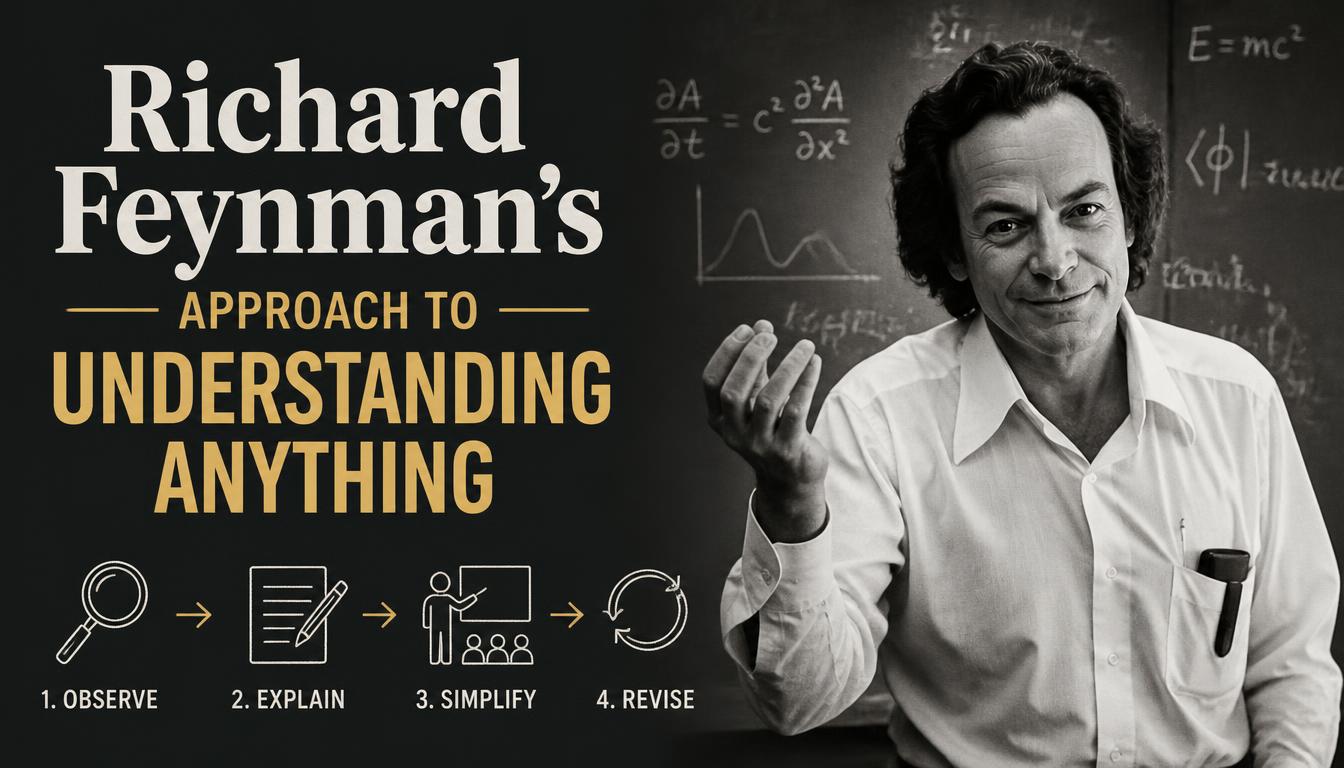
This guide breaks down Feynman's revolutionary approach to learning, contrasting the difference between knowing a name and knowing a concept, and provides a detailed guide to executing the famous 4-step Feynman Technique.
1. Knowing the Name vs. Knowing the ThingWhen Feynman was a child, his father taught him a lesson that shaped his entire approach to science.
While playing in a field, another boy asked Richard, "Do you know the name of that bird? It's a brown-throated thrush." Richard admitted he didn't know. The boy retorted, "Your father doesn't teach you anything!"
But Feynman's father had already taught him something far deeper. He had said:
“See that bird? It’s a Spencer’s Warbler. Well, in Italian, it’s a Chiarlo. In Portuguese, it’s a Sabiá... You can know the name of that bird in all the languages of the world, but when you’re finished, you’ll know absolutely nothing whatever about the bird. You’ll only know about humans in different places, and what they call the bird. So, let’s look at the bird and see what it’s doing.”
This distinction is the cornerstone of Feynman’s critical thinking. Rote memorization is not learning. Knowing the vocabulary of a field is merely learning "what humans call things." True understanding is observing the mechanics, the relationships, and the underlying principles of the phenomenon itself.
+------------------------------------+------------------------------------+
| Knowing the Name (Rote)            | Knowing the Thing (Deep)           |
+------------------------------------+------------------------------------+
| - Focuses on jargon & definitions  | - Focuses on mechanics & relations |
| - Brittle; fails under pressure   | - Flexible; applies to new contexts|
| - Feeds the ego; masks ignorance  | - Fosters curiosity & humility     |
| - Relies on authority & textbooks  | - Relies on observation & analogy  |
+------------------------------------+------------------------------------+
The Feynman Technique is a mental model designed to strip away jargon, expose gaps in your comprehension, and force a deep, intuitive grasp of any subject. It is an active cognitive feedback loop consisting of four simple steps.
[ Step 1: Choose & Write ] ---> [ Step 2: Explain to a Child ]
           ^                                     |
           |                                     v
[ Step 4: Simplify & Analogize ] <--- [ Step 3: Identify & Fill Gaps ]
Grab a blank sheet of paper. At the top, write down the name of the concept you want to learn or understand. It could be anything: The Laffer Curve, Quantum Entanglement, Photosynthesis, or Smart Contracts.
Write down everything you currently know about the topic. Whenever you read a new article or book on the subject, update this sheet.
Step 2: Explain the Concept to a 12-Year-OldBelow the title, write an explanation of the concept as if you were teaching it to a twelve-year-old child.
- The Constraint: You cannot use any technical jargon, buzzwords, or complicated terms.
- The Execution: You must use short, simple sentences, common verbs, and basic vocabulary.
Why a 12-year-old? Because a child has a decent vocabulary but lacks the patience and context for dense jargon. If you write, "Blockchain is a decentralized, peer-to-peer cryptographic ledger using consensus mechanisms," a child will tune out instantly. If you write, "Blockchain is like a shared notebook that a group of friends use. Everyone has an exact copy, and whenever someone wants to write a new line, everyone has to check their copies and agree that it's allowed," you have demonstrated real comprehension.
Using simple language forces you to understand the mechanics rather than hiding behind the vocabulary.
Step 3: Identify and Fill the Gaps in Your UnderstandingAs you attempt to write your simple explanation in Step 2, you will inevitably hit a wall. You will find yourself struggling to explain why a certain step happens, or you will find yourself slipping back into jargon because you don't know how to simplify it.
This struggle is the most valuable part of the technique. It is a precise map of your ignorance.
Stop writing, go back to your source materials (textbooks, research papers, documentation), and study that specific gap. Do not move on until you can explain that particular mechanism in plain, simple English.
Step 4: Review, Simplify, and Use AnalogiesNow, review your explanation. Read it aloud. If there are still areas that sound complex, heavy, or convoluted, edit them.
Finally, connect your explanation to a powerful analogy. Analogies are the ultimate test of conceptual mastery because they require you to map the structural relationship of your topic onto a completely different, familiar domain.
- For example: Explaining the electrical current in a wire by comparing it to water flowing through a pipe.
Let’s apply the Feynman Technique to a complex modern concept: Inflation (Economics).
- The Jargon-Heavy Definition: "Inflation is a quantitative measure of the rate at which the average price level of a basket of selected goods and services in an economy increases over a period, often associated with monetary expansion and a decrease in the purchasing power of a fiat currency."
Now, let's execute Step 2, 3, and 4 to simplify and analogize:
- The Feynman Explanation: Imagine a small island where there are only 10 apples and 10 dollars in total circulation. If everyone wants an apple, each apple will naturally cost exactly 1 dollar.
- Now, imagine a helicopter flies over the island and drops an extra 10 dollars, so there are now 20 dollars on the island, but still only 10 apples. Since people have more money but the number of apples hasn't changed, they will bid more to make sure they get one. Soon, each apple will cost 2 dollars.
- The apples didn't change, they didn't become tastier or larger. But because there was more money chasing the same amount of stuff, your 1 dollar bill can now only buy half an apple instead of a whole one. That is inflation: when money loses its power because there is too much of it.
Richard Feynman's method is more than a study hack; it is a profound philosophy of intellectual honesty. It demands that we strip away our academic armor, abandon our buzzwords, and confront what we actually understand.
The next time you want to master a difficult topic, don’t highlight chapters or re-read paragraphs. Grab a blank sheet of paper, find your inner twelve-year-old, and explain it. You will find that true clarity is not found in complex vocabulary, but in the ultimate simplicity of deep understanding
Richard Feynman's Approach to Understanding Anything
Stop memorizing and start understanding. Learn the Nobel Prize-winning physicist Richard Feynman's 4-step method to master complex concepts in minutes.