
Clinical Intelligence: How Doctors Actually Use AI for Research and Patient Communication

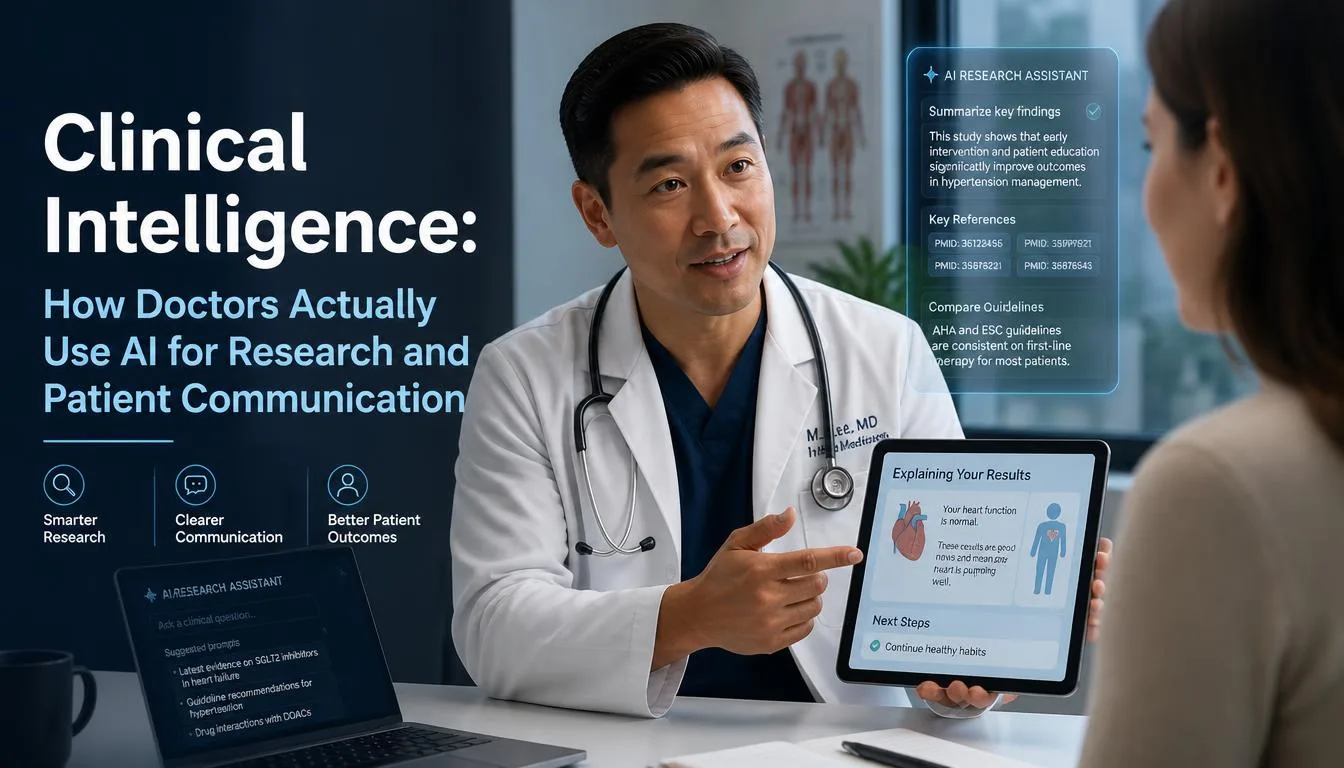
For years, the conversation surrounding artificial intelligence in healthcare has been dominated by dystopian fears of replacement or utopian promises of instant cures. Both narratives miss the mark. In clinical practice today, AI is neither a digital physician nor a futuristic novelty; it is a cognitive amplifier. Having spent years evaluating clinical decision support systems and workflow optimization tools, I've watched the paradigm shift from speculative hype to pragmatic deployment. Doctors are not using AI to bypass the human element of medicine. They are using it to reclaim it.
Administrative burden and information overload are the twin drivers of modern physician burnout. When clinicians spend upwards of two hours on electronic health record (EHR) documentation for every one hour spent face-to-face with a patient, the system is fundamentally broken. AI has emerged not as a luxury, but as a structural necessity to bridge this gap, specifically transforming how we conduct clinical research and how we translate complex medical concepts to vulnerable patients.
The Research Acceleration Engine: Beyond Literature ReviewsMedical research has long suffered from a discovery-to-bedside lag that averages roughly 17 years. The volume of biomedical literature published annually is staggering—well over one million papers a year—making it cognitively impossible for any human researcher to maintain comprehensive domain awareness, let alone synthesize cross-disciplinary insights.
Natural Language Processing (NLP) in Cohort DiscoveryOne of the most profound applications of AI in clinical research is the use of transformer-based Natural Language Processing to mine unstructured EHR data. Historically, identifying patient cohorts for clinical trials required armies of research coordinators manually combing through physician notes, discharge summaries, and pathology reports.
Today, advanced NLP models can ingest millions of de-identified patient records, parsing nuanced clinical context—such as distinguishing between a family history of a condition and an active patient diagnosis—with high fidelity. In our research unit, utilizing LLM-backed query tools has reduced cohort identification timelines from months to hours. This efficiency does not just accelerate trial enrollment; it broadens diversity in clinical trials by surfacing eligible patients in underserved community practices who would otherwise be missed.
Hypothesis Generation and Systematic Literature MappingGenerative AI tools are moving past simple search and retrieval to function as genuine research collaborators. When structuring a systematic review or meta-analysis, researchers now deploy specialized AI architectures to:
- Extract data points rapidly from heterogeneous PDF formats, standardizing variables across hundreds of trials.
- Detect statistical anomalies or potential publication bias in historical datasets before committing to expensive replication studies.
- Cross-reference genomic pathways with clinical outcomes to surface novel genotype-phenotype correlations that humans might overlook due to cognitive bias.
However, expert oversight remains non-negotiable. Hallucination rates in base models, while dropping, are still entirely unacceptable for direct scientific citation. The clinical researcher's role has therefore evolved from manual data collector to rigorous prompt engineer and validator.
Decoding Medicine: Transforming Patient CommunicationIf research is the engine of medical progress, communication is its delivery mechanism. Yet, the medical lexicon is fundamentally designed for peer-to-peer insulation, not patient comprehension. When a patient receives a pathology report dense with terms like "focal architectural distortion with atypical ductal hyperplasia," their immediate response is rarely informed compliance; it is acute anxiety.
This is where generative AI is quietly revolutionizing the exam room and the patient portal.
Translating Complex Diagnostics into Health LiteracyConsider the modern patient portal—an asynchronous battleground where patients receive lab results and imaging reports hours or days before speaking with their physician. Unmediated data delivery frequently leads to catastrophic internet-searching spirals.
Forward-thinking health systems are integrating clinician-in-the-loop AI tools that automatically draft plain-language summaries of complex test results. These systems operate under strict guardrails:
- Grade-Level Calibration: Adjusting vocabulary to match a sixth-grade reading level or tailoring explanations to specific cultural and linguistic backgrounds.
- Empathetic Framing: Structuring the output to validate emotional responses while clearly delineating between benign findings and urgent red flags.
- Actionable Next Steps: Explicitly detailing what the patient should monitor and what questions to bring to their follow-up visit.
As clinicians, our job is not just to be right; it is to be understood. AI acts as a linguistic bridge, translating the cold objectivity of biomedical science into human-centric reassurance.
Drafting Asynchronous Messages and Discharge InstructionsThe influx of secure messages via portals has created a second shift for physicians—answering dozens of intricate clinical queries after clinic hours. Generative AI models are now routinely used to draft empathetic, comprehensive responses to common patient inquiries.
For example, when a patient writes asking about side effects from a newly prescribed statin, an AI can draft a response outlining normal adaptation symptoms versus signs of rhabdomyolysis requiring immediate intervention. The physician reviews, edits, and approves the message in seconds rather than spending five minutes typing from scratch. The result? Faster turnaround times for patients and significantly reduced cognitive fatigue for the provider.
The Practical Reality: Pros, Cons, and GuardrailsTo understand how healthcare professionals actually use these technologies, we must look past the vendor promises and examine the operational realities on the ground.
The Pros:
- Time Reclamation: Drastic reduction in documentation and administrative friction, directly combating burnout.
- Cognitive Offloading: Enhanced ability to synthesize massive volumes of research literature and patient history.
- Standardized Clarity: Improved patient health literacy through tailored, digestible communication.
The Cons and Risks:
- Bias Amplification: AI models trained on historical health data can perpetuate or exacerbate racial and socioeconomic disparities in care recommendations.
- Liability and Accountability: The algorithm cannot hold a medical license. The legal and ethical responsibility remains entirely with the human clinician.
- Data Privacy Vulnerabilities: Integrating third-party LLMs into clinical environments risks exposing protected health information (PHI) if enterprise-grade HIPAA-compliant wrappers are not enforced.
The integration of artificial intelligence into research and patient communication is not a destination; it is an ongoing calibration of trust, technology, and clinical intuition. The physicians who thrive in the coming decade will not be those who attempt to out-compute the machine, nor those who blindly defer to it.
They will be the clinicians who master the art of the synthesis—using AI to accelerate discovery, clarify the opaque, and ultimately restore the sacred, uninterrupted human connection at the heart of the healing arts.
Clinical Intelligence: How Doctors Actually Use AI for Research and Patient Communication
Discover how physicians leverage artificial intelligence to accelerate clinical research, analyze EHR data, and improve health literacy.