
E-book vs. Course vs. Template: Which Digital Product Should You Actually Build First?

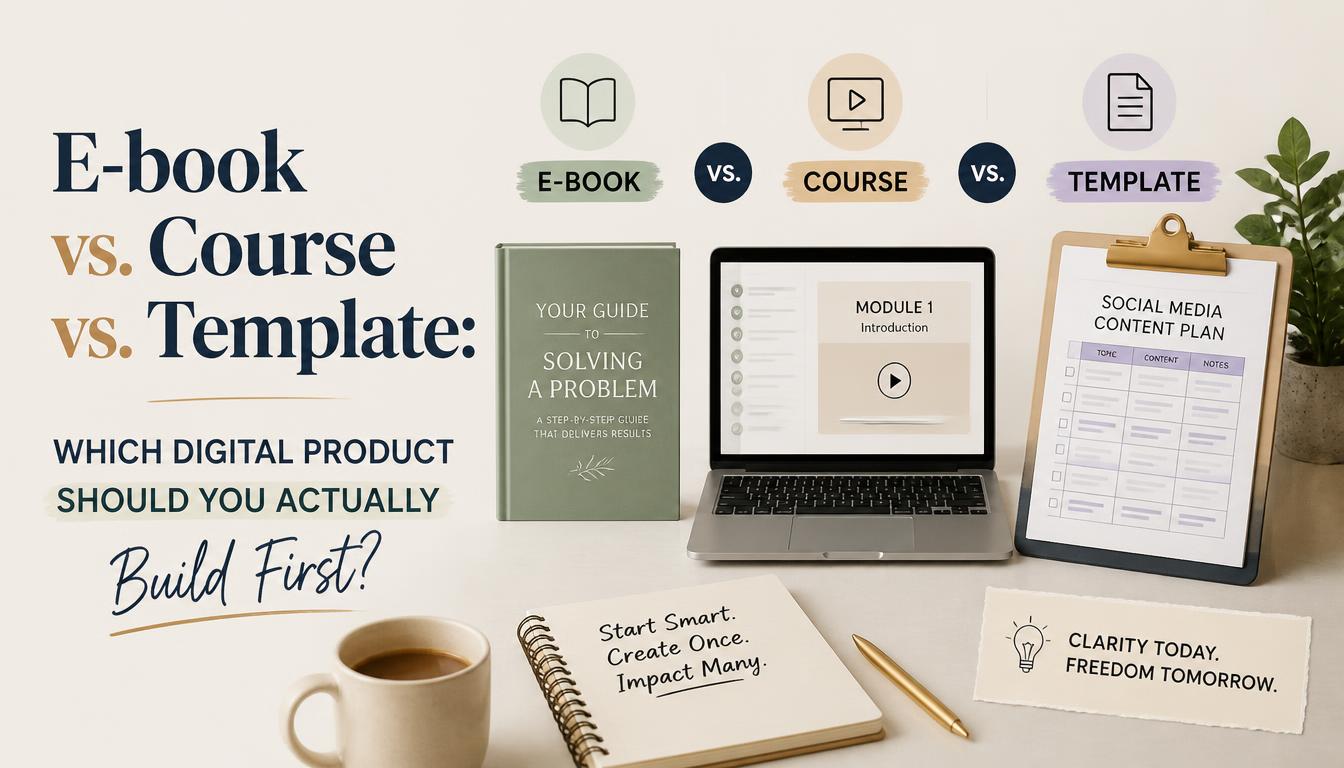
Most creators fail in the digital product space because they build what is easiest for them, not what delivers the transformation their customer actually needs. They spend six months recording a 40-hour video masterclass, only to launch it to an empty room. Or, they slap together a 10-page e-book, price it at $9, and wonder why nobody values their expertise.
Choosing between an e-book, an online course, and a digital template isn't just about format preference—it is about matching your audience's current state of awareness, your operational capacity, and the specific depth of transformation required to solve a burning pain point.
Over the past decade, we have audited hundreds of digital product businesses. The pattern is clear: the most profitable creators don't start with the biggest product; they start with the product that creates the fastest feedback loop.
The Anatomy of the E-Book: Information Consumption vs. ImplementationLet's address the elephant in the room: e-books have a bad reputation in modern digital marketing. Critics claim they are dead, largely because most e-books are bloated PDFs that people download, save to a desktop folder, and never open again.
However, when deployed correctly, an e-book is the most frictionless entry point into a high-ticket ecosystem. An e-book is essentially packaged perspective. It is designed to change how someone thinks about a problem, not necessarily to hold their hand through every step of execution.
When to Choose an E-Book- You are establishing a paradigm shift: If your core thesis challenges conventional wisdom in your industry, long-form written text is the superior medium to build a philosophical case.
- The subject matter requires linear reading: Complex mental frameworks, historical analysis, or strategic manifestos work brilliantly as downloadable PDFs or EPUBs.
- You need a low-friction tripwire: E-books excel at converting cold ad traffic into paying customers at a $19 to $37 price point, offsetting your customer acquisition costs.
The primary drawback of an e-book is its abysmal completion rate. The average consumption rate for a standard digital book hovers below 15%. If your business model relies on customer success stories to drive future sales, an e-book will rarely deliver the wins you need, because reading about a strategy is a far cry from executing it.
The Online Course: The Illusion of Comprehensive ValueOnline courses are the crown jewels of the creator economy. They command the highest price tags—frequently ranging from $297 to $2,000+—and promise the ultimate transformation: taking a student from zero to mastery.
Yet, the course format is also the biggest graveyard of creator burnout. Producing a high-retention, high-completion course requires a massive upfront investment of time, instructional design skill, and video production quality.
When to Choose an Online Course- The transformation requires visual, auditory, and kinesthetic learning: If your topic involves software tutorials, physical mechanics, or nuanced live coaching calls, video is non-negotiable.
- You have already validated the curriculum: You should never build a course in a vacuum. A course should be the recorded, polished version of a methodology you have already taught successfully 1-on-1 or in a live cohort.
- You have the bandwidth for community management and student support: Selling a course is only 40% of the battle; the remaining 60% involves maintaining a learning management system (LMS), answering student questions, and updating outdated modules.
First-time creators often fall into the trap of feature bloat. They believe that a 60-hour course is inherently more valuable than a 3-hour course. In reality, modern learners suffer from profound overwhelm. The best online courses are ruthlessly edited down to the shortest path to a specific result. If your course takes 100 hours to complete, your completion rates will plummet, and refund requests will skyrocket.
Digital Templates: The Speed-to-Value ChampionIf e-books sell perspective and courses sell education, templates sell speed. Templates—whether they are Notion dashboards, Figma UI kits, financial models in Excel, or cold-email swipe files—are artifacts of execution.
In our experience consulting with high-growth creators, templates consistently yield the highest customer satisfaction scores and the lowest refund rates. Why? Because the time-to-value is almost instantaneous.
When to Choose a Template- Your audience suffers from 'blank page syndrome': Professionals don't necessarily need to learn *how* to write a contract or build a database; they want the battle-tested asset they can deploy in 30 seconds.
- You operate in a B2B or productivity niche: Marketers, developers, designers, and project managers will gladly pay $47 to $147 for a system that saves them five hours of tedious setup.
- You want to test a niche with zero production overhead: You can build, package, and launch a high-utility template in a single weekend without touching a video camera or writing a 50,000-word manuscript.
Templates lack educational context. If a buyer does not understand the underlying principles of *why* the template is structured a certain way, they may misuse it and blame the product. To combat this, successful template creators always include a mandatory 5-minute Loom onboarding video or a concise instruction manual.
The Decision Matrix: E-Book vs. Course vs. TemplateTo crystallize your decision, evaluate your product idea against these three operational vectors:
- Production Complexity: Templates are the lowest (hours), E-books are medium (days/weeks), Courses are the highest (months).
- Price Ceiling: Templates cap around $150 (unless enterprise-level), E-books cap around $47, Courses scale infinitely past $2,000.
- Customer Implementation Speed: Templates are instant, E-books take hours of reading, Courses require days or weeks of study.
You do not have to choose just one forever. In fact, mature creator businesses utilize all three in a strategic sequence known as the Product Ladder.
Start by building a Template to solve an immediate, acute pain point and validate that your target market is willing to open their wallets. Once you have dozens of case studies from users of that template, expand the methodology into an E-book to deepen their strategic understanding. Finally, once you have an engaged community asking for deeper mentorship, package your entire framework into an elite Online Course.
Stop guessing what your market wants. Build the asset that requires the least friction to prove market demand, collect your validation in revenue, and let your customers dictate your product roadmap.
E-book vs. Course vs. Template: Which Digital Product Should You Actually Build First?
Stop guessing. Discover whether an e-book, online course, or digital template is the most profitable first product for your creator business.