
The Brutal Truth About Finding a Profitable Digital Product Niche (That Actually Sells)

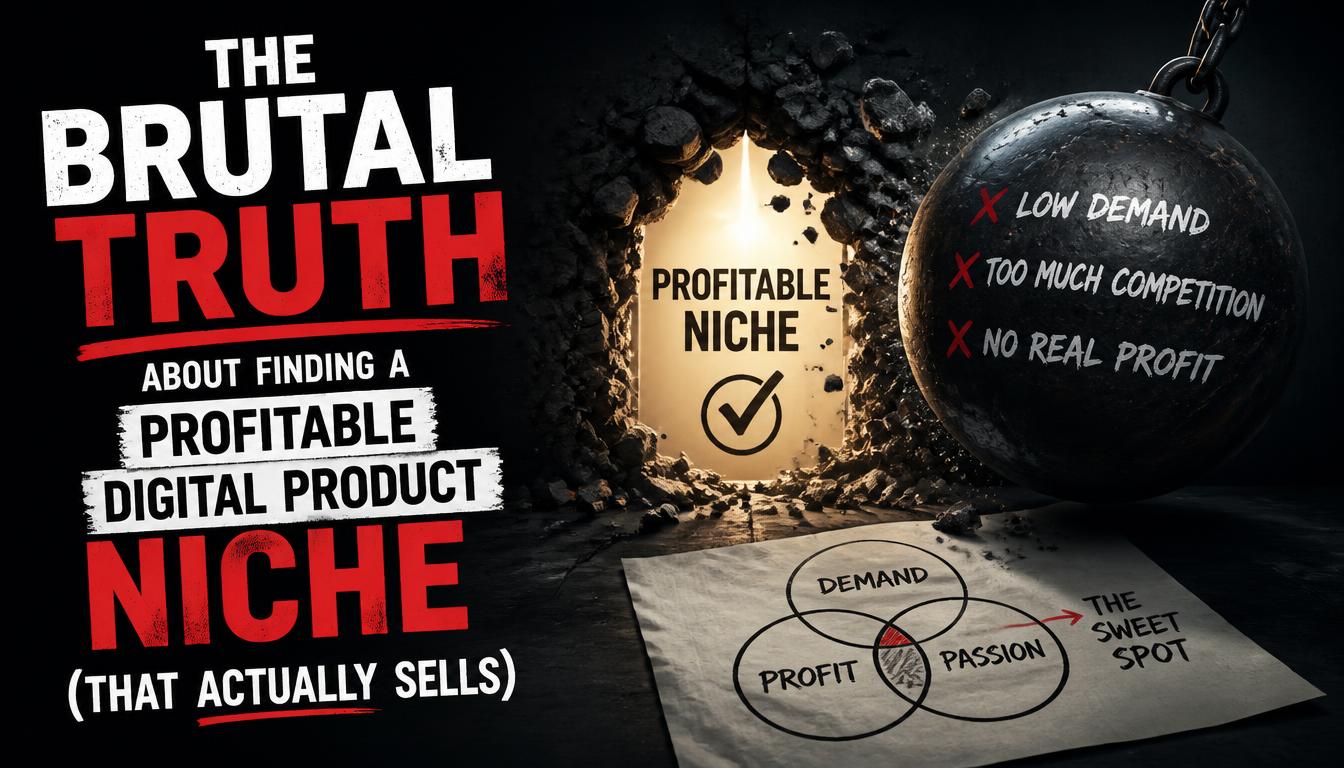
Most first-time creators fail before they write a single line of copy or record a single video. Why? Because they pick a niche based on passion rather than market mechanics. They build a digital product for everyone, which ultimately means it sells to no one.
Over the last decade of launching digital products—ranging from high-ticket masterclasses to hyper-specific Notion templates—I’ve watched hundreds of beginners burn out. They chase broad categories like 'personal finance' or 'fitness' and get crushed by legacy authorities. To win your first digital product launch, you must stop thinking about what you want to teach and start engineering where high intent meets severe friction.
The Myth of the Passion NicheThe standard advice—“follow your passion and the money will follow”—is financial suicide in the digital product space. Passion is a lagging indicator of success, not a precursor. If your passion is writing poetry about abandoned industrial sites, you have a wonderful hobby, but a catastrophic business model.
Profit lives at the intersection of three unyielding market forces:
- Acute Pain: The buyer is losing sleep, money, or status over this problem right now.
- High Purchasing Power: The target demographic has disposable income and a history of paying for solutions.
- Low Competitor Sophistication: The existing solutions in the market are outdated, overly complex, or missing entirely.
If you miss even one of these pillars, your conversion rates will flatline, no matter how good your sales page looks.
The Micro-Niche Framework: Going Down the Rabbit HoleBroad niches are for multi-billion-dollar corporations with infinite ad spend. As an independent creator launching your first product, your superpower is hyper-specialization. You need a micro-niche.
Let’s look at how this scales down in practice:
- Broad (Failure): Productivity for remote workers.
- Narrower (Better): Notion templates for freelance copywriters.
- Micro-Niche (Dominant): Standard Operating Procedure (SOP) Notion templates and client-onboarding workflows for agency-owning freelance copywriters scaling to 10k/month.
When you own the micro-niche, you become the undisputed authority overnight. Your marketing copy speaks directly to the buyer's inner monologue, driving conversion rates that broad-market creators can only dream of.
Data-Driven Niche Validation: Where to LookDo not guess if a niche is profitable. Never rely on your gut feeling. Instead, harvest qualitative and quantitative data from platforms where your buyers are already complaining, searching, and spending money.
1. Subreddit Autopsy and Forum MiningReddit is the world's most honest focus group. Go to subreddits related to your broad interest sphere and search for trigger phrases like:
- "I hate when..."
- "Is there a tool for..."
- "Why is it so hard to..."
- "I wasted $500 on..."
If you see the same complaint articulated across multiple threads with dozens of upvotes, you have identified a bleeding neck. People pay for tourniquets, not vitamins.
2. The Amazon Review BackdoorFind the top 5 bestselling books or physical products in your target space. Go straight to the 3-star reviews. 5-star reviews are often driven by fanboy enthusiasm, and 1-star reviews are usually driven by emotional ranters. 3-star reviews contain nuanced, objective critiques of what is missing from current market solutions.
If fifty 3柏-star reviews for a top-tier freelancing book say, "Great theory, but it lacks step-by-step templates for dealing with scope creep," your digital product has just been handed to you on a silver platter: *The Anti-Scope Creep Contract Kit for Freelancers*.
Evaluating Market Viability: The 4-Part Profit MatrixBefore committing your next 60 days to building an asset, run your shortlisted niche through our proprietary Profit Matrix.
1. The Pain Intensity Score (1–10)Is this a 'nice-to-have' or a 'need-to-have'? A guide on 'How to Meditate' is a nice-to-have. A guide on 'How to Pass the FAA Part 107 Commercial Drone Exam in 7 Days' is a need-to-have. Aim for a pain score of 8 or higher.
2. The Customer Lifetime Value (LTV) PotentialCan you sell more than one thing to this person? If you sell a $29 PDF on landing page design, can you upsell them later into a $197 conversion masterclass or a $997 agency teardown? Choose niches where the audience has an upward trajectory of spending.
3. Distribution FeasibilityWhere does this audience hang out? If your niche requires you to advertise on obscure, highly regulated platforms, your acquisition costs will eat your margins. Can you reach them organically via SEO, X (Twitter), LinkedIn, or specialized communities?
4. Intellectual MonopolyDo you have a unique framework, proprietary data, or a distinct worldview that separates you from generic AI-generated content? If a user can prompt ChatGPT to get the exact same information for free, your digital product is dead on arrival. Your niche must allow you to inject original experience.
Case Study: The Accidental $10k Micro-Niche LaunchLet's look at a real-world architectural example. A designer friend of mine was burnt out trying to sell general 'UI/UX design tutorials' on YouTube. The CPMs were low, and the product sales were nonexistent.
We pivoted her strategy entirely. Instead of teaching UI/UX, she focused strictly on designing dashboards for early-stage B2B SaaS startups that had just raised a pre-seed round. She built a single product: 'The Pre-Seed SaaS Design System & Figma Kit'.
She didn't market to millions of designers. She scraped Crunchbase for newly funded startups, reached out to founders on LinkedIn with a free UI audit, and pitched her $247 Figma kit as the shortcut. Within 45 days, she cleared $10,000 in pure digital profit from an audience of less than 1,500 total followers. The power is in the specificity.
Common Pitfalls to AvoidEven with a strong framework, beginners consistently sabotage their niche selection through three common psychological traps:
- The Imposter Syndrome Broadening Trap: Watering down your niche because you are afraid you aren't an expert enough to serve a specific group. Paradoxically, the narrower you go, the less you need to know about everything else—you just need to be two steps ahead of the buyer.
- The TAM (Total Addressable Market) Obsession: Worrying that your market is 'too small' because only 10,000 people globally fit the criteria. If 1% of those 10,000 people buy a $150 product, that is $15,000. For a solo creator, that is a life-changing side income or full-time runway.
- Ignoring Platform Dependency: Building a niche entirely dependent on a single algorithm's whims. Ensure your niche allows you to capture email addresses so you own your audience.Final Action Plan: Your Next 48 Hours
Stop reading about business and start executing. Open a blank spreadsheet right now. List three professional skills you possess that people have historically thanked you for. Cross-reference those skills against online communities where people are actively venting about their inability to solve related problems.
Find the friction. Narrow the scope. Build the prototype. Your first profitable digital product is waiting on the other side of specificity.
The Brutal Truth About Finding a Profitable Digital Product Niche (That Actually Sells)
Stop guessing what to sell. Learn the data-driven framework top creators use to find profitable, high-converting digital product niches.