
From Employee to Entrepreneur: Using AI to De-Risk the Transition

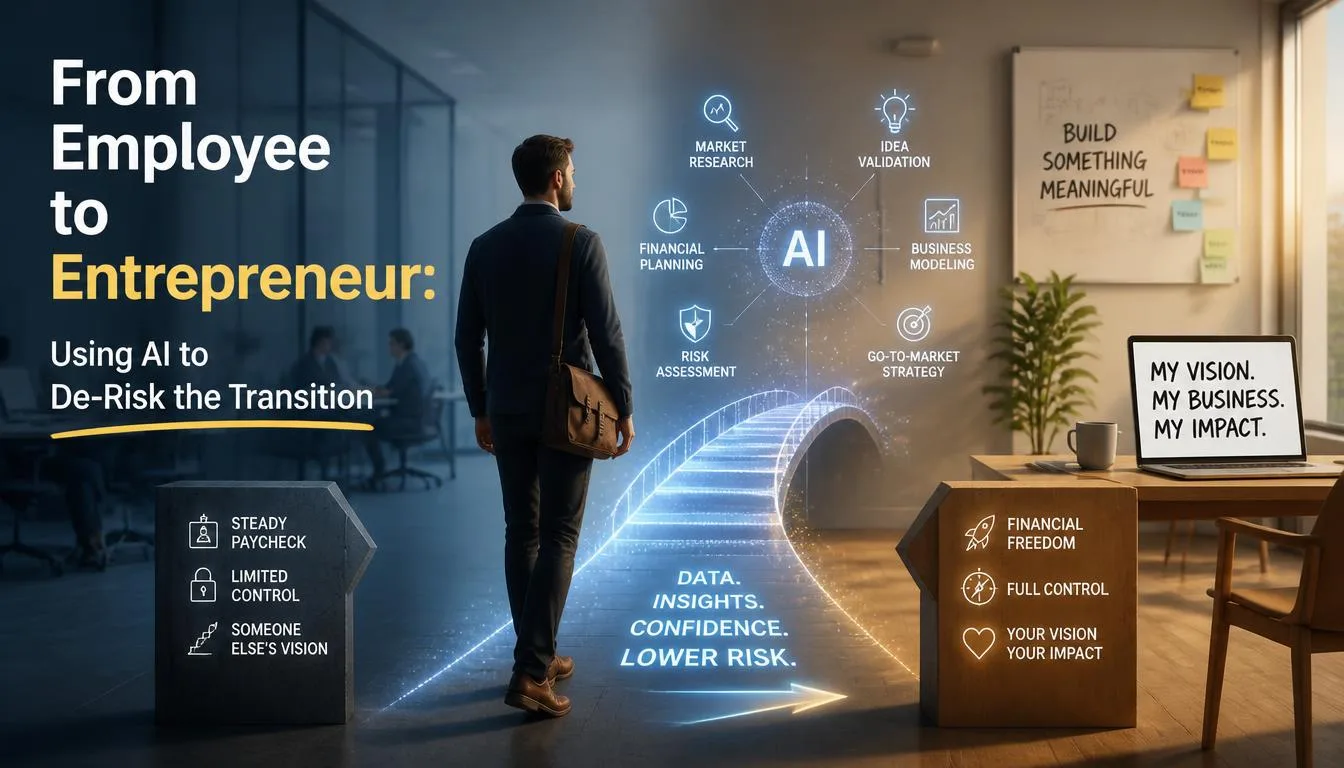
Leaving a secure W-2 position to launch a startup is statistically terrifying. For decades, the conventional wisdom dictated a binary choice: endure the corporate grind or leap blindly into entrepreneurship with a severance check and a prayer. Traditional risk-mitigation meant saving six months of living expenses, writing a 40-page business plan, and begging friends and family for pre-seed capital before validating a single assumption.
That paradigm is obsolete. Generative AI and autonomous agentic workflows have fundamentally rewritten the physics of early-stage business creation. Today, AI does not just write marketing copy; it functions as your fractional Chief Technology Officer, your data analyst, your lead generation engine, and your qualitative researcher. By deploying synthetic intelligence strategically while still employed, you can compress years of validation into weekends and de-risk your transition from employee to founder by up to 80%.
The Core Fallacy of Traditional Startup RiskMost corporate professionals fail when they transition to entrepreneurship because they mistake activity for validation. They spend months designing logos, registering LLCs, and building complex web architectures without ever testing if the market actually cares about their solution. This is known as the 'safety theater' of building a business.
When you are an employee, you are conditioned to focus on outputs—deliverables, reports, meetings. Entrepreneurship requires an obsession with outcomes and market feedback. The greatest risk in leaving a corporate job is not financial ruin; it is the opportunity cost of building something nobody wants while your runway burns down.
AI neutralizes this risk by allowing you to simulate a fully operational company as a solopreneur. You can stress-test unit economics, conduct multi-variant audience research, and MVP your product offering entirely after hours, all without risking your primary source of income.
Phase 1: Market Validation and Synthetic Customer DiscoveryBefore you resign, you must answer one question with empirical data: *Will a stranger trade their hard-earned money for the value I intend to create?* Traditionally, this required focus groups, expensive surveys, or weeks of cold outreach.
With advanced Large Language Models (LLMs), you can bypass weeks of administrative friction by building synthetic focus groups.
How to Deploy Synthetic Focus Groups- Profile Your Ideal Customer Persona (ICP): Feed granular demographic, psychographic, and behavioral data into an advanced model like Claude 3.5 Sonnet or GPT-4o.
- Simulate Objections: Prompt the AI to act as a notoriously skeptical enterprise buyer or a hyper-critical consumer within your target niche.
- Stress-Test Your Value Proposition: Run your core hypothesis through the persona. Ask the AI to aggressively tear apart your pricing model, feature set, and messaging.
This is not a replacement for real human interaction, but it acts as a high-fidelity rehearsal. By the time you reach out to real prospects on LinkedIn or via cold email, your messaging has already survived hundreds of simulated iterations.
Phase 2: Building Your Part-Time Technical Co-FounderEngineering talent is expensive. For non-technical founders stepping out of marketing, finance, or operations roles, hiring an agency or a technical co-founder historically meant giving up 50% equity or spending tens of thousands of dollars before writing a line of code.
AI-powered development environments (IDEs) like Cursor, integrated with models optimized for code generation, have democratized software creation. You do not need to be a senior full-stack engineer to build a functional Minimum Viable Product (MVP).
The Non-Technical Founder's Tech Stack for De-risking:- Cursor / GitHub Copilot: For natural-language-driven code generation, debugging, and architecture design.
- Retool or Bubble: For rapid database and frontend UI prototyping without wrestling with raw syntax.
- Make.com / Zapier + OpenAI APIs: For automating complex workflows and creating proprietary internal tools that showcase your service capability.
By building a working prototype while still employed, you shift your negotiating leverage. When you eventually pitch investors or early customers, you are not presenting a slide deck of unproven aspirations; you are demonstrating a working asset.
Phase 3: Automating the Fractional WorkforceOne of the hardest psychological hurdles for transitioning employees is the sudden loss of leverage. In a corporate environment, you have graphic designers, legal compliance teams, copywriters, and project managers a Slack message away. As a solo founder, the weight of every department falls squarely on your shoulders—unless you leverage agentic AI.
You can construct a suite of custom GPTs or specialized AI assistants that act as your departmental heads. This bridges the gap between being a lone employee and running a multi-disciplinary company.
Corporate DepartmentTraditional CostAI-Augmented Solopreneur ApproachLegal & Compliance$350+/hr for corporate counselDrafting initial terms of service, NDAs, and contractor agreements via legal-tuned LLMs, reviewed later by human counsel.Marketing & Copywriting$4,000/mo retainer for an agencyBrand voice-trained custom agents generating tailored email sequences, ad variants, and SEO-optimized pillar content.Financial Modeling$5,000+ for freelance fractional CFODynamic cash-flow scenario modeling and unit economic stress tests built directly in spreadsheets via advanced data analysts.Phase 4: The Financial Runway and Transition ThresholdDe-risking is fundamentally a mathematical equation. Most experts advise saving 6 to 12 months of living expenses. However, AI alters this calculation by dramatically shrinking operational overhead. Because your software, marketing, and operational costs can be kept under $200 a month in the beginning, your required runway drops proportionally.
The 3-Gate Transition FrameworkNever hand in your resignation letter based on an emotional epiphany. Instead, cross these three gates systematically:
- Gate 1: The Validation Gate. Your AI-assisted market research and outbound tests have yielded at least 10 committed waitlist signups, letters of intent (LOIs), or pre-orders from cold prospects.
- Gate 2: The Capability Gate. Your MVP is functional, tested, and built primarily using your own sweat equity and AI leverage, requiring zero external capital outlays.
- Gate 3: The Replacement Gate. Your side-hustle revenue consistently covers at least 30% of your current monthly W-2 take-home pay for three consecutive months, *or* your saved runway is backed by a validated customer acquisition channel that scales predictably.
The hardest part of moving from employee to entrepreneur is not learning how to code or write marketing copy; it is unlearning the employee mindset. Employees wait for permission, follow pre-existing playbooks, and optimize for internal politics.
Entrepreneurs design systems. By leveraging AI from the inside of your corporate career, you begin practicing the art of orchestration. You stop asking, *'How do I complete this task?'* and start asking, *'How do I build a system that executes this task autonomously?'*
Master that mental shift while your paycheck is still clearing every two weeks, and by the time you finally step out on your own, you won't be jumping into the dark. You’ll simply be stepping out of a cage you’ve already outgrown, into a machine you built yourself.
From Employee to Entrepreneur: Using AI to De-Risk the Transition
Learn how to use AI to de-risk your transition from employee to entrepreneur. Master market validation, fast MVPs, and automated workflows today.