
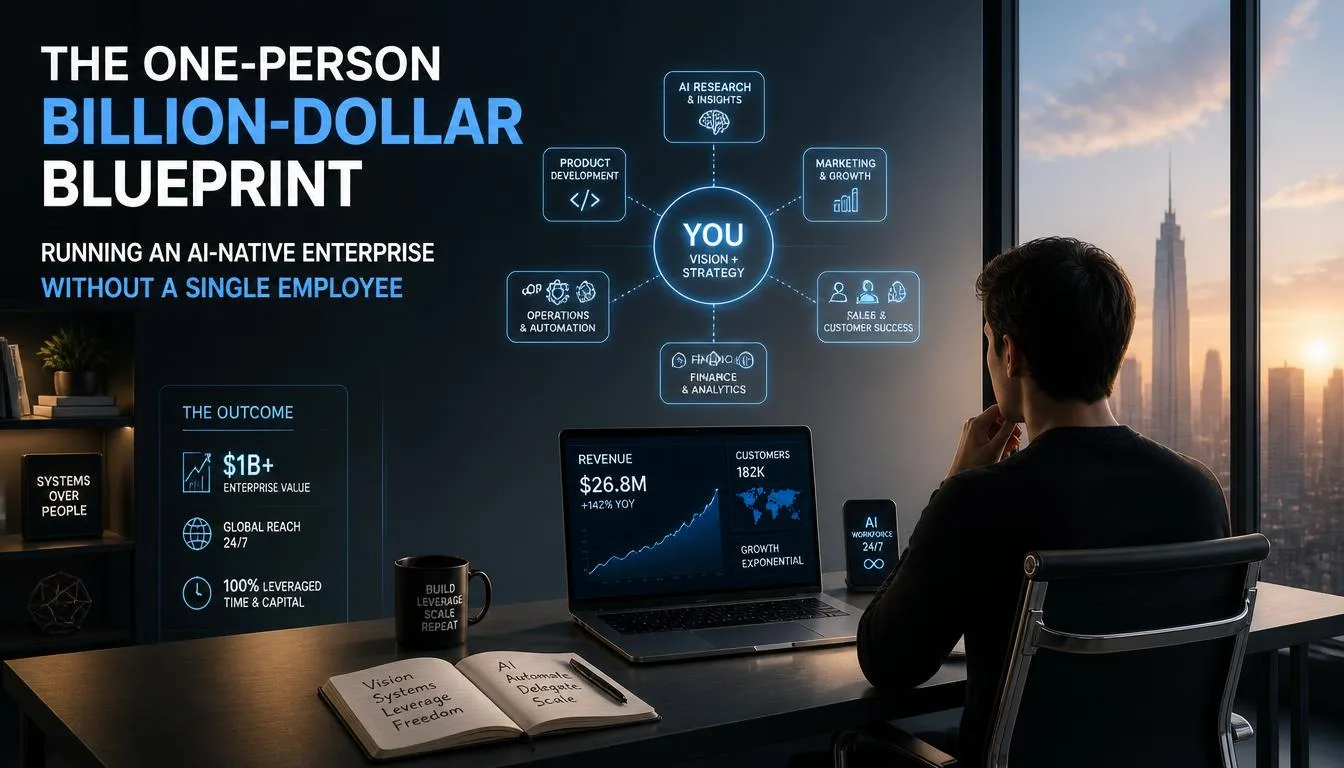
The One-Person Billion-Dollar Blueprint: Running an AI-Native Enterprise Without a Single Employee

For decades, the trajectory of business success was inextricably linked to headcount. You raised a seed round, you hired a marketing coordinator, a customer support rep, two junior developers, and an operations manager. Overnight, your primary job shifted from building a product to managing human psychology, payroll friction, and communication overhead.
That paradigm is officially obsolete.
We have entered the era of the solopreneur enterprise—a business model where a single human being acts entirely as the strategic visionary, while a constellation of specialized artificial intelligence agents, autonomous workflows, and LLM-driven APIs handle 95% of execution. This is not about writing better ChatGPT prompts to draft emails. This is about architecting an autonomous operating system where your business runs, optimizes, and scales while you sleep.
Having stress-tested this model across multiple digital assets and high-margin service firms, I can tell you definitively: hiring full-time employees too early is the single greatest point of failure for modern startups. Here is the exact architectural blueprint for building an AI-powered one-person empire.
The AI-Native Org Chart: Replacing Departments with Specialized Prompts and APIsWhen you operate an enterprise by yourself, you cannot afford to context-switch between CEO, copywriter, QA engineer, and data analyst. Cognitive fatigue is your enemy. To solve this, you must build a modular digital workforce using structured AI agents. Think of your business in discrete functional departments:
1. Market Research and Product Validation (The Strategy Unit)Before writing a line of code or drafting a landing page, you need ruthless market validation. Instead of hiring a $120k/year strategist, deploy custom retrieval-augmented generation (RAG) pipelines.
- Data Sourcing: Feed Reddit API exports, Hacker News threads, and Amazon review databases into a local vector database.
- Synthesis: Use advanced reasoning models (like OpenAI's o1 or Claude 3.5 Sonnet) to run automated sentiment analysis, identifying structural gaps in existing competitor offerings.
- Output: A validated product requirements document (PRD) generated in under 45 minutes, complete with pricing elasticity models based on historical SaaS data.
The barrier to software creation has dropped to zero. Today, writing code manually for boilerplate infrastructure is a waste of human capital. Your engineering department consists of a cascading chain of AI development environments.
- Architecture: Use LLMs to generate system architecture diagrams and database schemas (PostgreSQL or Supabase).
- Execution: Leverage agentic coding environments (such as Cursor, Windsurf, or Claude Engineer) to build out front-end components and back-end logic simultaneously.
- QA & Testing: Implement automated CI/CD pipelines where secondary AI agents review git diffs, write unit tests, and flag security vulnerabilities before deployment.
Marketing is no longer about human content mills churning out generic 500-word SEO articles. It is about programmatic distribution and hyper-personalized value creation.
- Long-form Content Engine: Feed raw audio transcripts of your strategic thinking into an AI pipeline that automatically structures, edits, and optimizes comprehensive thought-leadership content.
- Programmatic SEO: Generate thousands of high-intent programmatic landing pages targeting niche long-tail search queries using structured JSON datasets and dynamic copywriting templates.
- Conversion Optimization: Run automated multi-variate copy testing on your sales pages using programmatic layout and headline iterations generated by conversion-focused LLM agents.
To run an empire by yourself, you must move away from human-dependent workflows and embrace event-driven automation. This is where tools like Make.com, Zapier, and custom Python scripts via AWS Lambda become your core infrastructure.
The Event-Driven Customer Support LoopCustomer service is typically the first bottleneck for a solo founder. By integrating a fine-tuned LLM with your CRM and knowledge base, you can automate 98% of inbound inquiries while maintaining an authentic brand voice.
When a support ticket arrives:
- An API webhook captures the message and assesses user sentiment.
- The semantic search engine queries your product documentation and past resolution logs.
- The AI drafts a hyper-personalized, empathetic response, executing refunds or account adjustments autonomously via Stripe APIs if the parameters fall within safe, pre-defined rules.
- If sentiment drops below a critical threshold, it escalates directly to your personal Telegram or Slack for human intervention.
Traditional businesses scale linearly with cost: more revenue requires more employees, which increases overhead, management complexity, and cash flow risk. The AI-native solopreneur enterprise scales exponentially with margin.
Financial Comparison: Traditional vs. AI-Native Enterprise- Traditional Startup Team (5 people): $450,000+ annual payroll, office lease, health insurance, HR overhead, management friction, slow decision-making velocity.
- AI-Native Solopreneur (1 person): $3,000/year in enterprise software subscriptions, zero HR overhead, instant global deployment, 90%+ net profit margins.
This massive margin disparity allows you to weather economic downturns, underprice legacy competitors who are bogged down by payroll, and reinvest capital directly into high-yield user acquisition channels.
The Dark Side and Bottlenecks: What AI Cannot FixIntellectual honesty requires addressing the limitations of this model. Running a business entirely with AI agents does not mean you do nothing. It changes the nature of your labor from tactical execution to curation and taste.
1. The Taste DeficitAI is an engine of probability; it predicts the next most likely token based on historical data. By definition, it regresses to the mean. If your brand relies on radical innovation, bold contrarian positioning, or sublime aesthetic taste, the AI will give you average results. You must inject the 'taste'—the unquantifiable human intuition that decides whether a product, design, or message is truly exceptional.
2. Context DegradationAs your automated pipelines grow more complex, managing prompt drift and context windows becomes a technical discipline. An update to an underlying model (e.g., GPT-4o to a newer iteration) can silently break a finely tuned multi-agent workflow. You must maintain rigorous automated monitoring and fallback systems.
Your 30-Day Implementation RoadmapStop reading theory and start building your empire. Here is your immediate action plan:
- Audit Your Time: Track every minute of your workweek for 7 days. Identify repetitive digital tasks (coding, writing, scheduling, data cleanup).
- Build Your First Agentic Pipeline: Take the most time-consuming workflow and automate it using an LLM API connected to a no-code webhook tool.
- Productize Your Expertise: Package your unique intellectual property into a digital asset (SaaS, high-ticket advisory ecosystem, or programmatic content platform) and let your AI workforce handle distribution.
The leverage is unprecedented in human history. The tools are accessible to anyone with an internet connection. The only question left is whether you have the strategic discipline to step out of the manager's seat and become the architect of an autonomous machine.
The One-Person Billion-Dollar Blueprint: Running an AI-Native Enterprise Without a Single Employee
Discover how to build a high-margin, one-person business empire using AI agents, automated workflows, and zero employees. Read the expert blueprint.