
How AI Tools Erase the Freelance Experience Gap (And Why Senior Freelancers Are Sweating)

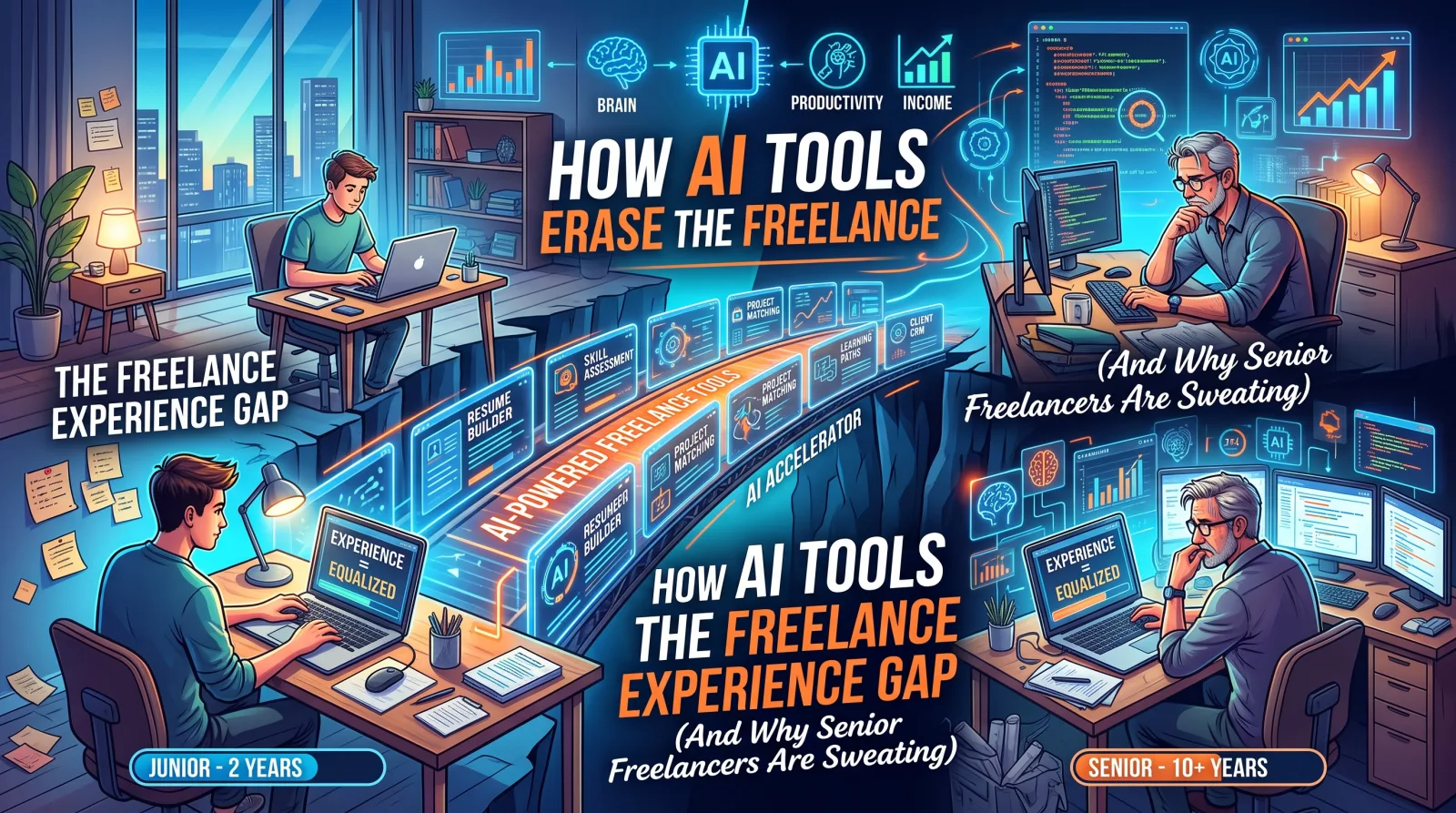
For decades, the freelance economy operated on a rigid, unwritten caste system. Seniority was currency. If you couldn't point to a decade of agency portfolio pieces, a roster of Fortune 500 clients, or deep domain expertise in niche technical writing, coding, or brand strategy, you were relegated to the bottom of the platform algorithms. You fought for microscopic scraps—low-paying gigs that demanded senior-level execution for junior-level pay.
That caste system is effectively dead. Generative AI and advanced machine learning agents have leveled the playing field with brutal efficiency. Today, an ambitious newcomer armed with the right stack of AI tools can execute complex tasks, analyze enterprise-grade datasets, and produce high-caliber deliverables that rival professionals with ten years in the trenches. We aren't just talking about basic grammar checkers or simple text generators. We are talking about cognitive leverage that compresses a decade of professional seasoning into a six-month onboarding window.
The Anatomy of the Freelance Experience GapTo understand why AI is such a disruptive equalizer, we have to deconstruct what 'experience' actually means in the freelance marketplace. Historically, clients paid premium rates for three distinct pillars of professional maturity:
- Execution Speed: Veterans knew the shortcuts, templates, and frameworks to get from brief to finished product in a fraction of the time.
- Risk Mitigation: Experienced freelancers rarely made catastrophic operational mistakes because they had already failed, learned, and adapted years prior.
- Strategic Depth: Seniors didn't just execute tasks; they anticipated downstream business consequences and consulted clients on broader strategy.
Until recently, replicating these pillars required years of grueling trial and error. New freelancers lacked the pattern recognition to avoid common pitfalls or the technical vocabulary to sound like seasoned consultants. AI tools don't just bridge this gap—they blast through it by functioning as an instantaneous, on-demand advisory board.
Tactical AI Stacks: How New Freelancers Outperform VeteransTo see how this plays out in the real world, let's look at a concrete case study. Consider Sarah, a copywriter who entered the freelance market six months ago with zero agency background. In a pre-AI environment, Sarah would spend her first two years writing low-converting blog posts at $0.05 a word, slowly learning SEO architecture, brand voice adaptation, and conversion rate optimization (CRO) through painful rejections.
Instead, Sarah deployed a specialized AI stack to bypass the beginner penalty entirely:
1. Strategic Discovery and Client OnboardingWhen pitching a complex SaaS client, Sarah uses advanced LLMs trained on strategic frameworks like Jobs-to-Be-Done (JTBD) and Miller Heiman sales methodologies. Before her discovery call, she feeds the client's public earnings reports, product landing pages, and competitor reviews into her AI environment. The system generates a comprehensive strategic audit, pinpointing conversion bottlenecks that even the client's internal team had overlooked. Sarah walks into the call sounding like an enterprise consultant with a decade of SaaS advisory under her belt—because her AI-synthesized prep work mirrors senior-level strategic depth.
2. Execution and Quality ControlWhen drafting long-form technical content, Sarah doesn't rely on generic prompts like 'Write an article about cloud security.' Instead, she utilizes multi-agent workflows. One AI agent acts as a strict technical fact-checker referencing RFC documentation, another acts as a direct-response copy editor optimizing for readability scores, and a third enforces the specific brand voice guidelines of the client. The result is a piece of content indistinguishable from—and often structurally superior to—work produced by mid-level agency copywriters.
3. Risk Mitigation and Scope ManagementOne of the hardest lessons for new freelancers is managing scope creep and difficult clients. Veterans know how to spot red flags and draft ironclad contracts. Sarah bypasses this learning curve by deploying legal-tech LLMs to analyze client-provided master service agreements (MSAs), highlighting predatory indemnification clauses, unfavorable payment terms, and scope traps. She uses AI-driven project management assistants to automatically generate meticulous change-order documentation the moment a client tries to expand the project boundaries.
Where AI Fails (And Why Human Judgment Still Reigns)To maintain an authoritative, nuanced perspective, we must address the limitations. AI tools do not eliminate the need for human accountability; rather, they shift the freelancer's value proposition. If you are a new freelancer who simply copies and pastes raw LLM output into a client deliverable, you will fail—and you deserve to. Clients are rapidly developing fatigue for generic, hallucination-prone AI slop.
The successful modern freelancer acts less like a traditional worker and more like an AI Orchestrator or Managing Director of a one-person firm. The competitive advantage has shifted from *manual execution* to *taste, curation, and final accountability*.
- Taste: Knowing the difference between mediocre AI output and exceptional human-grade work. AI can generate ten variations of a landing page headline, but the human must possess the cultural and emotional intelligence to select the one that resonates.
- Nuance: Reading the unspoken emotional cues in client Slack messages and course-correcting before a relationship sours.
- Accountability: Owning the final product. AI cannot take responsibility when a campaign fails or a codebase breaks.
Senior freelancers often rely on muscle memory and legacy processes. They built their workflows in an era of high friction, and many are slow to adopt autonomous agents, custom GPT architectures, and programmatic data analysis because their old ways 'still work.' This inertia is the new freelancer's greatest asset.
By mastering AI-native workflows from day one, newcomers operate with the output velocity of a three-person agency. They can deliver comprehensive deliverables—combining data analysis, design mockups, and strategic copy—that traditionally required cross-functional teams. They aren't burdened by legacy habits; they are natively optimized for high-leverage modern commerce.
Actionable Blueprint: Building Your AI-Powered Freelance Practice This WeekIf you are a new freelancer looking to close the experience gap immediately, stop wasting time on generic skill-acquisition courses. Instead, implement this operational blueprint:
Build a Custom Knowledge Base: Feed transcripts of top-tier industry interviews, teardowns of successful campaigns, and high-performing frameworks into your preferred AI workspace to create a proprietary domain model.Automate Your Administrative Overhead: Utilize AI scheduling, automated meeting transcription, and smart invoicing tools to free up 80% of your time for high-value strategic work.Charge for Outcomes, Not Hours: Because AI compresses your execution time, billing hourly penalizes your efficiency. Use your newfound speed to price your services based on business value and ROI, allowing you to command senior-level rates from your very first month.The playing field has fundamentally shifted. The experience gap used to be a fortress guarded by years of time served. Today, it is merely a technical hurdle that can be vaulted over with the right tools, sharp strategic thinking, and uncompromising quality control. The door is wide open—walk through it.
How AI Tools Erase the Freelance Experience Gap (And Why Senior Freelancers Are Sweating)
Discover how new freelancers use AI tools to bypass years of experience, execute like industry veterans, and command top senior rates today.