
Architectural Intelligence: How Design Leaders Are Deploying AI Beyond the Hype

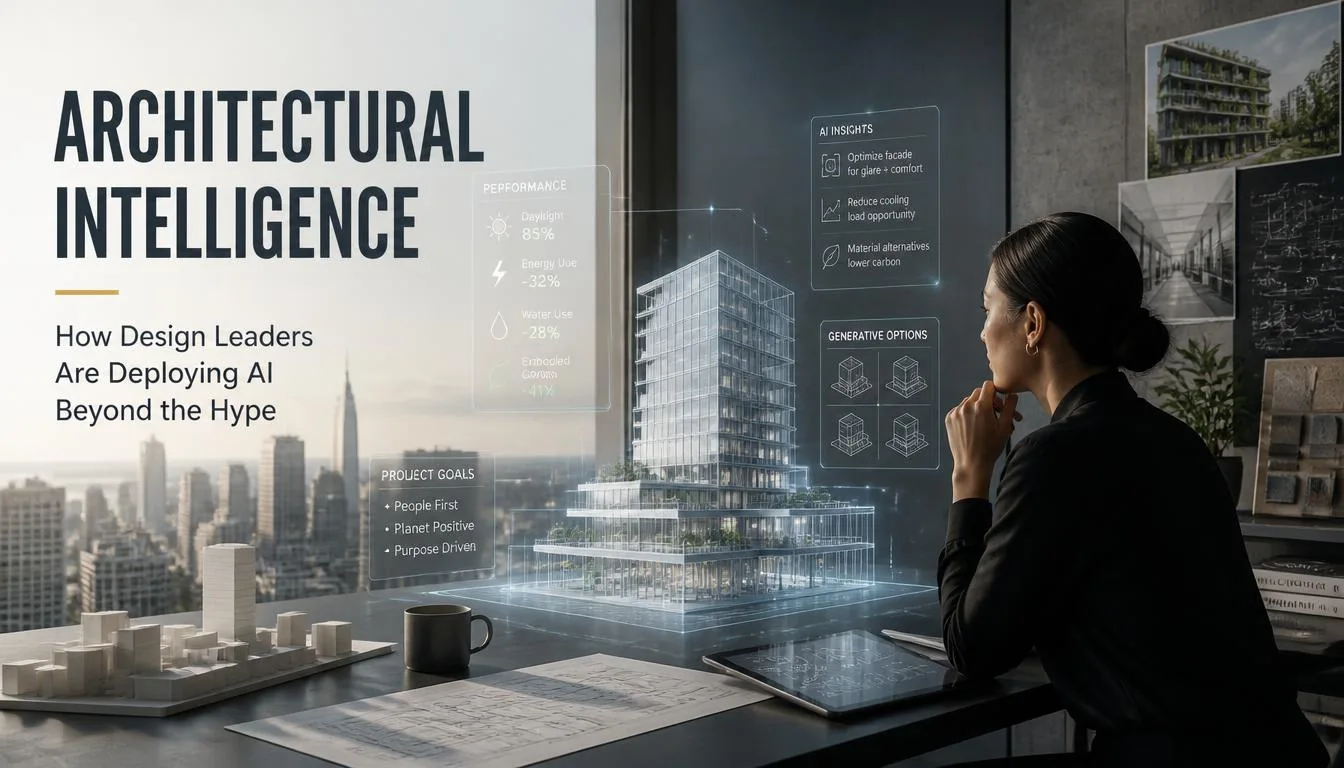
The architecture, engineering, and construction (AEC) industry has long suffered from a paradox: we design the future, yet our internal operations remain tethered to archaic software silos and linear workflows. For decades, the leap from a conceptual massing model to a fully coordinated BIM (Building Information Modeling) package has been an exercise in friction. Today, artificial intelligence is dismantling that friction. But let’s be entirely frank—if your definition of AI in architecture is typing a generic prompt into Midjourney to generate hyper-futuristic floating glass villas for a zoning board that demands brick-and-mortar context, you are missing the revolution.
Real computational transformation in architectural practice isn't happening in the realm of frictionless fantasy. It is happening in the unglamorous trenches of multi-variable optimization, generative spatial layout planning, automated code compliance, and hyper-realistic client alignment. As a practice leader who has integrated generative and predictive models into active workflows, I see a clear divide: firms treating AI as a rendering gimmick are bleeding billable hours, while firms treating AI as an infrastructural co-pilot are redefining profit margins and design rigor.
The Computational Shift: Moving From Static Drafting to Dynamic OptimizationTraditional design processes are iterative in the worst possible way. You draft, you evaluate, you find a clash or a thermal inefficiency, you redraft. This linear loop burns through human capital. Modern AI workflows invert this paradigm through constraint-based generative design and machine learning (ML) structural analysis.
Generative Space Planning and Programmatic LayoutsConsider the design of a 250,000-square-foot corporate headquarters or a healthcare facility. The programming phase alone typically requires weeks of interviews, spreadsheet choreography, and adjacency matrix sketching. We now deploy specialized graph-neural-network models that ingest programmatic requirements—such as department adjacencies, daylight access minimums, and vertical circulation nodes—and output thousands of floorplate iterations in minutes.
Unlike human designers who anchor to the first viable scheme due to cognitive fatigue, AI-driven spatial engines test radical permutations. For example, in a recent laboratory design project, our custom generative script evaluated variations for fume hood exhaust routing against structural grid efficiency. It surfaced an asymmetric core layout that reduced our MEP (Mechanical, Electrical, Plumbing) shaft volume by 14%. That is not just a stylistic choice; it is millions of dollars in construction cost saved before the design ever reached Design Development.
Predictive Structural Engineering and Carbon Footprint ReductionEngineers are naturally skeptical of black-box algorithms, and rightfully so. A failed structural element is catastrophic. Therefore, structural AI integration must operate within rigorous finite element analysis (FEA) boundaries. We use surrogate machine learning models trained on millions of historical FEA runs to instantaneously predict stress concentrations, deflection profiles, and seismic load distributions.
- Embodied Carbon Tracking: Real-time ML models evaluate concrete mix designs and steel-to-timber ratios against structural integrity metrics, driving down global warming potential (GWP) dynamically.
- Topology Optimization: AI algorithms carve away material from internal structural members where stress is minimal, resulting in organic, biomorphic load-bearing components that use up to 30% less material without compromising safety factors.
- Dynamic Code Compliance: Natural Language Processing (NLP) models ingest local zoning codes, IBC (International Building Code), and ADA requirements, flagging spatial violations instantly as Revit or Rhino models update.
For generations, the architectural presentation was a one-way performance. We spent weeks polishing a handful of curated renderings—often airbrushed with hyper-idealized lighting and impossibly spotless pavements—to present to clients who lacked the spatial literacy to translate 2D plans into lived reality. Then came the inevitable post-construction disappointment: 'Why is this corridor so dark?' or 'I didn’t realize the HVAC duct would hang that low.'
AI has fundamentally shattered this dynamic. Client presentations are no longer static exhibitions of our artistic talent; they are interactive, responsive co-design workshops.
Real-Time Neural Rendering and In-Meeting IterationUsing platforms that integrate AI-assisted real-time ray tracing and generative upscaling (such as Chaos Vantage or custom Unreal Engine pipelines powered by DLSS), we no longer render overnight. We render live. When a client sits across the table and asks, 'What does this boardroom look like if we swap the walnut paneling for board-formed concrete?' we do not say, "We'll update that for the next milestone." We click a material toggle, and the neural engine recalculates light bounces, texture displacement, and global illumination in real time.
This level of responsiveness changes the psychological dynamic of client meetings. It shifts the relationship from transactional vendor-and-client to collaborative problem-solvers. Clients stop looking for flaws in a static image and start engaging with the spatial consequences of their decisions.
AI-Driven Narrative and Emotional ResonanceBeyond visual fidelity, client presentations must sell a vision. Stakeholders don't buy square footage; they buy identity, productivity, and emotional resonance. We leverage AI-driven multimodal tools to synthesize massive amounts of client brand identity data, historical context, and occupant surveys into compelling visual mood boards and spatial narratives.
By feeding sentiment analysis of executive interviews into localized text-to-image and style-transfer models, we can generate targeted visualization sprints that mirror the psychological tone a tech startup desires (fluid, kinetic, transparent) versus what a conservative financial institution requires (monumental, tactile, secure). This ensures our first design presentation strikes an emotional chord that aligns precisely with the client's unspoken aspirations.
The Operational Reality: Risks, Guardrails, and Ethical PracticeAdopting AI in architecture and engineering is not without severe operational landmines. To deploy these tools responsibly, firms must establish strict internal guardrails.
IP, Copyright, and the Training Data QuagmireMany commercial AI image generators are trained on scraped internet data that includes copyrighted architectural works. If your firm uses a public model to generate a signature facade, you run the risk of inadvertently replicating a proprietary design, leading to severe legal liability. Forward-thinking practices are pivoting to fine-tuned, proprietary models trained exclusively on their own internal project archives, securing a proprietary design language while protecting client confidentiality.
The Erosion of Junior CraftsmanshipThere is a profound human cost if we rely too heavily on automation early in an architect's career. Junior staff traditionally learned the nuances of detailing, spatial proportions, and constructability by grinding through drafting and construction document coordination. If AI automates the grunt work, how do we train the master builders of tomorrow? Firms must curate deliberate mentorship tracks, ensuring that young designers use AI to elevate their critical thinking rather than bypass the foundational understanding of how buildings actually stand up.
The Strategic Verdict: Adapt or CommoditizeArchitecture and engineering have historically operated on low profit margins relative to the massive liability we shoulder. The firms that will dominate the next decade are those using AI not just to produce prettier pictures faster, but to drastically compress the loop between quantitative performance and qualitative design.
When you can optimize a structural grid for carbon efficiency, verify zoning compliance, and render hyper-realistic daylighting scenarios live in front of a hesitant client all within a single meeting, you are no longer just selling design hours. You are selling undeniable, predictive certainty. And in an industry defined by risk, certainty is the most valuable currency on earth.
Architectural Intelligence: How Design Leaders Are Deploying AI Beyond the Hype
Discover how leading architects and engineers deploy AI for generative design, structural optimization, and interactive client presentations.