
The 3x Leverage Playbook: How Elite Consultants Use AI to Scale Without Hiring

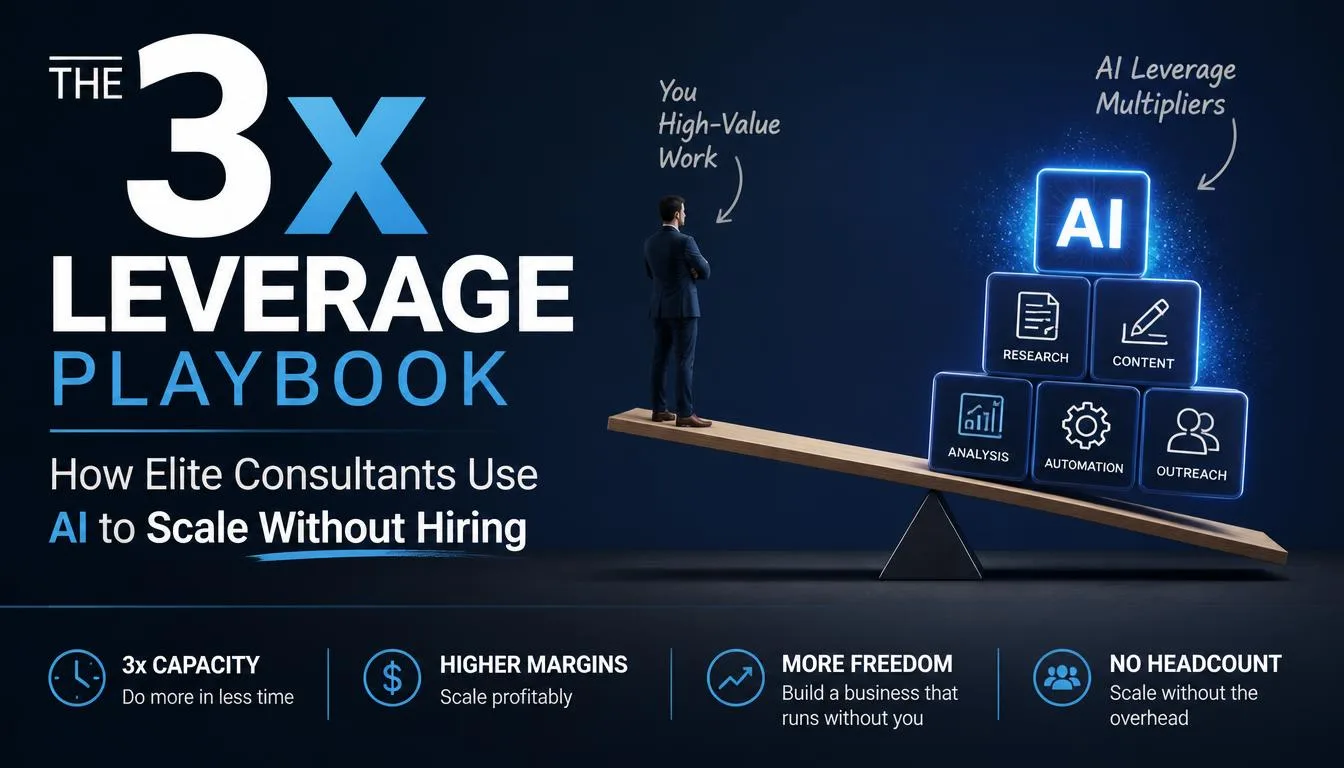
Most management and boutique consultants are failing at AI. They treat large language models like glorified search engines—asking ChatGPT to draft a quick email or summarize an annual report. Meanwhile, top-tier solo practitioners and boutique firms are using custom AI agent architectures to multiply their client capacity by three without adding a single headcount.
The math of traditional consulting is broken. Revenue is inextricably linked to billable hours. To grow 3x, you historically needed to hire three times as many analysts, junior partners, and operational staff, which introduces management overhead, margin compression, and communication drag. Generative AI breaks this linear relationship between labor and revenue. We are no longer living in an era where AI merely assists; it now executes complex, multi-step knowledge work.
Here is the exact operational framework elite consultants use to achieve 3x client capacity, maintain pristine delivery standards, and protect their profit margins.
The Myth of the Prompt: Why Chat Interfaces Fail ConsultantsIf your AI strategy involves opening a browser tab and typing "Act as a strategy consultant and write a market entry strategy," you will get generic, hallucination-prone fluff that damages your brand. Real enterprise consulting requires systemic data ingestion, rigorous hypothesis testing, context-aware synthesis, and tailored client communication.
To scale 3x, you must stop treating AI as a chat partner and start treating it as an agentic workforce. This means shifting from stateless prompts to stateful, chained AI workflows that integrate directly into your firm's tech stack via APIs, vector databases, and automation tools like Make or n8n.
The 4 Pillars of AI-Powered Leverage- Ingestion and Structuring: Automatically processing 500-page data rooms, expert interview transcripts, and financial statements into queryable vector embeddings.
- Hypothesis Generation: Running parallel agent swarms to stress-test business models against industry benchmarks.
- Artifact Synthesis: Generating client-ready deliverables (slide decks, financial models, executive summaries) formatted to exact brand guidelines.
- Knowledge Reuse: Turning every past project into an instantly retrievable internal IP asset.
Consider a boutique M&A due diligence advisory. Traditionally, analyzing a target company's historical financials, customer churn data, and contract portfolios consumed 60 to 80 hours of junior analyst time per deal.
By deploying a localized Retrieval-Augmented Generation (RAG) pipeline combined with custom Python execution environments, modern consultants execute this phase in under two hours.
How the Workflow Operates:- All target data room files (PDFs, Excel models, scanned legal docs) are automatically synced to secure cloud storage upon upload.
- An automated script parses, cleans, and indexes the text and tabular data into a private vector database.
- A chain of specialized AI agents runs concurrent analyses: one checks for anomalous cash-flow variations, another maps customer concentration risks, and a third audits employment agreements for liabilities.
- The system outputs a structured 15-page preliminary risk assessment and red-flag matrix, complete with citation links back to the source documents.
The consultant does not write the report. They review, validate, and add high-level strategic nuance. This reduces a multi-week bottleneck into a same-day deliverable, allowing the firm to handle three concurrent due diligence mandates with the exact same team.
Use Case 2: Hyper-Personalized Qualitative Research at ScaleQualitative stakeholder interviews are the bedrock of organizational design and change management consulting. Conducting, transcribing, coding, and synthesizing 40 executive interviews typically takes weeks of grueling thematic analysis.
Elite practitioners now deploy automated audio-to-insight pipelines. Every stakeholder interview is recorded, transcribed via high-accuracy speech-to-text models, and immediately processed through a multi-agent thematic coder.
The Execution Stack- Transcription & Diarization: Whisper-based models that accurately separate speakers and handle industry-specific jargon.
- Thematic Extraction: Custom-prompted LLM chains that cross-reference statements against frameworks like McKinsey's 7S or Kotter's Change Model.
- Sentiment Mapping: Quantifying cultural resistance points across different business units before writing a single slide.
Instead of spending 40 hours synthesizing transcripts, the consultant receives a pre-synthesized cultural diagnostic report. This shifts their role from a human transcription engine to a high-value trusted advisor interpreting the output for the CEO.
Use Case 3: Autonomous Deck Building and Deliverable GenerationThe greatest time drain in consulting is slide production. Transforming raw insights into clean, compelling PowerPoint decks eats up nights and weekends.
Top consultants are bypassing manual slide creation by integrating LLMs with programmatic presentation generators. Using tools that speak native XML or leveraging Python-pptx libraries combined with vector-indexed visual brand guidelines, they generate fully formatted, argument-driven presentations.
The Zero-to-Deck Protocol:- The consultant inputs the meeting notes and strategic recommendations into an internal workspace.
- The AI structures the narrative using the Pyramid Principle (conclusion first, supporting arguments below).
- The agent maps data points to specific visualization templates (charts, matrices, process flows) while strictly adhering to corporate color palettes and typography rules.
- The consultant performs a final 15-minute editorial polish rather than a 15-hour design marathon.
Scaling to 3x capacity via AI introduces distinct operational hazards. If you automate recklessly, you risk hallucinations, data breaches, and client alienation. Protecting your firm's reputation requires strict guardrails.
Pros and Cons of Scaling Consulting via AI Agents- PRO: Drastically lowers marginal delivery costs, instantly expanding operating margins.
- PRO: Eliminates mundane administrative toil, increasing employee and partner satisfaction.
- PRO: Standardizes analytical rigor across all client engagements, reducing human error.
- CON: Initial setup requires deep technical acumen or investment in custom workflow engineering.
- CON: Potential enterprise data leakage if employees paste confidential client data into public consumer chat interfaces.
- CON: Over-reliance on automation can lead to homogenized, vanilla recommendations if human strategic judgment is removed from the loop.
To mitigate these risks, elite firms enforce a zero-public-LLM policy, relying instead on enterprise-tier API endpoints with zero-data-retention agreements. Furthermore, they institute a strict Human-in-the-Loop (HITL) validation gate for every client-facing asset.
Implementation Roadmap: How to Transition Your Firm This QuarterYou do not need to rebuild your entire practice overnight. Reaching 3x capacity is an iterative engineering process. Follow this phased roadmap to integrate AI into your service delivery model without breaking operations.
Step 1: Audit Your Workflow BottlenecksTrack your billable hours for two weeks. Identify which tasks consume the most time but require the least proprietary strategic thought. Usually, this is data ingestion, transcription coding, first-draft writing, and basic chart generation.
Step 2: Build Single-Task Automation PipelinesDo not try to build an all-knowing AI consultant. Solve one specific friction point first—such as turning raw expert transcripts into thematic briefs. Once that workflow runs with 95% reliability, move on to the next link in the chain.
Step 3: Establish Your Proprietary IP VaultThe true moat of a consulting firm is its past work. Centralize your past decks, frameworks, and methodologies into a secure vector database. This ensures every AI-generated artifact sounds like *your* firm—using your proprietary terminology and proven mental models—rather than sounding like generic internet prose.
The Bottom LineThe future of consulting does not belong to firms with the largest headcount. It belongs to lean, highly leveraged operators who treat AI as an autonomous workforce rather than a toy. By systematizing your delivery, securing your data pipelines, and automating the mechanical layers of knowledge work, you can easily triple your client capacity, multiply your revenue per partner, and reclaim your time.
The 3x Leverage Playbook: How Elite Consultants Use AI to Scale Without Hiring
Discover elite agentic AI workflows consultants use to triple client capacity and scale revenue without adding headcount. Read the playbook.