
Why Critical Thinkers Thrive in Chaos While Everyone Else Panics

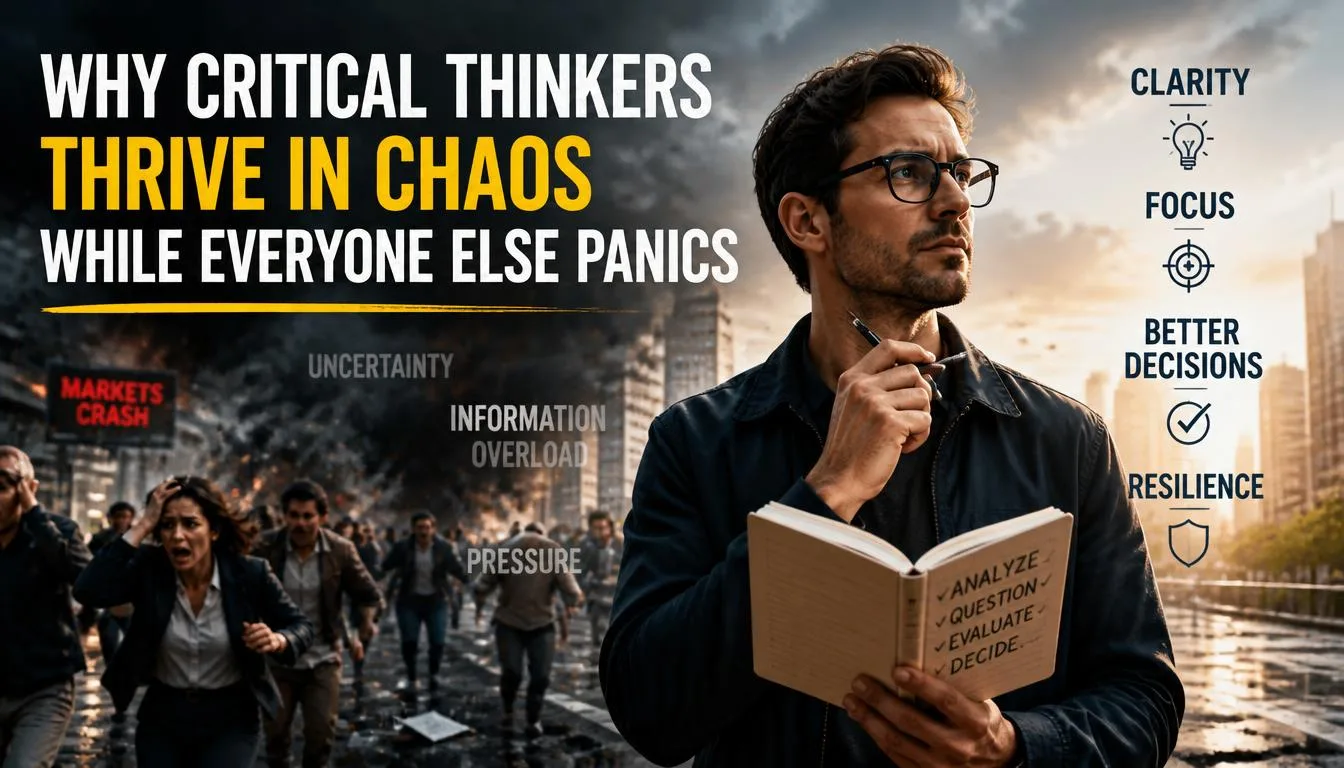
Most people treat uncertainty like a localized weather emergency—something to hunker down against, wait out, or panic over until the skies clear. When the macroeconomic landscape shifts, industry paradigms fracture, or personal plans implode, the default human response is a frantic scramble for false certainty. We crave neat narratives, binary choices, and the comforting illusion of control.
Yet, a distinct cognitive elite views uncertainty entirely differently. Critical thinkers do not just tolerate ambiguity; they weaponize it. Where others see chaos, they see a structural vacuum waiting to be navigated. Having spent over a decade training executives, quantitative analysts, and intelligence operators in advanced mental models, I have observed a consistent truth: high-level critical thinkers do not possess a crystal ball. Instead, they possess a superior operating system for reality.
To understand why critical thinkers handle uncertainty better than anyone else, we must dismantle the mechanics of how they process incomplete information, override cognitive biases, and execute decisions when the data is fundamentally broken.
The Psychology of Ambiguity Tolerance: Moving Past the Need for ClosureAt the root of poor decision-making under stress is the psychological construct known as the need for cognitive closure. Coined by social psychologist Arie Kruglanski, this refers to an individual's desire for a definitive answer on a given topic, any answer, as long as it alleviates the excruciating discomfort of ambiguity.
Under conditions of high uncertainty, individuals with a high need for closure experience a cognitive freeze. They prematurely seize on the first available hypothesis and stubbornly freeze on it, ignoring subsequent disconfirming evidence. This is why panic buying happens during supply chain disruptions, or why investors dump entire portfolios at the absolute market bottom based on a single alarming headline.
Epistemic Curiosity vs. Fear-Driven FinalityCritical thinkers operate on the opposite end of this spectrum. They possess high epistemic curiosity paired with high ambiguity tolerance. They recognize that premature closure is an intellectual trap. Instead of rushing to a premature conclusion to soothe their nervous system, they intentionally lengthen the cognitive gap between stimulus and response.
- The Novice Response: "We don't know what will happen next quarter, so we must freeze hiring and cut all budgets immediately."
- The Critical Thinker Response: "The variables are currently volatile. Let us map out three distinct scenarios, identify the leading indicators for each, and maintain optionality until the data resolves."
This refusal to prematurely anchor on a narrative allows critical thinkers to conserve their cognitive bandwidth. While others exhaust themselves fighting phantom threats, critical thinkers calmly monitor the environment for actual signal amidst the noise.
Bayesian Updating: How Critical Thinkers Treat Beliefs as Software, Not ScriptureOne of the most profound differentiators between average decision-makers and elite critical thinkers is how they manage their existing beliefs when faced with new, contradictory data.
Most people treat their opinions and strategic plans like sacred artifacts. When reality changes, they defend their initial thesis with aggressive confirmation bias, doubling down on failing strategies because admitting error feels like a threat to their identity.
Critical thinkers, conversely, utilize Bayesian updating—the mathematical process of continually recalculating the probability of a hypothesis as new evidence becomes available. To a critical thinker, a hypothesis is merely a working model designed to be violently tested and continuously upgraded.
Case Study: Navigating a Fractured Supply ChainConsider a real-world scenario from a mid-sized logistics firm facing sudden geopolitical trade restrictions. The standard management team panicked, arguing over who was to blame and attempting to resurrect defunct local vendor relationships that were no longer economically viable.
The lead strategist, a seasoned critical thinker, approached the crisis through a Bayesian lens:
- Establish the Prior: "Our primary shipping lanes have a 70% probability of disruption over the next six months."
- Gather Conditional Evidence: "Alternative overland routes are opening, but at a 25% cost premium."
- Recalculate Dynamically: Instead of clinging to the old cost model, the strategist immediately integrated the cost premium into updated client pricing tiers, securing operational continuity while competitors were still paralyzed by disbelief.
By treating their initial business plan as a beta version rather than an absolute gospel, they adapted in days while others floundered for quarters.
First-Principles Thinking: Stripping Away False ConstraintsUncertainty breeds institutional dogma. When people do not know what to do, they default to industry best practices, historical precedent, and corporate folklore. They ask, "How have we always handled this?" or "What are our competitors doing?"
Critical thinkers find these questions dangerously lazy. When the rulebook no longer applies because the game has fundamentally changed, relying on historical precedent is like using a map of ancient Rome to navigate modern Manhattan.
Deconstructing the Problem to Bedrock TruthsFirst-principles thinking requires boiling a problem down to its most foundational, undeniable truths and building up an actionable strategy from there. Elon Musk famously applied this to rocket manufacturing, realizing that raw materials for aerospace grade aluminum were a fraction of the cost of a finished rocket, thereby bypassing the inflated prices dictated by aerospace incumbents.
In high-stakes uncertainty, first-principles thinkers systematically separate:
- Physical/Economic Constraints: Absolute limitations imposed by physics, capital, or regulatory law.
- Social/Assumed Constraints: Imaginary boundaries imposed by tradition, ego, or institutional inertia.
When you strip away the social constraints, you realize that 80% of the limitations paralyzing your competitors during a crisis do not actually exist. They are simply ghosts of how things used to be done.
Emotional Regulation and Metacognition: The Secret Engine of ClarityYou cannot execute high-level critical thinking while your amygdala is hijacked. Evolutionary biology wired us to perceive uncertainty as an existential threat. When cortisol and adrenaline flood the prefrontal cortex, executive function goes offline, and the brain defaults to fight-or-flight heuristics.
This is why intelligent people often make catastrophic decisions under pressure—their raw IQ becomes inaccessible beneath a wave of unmanaged panic.
The Power of Metacognitive MonitoringCritical thinkers excel at metacognition—the ability to think about their own thinking. They possess an internal observer that steps back during moments of high stress and runs a quiet diagnostic:
"Notice how my heart rate is elevating. Notice how I am currently seeking out articles that confirm my fear that our market is collapsing. This is an emotional reflex, not a rational analysis. Pause. Breathe. Recalibrate."
By maintaining this psychological distance, they short-circuit the panic loop. They recognize that emotion is valid data, but it is a terrible master. They decouple their self-worth from the outcome of the immediate situation, which grants them the psychological safety required to take calculated risks.
Actionable Framework: The Critical Thinker’s Uncertainty PlaybookIf you want to cultivate this level of cognitive resilience, you cannot simply read about it; you must operationalize it. Here is the exact mental model framework high-level critical thinkers use when entering an unpredictable environment:
1. Inversion (The Art of Avoiding Stupidity)Instead of asking, "How do we succeed in this uncertain market?" ask, "What are all the definitive ways we could completely fail over the next 12 months?" By mapping out the failure modes, you can proactively build circuit breakers into your operations.
2. Scenario Planning with Kill SwitchesDo not build a single rigid plan. Build three distinct scenarios (Best Case, Base Case, Catastrophic Case) and attach explicit kill switches to them. Define in advance: "If metric X drops below Y, we automatically pull the plug on initiative Z." This removes emotional negotiation when the moment of crisis arrives.
3. Red Teaming Your AssumptionsActively assign someone on your team (or yourself) the role of the hostile critic. Their entire job is to poke holes in your current strategy. If your strategy cannot survive internal scrutiny from a friendly adversary, it certainly will not survive reality.
The Ultimate Competitive AdvantageIn a world characterized by accelerating technological disruption, economic volatility, and information overload, the demand for false certainty will always be high. Snake-oil salesmen, dogmatic ideologues, and reactionary leaders will always find an audience by offering simple answers to complex, chaotic problems.
However, simple answers to complex problems are invariably wrong. The people who build enduring enterprises, navigate personal crises with grace, and capitalize on asymmetric upside are those who master the art of standing comfortably in the fog.
Critical thinkers do not conquer uncertainty by eliminating it. They conquer it by refusing to let it govern their minds.
Why Critical Thinkers Thrive in Chaos While Everyone Else Panics
Discover how critical thinkers navigate ambiguity, overcome cognitive bias, and make high-stakes decisions when chaos strikes. Read the guide now.