
Start Here: The Beginner's Blueprint for Critical Thinking

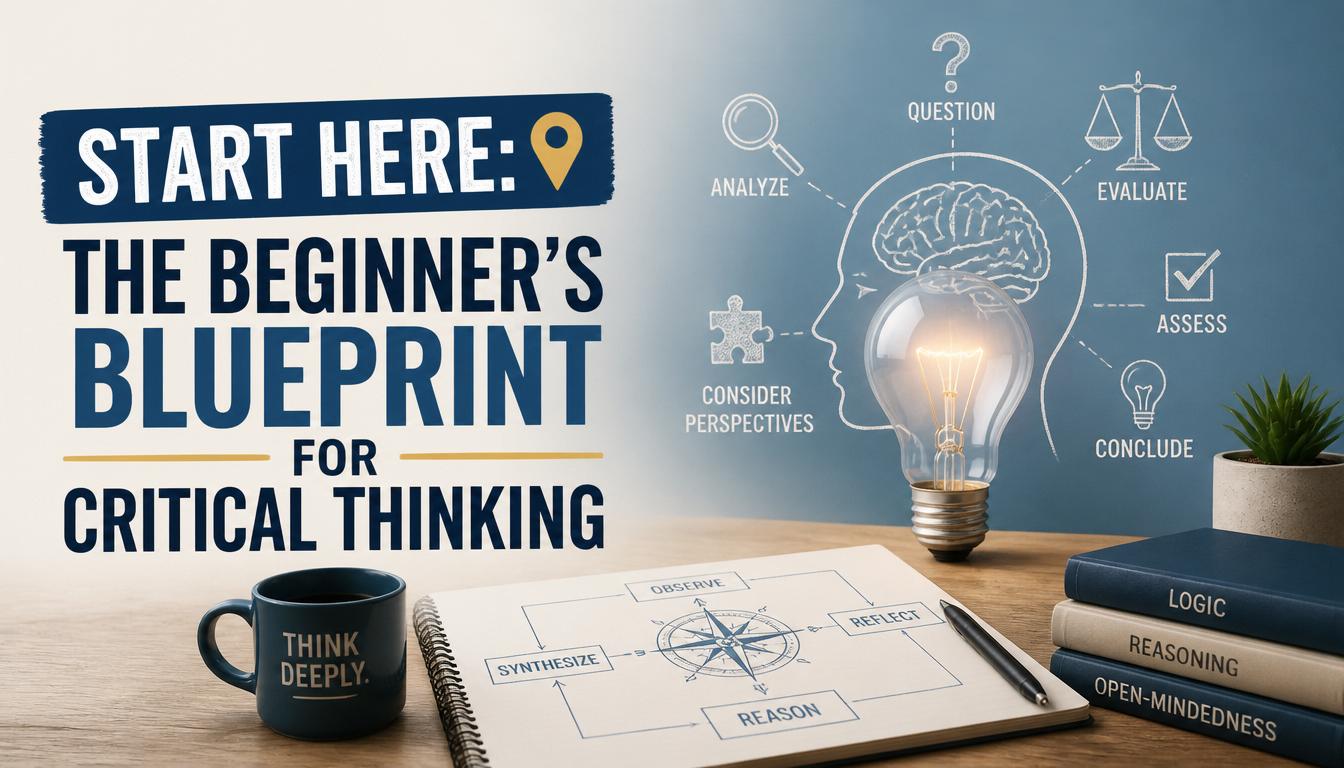
Blueprint for Critical Thinking
If you don't know where to begin, this is where you begin. A research-backed map of exactly what to learn, in what order, and why.
📖 25 min read Post-Doctorate Research Fully Referenced Series Roadmap Life-Changing"Dispositions and abilities are both necessary to be a critical thinker: dispositions lead people to pursue the truth, while their abilities enable them to clarify, negotiate different views, infer, and successfully achieve an end."
Ennis, 2011 — as synthesised in Heard, J., Critical Thinking: Skill Development Framework, ACER, 2025 The 5-Stage Blueprint at a Glance 1 What It Is Definitions & distinctions 2 The 6 Skills The cognitive foundation 3 The Dispositions The willingness to use them 4 Master Tools Metacognition & Socratic method 5 Daily Practice Making it permanent What this blueprint covers- Why most beginners start in the wrong place
- Stage 1: What critical thinking actually is
- Stage 2: The 6 core skills (the foundation)
- Stage 3: The 19 dispositions (the willingness)
- Stage 4: The master tools
- Stage 5: The daily practice
- 5 mistakes every beginner makes
- Your complete learning roadmap (series guide)
- A structured 30-day starting plan
- 10 research-backed benefits of starting now
- Frequently asked questions
- Full academic references
Here is the problem with most advice about developing critical thinking: it throws you straight into the deep end. You are told to "question everything," to "spot logical fallacies," to "think like a scientist" — all genuinely useful eventual goals, but presented without any sense of sequence. It is like being handed a piano and told to play a concerto before anyone has shown you where middle C is.
The result is predictable. Beginners try to do everything at once, get overwhelmed, and quietly abandon the project within a few weeks — concluding, wrongly, that critical thinking is either an innate talent they lack or a discipline too demanding to fit into ordinary life. Neither conclusion is true. What is true is that nobody gave them a map.
This guide is that map. It is built on the most rigorously established framework in the academic literature — the 1990 Delphi Report, in which 46 international experts in philosophy, psychology, and education reached formal consensus on what critical thinking actually consists of, through a process led by Dr. Peter A. Facione for the American Philosophical Association. Everything in this blueprint traces back to that foundation, supplemented by three and a half decades of subsequent research confirming, refining, and extending it.
The structure is simple: five stages, presented in the order research suggests they should be approached, each building on the one before it. By the end, you will know exactly what to learn, in what sequence, and you will have a 30-day starting plan and a roadmap to the deeper material that exists for each stage.
The single most important idea in this entire guideCritical thinking research draws a sharp and crucial distinction between two things that most beginners conflate: skills (the cognitive capacities — interpretation, analysis, evaluation, inference, explanation, self-regulation) and dispositions (the willingness to actually use those capacities — curiosity, open-mindedness, intellectual honesty, and others).
Research published in 2025 (Tandfonline, Studies in Higher Education) describes this with a musician analogy: a highly skilled musician can have excellent technique, musicianship, and intonation, yet be entirely indisposed to actually play. The skill exists. The willingness does not. The same is true of thinking. You can teach someone every cognitive skill in this guide, and if they lack the disposition to actually use them — out of laziness, fear, defensiveness, or simple habit — nothing changes. This is why this blueprint addresses both, in sequence, rather than skills alone.
01 Stage One · Foundation What Critical Thinking Actually IsBefore you can build anything, you need an accurate picture of what you are building. The formal definition from Facione's Delphi Report is this: critical thinking is "purposeful, self-regulatory judgment which results in interpretation, analysis, evaluation, and inference, as well as explanation of the evidential, conceptual, methodological, criteriological, or contextual considerations upon which that judgment is based."
That is precise but dense. In plain language: critical thinking is the deliberate, disciplined process of figuring out what is actually true (or most likely true) by examining evidence honestly, checking your own assumptions, considering alternative explanations, and being willing to revise your conclusions when the evidence demands it.
The most important thing for a beginner to understand at this stage is what critical thinking is not. It is not cynicism — doubting everything reflexively. It is not the same as intelligence — research confirms it is a distinct, trainable competency that smart people frequently fail to apply. It is not arguing or "being critical" of others in the everyday negative sense of the word. And it is not a finite skill you complete and then possess permanently — it is better understood as a lifelong, continuously developing capacity.
Research BasisFacione, P.A. (1990) — The Delphi Report, formal expert-consensus definition. PMC (2025, Determining Factors for Critical Thinking Development) — confirms critical thinking shares partial but not full variance with general cognitive ability (fluid intelligence), establishing it as distinct and trainable.
Your Action This WeekWrite a one-paragraph definition of critical thinking in your own words, based on what you've just read. Then write one example from your own life in the past month where you can identify either using it well or failing to use it. This single exercise begins building the self-awareness the rest of this blueprint depends on.
02 Stage Two · The Foundation Skills The 6 Core Skills — What Your Mind Needs to Be Able to DoThe Delphi Report's 46-expert panel identified six specific cognitive skills as the constituent parts of critical thinking. This is not one person's opinion — it is the result of formal, structured consensus-building among the leading critical thinking scholars of their generation, and it remains the most widely cited skills framework in the field more than three decades later.
1InterpretationUnderstanding what something actually means before reacting 2AnalysisBreaking arguments into claims, evidence, and assumptions 3EvaluationJudging how credible and strong the evidence really is 4InferenceDrawing conclusions that the evidence actually supports 5ExplanationCommunicating your reasoning clearly to others 6Self-RegulationMonitoring and correcting your own thinking processFor a beginner, the most important insight about these six skills is their order of dependency. You cannot evaluate evidence well if you have not first interpreted it correctly. You cannot draw sound inferences if your evaluation of the evidence was sloppy. And none of the first five skills function reliably without the sixth — self-regulation — checking the quality of the process as it happens. This is why self-regulation, though listed last, deserves early and serious attention. It is the skill that catches errors in all the others.
Research BasisFacione, P.A. (1990) — Delphi Report, original six-skill framework, near-unanimous expert consensus (above 95% agreement on analysis, evaluation, and inference as the most central skills). Tandfonline (2025) — confirms this six-skill framework remains the standard in contemporary critical thinking assessment research.
Your Action This WeekPick one news article or claim you encountered recently. Walk through all six skills explicitly, one at a time, in writing: What does it actually say (interpretation)? What is the argument structure (analysis)? How strong is the evidence (evaluation)? What conclusion does the evidence support (inference)? Could you explain your reasoning to someone else (explanation)? Where might your own bias have crept in (self-regulation)?
03 Stage Three · The Willingness The Dispositions — Why Skills Alone Are Not EnoughThis is the stage most beginner guides skip entirely — and it is arguably the most important one. The Delphi Report did not stop at identifying six skills. Facione's panel also identified 19 separate dispositions: stable personal tendencies that determine whether a person who has the skills will actually choose to use them in real situations.
Research published in 2025 (Studies in Higher Education, Tandfonline) summarises a condensed list of these dispositions as inquisitiveness, being well-informed, honesty, prudence, clarity, orderliness, diligence, reasonableness, and focus — alongside the full 19-item Delphi inventory, which includes fair-mindedness, open-mindedness, flexibility, and a genuine disposition to inquire and seek truth even when the truth is inconvenient.
Inquisitiveness Open-mindedness Fair-mindedness Intellectual honesty Prudence Systematicity Flexibility Diligence Truth-seeking Self-confidence Maturity of judgement Being well-informedWhy does this matter so much for a beginner? Because it explains a phenomenon almost everyone has noticed but rarely names: extremely intelligent, well-educated people who reason terribly about the things they care about most — their politics, their relationships, their identity. They have the cognitive skills. What they are often missing is the disposition: the genuine willingness to apply rigorous standards to beliefs they are emotionally attached to, the openness to being shown wrong, the patience to sit with uncertainty rather than seizing a comfortable answer.
PMC's 2025 research on factors affecting critical thinking development found that psychological well-being — including self-acceptance and a clearly defined sense of purpose — correlates positively with a more open and resilient disposition toward critical thinking. This is a genuinely important finding for beginners: developing critical thinking is not purely an intellectual project. It is connected to your emotional stability and how secure you feel, because the dispositions that make critical thinking possible — openness, willingness to be wrong, tolerance of uncertainty — are harder to access when you are anxious, defensive, or emotionally threatened.
Research BasisFacione, P.A. (1990) — Delphi Report, 19 dispositions identified by expert consensus. Tandfonline (2025) — skills vs. dispositions distinction with musician analogy. PMC (2025) — psychological well-being correlates with critical thinking disposition; anxiety and worry impair cognitive flexibility (citing Huamán-Tapia et al., 2023; Jia, 2024).
Your Action This WeekChoose one belief you hold that you feel emotionally invested in — something where being wrong would genuinely sting. Write down honestly: am I actually open to being shown wrong about this, or have I decided in advance that I am right? There is no shame in the honest answer. The goal is simply accurate self-knowledge about where your dispositions are currently strong and where they need development.
"Critical thinking dispositions lead people to pursue the truth and present it clearly, while their abilities enable them to clarify, negotiate different views, infer, hypothesise, integrate, and successfully achieve an end. Both are necessary."
— Bailin et al., 1999; Facione, 1990 — as synthesised in Heard, J., ACER Critical Thinking Framework, 2025 04 Stage Four · The Master Tools Metacognition and the Socratic Method — The Two Tools That Activate Everything ElseIf the six skills are the engine and the dispositions are the fuel, this stage is the steering wheel — the practical mechanisms through which you actually drive the whole system in real conversations and real decisions.
Metacognition — thinking about your own thinking — is the single most research-supported starting tool for beginners. A structural equation modelling study by Fayda-Kinik on metacognitive awareness and critical thinking disposition found that higher levels of metacognitive awareness directly increase a person's disposition toward critical thinking. Metacognition functions as the "regulatory control system for cognition" — comprising planning (deciding how to approach a thinking task), monitoring (checking how it's going while you're doing it), and evaluation (assessing afterward whether your thinking was sound). This is precisely the self-regulation skill from Stage 2, made into an active daily practice.
The Socratic Method — structured, genuinely curious questioning — is the second master tool, because it is the practical technique through which metacognition gets applied to actual conversations and beliefs, both your own and other people's. Where metacognition is the internal monitoring system, Socratic questioning is the external practice: asking "what do I actually mean by this?", "what am I assuming?", "what's the evidence?", "how might someone who disagrees see this?" — turning the abstract six skills into concrete, repeatable habits of inquiry.
For a beginner, these two tools deserve priority over everything else in this blueprint after the foundational understanding from Stages 1 through 3, because they are generative — they keep producing development on their own, indefinitely, without requiring you to learn new content. Once you have internalised the habit of monitoring your own thinking and asking good questions, every subsequent experience becomes raw material for further growth.
Research BasisFayda-Kinik, F.S. — Metacognitive Awareness and Critical Thinking Disposition: Structural Equation Modeling. ResearchGate. Cambridge Core, BJPsych Advances (2020) — Socratic questioning's role in producing self-discovered cognitive change. Brinkborg et al. (2022, ScienceDirect) — empirical proof that Socratic questioning produces measurable cognitive change.
Your Action This WeekBegin a simple two-minute nightly practice: ask yourself "Was my thinking today based on evidence or emotion? What did I assume without checking?" Separately, in one conversation this week, practise asking a genuine clarification question before responding to something you disagree with — "What exactly do you mean by that?" — before offering your own view.
05 Stage Five · Permanence The Daily Practice — Turning Knowledge Into Automatic HabitEverything in Stages 1 through 4 is, at this point, knowledge. Knowledge alone changes nothing. The defining feature of someone who has genuinely developed critical thinking — as opposed to someone who merely understands the theory — is that the practices have become automatic: they run without conscious deliberate effort, the way an experienced driver does not consciously think through every component of changing lanes.
This transition from deliberate effort to automatic habit is itself a researched process. Habit formation research (Lally et al., 2010, European Journal of Social Psychology) found that behaviours take an average of 66 days to become automatic, with a range from 18 to 254 days depending on complexity. Cognitive habits — which require overriding default, effortless mental processing — tend toward the more demanding end of that range. This means beginners should expect the first month or two of practice to feel effortful and deliberate. That is normal, expected, and not a sign of failure.
The specific daily practices that research most strongly supports for beginners are: a short morning or evening reflective journal examining your own assumptions and reasoning; the habit of asking "what is the evidence for this?" before accepting significant claims; and a regular practice of identifying, by name, the cognitive biases you notice operating in your own thinking. These three practices alone, applied consistently, build the foundation on which more advanced techniques can be layered.
Research BasisLally, P., van Jaarsveld, C.H.M., Potts, H.W.W., & Wardle, J. (2010) — habit formation timeline, European Journal of Social Psychology. OECD (2019) — Learning Compass 2030 framework confirms critical thinking is best developed through repeated, embedded daily practice rather than isolated instruction.
Your Action This WeekChoose just one of the three practices above — not all three. Commit to it daily for the next two weeks before adding anything else. The research is consistent: starting small and staying consistent beats starting big and quitting within days.
Common Pitfalls 5 Mistakes Every Beginner Makes — and How to Avoid Them- ⚠️ Mistake 1: Trying to learn everything at once Beginners who attempt the full skills-plus-dispositions-plus-tools-plus-habits framework simultaneously burn out within weeks. The five-stage sequence in this guide exists precisely to prevent this. Work through one stage at a time.
- ⚠️ Mistake 2: Focusing only on skills, ignoring dispositions Most beginner content teaches the six skills and stops there — producing people who know how to think critically but lack the willingness to apply it to beliefs that matter to them emotionally. Stage 3 of this guide exists because research shows this gap is where most critical thinking development genuinely fails.
- ⚠️ Mistake 3: Practising only on other people's beliefs, never your own It is far easier and more comfortable to apply critical thinking to arguments you already disagree with. Genuine development requires applying the same scrutiny to your own most cherished beliefs — which is precisely where dispositions like intellectual honesty and open-mindedness are tested.
- ⚠️ Mistake 4: Expecting immediate transformation Habit formation research confirms cognitive habits take an average of 66 days to become automatic — and meaningful skill development compounds over months and years, not days. Beginners who expect rapid transformation often abandon the practice just as it is beginning to take hold.
- ⚠️ Mistake 5: Treating critical thinking as a purely intellectual exercise PMC's 2025 research found that psychological well-being, anxiety levels, and emotional regulation directly affect critical thinking capacity. Beginners who ignore their own emotional state and well-being while trying to force intellectual rigour are working against their own neurology.
This blueprint is the entry point to a complete body of work on critical thinking. Once you have worked through the five stages above, here is the recommended order for going deeper into each area — matching the structure of this guide so you always know exactly what you are building on.
The Recommended Reading Path- What Is Critical Thinking? The Complete Beginner's Guide Read this alongside or immediately after Stage 1 for a deeper, fully expanded treatment of the foundational definitions and common myths.
- The 6 Core Elements of Critical Thinking Explained The full expansion of Stage 2 — a complete breakdown of interpretation, analysis, evaluation, inference, explanation, and self-regulation with real-world examples for each.
- Critical Thinking vs. Common Sense: What's the Real Difference? Builds on Stage 1's distinction between critical thinking and intelligence — using Kahneman's System 1/System 2 framework to explain why intuition alone is not enough.
- Thinking About Thinking: The Power of Metacognition The complete deep-dive into Stage 4's first master tool — Flavell's foundational framework, the neuroscience, and a full set of metacognitive practices.
- How to Use the Socratic Method in Everyday Conversations The complete deep-dive into Stage 4's second master tool — Paul and Elder's six question types, real dialogue scripts, and applications across relationships, parenting, and leadership.
- 10 Daily Habits of Highly Critical Thinkers The complete expansion of Stage 5 — ten specific, research-backed daily practices with a sample daily schedule and a 66-day habit formation plan.
- What the World's Top Psychologists Say About Critical Thinking Once the foundation is solid, this piece widens the lens — synthesising expert perspectives across the full field for a richer, more nuanced understanding.
- How Critical Thinking Can Save Relationships A direct application of everything in this blueprint to one of the highest-stakes areas of life — showing the five stages in action in real conflict and connection.
- Why Leaders Who Don't Think Critically Always Fail A second applied case study — this time in leadership and organisational contexts — showing what happens when the dispositions from Stage 3 are absent at scale.
- The One Question That Will Transform Your Thinking Overnight A focused, single-practice deep-dive that complements Stage 4 — the specific question "Could I be wrong?" as the most distilled form of the entire blueprint.
You do not need to read these in a single sitting, or even in a single month. The five-stage structure of this blueprint is designed so that each piece of deeper material has an obvious home — you will always know which stage you are reinforcing and why.
Practical Implementation A Structured 30-Day Starting PlanReading about critical thinking and practising it are different activities, and only one of them changes how you actually think. Here is a week-by-week plan that walks through all five stages in a manageable, non-overwhelming sequence.
PeriodFocusDaily Action Week 1 Stage 1 — Foundation Write your own working definition of critical thinking. Each day, identify one moment where you reacted automatically versus one where you thought deliberately. Notice the difference without judgement. Week 2 Stage 2 — The 6 Skills Apply the full six-skill walkthrough (interpretation through self-regulation) to one claim or article each day. This feels slow and deliberate at first — that is expected and correct. Week 3 Stage 3 — Dispositions Each day, identify one belief you hold that you feel emotionally protective of. Ask honestly: am I open to being wrong here? Notice your dispositional patterns — where you are naturally curious versus naturally defensive. Week 4 Stages 4 & 5 — Tools and Habit Begin the nightly metacognitive check-in (two questions, two minutes). In at least three conversations this week, practise a genuine clarification question before responding. By day 30, choose one daily practice from Stage 5 to continue indefinitely. What success looks like at day 30You will not have "completed" critical thinking — nobody ever does. What you should have by day 30 is: a working understanding of what critical thinking actually involves, direct experience applying the six skills deliberately, honest self-knowledge about your own dispositional strengths and gaps, a functioning nightly metacognitive habit, and the confidence to continue into the deeper material in the series roadmap above. That is a complete, solid foundation — and from here, the depth available in each stage is genuinely without limit.
Why Start Now 10 Research-Backed Benefits of Starting This Journey Today 01A genuine, learnable foundationUnlike many self-improvement domains, critical thinking has a rigorously established expert-consensus framework (Facione, 1990) — meaning you are not guessing at what to learn.
02Compounding returns over timeBecause metacognition and Socratic questioning are generative tools, early investment in Stage 4 keeps producing development indefinitely without requiring new content.
03Better decisions immediatelyEven partial application of the six skills — particularly evaluation and inference — produces measurably better decision quality from the very first weeks of practice.
04Resistance to manipulationStage 2's evaluation skill and Stage 4's questioning habit together make you significantly harder to deceive through misinformation, manipulation, or sophisticated rhetoric.
05Improved relationshipsStage 4's Socratic questioning, applied to conflict and disagreement, reduces defensiveness and increases genuine mutual understanding — research-confirmed across relationship contexts.
06Greater self-knowledgeStage 3's disposition self-assessment and Stage 5's nightly check-in together build an accurate, detailed picture of your own cognitive patterns over time.
07Psychological resiliencePMC's 2025 research found that critical thinking development and psychological well-being reinforce each other — meaning this practice supports emotional stability, not just intellectual sharpness.
08Career and leadership advantageCritical thinking remains consistently ranked among the most sought-after skills by employers, and DDI's research confirms it is rare among current leaders — making it a genuine differentiator.
09A complete map for lifelong growthBecause the field is well-researched and well-structured, you are never without direction — there is always a next stage, a next skill, a next disposition to develop.
10The freedom of clearer thoughtBeyond any practical benefit, research and centuries of philosophical tradition agree: thinking clearly is one of the most genuinely freeing capacities a person can develop — freedom from manipulation, from unexamined fear, and from beliefs that were never really yours to begin with.
Frequently Asked Questions Beginners Ask Where should a complete beginner start with critical thinking?+ A complete beginner should start by understanding the formal distinction between critical thinking skills and critical thinking dispositions, established in Facione's 1990 Delphi Report. Skills are the six cognitive abilities (interpretation, analysis, evaluation, inference, explanation, self-regulation); dispositions are the willingness to actually use them (inquisitiveness, open-mindedness, intellectual humility, and 16 others). Beginners should build basic awareness of both, then focus first on metacognition — thinking about your own thinking — since research shows it is the regulatory mechanism that makes all other critical thinking skills usable in daily life. What is the difference between critical thinking skills and dispositions?+ Skills are capacities — the cognitive abilities to interpret, analyse, evaluate, and infer. Dispositions are the willingness to voluntarily exercise those skills. Facione's Delphi Report (1990) identified 19 dispositions, including inquisitiveness, being well-informed, honesty, prudence, fair-mindedness, and a disposition to inquire and seek truth. Research uses a musician analogy: a highly skilled musician can be technically skilled but indisposed to actually play. A person can have strong critical thinking skills and never use them if the dispositions are missing — which is why beginners need to develop both together, not skills alone. How long does it take to learn critical thinking as a beginner?+ Critical thinking has no fixed completion point — research describes it as a lifelong, continuously developing capacity rather than a skill with an endpoint. However, measurable improvement in core competencies can begin within weeks of deliberate practice. Habit-formation research (Lally et al., 2010) found behaviours take an average of 66 days to become automatic. A structured beginner following the 30-day plan in this guide can expect noticeable changes in their thinking quality within a month, with compounding improvement over subsequent months and years. What is the single most important first step in learning critical thinking?+ Research consistently points to metacognition — the capacity to monitor and regulate your own thinking — as the foundational first step after basic conceptual understanding. Studies on metacognitive awareness and critical thinking disposition found that higher levels of metacognitive awareness directly increase a person's disposition toward critical thinking. Metacognition is described as the regulatory "control system" for cognition, comprising planning, monitoring, and evaluation. Without this regulatory layer, the six core skills operate inconsistently and without self-correction. Is critical thinking the same as being smart?+ No. Research found that while critical thinking test scores share some variance with general cognitive ability (fluid intelligence), critical thinking is a distinct, trainable competency that intelligence alone does not guarantee. Many highly intelligent people think poorly because they lack the dispositions — open-mindedness, intellectual humility, willingness to question their own assumptions — that determine whether their cognitive capacity is actually deployed well. Critical thinking is a skill and a disposition set that can be deliberately developed, not a fixed trait determined by IQ. What stops beginners from developing critical thinking?+ Research on factors affecting critical thinking development identified several barriers: excessive worry and anxiety, which overload working memory and reduce cognitive flexibility; confirmation bias, which limits objective evaluation; fear of ambiguity, which pushes people toward premature certainty; and close-mindedness or resistance to change. The same research found psychological well-being — including self-acceptance and a clear sense of purpose — correlates positively with a more open and resilient disposition toward critical thinking, meaning emotional and cognitive development are linked, not separate processes. Full Academic References- [1] Facione, P.A. (1990). Critical Thinking: A Statement of Expert Consensus for Purposes of Educational Assessment and Instruction (The Delphi Report). California Academic Press. ERIC Document ED315423.
- [2] Tandfonline / Studies in Higher Education. (2025). Assessing students' critical thinking abilities via a systematic evaluation of essays. DOI: 10.1080/03075079.2025.2470969. tandfonline.com
- [3] PMC / National Library of Medicine. (2025). Determining Factors for the Development of Critical Thinking in Higher Education. pmc.ncbi.nlm.nih.gov
- [4] Heard, J. (2025). Critical Thinking: Skill Development Framework (2nd Edition). Australian Council for Educational Research (ACER). research.acer.edu.au
- [5] Fayda-Kinik, F.S. Metacognitive Awareness and Critical Thinking Disposition of Pre-Service Teachers: A Structural Equation Modeling Approach. ResearchGate. researchgate.net
- [6] Lally, P., van Jaarsveld, C.H.M., Potts, H.W.W., & Wardle, J. (2010). How are habits formed: Modelling habit formation in the real world. European Journal of Social Psychology, 40(6), 998–1009.
- [7] OECD. (2019). Critical Thinking — OECD Learning Compass 2030 Construct. oecd.org
- [8] Cambridge Core, BJPsych Advances. (2020). Socratic questioning put into clinical practice. DOI: 10.1192/bja.2020.7. cambridge.org
- [9] Brinkborg, H. et al. (2022). Using Socratic Questioning to promote cognitive change and achieve depressive symptom reduction. Behaviour Research and Therapy, 150. ScienceDirect. sciencedirect.com
- [10] PMC / Health Science Reports, Wiley. (2025). Applying Critical Thinking Frameworks in Public Health: A Systematic Review. pmc.ncbi.nlm.nih.gov
- [11] Paul, R., & Elder, L. (2007). The Thinker's Guide to the Art of Socratic Questioning. Foundation for Critical Thinking Press.
- [12] Bailin, S., Case, R., Coombs, J.R., & Daniels, L.B. (1999). Conceptualizing critical thinking. Journal of Curriculum Studies, 31(3), 285–302. (As cited in Heard, ACER, 2025.)
- [13] Ennis, R.H. (2011). The nature of critical thinking: An outline of critical thinking dispositions and abilities. (As cited in Heard, ACER, 2025.)
- [14] Asana Resources. (2026). 7 steps to uplevel your critical thinking skills. asana.com
Five stages. One definition you understand. Six skills you can name. Nineteen dispositions you can recognise in yourself. Two master tools. One daily habit waiting to begin.
Stage 1: Understand Stage 2: Build the skills Stage 3: Develop the willingness Stage 4: Install the tools Stage 5: Make it permanentStart with one action from Stage 1, today. Everything else in this entire field builds from there.
Research basis: Facione 1990 Delphi Report · Tandfonline 2025 Skills/Dispositions Framework · PMC 2025 Higher Education Factors · Fayda-Kinik Metacognitive Awareness Study · Lally et al. 2010 Habit Formation · OECD Learning Compass 2030 · Cambridge Core BJPsych Advances · Brinkborg et al. 2022 ScienceDirect · Paul & Elder 2007
© 2025 Critical Thinking Hub · Published July 2, 2025 · For educational purposes only.
Start Here: The Beginner's Blueprint for Critical Thinking
Dispositions and abilities are both necessary to be a critical thinker: dispositions lead people to pursue the truth, while their abilities enable them to clarify, negotiate different views, infer, and successfully achieve an end.