
How to Read the News Without Being Deceived

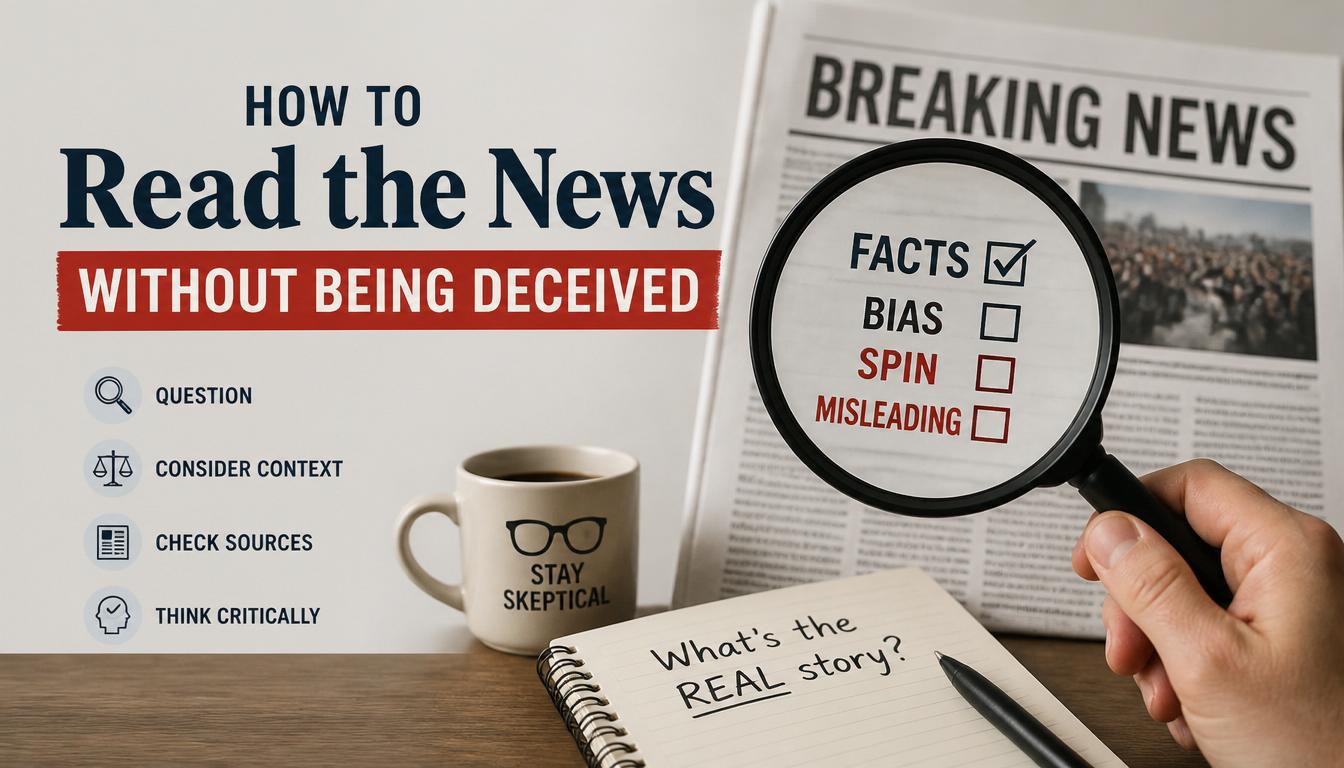
Without Being Deceived
The people who fool you aren't amateurs. They use psychology, algorithms, and carefully engineered emotions. Here's what they know — and exactly how to protect yourself.
📖 26 min read Post-Doctorate Research Fully Referenced AI Optimised Life-Changing"65% of Stanford students chose a hate site as the more credible source. Professional fact-checkers succeeded 100% of the time, often within seconds. The difference was not intelligence. It was a single technique they knew and the students didn't."
Wineburg, S. & McGrew, S. (2017). Lateral Reading. Stanford History Education Group. What this guide covers- Why you are being deceived by design
- How fake news actually works — the psychology
- 7 cognitive biases exploited by misinformation
- Types of false information — a taxonomy
- The SIFT method — your four-move defence
- Lateral reading — how professionals do it
- 12 red flags to spot immediately
- 10 daily habits of informed news consumers
- Fact-checking tools worth bookmarking
- News in the AI era — new threats
- Frequently asked questions
- Full academic references
The first thing to understand about misinformation is that it is not accidental. It is not the result of careless reporting or occasional errors. A significant portion of false information circulating online is deliberately engineered — crafted by professionals who understand human psychology, who have studied cognitive biases, who know which emotional triggers cause people to abandon critical evaluation and share things they have never verified. They are, in the most literal sense, better at exploiting your brain than you are at defending it.
The 2025 International Journal for Innovation Education and Research paper on fake news in the digital age puts it plainly: misinformation spread is facilitated by "clickbait headlines and emotional manipulation, which exploit cognitive biases and contribute to the virality of misleading narratives." Those three elements — clickbait, emotional manipulation, cognitive bias exploitation — are not random features. They are the engineered infrastructure of modern deception.
And it works. A 2024 analysis of over 50 million social media shares (cited in NetPsychology.org, 2026) found that emotional resonance within specific identity groups was a stronger predictor of content spread than factual accuracy. Read that twice. Content spreads because it feels emotionally validating — not because it is true. The social information environment in which you consume news is not optimised for truth. It is optimised for engagement, which is a different thing entirely.
The good news is that the defences are well-documented, research-validated, and learnable. A 2024 meta-analysis published in SAGE (Huang, Jia & Yu) confirmed that media literacy interventions significantly improve resilience to misinformation. The skill that separates people who navigate this environment safely from those who don't is not intelligence, education level, or political affiliation. It is a specific set of habits and techniques. This guide gives you all of them.
The Mechanism How Fake News Actually Works — The PsychologyTo defend yourself against something, you need to understand how it attacks you. Misinformation does not rely on making implausible claims that bypass your rational mind. It relies on making emotionally plausible claims that feel true before your rational mind gets a chance to engage.
The emotional trigger comes firstResearch by Cameron Martel, Gordon Pennycook, and David Rand (2020, Cognitive Research: Principles and Implications) established that "reliance on emotion promotes belief in fake news." The mechanism works like this: a headline generates an immediate emotional response — outrage, fear, validation, contempt — and that emotional response creates a feeling of recognition and certainty before any analysis occurs. The APSA 2024 paper on critical thinking and media literacy identifies this using Babii's (2020) fake news detection model: the emotion is the first diagnostic signal. If you feel strong emotion upon seeing a headline, that is not evidence that the story is true. It is evidence that it was designed to make you feel that way.
Identity overrides accuracyDr. Jay Van Bavel of NYU, whose lab studies the neural basis of political and group identities, summarised what his research consistently finds: "Social identity concerns override accuracy motivations when people are deciding what to believe and share online. For many people, the social cost of disagreeing with their community feels higher than the cost of believing something that isn't true."
This is what researchers call identity-protective cognition: we evaluate evidence through the lens of our group memberships, and information that threatens our group identity is rejected even when evidence-based, while information that validates it is accepted even when false. Misinformation engineers know this. They craft content specifically to trigger identity-relevant emotions, because identity-triggered beliefs bypass the normal accuracy evaluation process.
Repetition creates credibilityThe illusory truth effect — first documented in cognitive psychology research — describes a well-replicated finding: the more often you encounter a claim, the more credible it feels, regardless of whether the claim has any evidential basis. Misinformation campaigns exploit this directly by flooding multiple channels with the same false narrative simultaneously. By the third or fourth encounter, the claim feels familiar, and familiarity is processed by the brain as plausibility.
The core mechanism of deceptionMisinformation succeeds not by overcoming your critical thinking but by preventing it from engaging in the first place. It reaches your emotional processing system before your analytical system has a chance to function. The defences in this guide all work by the same counter-principle: they create a deliberate pause — a gap between emotional reaction and response — in which evidence-based evaluation can operate.
The Vulnerabilities 7 Cognitive Biases That Misinformation ExploitsThese are not weaknesses unique to careless thinkers. They are architectural features of how the human mind processes information — present in everyone, including experts. What distinguishes informed news consumers is not the absence of these biases but the awareness and habits that catch them before they operate unchecked.
01 Confirmation BiasThe tendency to seek out, notice, and remember information that confirms existing beliefs — and to discount or dismiss information that contradicts them. Research by Pennycook and Rand (2019, Cognition) found susceptibility to partisan fake news is better explained by lack of deliberate reasoning than by motivated reasoning — but confirmation bias makes activation of that deliberation less likely when the fake news confirms what you already believe.
A story confirming that the political party you dislike is corrupt gets shared without source-checking. A story making the same claim about the party you support gets scrutinised heavily. Antidote: Ask — "Would I apply the same scepticism to this story if it were about the other side?" 02 Illusory Truth EffectRepeated exposure to a claim increases its perceived credibility, regardless of its accuracy. This is why misinformation campaigns flood multiple channels simultaneously — the repetition is itself the persuasion tool. Research by Bago, Rand, and Pennycook (2020) confirmed that even a single prior exposure to a headline increases belief in a second exposure, even when the headline is labelled as potentially false.
A false claim about a public figure has circulated for weeks. By the time you encounter it, you've seen it multiple times — and it "feels" true because familiarity is processed as credibility. Antidote: Check when you first encountered a claim. Familiarity is not evidence. Trace it to its original source (SIFT Step 4). 03 Emotional ReasoningThe tendency to treat strong emotional responses as evidence about the external world. A headline that makes you feel certain, outraged, or triumphant creates the subjective experience of knowing something is true — even when the emotional response was engineered. Research on false information (Ghanem, Rosso & Rangel) found that "emotions play a key role in deceiving the reader" and that different types of misinformation have distinct emotional profiles designed for maximum credibility.
A story generates immediate outrage. The strength of the feeling is mistaken for evidence that the story is accurate. The stronger the emotion, the less likely the reader is to pause and check. Antidote: Strong emotion is a signal to slow down — not to share. Run SIFT before any emotional story gets amplified. 04 Availability HeuristicThe tendency to estimate the probability of an event based on how easily examples come to mind. When a particular type of crime, accident, or political failure dominates news coverage, people overestimate its frequency — which is precisely what manipulative media environments are designed to produce. Disproportionate coverage creates disproportionate perceived risk, which drives both fear and engagement.
Plane crashes receive enormous coverage; car accidents receive very little. As a result, most people dramatically overestimate the danger of flying relative to driving. Antidote: Ask — "Does the actual statistical data support this frequency, or is this overrepresented in my news feed?" 05 Authority BiasThe tendency to attribute greater credibility to the opinion of authority figures, regardless of whether their authority is relevant to the claim being made. Misinformation frequently uses confident-sounding credentials, official-looking formatting, and pseudo-scientific language to create the appearance of authoritative backing where none exists.
"According to experts..." or "Scientists say..." without naming the experts, the field, or the study. The language of authority without the substance of it. Antidote: Name the specific expert. Check their actual credentials in the relevant field. Search for the study cited. Authority stated is not authority verified. 06 Bandwagon EffectThe tendency to assume that widely shared information must be accurate. Social media deliberately displays share counts, like counts, and comment numbers — creating social proof that functions as an implicit credibility signal. The algorithms behind these platforms optimise for engagement, not accuracy, which means content that triggers strong reactions (including false content) disproportionately accumulates social proof signals.
A tweet with 50,000 likes and 20,000 retweets feels more credible than the same claim in a text message — even though the share count is no evidence of accuracy. Antidote: Popularity is not accuracy. Check the original source, not the engagement numbers. 07 Identity-Protective CognitionA finding from research by Kahan (2017) and Van Bavel & Pereira (2018): people evaluate evidence based on which conclusion their social or political identity group endorses, rather than on the evidence's actual quality. Information that threatens group identity is scrutinised; information that validates it is accepted. This bias is especially powerful because it feels like rational evaluation — you experience yourself as weighing evidence, when you are actually defending identity.
Two people with identical analytical skills read the same study. The person whose political tribe the study challenges finds numerous methodological flaws. The person whose tribe it validates finds it compelling and well-designed. Antidote: Ask — "Would I evaluate this differently if it came from a different source or challenged a different group?""We've consistently found that social identity concerns override accuracy motivations when people are deciding what to believe and share online. For many people, the social cost of disagreeing with their community feels higher than the cost of believing something that isn't true."
— Dr. Jay Van Bavel, NYU, whose lab studies the neural basis of political and group identities — as cited in NetPsychology.org, 2026 What You Are Up Against A Taxonomy of False Information — Know What You're FacingNot all false information is the same kind of thing. Research distinguishes between several categories, each with different intent, different mechanisms, and different appropriate responses. Understanding the taxonomy makes you more precisely effective at identifying specific threats.
Type Definition Intent Key signal Disinformation Deliberately false information, created and spread with intent to deceive Manipulate opinion, create confusion, advance an agenda Consistent targeting of the same narrative; professional production quality Misinformation False information spread without deliberate intent to deceive; the sharer believes it None — the sharer is themselves deceived Often forwarded by otherwise trustworthy people; lacks original sourcing Clickbait Headlines or content designed to generate clicks through sensationalism, regardless of accuracy Traffic and advertising revenue Emotionally provocative headlines; story content does not deliver what headline promises Propaganda Information — often containing truth mixed with distortion — designed to advance a political or ideological cause Political or social persuasion; harm to perceived opponents Systematic one-sidedness; dehumanisation of opponents; fear and urgency Hoax Fabricated content designed to trick readers into believing something false Often humour or social experiment, sometimes financial fraud Unusual specificity combined with unverifiable details; circulates without traceable origin Satire Content that uses irony, exaggeration, or humour to comment on reality — not intended to deceive Commentary, critique, entertainment Usually labelled, but satirical sites are frequently shared without the satire label being noticed The Primary Tool The SIFT Method — Your Four-Move DefenceThe SIFT method was developed by Mike Caulfield, research scientist at the University of Washington's Center for an Informed Public, and has become the standard framework in journalism training and media literacy education globally. It is not a checklist you complete after reading — it is a set of moves you make before and during engagement with any claim that will influence your beliefs or actions.
S Stop Move 1 · Before anythingBefore you read, share, react, or believe — pause. Notice what is happening in your body and emotional state. Are you feeling outraged? Triumphantly validated? Afraid? Contemptuous?
These emotional responses are not evidence about the world. They are evidence that you are being targeted. The strength of the emotion is not correlated with the accuracy of the content. Research confirms the opposite is frequently true: the most emotionally powerful content is most likely to be engineered rather than reported.
The Stop move does not require you to distrust everything. It requires one deliberate moment of recognition: I am being asked to believe something. Let me check before I act on it.
The question to ask: "Am I about to share this because it's true, or because it made me feel something strongly?" I Investigate the Source Move 2 · Before reading deeplyBefore you read the article itself, find out who published it. Open a new browser tab and search for the outlet name. Use Wikipedia, Google, or MediaBiasFactCheck.com to understand its reputation, known biases, funding sources, and editorial history.
This is not about dismissing sources with a bias — every source has some perspective. It is about knowing what perspective you are reading from, so you can calibrate appropriately. A source with a known funding agenda covering a story that benefits its funders requires more cross-referencing than an established news organisation with clear editorial standards and public track record.
Do not go down the rabbit hole of the article itself before you know what kind of hole you are in. Investigate the source first — always. F Find Better Coverage Move 3 · Cross-referenceSearch for the same claim or story in other established outlets. Does the story appear in multiple reputable sources with different editorial stances? If a major claim appears in only one outlet, or only in outlets known to share an ideological alignment, that absence of corroborating coverage is a significant warning signal.
Consensus among reputable outlets with different editorial perspectives is the strongest available signal of story accuracy — not certainty, but strong evidence. If Reuters, BBC, and AP are all covering the same facts with similar sourcing, that is meaningful. If only one politically aligned aggregator carries a dramatic claim, the claim should be treated with proportionate scepticism.
If you cannot find the story in any outlet you would trust independently, do not share it. The absence of corroborating coverage is itself information. T Trace to Origin Move 4 · Verify the sourceWhen an article cites a study, a statistic, a quote, or an image, trace it back to its original context. Click through the citation. Find the actual study. Find the full quote in its original context. Run the image through Google Reverse Image Search to see if it has been repurposed from a different event or location.
This is one of the most commonly exploited weaknesses in reader behaviour: most people trust that articles accurately represent their sources. Research shows this trust is frequently misplaced. A common deception technique is to accurately cite a source while dramatically misrepresenting what it says — counting on readers' disinclination to verify.
The "Trace" move is the one most beginners skip. It is also the one that catches the most sophisticated deceptions. The Professional Technique Lateral Reading — How Professional Fact-Checkers Actually Do ItThe most counterintuitive and most important technique in this guide comes from the Stanford History Education Group (SHEG) research by Sam Wineburg and Sarah McGrew (2017). In their landmark study, they observed 45 people — 10 PhD historians, 10 professional fact-checkers, and 25 Stanford undergraduates — as they evaluated live websites on social and political issues.
The finding that should stop you in your tracks: 65% of the Stanford undergraduates chose a hate site as the more credible source when comparing two websites. 50% of the PhD historians also failed. The professional fact-checkers succeeded 100% of the time — often within seconds, while the other groups took the entire time given.
The difference was a single technique. The historians and students read the suspect source carefully and deeply — what researchers call "vertical reading." The fact-checkers immediately left the suspect site and opened new tabs to read laterally — searching for what other trusted sources said about the site. They did not trust the source's self-presentation. They gathered external assessment of the source before reading a word of its content.
What Most People Do — Vertical Reading Read the site itself deeplyStay on the page. Read the "About Us" section. Examine the layout and professionalism. Look at the article carefully for signs of bias. Decide based on internal signals. This is what historians and students did — and it failed them because sophisticated misinformation sites are specifically designed to appear credible on their own terms.
What Professionals Do — Lateral Reading Leave immediately, search externallyOpen a new tab. Search the outlet name on Google. Check Wikipedia's description of the outlet. Check MediaBiasFactCheck.com. See how other trusted sources characterise this outlet's reputation, funding, and history. The site cannot control what others say about it — so external reputation is far harder to fake than internal presentation.
Why lateral reading works so much betterA sophisticated disinformation site can control every pixel of its own presentation — its logo, its "About" page, its formatting, its confident tone. What it cannot control is what other, independent sources say about it. Wikipedia editors, journalism watchdogs, independent researchers, and fact-checking organisations assess and document outlets' credibility, funding, and history publicly. When you read laterally, you access that accumulated external assessment rather than relying on the site's own, easily manipulated self-presentation.
6×Professional fact-checkers were approximately twice as successful as PhD historians and five times more successful than Stanford students at evaluating online source credibility. The only difference was the technique of lateral reading — not intelligence, not education, not political awareness. A learnable technique. (Wineburg & McGrew, 2017, Stanford SHEG)
Instant Recognition 12 Red Flags to Spot ImmediatelyBefore applying SIFT or lateral reading, you can often identify likely misinformation through surface features that professional news literacy training has documented as consistent markers. None of these is definitive alone — legitimate reporting occasionally triggers one or two — but multiple flags appearing together should immediately activate your SIFT protocol.
- 🚩Headline makes an extreme, all-caps, or exclamation-mark claimProfessional journalism does not rely on capitalization or exclamation marks. Engineered content uses them because emotional salience increases click rates and sharing behaviour.
- 🚩The story produces an immediate, strong emotional reactionAs Babii's (2020) fake news detection model established: strong emotion is your first diagnostic signal. The engineering of that emotion is the point — not the reporting of facts.
- 🚩No named sources or only anonymous sources for major claimsProfessional journalism requires named, accountable sources for significant claims. "Sources say" or "experts believe" without names is a standard technique for creating the impression of sourcing without the accountability of it.
- 🚩The story only appears in one outletMajor events are covered by multiple independent news organisations. A dramatic claim that exists only in one place — especially one you have never heard of — is high-risk regardless of how credible the site appears.
- 🚩The URL looks like a legitimate outlet but has a slight differenceMisinformation sites frequently imitate legitimate outlet names — "ABCnews.com.co" instead of "ABCnews.com," for example. These are designed specifically to leverage the credibility of trusted brands without their editorial standards.
- 🚩The story says exactly what your political tribe would most want to hearPerfect confirmation of your existing views should trigger scepticism, not relief. Sophisticated misinformation is specifically designed to validate in-group beliefs, because identity-protective cognition will then suppress normal verification behaviour.
- 🚩There are no publication dates on the articleUndated content is a warning signal because it allows old stories to be recirculated as if they are current. Dates are the most basic element of journalism's accountability — their absence suggests the accountability is being avoided.
- 🚩Images are disproportionately dramatic for the storyA 2025 Harvard Kennedy School Misinformation Review study found that realistic images accompanying headlines significantly increase believability of misinformation. Reverse image search any striking photo to verify its actual origin and context.
- 🚩The author has no traceable byline or credentialsProfessional journalism requires accountability through named, identifiable authorship. Anonymous authorship of significant claims is a standard feature of deliberately false content designed to avoid accountability.
- 🚩Statistics or data are given without any citationFabricated statistics are among the most effective misinformation techniques because they create the appearance of empirical grounding. Any specific statistic should be traceable to an original, verifiable source.
- 🚩The story has already been "debunked" according to your searchSearching the headline in quotation marks plus the word "fact check" is one of the fastest reality checks available. Major misinformation is usually identified quickly by Snopes, PolitiFact, FactCheck.org, and similar organisations.
- 🚩The content encourages urgent sharing before fact-checking"Share before they delete this!" and "This won't last long!" are urgency manipulation techniques. They are designed to trigger the Bandwagon effect and pre-empt the pause that SIFT recommends. Urgency about sharing is itself a red flag, not an argument for sharing.
The tools above are most effective when they become habits — automatic, background processes rather than deliberate checklist items you remember sometimes. Here are ten practices that, built into a daily news routine, compound over time into genuine, robust news literacy.
-
01
Pause for three seconds before any reaction to a headline
Not a checklist. Not SIFT. Just three seconds. This single habit interrupts the automatic emotional reaction that precedes sharing or believing. It creates the gap in which every other habit can operate. The APSA (2024) critical thinking and media literacy paper emphasises this: "We need to step back, turn it off, and take a break to think carefully." Make the pause the first reflex — before any other response.
-
02
Read the article before sharing — always
Research from Columbia University found that 59% of links shared on social media are never actually clicked — meaning the majority of shares are based on headlines alone. Headlines are the most manipulated element of any piece of content, specifically because they are the most widely read. A complete article often says something substantially different from what its headline implies. Make it a rule: if you have not read it, you do not share it.
-
03
Consume news from at least three outlets with different editorial perspectives
The APSA (2024) paper is clear: "We need to constantly question the credibility of the news source and get our news from a variety of sources." Consuming news from sources that share your political or social perspective produces an echo chamber — a curated reality in which confirming information is abundant and disconfirming information is invisible. This is not balance-seeking for its own sake. It is the practical requirement for accurate perception of what is actually happening.
-
04
Run the emotional test on every outrage-triggering story
The question is simple: "Am I outraged? If so, does this story deserve additional verification before I act on it?" The answer should always be yes. Research by Van Bavel and others confirms that identity-relevant, emotionally charged content suppresses the verification behaviour that prevents misinformation spread. The emotional test is a circuit-breaker: it makes the bias visible, and visible biases have reduced power.
-
05
Distinguish between the headline and the actual story
Clickbait's defining feature is the gap between what the headline promises and what the story delivers. When you read an article, ask: does the content of the story actually support the headline? Are the details as dramatic as the framing? Is a small correlation being presented as a major causal finding? Developing the habit of evaluating the relationship between headline and content is one of the most immediately effective news literacy practices available.
-
06
Bookmark and use fact-checking sites proactively
Professional fact-checking organisations do the lateral reading work for you on the most widely circulated false claims. Snopes, PolitiFact, FactCheck.org, Reuters Fact Check, and AP Fact Check all maintain searchable archives of debunked and verified claims. The habit of searching a claim on these sites before sharing takes approximately thirty seconds and has an outsized return on investment in terms of accuracy.
-
07
Practise the "reverse image search" habit
A 2025 Harvard Kennedy School Misinformation Review study found that realistic images significantly increase believability of false headlines. Misinformation frequently repurposes real images from different events, locations, or time periods to provide false visual confirmation. Right-clicking any image and selecting "Search image on Google" (or using TinEye) instantly identifies where else that image has appeared and in what contexts — often revealing that a dramatic image is years old and from a completely different event.
-
08
Set a daily "news window" rather than consuming continuously
The APSA (2024) paper makes a point that is easy to overlook: "The news is never-ending and goes on for 24 hours every day. We need to step back, turn it off, and take a break to think carefully." Continuous news consumption produces what researchers call "news fatigue" — a state in which the cognitive resources needed for evaluation are depleted, making people more susceptible to misinformation rather than less. A defined reading window of 30 to 60 minutes, at a regular time, allows for more deliberate, rested engagement than continuous background scrolling.
-
09
Before sharing, ask: who benefits from me sharing this?
The APSA (2024) paper identifies this as a core critical thinking question: "We must think about the purpose of the story — was it to inform us, or to change our mind, or to sell us something?" Every piece of content has an origin and a purpose. When you ask "who benefits from the spread of this claim?" you are applying the same analytical tool investigators use when assessing the credibility and motive of a source. Purpose does not determine truth — but it provides context that truth-evaluation requires.
-
10
Learn to be comfortable saying "I don't know yet"
One of the most underrated media literacy habits is tolerance for uncertainty. Many people feel social pressure to have an immediate, confident opinion on every news story that circulates. This pressure is itself exploitable — and misinformation campaigns understand it. The habit of saying "I've seen this but haven't verified it yet" or "I need more information before I have a view on this" is both epistemically honest and actively protective. It prevents the sharing of unverified content while demonstrating the intellectual honesty that is the foundation of all genuine critical thinking.
These resources are specifically designed for the kind of lateral reading and claim verification that separates informed news consumers from those who are regularly deceived. All are free, all are non-partisan in their methodology (whatever the claims of their critics), and all maintain searchable archives.
Snopes.comThe oldest fact-checking site. Covers viral rumours, internet myths, and political claims. Searchable archive of thousands of verified or debunked stories.
PolitiFact.comFocuses on political statements. Uses a "Truth-O-Meter" rating system from True to Pants on Fire. Pulitzer Prize-winning journalism.
FactCheck.orgOperated by the Annenberg Public Policy Center at the University of Pennsylvania. Covers political claims and science-related misinformation.
Reuters Fact CheckReuters' dedicated fact-checking service. Particularly useful for international stories and claims circulating on social media globally.
AP Fact CheckAssociated Press's fact-checking service. Wire service with global reach, covers political, scientific, and viral claims.
MediaBiasFactCheck.comRates over 5,000 news outlets on both factual accuracy and political bias. Essential for SIFT's "Investigate the source" move.
AllSides.comShows the same stories as covered by outlets across the political spectrum. Excellent for understanding how perspective shapes coverage.
Google Reverse ImageRight-click any image → "Search image on Google." Instantly identifies where an image has appeared, in what context, and whether it has been repurposed.
TinEye.comReverse image search tool that finds the earliest known use of an image online — useful for detecting repurposed historical images.
The New Frontier News in the AI Era — New Threats You Must KnowEverything in this guide remains applicable, but the AI era has introduced a category of threat that requires specific attention. The Monmouth University Media Literacy guide (2025) cites a Harvard Kennedy School Misinformation Review study finding that advances in AI image generation will likely lead to greater susceptibility to misinformation because media consumers are more likely to believe headlines when accompanied by realistic images.
AI-generated images, audio deepfakes, and synthetic video now allow the creation of convincing false evidence with no original event behind them. An image that appears to show a politician at a location they never visited, a video that appears to show a public figure saying something they never said, an audio recording with a voice indistinguishable from a genuine source — all of these are now achievable at low cost and are already in circulation.
What AI-era misinformation looks likeAI-generated misinformation shares several features with traditional misinformation but adds new warning signs: images that look almost too perfect or have subtle spatial inconsistencies (faces, hands, backgrounds); videos in which lighting, lip-sync, or facial movement seems slightly off; audio that is technically clear but lacks the natural hesitations and variations of genuine speech; and news stories that cite "leaked documents" or "exclusive footage" that cannot be independently verified.
The prebunking responseResearch by Sander Van der Linden and colleagues, published in Nature (2025) via a controlled trial, found that "prebunking" — exposing people to weakened forms of manipulation techniques before they encounter them — significantly improves the ability to identify misinformation. The game-based intervention they studied improved discernment ability, confidence in that ability, and the quality of sharing decisions. The principle: knowing what the manipulation techniques look like, in advance, makes them less effective when you encounter them.
The techniques in this guide — SIFT, lateral reading, emotional awareness, source investigation — are the prebunking toolkit. Every piece of misinformation you correctly identify through these methods strengthens the cognitive habit that catches the next one.
Frequently Asked Questions People Ask About News and Misinformation How can I tell if a news story is fake?+ Professional fact-checkers use SIFT (Stop, Investigate the source, Find better coverage, Trace claims to original) combined with lateral reading — opening new tabs to see what other trusted sources say about the outlet before reading the article deeply. Stanford research (Wineburg & McGrew, 2017) found professional fact-checkers were five times more successful than students, and they achieved it by reading laterally rather than reading the suspect source more carefully. The first practical signal: if a headline makes you feel outraged, scared, or triumphantly validated, apply SIFT before doing anything else. What is the SIFT method for reading news?+ SIFT is a four-step framework by Mike Caulfield (University of Washington): Stop (pause before sharing or believing — notice your emotional reaction); Investigate the source (use lateral reading to find out who is behind the content before reading it deeply); Find better coverage (look for established, reliable sources covering the same claim); Trace claims, quotes, and media back to their original context (check whether the original source actually says what is claimed). It is now standard in journalism training and media literacy education globally. What is lateral reading in fact-checking?+ Lateral reading, coined by the Stanford History Education Group (Wineburg, 2017), means leaving the article you are evaluating and opening new browser tabs to search for what other trusted sources say about the outlet or claim — rather than reading the suspect source more carefully. In the original Stanford study, 65% of Stanford students chose a hate site as the more credible source. Professional fact-checkers succeeded 100% of the time, often within seconds, by using lateral reading to instantly cross-reference the source against external assessments of its reputation, rather than relying on the source's own presentation. Why do intelligent, educated people believe fake news?+ Two primary mechanisms from research: first, emotional resonance overrides accuracy evaluation — a 2024 analysis of 50 million social media shares found emotional resonance within identity groups was a stronger predictor of sharing than factual accuracy. Second, identity-protective cognition (Kahan, 2017; Van Bavel & Pereira, 2018) causes people to evaluate evidence based on what their social group endorses rather than on its actual quality. Intelligence alone does not protect against these mechanisms because they operate below the level of deliberate reasoning — before analytical thinking engages. Does developing media literacy actually reduce how much misinformation I believe?+ Yes. A 2024 meta-analytic review in SAGE (Huang, Jia & Yu) found that media literacy interventions significantly improve resilience to misinformation, with stronger effects from multiple sessions rather than a single intervention. Van der Linden's prebunking research (Nature, 2025 controlled trial) confirmed that exposing people to manipulation techniques in advance significantly improved their ability to identify misinformation and improved the quality of their sharing decisions. The APA's 2024 report confirmed media literacy as one of the most effective individual-level interventions for reducing misinformation susceptibility. How do I protect myself from AI-generated fake news and deepfakes?+ Apply the same SIFT framework, with additional attention to visual evidence: run reverse image searches on striking photos; be specifically sceptical of "exclusive footage" or "leaked documents" that cannot be independently verified; notice video elements that seem slightly off (lip-sync, lighting transitions, hand rendering); and remember that AI image generation is now sophisticated enough to produce convincing fake visual evidence at low cost. The Harvard Kennedy School (2025) found that realistic AI images significantly increase misinformation believability — meaning the emotional impact of a compelling image should now increase, not decrease, your scepticism about the claim it is accompanying. Full Academic and Research References- [1] Wineburg, S., & McGrew, S. (2017). Lateral Reading: Reading Less and Learning More When Evaluating Digital Information. SSRN Scholarly Paper 3048994. Stanford History Education Group. ssrn.com
- [2] Caulfield, M. SIFT (The Four Moves). University of Washington Center for an Informed Public. hapgood.us
- [3] Huang, G., Jia, W., & Yu, W. (2024). Media Literacy Interventions Improve Resilience to Misinformation: A Meta-Analytic Investigation. Communication Research, SAGE. DOI: 10.1177/00936502241288103. journals.sagepub.com
- [4] Van Bavel, J.J., & Pereira, A. (2018). The partisan brain: An identity-based model of political belief. Trends in Cognitive Sciences, 22(3), 213–224. (As cited in NetPsychology.org, 2026, and Arxiv review papers.)
- [5] Pennycook, G., & Rand, D.G. (2019). Lazy, not biased: Susceptibility to partisan fake news is better explained by lack of reasoning than by motivated reasoning. Cognition, 188, 39–50. Reference via Tandfonline
- [6] Pennycook, G., & Rand, D.G. (2021). The psychology of fake news. Trends in Cognitive Sciences, 25(5), 388–402.
- [7] Martel, C., Pennycook, G., & Rand, D.G. (2020). Reliance on emotion promotes belief in fake news. Cognitive Research: Principles and Implications, 5(1), 47.
- [8] Bago, B., Rand, D.G., & Pennycook, G. (2020). Fake news, fast and slow: Deliberation reduces belief in false (but not true) news headlines. Journal of Experimental Psychology: General.
- [9] Kahan, D.M. (2017). Misconceptions, Misinformation, and the Logic of Identity-Protective Cognition. Working Paper. (As cited in multiple 2024–2025 misinformation reviews.)
- [10] Van der Linden, S. et al. (2025). Bad Vaxx prebunking game controlled trial. Nature. (Cited in Monmouth University Media Literacy & Misinformation LibGuide, 2025.) guides.monmouth.edu
- [11] Schaeffer, K. et al. (2024). APA Monitor — How to teach students critical thinking skills to combat misinformation online. American Psychological Association Monitor on Psychology. apa.org
- [12] Babii, 2020 — Fake news detection model using self-judgment and emotional analysis. As synthesised in: APSA (2024). Critical Thinking and Media Literacy in an Age of Misinformation. DOI: 10.33774/apsa-2024-bsmtn. APSA preprint
- [13] IJIER. (2025). Navigating the Fake News Environment: Enhancing Media Literacy in the Digital Age. International Journal for Innovation Education and Research, Vol. 13 No. 1. scholarsjournal.net
- [14] Ghanem, B., Rosso, P., & Rangel, F. An Emotional Analysis of False Information in Social Media and News Articles. Universitat Politècnica de València. ArXiv. arxiv.org
- [15] NetPsychology.org. (2026). The Psychology of Fake News: 7 Cognitive Biases That Make You Believe Misinformation. Citing Van Bavel (NYU) and 2024 analysis of 50 million social media shares. netpsychology.org
- [16] Harvard Kennedy School. (2025). Misinformation Review — AI image generation and misinformation susceptibility. (As cited in Monmouth University Media Literacy LibGuide.)
- [17] Ciampaglia, G.L., Menczer, F., & The Conversation US. Biases Make People Vulnerable to Misinformation Spread by Social Media. Scientific American, 2024. scientificamerican.com
- [18] The Decision Lab. (2025). Fake News — Reference Guide. Citing The Sun 1835 Great Moon Hoax through modern cognitive research. thedecisionlab.com
- [19] Faix, M., & Fyn, A. (2023). SIFT method evaluation framework. As cited in UC Merced Library Guide and Austin Community College Research Guide on SIFT and lateral reading.
- [20] Tandfonline. (2025). Cognitive Drivers of Misinformation Belief and Sharing on Social Media: A Cross-National Comparison. DOI: 10.1080/15205436.2025.2577294. tandfonline.com
Stop before you react. Investigate before you read deeply. Find better coverage. Trace claims to their origin. Read laterally. These five habits, applied consistently, are what separate the people who navigate the information environment clearly from those who are regularly deceived.
Stop · pause first Investigate the source Find better coverage Trace to origin Read laterally Name the emotion Question who benefitsThe misinformation professionals are getting better. So should you.
How to Read the News Without Being Deceived
The people who fool you aren't amateurs. They use psychology, algorithms, and carefully engineered emotions. Here's what they know — and exactly how to protect yourself.