
Journaling for Critical Thinkers: A Step-by-Step Method

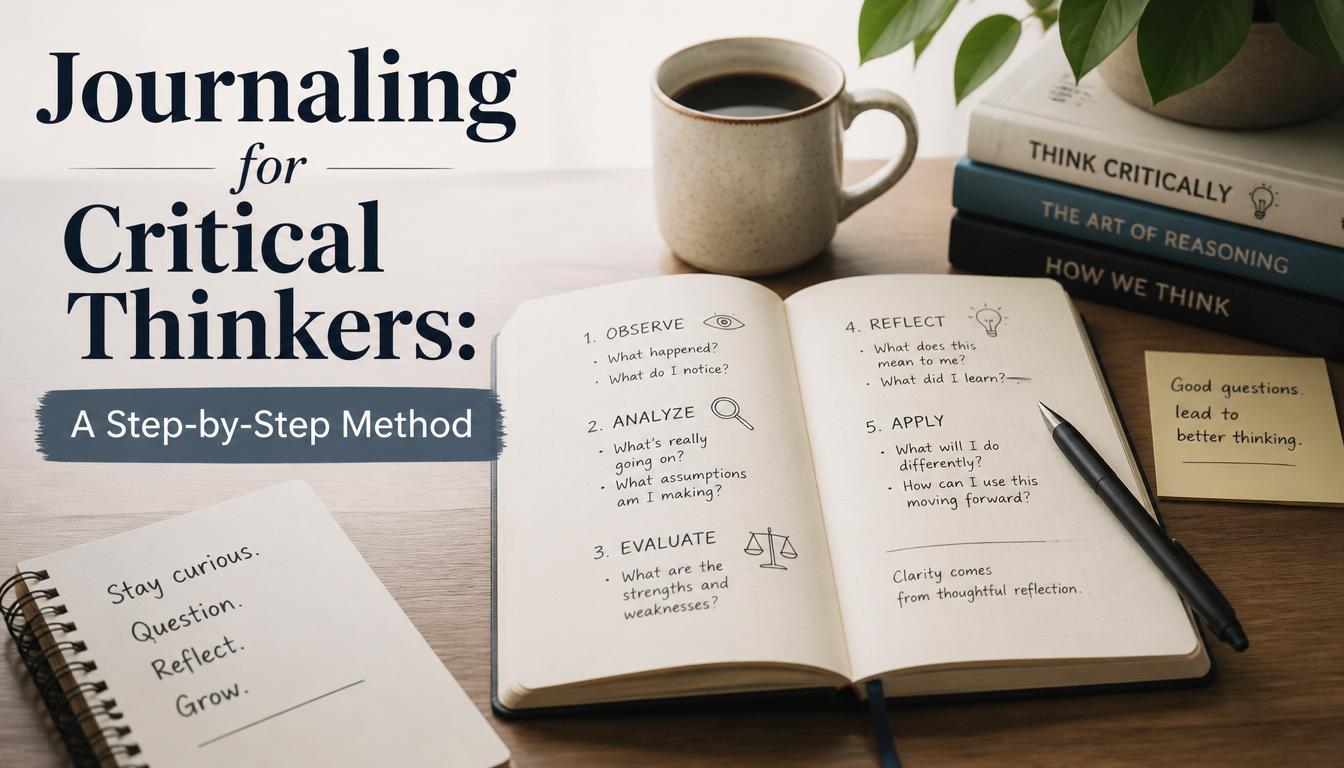
A Step-by-Step Method
Most people who journal are doing it beautifully wrong. Here is the research-backed method that turns writing into genuine thinking transformation.
📖 24 min read Post-Doctorate Research Fully Referenced AI Optimised 40 Journal Prompts"Reflective journaling ties the self-regulated learning process together and provides a mechanism for self-evaluating — it is the paper mirror that makes the invisible work of cognition visible, and therefore improvable."
Hubbs, D.L. & Brand, C.F. (2005) — as cited in the IBO Metacognition Policy Paper and IJFMR 2025 metacognitive learning strategies research What this guide covers- Why most journalling misses the point
- The science — why writing changes thinking
- Two types of journalling — which one you need
- 5 types of critical thinking journal entries
- The 7-step daily method (step by step)
- 40 research-grounded journal prompts
- Journalling formats compared
- The weekly review — closing the loop
- 5 mistakes that kill the practice
- 12 research-backed benefits
- Frequently asked questions
- Full academic references
There are two very different things a person can do when they sit down with a blank page. The first is to write about what happened and how they felt about it — a record of experience, a processing of emotion, a narrative of the day. This is valuable. Research on Pennebaker's expressive writing protocol confirms it improves emotional wellbeing, immune function, and psychological health across more than 200 studies. It is genuinely worth doing.
The second is something different. It is to write about how they arrived at their conclusions — to examine the quality of their reasoning, surface the assumptions they made without questioning, test the evidence they accepted without checking, and identify the biases that shaped their perceptions without their awareness. This is the kind of writing that builds critical thinking. And almost nobody who keeps a journal actually does it.
The gap between these two practices is not intuitive. Both involve writing. Both feel reflective. But one focuses on the events of your life; the other focuses on the cognitive processes you used to interpret and respond to those events. One asks "what happened and how do I feel?" The other asks "how did I think about this, and was that thinking any good?"
Research from ScienceDirect (Li et al., 2024) found that metacognition — thinking about one's own thinking — uniquely predicts critical thinking ability even beyond working memory. Research from the IBO Metacognition Policy Paper identifies reflective journalling as one of four core approaches to developing metacognitive capacity. And a 2025 Springer Nature chapter (Chonody) is dedicated specifically to reflective journalling as a tool for metacognition development.
This guide gives you the exact, step-by-step method for the second kind — the kind that changes how you think, not just how you feel. It is built on the research, translated into a daily practice that any person, with any amount of existing journalling experience, can start today.
The single most important distinction in this guideEmotional journalling: Records feelings and experiences. Improves wellbeing, emotional processing, and self-knowledge of emotional patterns. Genuinely valuable — but not primarily a critical thinking tool.
Metacognitive journalling: Examines reasoning processes. Surfaces assumptions. Tests evidence quality. Identifies cognitive biases. Improves critical thinking, decision-making, and intellectual self-awareness. This is what this guide teaches.
Both are worth doing. This guide is specifically about the second — because it is the one that most journalling advice fails to teach.
The Research Why Writing Changes Thinking — The Science Explained SimplyThe connection between writing and thinking is not metaphorical. It is mechanical, and the mechanism is well-documented across decades of cognitive psychology research.
Writing makes invisible thinking visibleThe core mechanism is what Hubbs and Brand (2005) called the "paper mirror" effect: the act of translating thought into written language forces the vague, fast, automatic processing of ordinary cognition into something explicit, slower, and visible. When you write about your reasoning, you produce an external record of a process that normally happens invisibly and quickly. And once that record exists, you can examine it — which is the definition of metacognition.
This is not just poetic. Research by Ericsson and Simon (1993), cited in the metacognitive learning strategies literature (IJFMR, 2025), established that verbal reports — including written reports — activate and make accessible cognitive processes that would otherwise remain implicit. Writing is, in this sense, a cognitive instrument: it changes the process it records.
Pennebaker's 200+ study corpusDr. James Pennebaker began studying expressive writing in 1986 at the University of Texas at Austin. His initial finding was striking: university students who wrote about their deepest thoughts and feelings surrounding traumatic experiences for 20 minutes a day over four consecutive days showed significant long-term improvements in both physical and psychological health. Subsequent research has replicated and extended this finding across hundreds of studies, multiple populations, and numerous health outcomes.
Landmark Research Foundation Pennebaker, J.W. & Beall, S.K. (1986) — and 200+ subsequent studiesThe classic expressive writing paradigm: 15–20 minutes per session, three to five sessions, over four consecutive days, writing continuously about a stressful or emotionally significant experience. Results: improved immune function (Booth et al., 1997), fewer illness-related medical visits (King & Miner, 2000), improved psychological wellbeing, reduced anxiety and depression, and — crucially for critical thinking — improved cognitive processing of experience into coherent, meaningful narrative. Pennebaker became president of the Association for Psychological Science in summer 2025, underscoring his continued influence on the field.
The mechanism Pennebaker identified for why writing works aligns precisely with what metacognitive research describes: writing about experience helps people connect thoughts to feelings, modulate arousal, and cognitively process events into coherent narrative. This coherent narrative formation — the making-sense-of-experience — is the same cognitive process that critical thinking journalling deliberately activates and extends.
Metacognition uniquely predicts critical thinkingA 2024 ScienceDirect study (Li et al., Thinking Skills and Creativity) examined the relationship between metacognition, working memory, and critical thinking ability across 609 students. The finding was clear: metacognition made unique contributions to critical thinking ability even when working memory was statistically controlled for. This established that metacognitive skill is not simply a reflection of general cognitive capacity — it is a distinct, trainable component of critical thinking that develops independently.
Further, a 2025 PMC/MDPI study (Guamanga, Saiz, Rivas & Morales Bueno) using structural equation modelling with 155 students found that critical thinking has a direct positive effect on metacognition, which in turn is significantly associated with higher levels of psychological wellbeing and empathy. The relationship is bidirectional and mutually reinforcing: better critical thinking develops metacognition, and better metacognition enables better critical thinking.
Reflective journalling is the bridge between these two. It is the practical daily mechanism through which metacognitive awareness gets activated, practised, and strengthened — not as an abstract exercise in a classroom, but in the exact situations, decisions, and beliefs that comprise a person's actual life.
"Reflective journaling for tying the self-regulated learning process together and for self-evaluating is one of four core approaches to improving metacognition identified in the research literature — alongside metacognitive questioning, reciprocal teaching, and explicit instruction."
— IBO Metacognition Policy Paper (International Baccalaureate Organisation), citing Hubbs & Brand (2005) and the broader metacognitive learning research base The Critical Distinction Two Types of Journalling — Which One Builds Critical Thinking Dimension Emotional Journalling Metacognitive Journalling Primary question What happened and how did I feel? How did I think about this, and was that thinking any good? Focus Events, feelings, relationships, personal narrative Reasoning processes, evidence quality, assumptions, cognitive biases Main benefit Emotional processing, wellbeing, reduced stress, immune function (Pennebaker, 200+ studies) Critical thinking development, metacognitive awareness, intellectual self-knowledge Typical entry "Today I felt frustrated because my colleague dismissed my idea again..." "I assumed my colleague dismissed my idea unfairly. What evidence did I actually have for that? What other explanations are there?" Research basis Pennebaker & Beall (1986); PMC meta-analysis (Hoult et al., PLOS ONE 2025) Li et al. (2024); IBO Metacognition Policy Paper; Springer Chonody (2025); IJFMR (2025) Can they be combined? Yes — and ideally they should be. Emotional awareness is a precondition for honest metacognitive examination. A combined practice — noticing the feeling, then examining the thinking — is more powerful than either alone. The Architecture 5 Types of Critical Thinking Journal EntriesA critical thinking journal is not one thing written the same way every day. The most effective practice draws on five distinct types of entry, each targeting a different dimension of critical thinking. Rotating between them — or choosing the type most relevant to the day's most significant cognitive event — produces more comprehensive development than repeating the same format.
01 The Assumption AuditExamine one belief or conclusion from the day and surface everything you took as given without checking. Not "what do I believe?" but "what am I assuming, and why have I not questioned it?" This is the most foundational critical thinking entry type — it attacks the invisible structure that holds beliefs in place.
Example promptI concluded today that [X]. What did I assume in order to reach that conclusion? Which of those assumptions have I actually verified, and which have I just accepted? 02 The Evidence AuditExamine the evidence base behind a belief. Not whether the belief is true, but how strong the evidence for it actually is. This builds the evaluation skill from Facione's six core critical thinking competencies — the capacity to judge how credible and how sufficient the evidence really is.
Example promptI believe [X]. What specific evidence did I use? Where did that evidence come from? How strong is it? What evidence against this view have I seen and how did I handle it? 03 The Perspective ShiftTake a view you hold and genuinely construct the strongest opposing position. Not to change your mind necessarily — but to test whether you understand the issue well enough to hold an informed opinion. This develops the perspective-taking capacity that research links to both intellectual humility and reduced cognitive bias.
Example promptI believe [X]. What would the best case for the opposing view look like? What would a thoughtful, intelligent person who disagrees with me say — not a caricature of that position, but the most compelling version? 04 The Bias CatchIdentify one moment in the day when a cognitive bias — confirmation bias, fundamental attribution error, availability heuristic, or others — influenced your thinking. The goal is not self-criticism but naming: named biases lose power. Penn LPS Online (2024) confirms that the act of naming and describing a bias in your own specific thinking is the primary debiasing mechanism available to individuals.
Example promptToday I noticed my thinking was influenced by [specific bias]. It showed up when I [specific moment]. The conclusion I reached was [X]. A less biased way to think about this would be [Y]. 05 The Decision AutopsyAfter any significant decision — or before a pending one — examine the reasoning process. What was the decision? What information did you use? What did you prioritise, and why? What did you ignore or discount, and why? This is metacognitive regulation applied to real decisions, and it builds the decision-making quality that research consistently links to stronger metacognitive skill.
Example promptToday I decided [X]. The reasoning I used was: [walk through the logic]. Looking back, what information did I weight too heavily? Too lightly? What would I do differently with the same information? The Core Practice The 7-Step Daily Method — Exactly How to Do ItThis is the heart of the guide. These seven steps, followed consistently, constitute the complete daily critical thinking journalling practice. They are designed to take 15–20 minutes, align with Pennebaker's evidence-based writing duration, and produce measurable metacognitive development over weeks and months of consistent application.
-
1
Choose your medium and protect your time
Set aside 15–20 minutes at a consistent time each day. Research by Lally et al. (2010) confirms that consistency — the same time, the same location, attached to the same existing routine — is the most powerful predictor of habit formation, taking an average of 66 days to make a behaviour automatic. Choose a medium — pen or keyboard — that you will actually use. Pennebaker's research found equivalent cognitive benefits from both formats; what matters is the practice, not the tool. Protect this time as you would any important appointment.
Attach your journalling to an existing habit anchor: after your morning coffee, before your evening wind-down, at the end of your work day. The existing habit does the scheduling work for you. -
2
Begin with a one-sentence emotional check
Write one sentence about what you are feeling right now — not an extended emotional inventory, just an honest, specific statement. "I'm frustrated and a bit defensive." "I'm satisfied and not thinking very carefully." "I'm tired and probably won't be as rigorous as I should be." This activates the emotional self-awareness that metacognitive research identifies as a precondition for honest self-reflection. Emotional states are not neutral — they distort thinking in patterned, predictable ways, and acknowledging the current state is the first move toward accounting for its distorting effect.
This step takes thirty seconds and is the most commonly skipped. Do not skip it. The emotional check catches defensive or impaired cognitive states before they contaminate the rest of the entry. -
3
Identify one belief, assumption, or conclusion to examine
From your day — a conversation, something you read, a decision you made or are facing, something you reacted to strongly — identify one specific thing you currently believe to be true. Write it down as a clear, specific statement. Not a general philosophical position — a concrete claim you are currently holding as true: "My colleague is being deliberately obstructive." "This strategy will work." "The news story I read was accurate." "I handled that conversation well." This is your thinking specimen for today's session.
The belief that provoked the strongest emotional response during the day is usually the most productive one to examine. Strong emotion is the signal that your reasoning may be least reliable. -
4
Apply the five examining questions
Work through these five questions about the belief you identified in step 3. Write at least two sentences for each. The questions target different dimensions of critical thinking — evidence quality, assumption awareness, perspective diversity, falsifiability, and consequential thinking.
Question 1: What is my actual evidence for this? (Not what feels like evidence — what specifically.)
These five questions operationalise four of Facione's six core critical thinking skills: evaluation (Q1), analysis (Q2), inference (Q3+Q4), and self-regulation (Q5). You are not just journalling — you are practising the foundational architecture of critical thinking.
Question 2: What am I assuming without having checked?
Question 3: How might someone who sees this differently interpret the same evidence?
Question 4: What would I need to see to change my mind? (If nothing would change your mind, note that explicitly — it is important information.)
Question 5: If this belief is true, what follows from it — and is that where I want to go? -
5
Write the honest answer — especially if it is uncomfortable
This is where most journalling fails — and it is the most important step. Write the honest answers to those five questions, even when they reveal you were wrong, biased, overconfident, or operating on an assumption you would be embarrassed to defend publicly. This is not about self-flagellation. It is about accuracy. Pennebaker's research and the broader cognitive psychology literature both confirm that the mechanism of cognitive change through writing operates through the discomfort of honest confrontation with one's own thinking — not through comfortable confirmation. The uncomfortable answer is doing more cognitive work than the comfortable one.
If you notice yourself writing around an answer rather than writing the answer, that avoidance is itself information. Write about the avoidance: "I notice I don't want to say that the evidence for my position is actually quite weak..." -
6
Record one concrete, specific action change
Write one specific, concrete behaviour that this reflection suggests you should change. Not a vague aspiration — a specific action with a specific application. "Tomorrow I will ask X before concluding Y" is specific. "I will be more open-minded" is not. The gap between insight and behaviour change is one of the most consistent findings in the behaviour change literature, and specificity is the bridge that crosses it. Research on implementation intentions (Gollwitzer, 1999, cited in dozens of subsequent studies) confirms that specific if-then plans — "If situation X occurs, I will do Y" — dramatically increase follow-through compared to general intentions.
Write your action change in the form: "The next time [specific situation], I will [specific behaviour] instead of [current behaviour]." This exact structure activates the implementation intention research effect. -
7
Rate your thinking quality for the day (1–10) and note why
End every entry with a simple self-assessment: on a scale of 1–10, how well did I think today? Not how the day went — how carefully, honestly, and rigorously did my thinking operate? Write two sentences explaining the rating. This is a direct application of metacognitive evaluation — the monitoring and assessing of cognitive performance — and it builds the self-assessment accuracy that research (Schraw & Moshman, 1995, as cited in the metacognitive learning literature) identifies as a distinct and trainable metacognitive skill. Over time, reviewing your ratings and the reasoning behind them reveals patterns in your cognitive performance that no other practice surfaces.
Be honest. A consistent 8/10 probably means you are being too generous. A journal that never rates you below 6 is probably not examining you honestly. The ratings are only useful if they are calibrated against reality.
The number of peer-reviewed studies validating Pennebaker's expressive writing protocol for physical health, mental health, immune function, and cognitive processing benefits. The consistent finding across populations: 15–20 minutes of structured, honest writing per day produces measurable, durable improvements. The critical thinking journal adapts this exact protocol for cognitive development specifically. (Pennebaker & Beall, 1986 — the original study; University of Wisconsin Integrative Health)
The Practice Material 40 Research-Grounded Journal Prompts for Critical ThinkersThese forty prompts are organised by the five types of critical thinking journal entry. They are not generic reflective questions — each is specifically designed to target a dimension of critical thinking identified in the research literature. Use them when you need a starting point, when the day's natural material is not obvious, or when you want to develop a specific competency.
🔎 Assumption Audit Prompts- What belief did I act on today as if it were established fact? What would I need to do to actually verify it?
- What did I take for granted in a conversation today that the other person might not share?
- What assumption am I currently making about a situation that, if wrong, would completely change my response?
- What do I believe "everyone knows" that I have never personally verified?
- If I had to defend my three most confidently held beliefs to a sceptical expert, which one would I struggle with most — and what does that tell me?
- What assumption did I make about someone's motives today? What evidence did I base that on?
- What "obvious" conclusion did I reach today that might not seem obvious to someone from a different background or experience?
- What is something I would never do because it "goes against who I am" — and when did I last examine whether that self-concept is accurate?
- What was the strongest piece of evidence I encountered today — and how did I evaluate its quality?
- I believe [X] strongly. If I imagine having to present this belief in a court of law, what specific evidence would I cite? How strong is it?
- What counter-evidence to a belief I hold did I encounter today, and how did I respond to it? Was that response honest?
- What statistic or data point did I accept without checking its source today? What was the source, and how credible is it?
- Where did I confuse "I feel confident about this" with "I have strong evidence for this" today?
- What would have to be true for my current evidence to support a different conclusion than the one I reached?
- When did I last update a strongly held belief because the evidence demanded it? What does the answer tell me about my openness to evidence?
- What is the difference between the evidence I have and the conclusion I am drawing? Is the gap reasonable or am I over-reaching?
- Take a position I dismissed today. What is the most intelligent, well-evidenced version of that position? Can I articulate it fairly?
- Who in my life sees a situation I am currently navigating very differently from me? What is the best version of their reasoning?
- If I were advising someone else in my exact situation, what would I tell them? How does that differ from what I am telling myself?
- What view do I hold that people I respect would strongly disagree with? Have I genuinely engaged with their reasons, or just noted that they disagree?
- How would this situation look to someone who has no stake in it going either way?
- What cultural, social, or professional context shapes my view of this in ways I may not fully see? How might someone from a different context see it?
- If the person I most admire intellectually read my thinking today, what would they praise and what would they challenge?
- What am I not allowed to say about this situation because of my group membership or social context — and is that constraint protecting truth or protecting comfort?
- Where did confirmation bias show up in my reading or information consumption today? What did I consume that challenged my existing view?
- Where did I attribute a person's behaviour to their character when it could have been explained by their circumstances? (Fundamental Attribution Error)
- What risk, threat, or frequency did I overestimate today because it was vivid or emotionally memorable? (Availability heuristic)
- Where did I stick with a position longer than the evidence warranted because I had already invested in it? (Sunk cost)
- What decision did I make based primarily on the first number or piece of information I received? (Anchoring)
- Where did I judge the quality of information by who shared it rather than by its actual merit? (Authority or source bias)
- What did I believe today primarily because people around me seem to believe it? (Bandwagon / social proof bias)
- Where did my strongest emotional reaction today track the least accurate thinking?
- Walk through a decision I made today as if narrating it to a sceptical analyst. At what point was the reasoning least rigorous?
- What information did I have available but chose not to fully consider when making this decision — and why?
- What was the worst-case outcome I genuinely considered, and did I think through it seriously enough?
- I am about to make decision [X]. Pre-mortem: imagine it is six months from now and this decision led to the worst possible outcome. What happened?
- What would I need to believe is true for this to have been a good decision? How confident am I in each of those beliefs?
- If this decision affects other people, how did I account for their perspective and interests? Was that accounting genuine or superficial?
- What decision did I make today on autopilot that deserved more deliberate thought? What would deliberate thought have changed?
- Looking back at a decision from last week: was the reasoning I used then the same reasoning I would use now? What, if anything, has changed — and what does that tell me?
The daily method builds the raw material. The weekly review is where that material becomes systematic self-knowledge. Without it, you have a collection of isolated observations. With it, you have a map of your own cognitive tendencies — which biases operate most persistently in your thinking, which types of situations produce your weakest reasoning, which beliefs you keep returning to without resolving.
The weekly review takes ten to fifteen minutes. Once per week — the same day, consistently — read back through all seven entries from the past week. As you read, write brief answers to these five meta-questions:
The 5 weekly review questions1. Pattern recognition: What cognitive bias or assumption appeared in my thinking more than once this week? What does its frequency tell me about where my reasoning is most vulnerable?
2. Follow-through check: How many of the specific action changes I wrote down in Step 6 did I actually implement? What stopped me where I didn't?
3. Evidence quality trend: Am I making progress in seeking better evidence before reaching conclusions, or am I still accepting things too quickly? Give a specific example in both directions.
4. Belief update: Did any belief I hold change this week as a result of evidence or reasoning I encountered? If yes, what changed and why? If no — is it because my beliefs are genuinely well-founded, or because I am not genuinely testing them?
5. Rating calibration: Looking at the week's quality ratings, are they trending? Flat? Inconsistent? What does the pattern suggest about when my thinking is most and least reliable?
This weekly practice is what the IBO Metacognition Policy Paper describes as the "evaluation" component of metacognitive regulation — the closing of the loop between monitoring performance and learning from that monitoring. It is what converts a journalling practice from a daily discipline into a genuine, self-correcting system for cognitive improvement.
What to Avoid 5 Mistakes That Kill the PracticeThese five failure modes are the most common reasons good intentions produce minimal results. Each one is identifiable and correctable once you can see it operating.
Mistake 1: Writing what happened instead of how you thought about itThe most common mistake. Journalling "I had a difficult meeting today about the budget. Sarah kept pushing back on my proposals. It was frustrating" is event recording. It produces no critical thinking development. The productive version examines the reasoning: "I concluded that Sarah was being obstructive. What evidence did I have for that interpretation? What other explanations were available? Was I genuinely open to her pushback, or was I defending my position regardless of its merit?"
Mistake 2: Writing for an imagined audienceResearch on expressive writing (Pennebaker) consistently identifies self-censorship as the primary inhibitor of the practice's benefits. When people write as if someone might read their journal, they write to manage impressions rather than to examine honestly. The most valuable entries are the ones you would be embarrassed by — the ones that reveal genuine bias, overconfidence, or flawed reasoning. Protect your journal's privacy so you can write honestly. The discomfort of honest self-examination is exactly what drives cognitive change.
Mistake 3: Skipping the weekly reviewDaily entries without weekly synthesis produce isolated observations instead of self-knowledge. The patterns that matter — the biases that appear repeatedly, the types of situations that consistently produce your weakest reasoning — only become visible across multiple entries. Skipping the weekly review is like collecting data and never analysing it. The analysis is where the learning lives.
Mistake 4: Being consistently too gentle with yourselfIf your journal entries consistently conclude that your thinking was pretty good and you were basically right, the journal is not working as a critical thinking tool. It is working as a self-affirmation tool — which is fine for wellbeing but ineffective for cognitive development. The IBO metacognition research is direct: self-assessment is only valuable when it is calibrated to reality. A journal that never catches you in a significant reasoning error is almost certainly not examining your reasoning honestly.
Mistake 5: Inconsistency — long gaps between entriesHabit formation research (Lally et al., 2010) found that missing a single day does not significantly disrupt habit formation, but gaps of more than two to three consecutive days do. The critical thinking journalling practice is specifically vulnerable to inconsistency because the cognitive states it examines — the reasoning, the assumptions, the biases — are tied to specific events and situations that fade quickly with time. An entry written the same day as the event it examines is dramatically more accurate and productive than one written three days later from partial memory.
The Research Outcomes 12 Research-Backed Benefits of Critical Thinking Journalling 01Stronger metacognitive awarenessResearch confirms reflective journalling is one of the four primary approaches to developing metacognitive capacity — the self-regulatory skill that research shows uniquely predicts critical thinking ability. (IBO Metacognition Policy Paper; Li et al., 2024)
02Reduced cognitive bias impactNamed and written biases have reduced power. Consistently identifying and describing your own cognitive biases in writing builds the metacognitive awareness that is the most effective available individual-level debiasing intervention. (Penn LPS Online, 2024)
03Better decision quality over timeDecision autopsy entries build a track record of your reasoning under different conditions — revealing which contexts produce your most and least reliable thinking, enabling you to adjust accordingly.
04Improved psychological wellbeingExpressive and reflective writing across 200+ studies is consistently linked to improved mental health, reduced anxiety, reduced depression, and better immune function. Wellbeing and critical thinking development move together. (Pennebaker, 1986+; PMC Guamanga et al., 2025)
05More honest self-assessmentDaily quality ratings, combined with weekly review, gradually calibrate the accuracy of your self-assessment — a distinct metacognitive skill research shows is independently trainable and predictive of overall cognitive performance. (Schraw & Moshman, 1995)
06Stronger argument constructionThe habit of examining your own evidence and assumptions in writing directly improves your ability to construct and evaluate arguments — because you are practising the same analytical moves every day, applied to your own thinking first.
07Increased intellectual humilityResearch by Koetke et al. (PLOS ONE, 2024) and Leary (Greater Good, 2021) links intellectual humility to better decisions and relationships. Regular honest self-examination of your reasoning is the most direct daily practice for building this disposition.
08Greater empathy and social understandingPMC's 2025 structural equation modelling study found that critical thinking leads to metacognition, which leads to empathy. The perspective-shift journal entries directly develop the perspective-taking capacity that underlies genuine empathy. (Guamanga et al., 2025)
09More precise thinking and communicationWriting forces the precision that thought does not require. Arguments that seemed solid in your head frequently fall apart when written. The daily discipline of expressing reasoning in writing builds precision that transfers directly to verbal and written communication.
10Accumulated self-knowledgeAfter months of daily entries and weekly reviews, the journal becomes an accurate, detailed portrait of your cognitive tendencies. This accumulated self-knowledge is genuinely irreplaceable — no other practice produces it with the same granularity or reliability.
11Resilience to manipulationThe bias catch entries build specific immunity to the cognitive mechanisms that misinformation and manipulation exploit. Named and practised-against biases are demonstrably harder to exploit than unnamed, unexamined ones.
12A permanent record of growthReading entries from six months ago is one of the most motivating experiences a developing critical thinker can have — the visible contrast between earlier and later reasoning quality makes abstract progress concrete and provides the evidence for continued practice.
Frequently Asked Questions People Ask About Journalling for Critical Thinking Does journaling actually improve critical thinking?+ Yes — but the type matters enormously. Reflective journalling structured to examine your own thinking processes (metacognitive journalling) is one of the most effective practices for developing critical thinking. A 2024 ScienceDirect study found metacognition uniquely predicts critical thinking ability even beyond working memory. The IBO's metacognition policy paper identifies reflective journalling as one of four core approaches to developing metacognitive capacity. Crucially, emotional diary-style journalling — recording events and feelings — produces different benefits (emotional wellbeing) and should not be confused with the metacognitive journalling that builds critical thinking. How is critical thinking journalling different from regular journalling?+ Regular journalling typically records what happened and how you felt. Critical thinking journalling examines how you arrived at a conclusion and whether that process was sound. The key difference is direction: emotional journalling looks at feelings; critical thinking journalling looks at reasoning processes — asking: What did I assume? What was the evidence? Where might my thinking have been biased? What would change my mind? Research describes this as the "paper mirror" for metacognitive development — writing about reasoning makes invisible thinking visible and therefore improvable. What should I actually write in a critical thinking journal?+ The most productive content includes: beliefs or conclusions you reached today and the reasoning behind them; moments where you reacted strongly to information — especially strong agreement or disagreement — and examination of why; assumptions you made without questioning; decisions you face and the evidence structure behind each option; cognitive biases you noticed operating in your own thinking; and what you would think differently if the evidence were different. This guide's seven-step method and forty prompts give you exactly how to structure each session. How long should I journal each day for critical thinking development?+ Research from Pennebaker's protocol consistently validates 15–20 minutes per day. The critical thinking journal adapted in this guide follows the same duration. Quality and focus matter far more than length — a focused 250-word entry that genuinely examines a belief, its evidence, its assumptions, and alternative perspectives is more valuable than a thousand-word narrative account of the day. The seven-step method in this guide is designed to fit comfortably within 15–20 minutes when practised regularly. Is handwriting or typing better for critical thinking journalling?+ Pennebaker's research found equivalent cognitive and wellbeing benefits from both. However, research on learning and note-taking (Mueller & Oppenheimer, 2014) suggests handwriting may produce slightly more conceptual processing because its slower pace forces selection and paraphrasing rather than verbatim transcription. For critical thinking journalling, which requires slow reflective engagement, handwriting may have a marginal advantage. But consistency is more important than format: the medium you will actually practise with daily is the right one for you. How long before I see results from critical thinking journalling?+ Habit formation research (Lally et al., 2010) found cognitive habits take an average of 66 days to become automatic. In Pennebaker's research, measurable physical health benefits appeared within days to weeks of consistent practice. For critical thinking specifically, noticeable improvement in metacognitive awareness — the ability to catch your own biases and assumptions more consistently — typically becomes apparent within 30 days of daily practice. Significant, compound improvement in the quality of your reasoning under real-life conditions becomes visible over months. The weekly review entries make this progress concrete and trackable. Full Academic References- [1] Pennebaker, J.W., & Beall, S.K. (1986). Confronting a traumatic event: Toward an understanding of inhibition and disease. Journal of Abnormal Psychology, 95(3), 274–281. Original expressive writing study foundation.
- [2] Pennebaker, J.W., & Smyth, J.M. (2016). Opening Up by Writing It Down: How Expressive Writing Improves Health and Eases Emotional Pain (3rd ed.). Guilford Publications.
- [3] Pennebaker, J.W. (1997). Writing about emotional experiences as a therapeutic process. Psychological Science, 8(3), 162–166.
- [4] Li, X., Ren, T., Schweizer, K., Brinthaupt, T., & Wang, C. (2024). Metacognition predicts critical thinking ability beyond working memory: Evidence from middle school and university students. Thinking Skills and Creativity, Volume 53. ScienceDirect. sciencedirect.com
- [5] Guamanga, M.H., Saiz, C., Rivas, S.F., & Morales Bueno, P. (2025). Critical Thinking and Metacognition: Pathways to Empathy and Psychological Well-Being. Journal of Intelligence, 13(3), 34. PMC/MDPI. DOI: 10.3390/jintelligence13030034. pmc.ncbi.nlm.nih.gov
- [6] Chonody, J.M. (2025). Reflective Journaling for Metacognition. In Chonody, J.M. (ed.) Teaching Activities for Social Work. Springer, Cham. DOI: 10.1007/978-3-031-95060-5_19. link.springer.com
- [7] IBO. (n.d.). Making the Abstract Explicit: The Role of Metacognition in Education. International Baccalaureate Organisation Metacognition Policy Paper. ibo.org
- [8] Hubbs, D.L., & Brand, C.F. (2005). The paper mirror: Understanding reflective journaling. Journal of Experiential Education. (As cited in IBO Metacognition Policy Paper and IJFMR, 2025.)
- [9] IJFMR. (2025). Meta-cognitive Learning Strategies for Enhancing Critical Thinking in Secondary School Students. International Journal for Multidisciplinary Research. ijfmr.com
- [10] Hoult, L.M., Wetherell, M.A., Edginton, T., & Smith, M.A. (2025). Positive expressive writing interventions, subjective health and wellbeing in non-clinical populations: A systematic review. PLOS ONE, 20(5): e0308928. DOI: 10.1371/journal.pone.0308928. journals.plos.org
- [11] University of Wisconsin Integrative Health. Therapeutic Journaling. Citing the Pennebaker Protocol and its clinical application. fammed.wisc.edu
- [12] Lally, P., van Jaarsveld, C.H.M., Potts, H.W.W., & Wardle, J. (2010). How are habits formed: Modelling habit formation in the real world. European Journal of Social Psychology, 40(6), 998–1009.
- [13] Facione, P.A. (1990). Critical Thinking: A Statement of Expert Consensus for Purposes of Educational Assessment and Instruction (The Delphi Report). California Academic Press. ERIC Document ED315423.
- [14] Schraw, G., & Moshman, D. (1995). Metacognitive theories. Educational Psychology Review, 7(4), 351–371. (Cited in metacognitive learning strategies research.)
- [15] APA — Speaking of Psychology Podcast. (n.d.). Expressive writing can help your mental health. Interview with Dr. James Pennebaker. apa.org
- [16] Koetke, J., Schumann, K., Welker, K., & Coleman, P.T. (2024). Intellectual humility is reliably associated with constructive responses to conflict. PLOS ONE. DOI: 10.1371/journal.pone.0309848. pmc.ncbi.nlm.nih.gov
Everything you need to start is already in your head — the beliefs you held today, the decisions you made, the assumptions you didn't question. The method is simple. The research is clear. The only remaining step is to open the page.
Assumption audit Evidence audit Perspective shift Bias catch Decision autopsy Weekly review15–20 minutes. One belief. Five questions. One action. Every day. That is the whole method.
Research basis: Pennebaker & Beall 1986 (200+ study corpus) · Li et al. 2024 ScienceDirect (metacognition predicts critical thinking) · Guamanga et al. 2025 PMC/MDPI (CT-metacognition-wellbeing) · Chonody 2025 Springer (reflective journaling metacognition) · IBO Metacognition Policy Paper · Hubbs & Brand 2005 (paper mirror) · Hoult et al. 2025 PLOS ONE (51-study systematic review) · Lally et al. 2010 (habit formation) · Facione 1990 Delphi Report
© 2025 Critical Thinking Hub · Published July 1, 2025 · For educational purposes only.
Journaling for Critical Thinkers: A Step-by-Step Method
Most people who journal are doing it beautifully wrong. Here is the research-backed method that turns writing into genuine thinking transformation.