
The 5-Why Technique: Your First Critical Thinking Tool

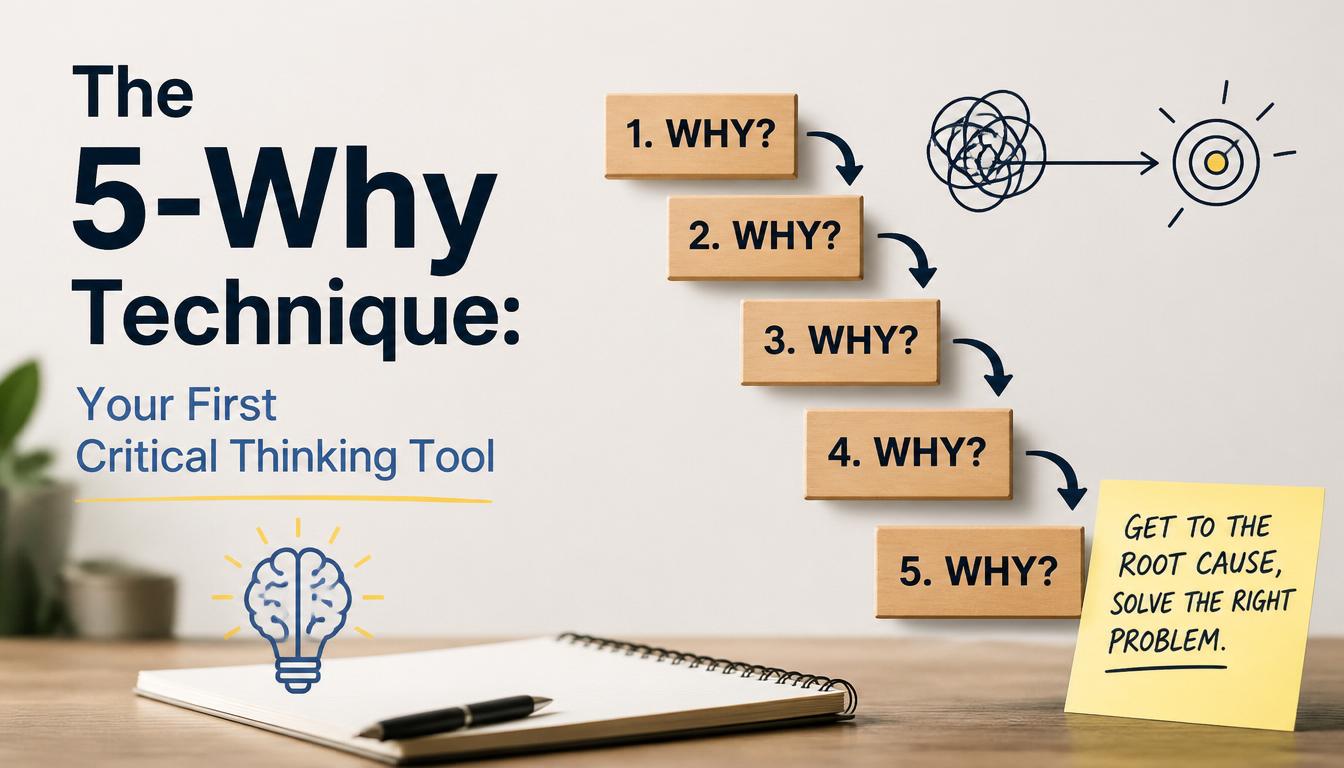
The 5 Whys is a critical-thinking method where you ask "Why?" repeatedly — usually about five times — about a problem, using each answer to shape the next question, until you stop hitting excuses and start hitting the actual cause. It was created inside a Japanese textile factory a century ago, it takes about ninety seconds to learn, and it is arguably the single fastest way for an ordinary person to upgrade from reactive thinking to root-cause thinking. This guide explains where it came from, exactly how to run it on your own problems — money, health, relationships, work — where it breaks down, and how to use it without fooling yourself.
Why This Matters Before You Learn Anything ElseMost people solve problems the same way, over and over, without noticing the pattern: something goes wrong, they find the nearest plausible explanation, they patch that one thing, and the problem comes back in a few weeks wearing a different mask.
You're late paying rent, so you blame this month's expenses. You're tired all the time, so you blame your schedule. A relationship keeps having the same fight, so you blame the last thing that was said. Every one of these is a real fact. None of them is the cause. They're the top layer of a much deeper stack, and the top layer is the only one most people ever look at — because looking further takes an extra thirty seconds of discomfort that most brains are wired to avoid.
The 5 Whys exists to force those extra thirty seconds. It is not a business hack. It is a lens correction for a mental habit almost everyone shares: stopping at the first answer that sounds true instead of continuing until you reach the answer that is actually load-bearing.
Where the 5 Whys Came From (And Why the Origin Story Actually Matters)The technique wasn't invented by a consultant or a productivity author. It came out of a textile workshop.
Sakichi Toyoda, a Japanese inventor born in 1867, spent his early life watching his mother work for hours at a hand loom. That experience shaped his entire career: he became obsessed with building machines that solved real problems instead of just looking impressive on paper. He eventually founded Toyoda Automatic Loom Works, the company that would later give rise to Toyota Motor Corporation, and he used a habit of repeated "why" questioning through the 1930s to dig into manufacturing defects on the shop floor instead of accepting the first explanation an operator offered.
Two decades later, Taiichi Ohno — the engineer who built the Toyota Production System and is often called the father of Lean manufacturing — took that habit and formalized it into a named method. Ohno described it as the basis of Toyota's entire scientific approach to problems: ask "why" enough times, and the true nature of a problem, along with its real fix, eventually comes into focus. The method spread from Toyota's factories into Kaizen, Six Sigma, lean construction, and eventually into software engineering, medicine, aviation safety, and personal development — one of the rare frameworks that survived the jump from a single factory floor to essentially every industry on Earth.
There's a detail in that history worth sitting with: the 5 Whys wasn't originally built as a "root cause analysis" tool at all. Ohno first used it to figure out why a new feature or manufacturing change was actually needed — a decision-clarifying tool, not just a blame-finding one. That dual identity, explored below, is exactly why it works as well on your own life as it does on a factory line.
The Method Itself: How to Actually Run a 5 WhysThe mechanics are almost embarrassingly simple, which is exactly why people underestimate them.
- Write down the problem in one plain sentence. Not a feeling, not a vague complaint — an observable fact. "I'm always tired" is a feeling. "I've woken up exhausted four mornings this week" is a fact you can interrogate.
- Ask "Why did this happen?" Answer honestly, in one sentence, based on what you actually know — not what sounds good.
- Take that answer and ask "Why?" again — but now the question is aimed at the answer you just gave, not at the original problem.
- Repeat. Each new "why" attaches to the previous answer, so you're descending a ladder, not circling the same rung.
- Stop when the answer becomes something you can actually act on — a decision, a habit, a system, or a boundary — rather than another fact you can't control. This might take three whys. It might take eight. Five is a starting rhythm, not a hard rule.
The problem: a machine on the production line stopped working.
- Why did the machine stop? → A fuse blew because of an overload.
- Why was there an overload? → The bearings weren't sufficiently lubricated.
- Why weren't they lubricated? → The lubrication pump wasn't circulating enough oil.
- Why wasn't the pump working properly? → Its intake was clogged with metal shavings.
- Why was it clogged with shavings? → There was no strainer fitted on the pump.
Notice what happened. The obvious first fix — replace the fuse — would have had the machine running again in ten minutes and failing again in three weeks. The real fix, installing a strainer, costs almost nothing and solves the problem permanently. That gap between the cheap symptom-fix and the cheap-but-invisible real fix is the entire value proposition of this technique.
A worked example — an ordinary personal problemThe problem: "I keep missing my savings goal every month."
- Why? → I spend more than I planned on food delivery in the last week of the month.
- Why? → By then I'm too tired to cook and don't want to think about it.
- Why? → I'm tired because I'm staying up late scrolling instead of sleeping.
- Why? → Scrolling is the only "down time" I schedule for myself all day.
- Why? → I don't build any deliberate rest into my day, so my brain grabs it at midnight instead.
The first-layer fix would have been a budgeting app with a spending cap. The real fix is a fifteen-minute wind-down block earlier in the day — something that never would have surfaced if the questioning had stopped at "I spend too much on food delivery."
This is the pattern worth internalizing: the first answer is almost always true, and almost never useful. The technique's entire job is to keep you moving past "true" toward "useful."
The Psychology Underneath It: Why Your Brain Needs This ToolThere's a well-documented reason the first explanation that comes to mind usually isn't the real one. Human reasoning defaults to whatever explanation requires the least mental effort and best fits the story we already believe about ourselves — psychologists sometimes call this the path of least cognitive resistance. Under time pressure or discomfort, most people accept the first cause that "feels right" and stop there, because continuing to question feels like continuing to suffer.
The 5 Whys works precisely because it interrupts that default. Each "why" is a small, structured refusal to accept the first answer as final. It doesn't require intelligence or expertise — it requires a habit of discomfort tolerance for about five extra sentences. That's what makes it a genuine first critical thinking tool rather than an advanced one: it doesn't ask you to learn logic, statistics, or philosophy. It asks you to keep asking one more question when your instinct says stop.
It also quietly separates two things people usually confuse: a cause and a trigger . A trigger is the thing that happened right before the problem. A cause is the condition that made the trigger capable of producing that problem in the first place. Most arguments, most recurring mistakes, and most "bad luck" patterns in a person's life are actually the same underlying cause wearing a new trigger every time. The 5 Whys is a fast way to notice that repetition instead of re-living it.
Where the 5 Whys Breaks (Be Honest About This Part)No tool this simple is free of limits, and pretending otherwise would make this guide worse, not better. Critical thinking includes being critical of your own tools.
It tends to stop at a single cause, when real problems often have several. A five-step chain of "why" questions produces one linear thread. Complex situations — a failing business, a health issue, a broken team — usually have multiple contributing causes running in parallel, not one straight chain. Treating a multi-cause problem as if it had one root cause is a common misuse of the technique.
The depth of the answer depends entirely on what the questioner already knows. If you don't know enough about a domain, "why" number three might just hit a wall of "I don't know," and the method has no built-in way to fill that gap. It surfaces the limits of your own knowledge; it doesn't expand them.
Results aren't repeatable. Two different people running the same 5 Whys on the same problem can land on two different "root causes," because each questioner brings their own assumptions to which branch they follow. This is fine for personal reflection, where you're the only stakeholder, but it's a real weakness in team or organizational settings where consistency matters.
Stopping at exactly five is arbitrary. There is nothing magical about the number five — some analysts have pointed out that the fifth answer has no guaranteed relationship to the actual root cause, and a problem might need three whys or twelve. Treat "five" as a name and a rhythm, not a rulebook.
For genuinely high-stakes or multi-layered problems — a serious safety incident, a recurring conflict involving several people, a business failure with many moving parts — the 5 Whys is best used as a first pass, not the final analysis. Pair it with a tool built for branching causes, such as a fishbone (cause-and-effect) diagram, before locking in a conclusion.
How to Use It Without Fooling YourselfA few working rules keep the technique honest instead of turning it into a way to just rationalize whatever you already believed:
- Answer based on what you actually observed, not what you assume. If you don't know why something happened, say "I don't know" and go find out — don't guess and call the guess a "why."
- Direct each question at the answer, not at the person. "Why did I miss the deadline" leads somewhere useful. "Why am I so lazy" leads to a dead end dressed up as an answer, because it's a judgment, not a cause.
- Stop at something actionable, not just something true. "The economy is bad" might be true and is not a stopping point, because you can't act on it. "I don't have an emergency fund, so one bad week wrecks my whole month" is a stopping point, because you can build one.
- Write it down. The chain is easy to talk yourself out of halfway through if it's only happening in your head. Five lines on paper or in a notes app takes less than two minutes and keeps you honest.
- Revisit it later. The first time you run this on a real problem in your life, expect the fifth answer to surprise you a little. If it doesn't surprise you at all, you probably stopped one "why" too early.
What is the 5 Whys technique in simple terms?
It's a method for finding the real cause of a problem by asking "Why did that happen?" about five times in a row, with each question building on the answer before it, instead of stopping at the first explanation.
Who invented the 5 Whys?
Sakichi Toyoda, the founder of Toyoda Automatic Loom Works, used the approach in the 1930s to investigate manufacturing issues. Taiichi Ohno later formalized it as a core part of the Toyota Production System in the 1950s, and it spread from there into Kaizen, Six Sigma, and lean methodologies worldwide.
Does it always have to be exactly five whys?
No. Five is a practical starting rhythm, not a rule. Simple problems might resolve in three questions; more tangled ones can take seven, ten, or more. The point is to keep asking until you hit something you can actually act on.
What's the difference between the 5 Whys and root cause analysis?
The 5 Whys is one simple technique
within
the broader field of root cause analysis. It's fast and requires no special tools, but it usually finds a single linear cause. Formal root cause analysis often uses additional tools, like fishbone diagrams or fault trees, to capture multiple contributing causes at once — something the 5 Whys is not well suited to on its own.
Can I use the 5 Whys on personal problems, not just work problems?
Yes — this is arguably where it's most useful, because in a personal setting you don't need a team's agreement, just your own honesty. It works well on money habits, procrastination, recurring arguments, health routines, and any pattern that keeps repeating despite your best intentions.
What are the biggest mistakes people make with the 5 Whys?
The three most common: stopping at the first comfortable answer instead of continuing, chasing only one cause when a problem actually has several running in parallel, and turning a "why" question into blame ("why am I so bad at this") instead of a fact-based question ("why did this specific thing happen").
Is the 5 Whys considered a real critical thinking tool, or just a business technique?
Both. It was born in a factory, but its underlying skill — refusing to accept the first plausible explanation and instead tracing a chain of cause and effect — is a foundational move in critical thinking generally. That's exactly why it works as well in personal reflection as it does in engineering.
Every time something in your life keeps going wrong in the same way, you already know the fix that hasn't worked. What you probably haven't done yet is ask "why" five times in a row and follow the answers all the way down — and that's the entire difference between fixing a symptom and fixing a life.
References- Wikipedia — Five whys . https://en.wikipedia.org/wiki/Five_whys
- Mindtools — 5 Whys: Getting to the Root of a Problem Quickly . https://www.mindtools.com/a3mi00v/5-whys/
- Sloww — Five Whys (or 5 Whys): Root Cause Analysis for Problem Solving . https://www.sloww.co/5-whys/
- ProClipse Consulting — The Journey of the 'Five Whys' Technique . https://proclipseconsulting.com/resources/blog/the-journey-of-the-five-whys-technique
- Tuzzit — Discover who is Sakichi Toyoda . https://www.tuzzit.com/en/creator/sakichi_toyoda
- airfocus by Lucid — What Are the Five Whys (5 Whys)? https://airfocus.com/glossary/what-are-the-five-whys/
- Lean Six Sigma Canada — The 5 Whys Technique . https://leansixsigmacanada.com/the-5-whys-technique/
- InfoQ — Limitations of the Five Whys Technique in Agile Retrospectives . https://www.infoq.com/news/2015/02/five-why/
- EasyRCA — 5 Whys Analysis Pitfalls: Limitations and How to Avoid Them . https://easyrca.com/blog/common-limitations-of-5-whys-analysis-and-how-to-avoid-them/
- TapRooT — Are You Dissatisfied with 5-Whys Root Cause Analysis? https://taproot.com/dissatisfied-with-5-why-root-cause-analysis/
- ThinkReliability — Top Criticisms of the 5-Why Approach . https://blog.thinkreliability.com/top-criticisms-of-the-5-why-approach
- Orca Lean — How Toyota Utilizes the 5 Whys Method for Problem Solving . https://www.orcalean.com/article/how-toyota-is-using-5-whys-method
The 5-Why Technique: Your First Critical Thinking Tool
A complete, practical guide to the 5 Whys — the deceptively simple question-asking method that trains you to find real causes instead of chasing symptoms, in work, money, relationships, and everyday decisions.