
The 5 Levels of Critical Thinking Mastery Explained

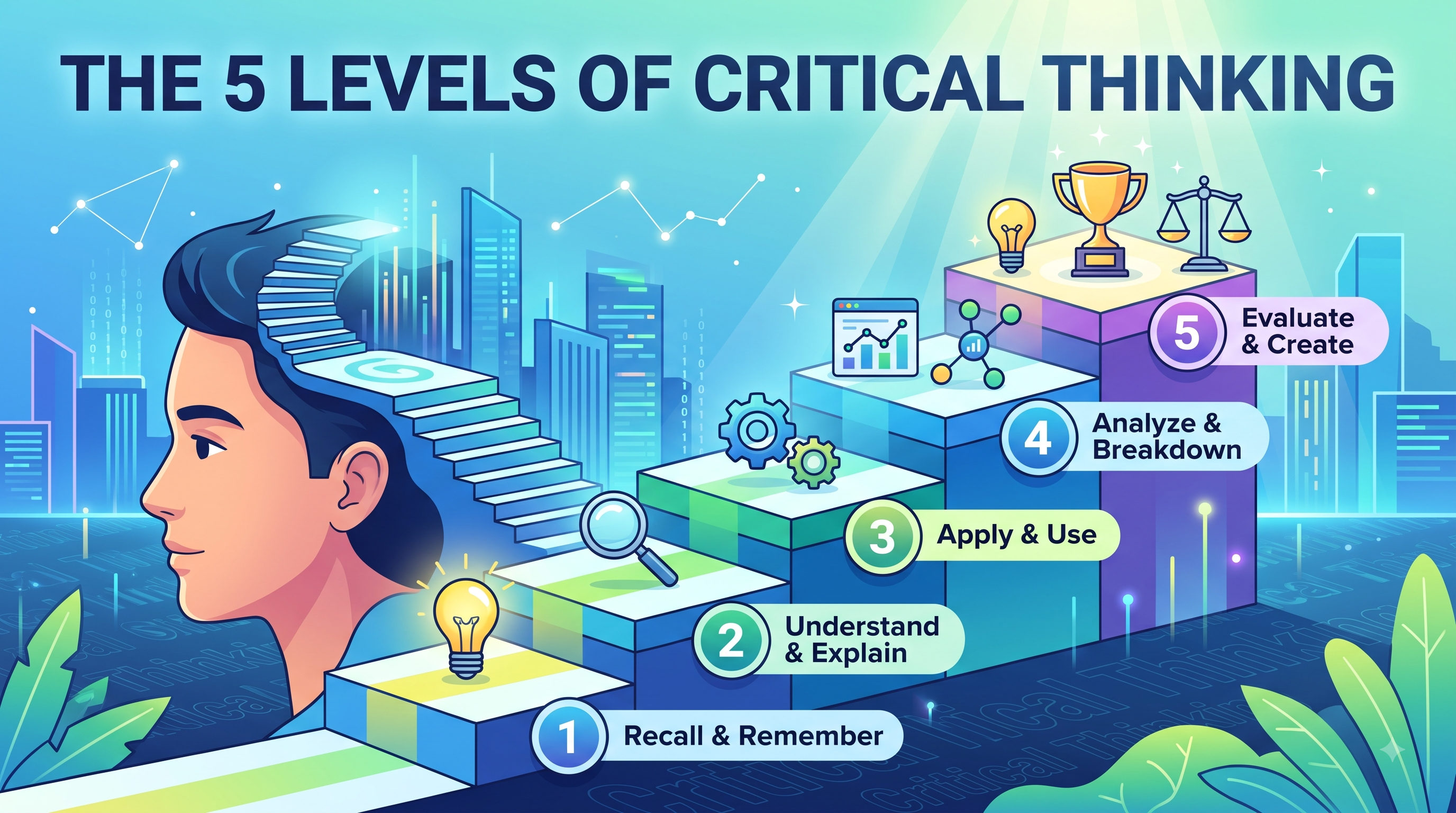
Most people believe that critical thinking is a binary trait—you either have it or you do not. We tend to assume that because we can read, write, and hold opinions, we are automatically skilled thinkers. However, developmental psychologists and educational theorists paint a far more complex picture. Critical thinking is not an on-off switch; it is a lifelong developmental spectrum.
Just as a pianist progresses from basic scales to complex concertos, a thinker moves through distinct stages of cognitive maturity. In the late 1990s, critical thinking pioneers Dr. Richard Paul and Dr. Linda Elder introduced a developmental model outlining the stages of critical thinking. By adapting their academic research into a modern, practical framework, we can map out The 5 Levels of Critical Thinking Mastery.
Understanding these levels is not about labeling yourself or others. It is about diagnosing your current cognitive default, recognizing the blind spots associated with each stage, and establishing a deliberate path for intellectual growth.
Level 1: The Reactive Thinker (The Instinctive Mind)At Level 1, thinking is almost entirely automatic, impulsive, and unreflective. The Reactive Thinker relies heavily on what Daniel Kahneman terms System 1 cognitive processing—a fast, emotional, and subconscious mode of thinking that uses mental shortcuts (heuristics) to make rapid judgments.
Characteristics of Level 1:- Prejudice and Egocentrism: Decisions are made based on immediate feelings, personal desires, or inherited prejudices. The thinker cannot separate their identity from their beliefs.
- Blindness to Bias: The Reactive Thinker is completely unaware of their cognitive biases (such as confirmation bias or anchoring). They believe they see the world exactly as it is, and anyone who disagrees is either stupid or malicious.
- Slogan-Based Reasoning: Rather than analyzing complex issues, they rely on simple slogans, memes, and black-and-white dualities (e.g., "Good vs. Evil," "Us vs. Them").
- Inability to Track Evidence: If you ask a Level 1 thinker why they believe something, they will offer circular reasoning ("I believe it because it's true") or appeal to tribal authority ("Everyone in my group knows this").
The instinctive mind is highly susceptible to manipulation by demagogues, clever marketing, and algorithmic social media feeds. Because the Level 1 thinker does not monitor their cognitive processes, they are a passive passenger in their own mind.
Level 2: The Aware Thinker (The Cognitive Awakening)The transition from Level 1 to Level 2 is marked by a profound realization: "My thinking is not perfect, and my mind can easily be deceived." The Aware Thinker has experienced a cognitive awakening. They recognize that logical fallacies exist, that cognitive biases distort their judgment, and that much of what they believe is the result of social conditioning.
Characteristics of Level 2:- Emergent Self-Monitoring: The thinker begins to observe their own mental processes. They might catch themselves reacting defensively during an argument and think, "Am I angry because they are wrong, or because my ego is threatened?"
- Knowledge Without Practice: While Level 2 thinkers can define concepts like the Straw Man fallacy or Confirmation Bias, they struggle to prevent these errors in real-time. They are like a novice golfer who knows the theory of a perfect swing but still slices the ball into the woods.
- Cognitive Dissonance: Because they are aware of their inconsistencies but lack the tools to resolve them, Level 2 thinkers often experience mental discomfort (cognitive dissonance) when confronted with challenging data.
The biggest trap at this level is intellectual despair or cynicism. Realizing that absolute certainty is an illusion, some thinkers stop searching for truth altogether, falling into the trap of lazy relativism ("Everyone has their own truth, so nothing really matters").
Level 3: The Active Practitioner (The Structured Mind)To break through to Level 3, a thinker must move from passive awareness to active, structured practice. The Active Practitioner does not rely on raw intellect or intuition; they use deliberate, external cognitive scaffolding to guide their thinking.
Characteristics of Level 3:- Reliance on Checklists and Rubrics: Level 3 thinkers actively use established evaluation frameworks. When reading a research paper, they run the CRAAP Test (evaluating Currency, Relevance, Authority, Accuracy, and Purpose). When analyzing news, they use the SIFT lateral reading method (Stop, Investigate, Find, Trace).
- Socratic Inquiry: They have moved beyond asking what is happening to asking how and why. They use Socratic questioning to unpack assumptions, probe evidence, and explore implications.
- Intellectual Discipline: They actively schedule time to think deeply. They write out arguments, outline pros and cons, and deliberately search for disconfirming evidence to stress-test their ideas.
Because their thinking relies heavily on external tools, Level 3 thinkers can become rigid and formulaic. If a situation does not fit neatly into their checklists or spreadsheets, they can experience analysis paralysis, over-complicating simple decisions.
Level 4: The Strategic Thinker (The Framework Builder)At Level 4, critical thinking is no longer an external chore or a set of checklists; it has been internalized into a fluid, habitual operating system. The Strategic Thinker views the world through a deeply curated library of mental models and systems-level frameworks.
Characteristics of Level 4:- Mental Model Integration: Instead of treating problems as isolated events, Level 4 thinkers categorize them. They apply First Principles Thinking to deconstruct complex systems, use Second-Order Thinking to project long-term consequences, and employ Inversion to avoid catastrophic failures.
- The Scout Mindset: Coined by Julia Galef, this is the default operating state of the Level 4 thinker. They are genuinely motivated to see the world as it is, not as they wish it to be. They welcome correction because every corrected error represents an upgrade to their internal map of reality.
- Systems Literacy: They understand that variables do not exist in a vacuum. They look for feedback loops, delays, and systemic leverage points, realizing that local interventions often produce unintended global consequences.
Strategic thinkers can sometimes overestimate the perfection of their mental models. They may attempt to force highly complex, organic human systems (like corporate cultures or macroeconomic trends) into neat mathematical or logical frameworks, ignoring qualitative nuances.
Level 5: The Fluent Master (The Wise Mind)The pinnacle of cognitive development is the Fluent Master. At this level, critical thinking has integrated deeply with emotional intelligence, epistemic humility, and lived experience to become wisdom. The Master Thinker does not "do" critical thinking; they are critical thinkers.
Characteristics of Level 5:- Effortless Cognitive Flexibility: Level 5 thinkers can shift frameworks instantly depending on the context. They do not get wedded to a single mental model. They can hold two contradictory, highly compelling arguments in their mind simultaneously without experiencing distress, waiting for evidence to tip the scale.
- Deep Epistemic Humility: The hallmark of Level 5 is knowing the vast extent of what they do not know. They speak with measured, probabilistic language, and they are completely comfortable uttering the words, "I don't know enough to have an opinion on that."
- Adversarial Empathy: They do not just tolerate opponents; they master the Steel-Man Argument. They can articulate their opponent's position so beautifully, charitably, and powerfully that the opponent says, "Yes, that is a better version of my argument than I could have ever constructed."
- Seamless Metacognition: Their brain monitors its own processing in real-time, instantly adjusting for emotional fluctuations, physical fatigue, and ego-defensive maneuvers without requiring deliberate effort.
| Stage | Mode of Thinking | Relationship to Bias | Core Toolset | Primary Vulnerability |
|---|---|---|---|---|
| Level 1: Reactive | Automatic, emotional, impulsive | Completely blind | Intuition, tribal beliefs, slogans | Highly vulnerable to manipulation |
| Level 2: Aware | Emerging self-observation | Aware of bias but unable to stop it | Cognitive vocabulary, definitions | Cynicism, intellectual despair |
| Level 3: Active | Deliberate, structured, mechanical | Actively audits beliefs using guides | Checklists (CRAAP, SIFT, 5 Whys) | Rigid formulaic thinking, analysis paralysis |
| Level 4: Strategic | Habitual, framework-driven | Actively seeks disconfirming evidence | Mental models, systems mapping | Over-reliance on abstract frameworks |
| Level 5: Fluent Master | Fluid, effortless, integrated | Epistemic humility, self-correcting | Steel-manning, metacognition | Extremely rare, requires continuous effort |
Moving from one level of critical thinking to the next requires targeted, deliberate practice. Here is your progression guide to level up your mind:
How to move from Level 1 to Level 2:- Read Widely Outside Your Bubble: Deliberately read high-quality opinions from sources you disagree with. Focus on understanding why intelligent people hold those views.
- Keep a "Reaction Log": Whenever you feel a sudden surge of anger, defensiveness, or smug certainty while reading an article or discussing a topic, write down what triggered it.
- Adopt Scaffolding: Never evaluate a major decision or complex article in your head. Use physical tools. Write down the premises and conclusion. Execute a formal CRAAP Test or Socratic analysis on paper.
- Practice the "5 Whys" Daily: When a problem occurs in your personal or professional life, don't stop at the first surface symptom. Ask "Why?" five times to find the systemic flaw.
- Build a Mental Model Library: Pick one major mental model per month (e.g., Inversion in Month 1, First Principles in Month 2) and actively apply it to your daily tasks.
- Adopt the Scout Mindset: Practice celebrating being wrong. When you discover you made an error, write a journal entry about what you learned and how it improves your decision-making.
- Master the Steel-Man: Before you critique any argument, force yourself to write a paragraph defending it. Make that paragraph so strong that your opponent would thank you for it.
- Practice Epistemic Humility: Actively reduce the number of topics you hold strong opinions on. Practice saying, "I don't have enough data to form an authoritative opinion on that," and feel the mental liberation it brings.
The 5 Levels of Critical Thinking Mastery Explained
Discover the 5 levels of critical thinking mastery. Learn how to diagnose your cognitive stage and implement actionable habits to advance your thinking.