
The Beginner's Guide to Logical Fallacies

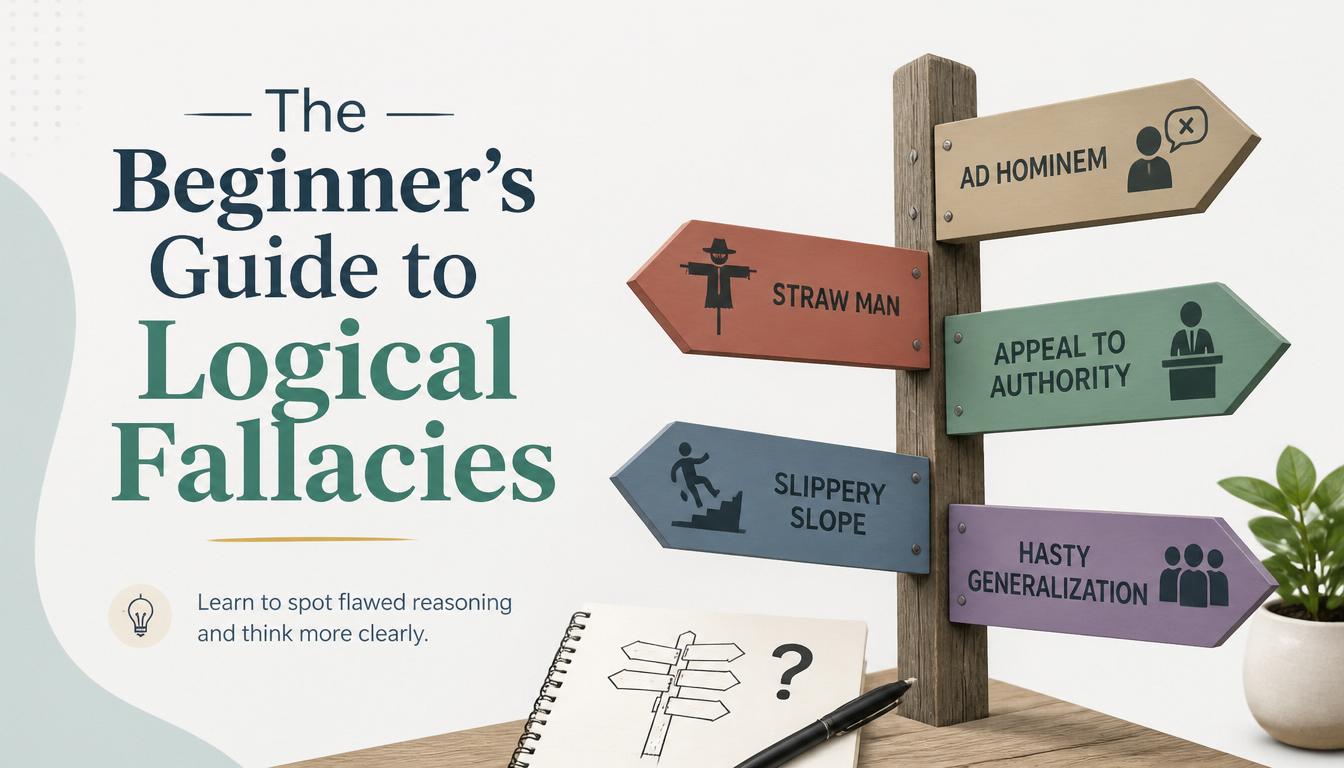
Our brains are hardwired to recognize patterns and make rapid associations. While this keeps us safe in dangerous physical environments, it also makes us highly susceptible to logical fallacies—structural or contextual flaws in reasoning that completely invalidate an argument's conclusion [5].
A logical fallacy is essentially a software bug in human reason. Often, these fallacies are used accidentally because the speaker is emotional or uneducated in logic. However, they are also used deliberately as deceptive rhetorical tricks by advertisers, politicians, and internet trolls to manipulate your opinions and behavior.
Author Sahil Bloom describes logical fallacies as "field guides to avoiding arguments with fools" [9]. If you do not know how to spot these bugs, you will easily be misled by bad reasoning, lose arguments you should win, and make critical errors in your own personal and professional life.
In this beginner's guide, we will dissect the mechanics of logical flaws, break down the five most common fallacies with modern examples, explore how to counter them gracefully, and master a vital meta-logic concept: the Fallacy Fallacy [5].
1. What is a Logical Fallacy? Structure vs. ContentTo spot a fallacy, you must understand that an argument can fail in two primary ways:
- Factual Failure: The premises are simply false (e.g., "The Earth is flat").
- Logical Failure (The Fallacy): The structure of the reasoning is broken, meaning the conclusion does not logically follow from the premises, even if the premises are factually true [5].
For example:
- Premise 1: Abraham Lincoln was a president of the United States. (True)
- Premise 2: Barack Obama was a president of the United States. (True)
- Conclusion: Therefore, Abraham Lincoln and Barack Obama were the same person. (False)
This is a structural fallacy. Both premises are 100% true, but the conclusion is absurdly false because the logical link is completely broken.
2. The Big 5 Logical Fallacies ExplainedLet's explore the five most common logical fallacies you will encounter in daily life, work meetings, and online discussions.
Fallacy 1: Ad Hominem (The Character Attack)- Definition: Attacking the person’s character, personal traits, background, or physical appearance rather than addressing the substance of their logical argument [1, 5].
- The Flaw: A person's personal flaws, job, or background do not affect the objective truth of their argument.
- Modern Example: "We should not listen to Jessica's proposal for reducing our department's energy costs. She was arrested for protesting in college, so she is clearly just a radical environmentalist."
- How to Spot It: Listen for transitions from the topic to the person. Look out for insults and labeling.
- Definition: Misrepresenting, exaggerating, or completely oversimplifying an opponent’s argument to make it look ridiculous and far easier to attack [5].
- The Flaw: By fighting a fake, distorted version of the argument (a "strawman") rather than the actual argument, the speaker commits intellectual fraud.
- Modern Example:
- Colleague: "I think we should allocate 10% of our budget to training team members on AI tools."
- Manager (Strawman): "So what you’re saying is we should stop spending money on client acquisitions and let our sales pipeline collapse just so we can play with new software?"
- How to Spot It: Look for phrases like "So what you're saying is..." followed by a highly extreme, exaggerated version of the original point.
- Definition: Presenting only two extreme, contrasting options or outcomes when, in reality, multiple shades of gray, compromise positions, or alternative solutions exist [5].
- The Flaw: It artificially limits choice to force a high-pressure decision, ignoring the complexity of reality.
- Modern Example: "Either we completely ban smartphones in schools, or we accept that our children will grow up illiterate and completely distracted. There is no middle ground."
- How to Spot It: Listen for "either/or" statements that ignore other possibilities.
- Definition: Claiming that a minor first step will inevitably set off a catastrophic chain reaction leading to an extreme, disastrous final outcome, without providing any empirical evidence that this chain reaction will actually occur [5].
- The Flaw: It relies on fear-mongering and assumes a pre-determined, unstoppable trajectory.
- Modern Example: "If we allow employees to work from home on Fridays, next they’ll want to work from home all week. Soon, our offices will stand empty, our corporate culture will dissolve, and the company will go completely bankrupt within a year."
- How to Spot It: Look for catastrophic logical leaps with no statistical evidence linking the steps.
- Definition: Relying on the endorsement, opinion, or word of a prominent or famous figure as definitive proof of your argument, even if that figure lacks relevant expertise in the specific subject [2, 5].
- The Flaw: Authority does not equal truth. An expert's opinion is only valuable if backed by empirical evidence within their specific domain [2].
- Modern Example: "Dr. Harrison, a world-famous literature professor at Oxford, says that the economic impacts of corporate tax hikes are overwhelmingly positive. Therefore, we must implement tax hikes immediately."
- How to Spot It: Look for the citation of famous names, celebrities, or prestigious credentials to shut down a debate about actual data.
As you begin studying logical fallacies, you will likely start seeing them everywhere. It is incredibly tempting to run around pointing at people and shouting, "Ad Hominem!" or "Strawman!" and declaring their claims false.
However, doing so makes you fall victim to a crucial meta-logic error known as the Fallacy Fallacy [5, 9].
- The Fallacy Fallacy Defined: Assuming that because an argument contains a logical fallacy, the underlying conclusion must be completely false [5, 9].
In reality, a person can make an incredibly fallacious argument, but their final conclusion can still be factually correct. The presence of a fallacy only proves that the path the speaker took to reach their conclusion was logically invalid; it does not disprove the conclusion itself [5].
A Simple Example:- Premise 1: My doctor says smoking is bad for health.
- Premise 2: My doctor is a hypocrite who smokes a pack of cigarettes a day. (Ad Hominem attack)
- Conclusion: Therefore, smoking is actually perfectly healthy.
This argument is highly fallacious because it uses an ad hominem attack to dismiss the doctor's medical advice. However, if we claim that "smoking is healthy" simply because the doctor's argument was fallacious, we are completely wrong. Smoking is, in fact, highly damaging to health.
The Lesson: Spotting a fallacy should build intellectual humility [9]. It is not a weapon to destroy opponents, but an internal compass to ensure you are seeking truth and making sound arguments.
4. The Fallacy Field Guide: How to Defuse Them GracefullyWhen someone uses a logical fallacy against you in a meeting or discussion, do not get emotional. Do not attack their character (which would make you guilty of an ad hominem!). Instead, use these neutral, highly effective scripts to defuse the fallacy instantly:
How to Defuse a Strawman:- The Trap: They exaggerate your position.
- The Response: "That is a very interesting point, but it is not what I proposed. My actual proposal was to allocate 10% of our budget to training. I am not suggesting we cut our sales pipeline. Let's look back at the actual numbers for training to see if that works."
- The Trap: They force an "either/or" choice.
- The Response: "I don't think we are limited to just those two extreme choices. What if we explored a third option, such as allowing remote work on a trial basis for one day a month, and evaluated the productivity impact?"
- The Trap: They predict a catastrophic chain reaction.
- The Response: "I understand your concern about long-term cultural impacts, but do we have any data from companies in our industry showing that a single work-from-home day leads to bankruptcy? Let's look at the actual case studies."
A: Because our brains are optimized for speed, not formal logic. From an evolutionary perspective, System 1 shortcuts (heuristics) are incredibly efficient for rapid, daily decision-making [2]. Fallacies often feel emotionally satisfying and cognitively fluent, allowing us to bypass the heavy energy cost of analytical System 2 thinking [2].
Q: Is a cognitive bias the same as a logical fallacy?A: No, but they are closely related. A cognitive bias is an internal, subconscious pattern of systematic error in human judgment (it happens in the mind) [2, 8]. A logical fallacy is an external, structural flaw in how an argument is expressed in language (it happens in the words) [5]. Cognitive biases are often what drive us to commit logical fallacies.
Q: Can an argument from authority ever be valid?A: If we rely on the consensus of qualified experts within their active domain of expertise (e.g., citing a climate scientist on climate change), this is a reasonable heuristic for decision-making. However, it is still not "definitive proof." In true critical thinking, authority is a guide, but the ultimate authority must always be empirical evidence [2].
The Beginner's Guide to Logical Fallacies
Stop losing arguments to logical tricks. Learn the big 5 logical fallacies, how to counter them, and master the crucial "Fallacy Fallacy."