
Why the T-Shaped Skill Set is Dead in the AI Economy (And How to Upgrade It to an Infinite Loop)

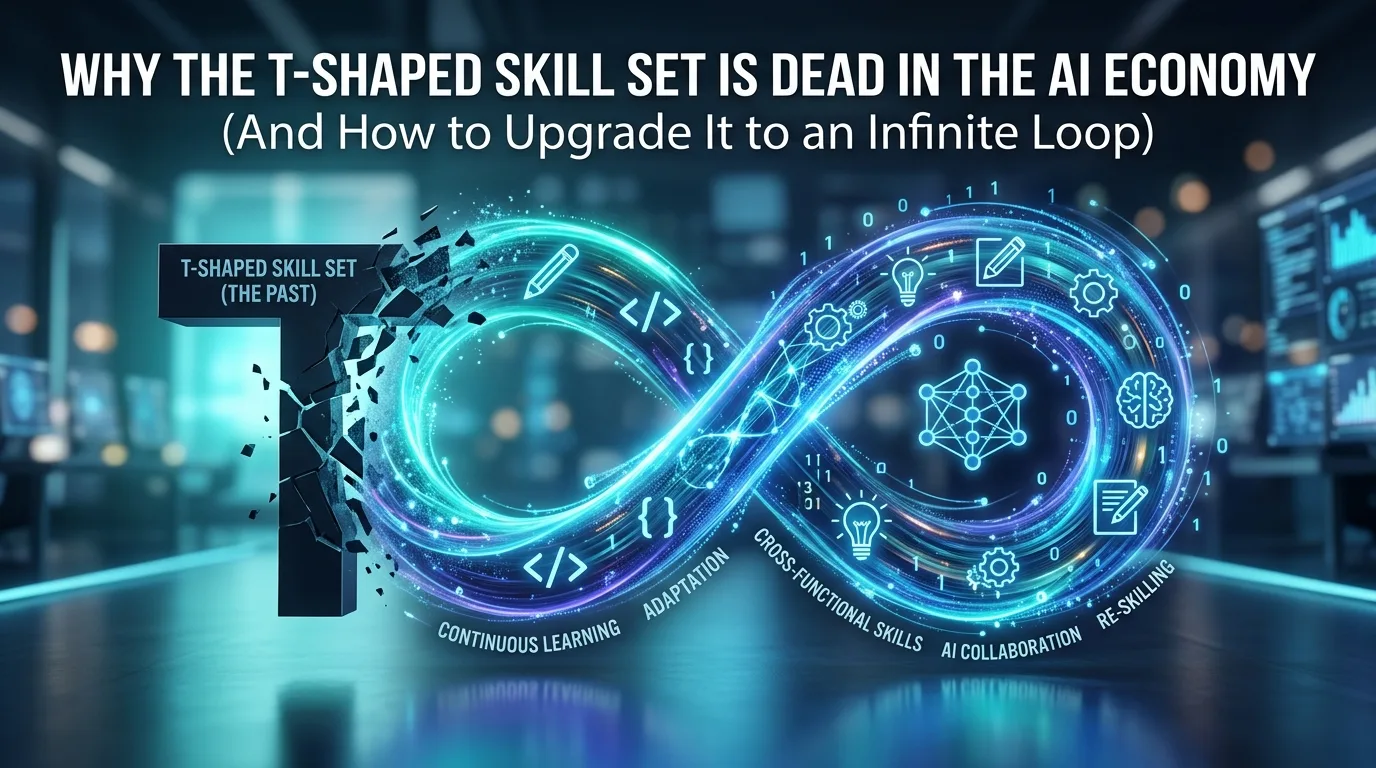
For the past decade, career strategists have preached the gospel of the T-shaped professional. The vertical stem represented deep, specialized expertise in a single domain, while the horizontal bar denoted a broad, cross-functional understanding of adjacent fields. In a pre-LLM (Large Language Model) world, this framework was the ultimate career insurance policy. It allowed human workers to specialize deeply while communicating effectively across departments.
That framework is now obsolete.
When artificial intelligence can instantly synthesize cross-functional data, write passable code across twenty languages, and draft marketing copy tailored to nuanced buyer personas, the traditional horizontal bar of your T-shaped skill set becomes commoditized. If your "broad knowledge" consists of surface-level competencies that a generative model can replicate in 1.4 seconds, you are competing directly with a multi-billion-parameter machine—and losing.
To survive and dominate in the modern AI economy, we must move past the static T-shaped model. We need to build dynamic, compounding capability structures that leverage human agency where silicon cannot compete.
The Anatomy of Post-T-Shaped CompetencyIn our work advising enterprise leadership teams on workforce transformation, we consistently see a fatal misconception: the belief that adding more technical tools to your resume constitutes upskilling. It does not. Learning how to prompt ChatGPT or operate an automated CRM interface is like learning how to use a calculator; it is a baseline utility, not a differentiating skill.
The modern AI economy rewards a starkly different structural architecture. We call this the M-Shaped or Compound Loop model, characterized by three distinct structural layers:
- The Core Anchor (Hyper-Specialization): Unlike the old vertical stem, this is no longer just about executing tasks. It is about architectural judgment, edge-case troubleshooting, and knowing *why* something works when the model hallucinates.
- The Synthesizing Bridge (Meta-Cognitive Translation): The ability to translate ambiguous human problems into precise, multi-step algorithmic workflows. You are no longer the doer; you are the orchestrator and validator.
- The Human-Centric Capstone (Tacit Knowledge & Trust): High-stakes empathy, cross-cultural negotiation, political capital, and accountability. These cannot be tokenized or automated.
If you are a software engineer, data analyst, or financial strategist, your value no longer lies in syntax or execution speed. AI writes boilerplate code and builds standard DCF models instantly. Your vertical stem must shift from production to verification and design.
Shifting from Execution to OversightConsider a senior data scientist. In the past, 70% of their day was spent cleaning data, writing SQL queries, and training baseline models. Today, automated machine learning (AutoML) and LLM-driven data pipelines handle that drudgery. The new vertical stem requires the data scientist to possess deep epistemological understanding: knowing where the training data is biased, understanding the probabilistic limitations of the model, and designing validation frameworks that catch catastrophic failures before they hit production.
Actionable Insight: Audit your current daily tasks. If a task requires pattern recognition based on historical data, assume an AI can do it 80% as well as you, for 1% of the cost. Double down on the 20% that requires contextual exception handling, systemic risk assessment, and original synthesis.
Pillar 2: Redefining the Horizontal Bar as "System Orchestration"The horizontal bar of the traditional T-shaped professional was built for human collaboration—attending cross-functional meetings, understanding marketing speak, or grasping basic finance. In the AI economy, your horizontal bar must be technological and systematic.
The Rise of the AI Generalist-DirectorYou do not need to learn how to code Python from scratch if you are a marketer, but you do need to understand how API calls work, how vector databases retrieve context (RAG systems), and how multi-agent LLM workflows orchestrate complex campaigns. Your horizontal breadth is no longer about talking to humans across silos; it is about orchestrating modular software and autonomous agents to execute complex, multi-stage business objectives.
Case Study: The Transformation of a B2B SaaS Product ManagerLet us look at a real-world structural shift we facilitated within a mid-market SaaS firm.
The Legacy Profile: Sarah was a traditional Product Manager. She gathered requirements, wrote PRDs (Product Requirements Documents), coordinated with engineering sprints, and managed stakeholders.
The AI Disruption: Generative AI tools reduced the time required to write PRDs from days to hours. Junior engineers were using AI coding assistants to build features without needing explicit architectural specs from Sarah.
The Pivot to Compound Capability: We helped Sarah restructure her skill set:
- Vertical Depth: Moved from writing feature specs to mastering UX psychology and quantitative user-behavior telemetry. She became the arbiter of what problems were actually worth solving, rather than how they should be built.
- Horizontal Breadth: Learned prompt engineering frameworks, fine-tuning methodologies for proprietary models, and cost-latency tradeoffs of various LLM architectures.
- The Result: Sarah transitioned from a traditional PM to an AI Product Architect. Her output increased by 400%, and she now manages autonomous product squads where she acts as the human-in-the-loop director.
Navigating this transition requires ruthlessly evaluating where you invest your limited cognitive energy. Here is how the strategic landscape breaks down:
- Pros of the Compound Skill Model:
- Resilience to Automation: You are insulated against single-point tool disruptions because your value is systemic, not task-based.
- Non-Linear Leverage: You can achieve the output of a 10-person team as a solo operator, exponentially increasing your market value.
- Continuous Relevance: By focusing on meta-learning and orchestration, your skills adapt organically as new foundational models are released.
- Cons and Hidden Traps:
- Cognitive Fatigue: The pressure to constantly update your mental models regarding tech stacks leads to severe burnout if boundaries aren't set.
- The Trap of Shallow Breadth: It is easy to fall into the illusion of competence—knowing a little bit about fifty different AI tools without mastering the underlying logic of any of them.
- Imposter Syndrome: As job titles blur, defining your professional identity becomes psychologically taxing.
Theory is useless without execution. If you want to future-proof your career over the next 24 to 36 months, execute this exact operational playbook:
1. Identify Your "Moat" SkillsWrite down every task you perform in a week. Highlight the ones that involve emotional intelligence, physical presence, legal or ethical accountability, or complex multi-variable negotiations. This is your moat. Protect it, market it, and deepen it.
2. Learn the Mechanics, Not Just the InterfaceStop watching basic "How to use ChatGPT" tutorials. Instead, study how systems communicate. Understand JSON data structures, how retrieval-augmented generation (RAG) works, and the fundamentals of database architecture. When you understand how the engine works under the hood, you can command AI tools with a precision that 99% of casual users cannot match.
3. Build in Public and Ship SystemsThe resume is dying. The proof of work is everything. Build small-scale automated workflows using no-code platforms, APIs, and custom prompts that solve actual friction points in your current job. Show your leadership team—or the market—how you systematically eliminate operational waste using AI orchestration.
Final VerdictThe T-shaped professional was built for an era of human-centric scaling. The AI economy demands something more fluid, rigorous, and deeply human. By anchoring your expertise in high-judgment domains and expanding your horizontal reach into system orchestration, you stop running from the machines—and start driving them.
Why the T-Shaped Skill Set is Dead in the AI Economy (And How to Upgrade It to an Infinite Loop)
Stop using outdated career advice. Discover how to upgrade the traditional T-shaped skill set into a compound capability model for the AI era.