
Data Literacy: The Invisible Skill Gap Killing Careers and Q3 Budgets

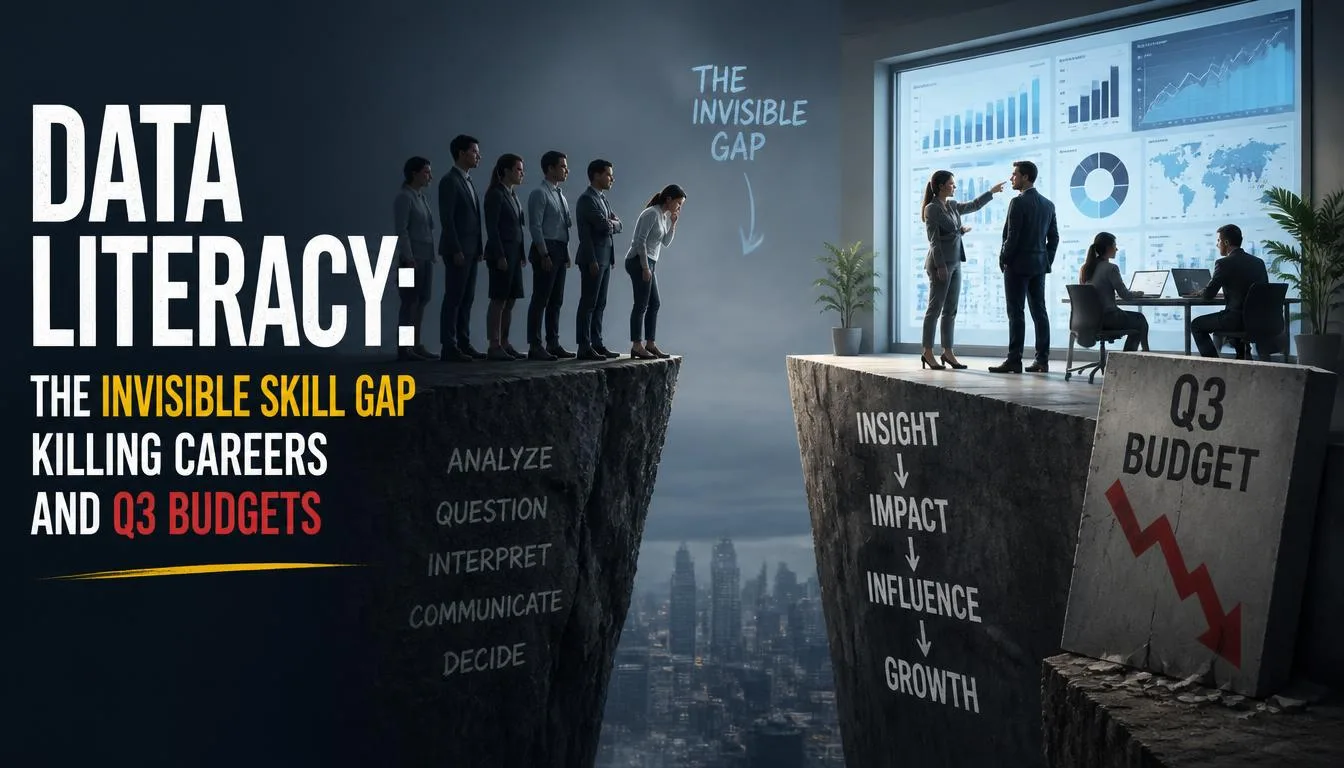
Walk into any executive boardroom today, and you will hear a standardized corporate mantra: “We are becoming a data-driven organization.” Dashboards glow from multi-monitor setups, cloud data warehouses overflow with customer telemetry, and enterprise software vendors promise that AI will automate our strategic thinking.
Yet, look closer at the daily reality of these same organizations. Mid-level managers stare blankly at a cohort retention chart, unable to distinguish a correlation from a causal relationship. Marketing directors sign off on campaigns based on vanity metrics that have zero statistical significance. Finance teams spend hours manually consolidating spreadsheets that were structurally obsolete before they were saved.
The dirty secret of the modern enterprise is not that we lack data. It is that we suffer from a catastrophic deficit of data literacy among the people actually making operational decisions. Universities churn out graduates fluent in theories of management but functionally illiterate in basic quantitative reasoning. Bootcamps teach software engineering or advanced data science, assuming everyone wants to code models all day. They completely miss the massive, untapped middle: the business professionals who need to interrogate data without becoming data scientists.
If you want to understand why career mobility has stagnated for millions of professionals, look no further than this skills gap. Employers are desperate for staff who can read, write, and communicate with data, yet traditional educational institutions continue to ignore the mandate.
Defining Real Data Literacy (Beyond the Buzzword)Let us clear up a common misconception right away. Data literacy does not mean knowing how to write Python scripts, configure a Snowflake database, or tune a gradient-boosting machine learning algorithm. That is the domain of data engineers and data scientists. Those roles are vital, but they are specialists.
True data literacy is a generalist competency. It is the functional equivalent of reading and writing literacy during the Industrial Revolution—a baseline requirement for participation in the modern economy.
At its core, data literacy rests on three foundational pillars:
Critical Skepticism: The ability to look at a chart, metric, or study and ask, “Where did this number come from, how was it collected, and who benefits from me believing it?” Data-literate professionals do not take dashboards at face value; they interrogate the underlying assumptions. Contextual Interpretation: Understanding the difference between statistical significance and practical significance. Knowing when a sample size is too small to draw a conclusion, or why an average (mean) is completely useless when a dataset is heavily skewed by outliers. Narrative Translation: The art of turning quantitative findings into a compelling business story. Data without a narrative is just noise. Data-literate professionals can translate a complex pivot table into a clear, actionable recommendation for non-technical stakeholders.The Cost of Functional IlliteracyWhen organizations lack this baseline capability, the consequences show up directly on the balance sheet. In my consulting work with mid-market enterprises, I frequently encounter what I call the “Dashboard Graveyard”—hundreds of thousands of dollars spent on custom BI implementations that users abandoned because nobody knew what the metrics actually meant.
Consider a real-world scenario from a consumer goods client I advised last year. Their regional sales director noticed a 15% spike in churn over a single month and panicked, immediately greenlighting an expensive discounting campaign to retain customers. A data-literate colleague intervened and ran a simple segmentation analysis. The spike was entirely attributable to a seasonal onboarding shift from the previous year. The churn wasn't real; it was a baseline normalization. The panicked intervention would have unnecessarily slashed margins by millions.
That is what data literacy buys you: immunity against expensive panic.
Why Traditional Education is Failing the MarketWhy aren't schools teaching this? Part of the problem is academic siloing. Traditional education forces a false dichotomy: you are either a “math person” destined for engineering or finance, or a “words person” destined for humanities, marketing, or creative fields.
This binary thinking is obsolete. The most valuable professionals in the 2026 labor market are hybrids. They possess the empathy and communication skills of the humanities major combined with the structural, empirical rigor of the scientist.
Furthermore, business schools still rely heavily on retrospective case studies. Students analyze what happened to Blockbuster or Kodak twenty years ago in a static Harvard Business Review text. They rarely learn how to open a raw, messy CSV file, clean up missing values, handle null data points, and derive a real-time insight from a live system. They are trained to consume sanitized data summaries rather than raw operational reality.
The Employer’s Secret Weapon: The Analytical GeneralistWhen hiring managers sift through resumes, they see thousands of candidates listing skills like “Excel,” “Tableau,” or “SQL.” To a recruiter, these keywords have largely lost their meaning. Anyone can watch a two-hour YouTube tutorial and list Tableau on their LinkedIn profile.
What employers actually look for—and struggle to find—is evidence of applied quantitative reasoning. They want to see how you solved a messy business problem using quantitative evidence when the path forward was ambiguous.
The Data Literacy Hiring MatrixLevelCompetency ProfileMarket ValueConsumerCan look at pre-built dashboards and read standard metrics.Commoditized (Baseline expectation for any office role).PractitionerCan clean data, build custom models/reports, and spot anomalies.High Demand (Where most career acceleration happens).StrategistCan translate data insights into systemic organizational policy and strategy.Executive Level (Extremely rare, commands top-tier compensation).Notice where the career bottleneck occurs. Companies have plenty of consumers and a fair number of specialists, but they face a severe famine of Practitioners and Strategists who bridge the gap between technical teams and business units.
How to Build Your Data Literacy (Without Getting a CS Degree)If you recognize this gap in your own skill set, the good news is that data literacy is entirely learnable through deliberate practice. You do not need to spend four years studying linear algebra. You need a practical, project-based curriculum.
1. Master the Art of Asking Better QuestionsBefore you touch a single software tool, train your brain to interrogate claims. When presented with a statistic or a report, practice running through a mental checklist:
- What is the population being sampled, and is it representative?
- What confounding variables have been left out of this analysis?
- Is the metric measuring activity (output) or value (outcome)?
- What does the distribution look like? (Always ask for the median and range, not just the average).
Excel is great for small datasets, but it creates bad habits (like hidden formulas and manual overwrites). Learning SQL (Structured Query Language) is the single highest-ROI technical skill for a non-technical professional. It allows you to bypass the data team for routine questions, pull raw data directly from the source, and understand how relational databases are structured.
3. Study Experimental DesignYou don't need to run clinical trials, but understanding the basics of A/B testing, control groups, and randomized sampling will transform how you view business initiatives. Most corporate projects fail because companies launch changes globally without ever setting up a control group to measure what would have happened anyway.
4. Practice Ethical Data StorytellingData can be manipulated to prove almost anything. Data-literate professionals understand the ethics of visualization—how axis truncation, scale manipulation, and selective timeframes can completely distort reality. Force yourself to present your findings to colleagues who disagree with your premise, and listen closely to how they poke holes in your charts.
The Bottom Line for Your CareerAs artificial intelligence automates routine operational tasks, the market value of rote administrative work is plummeting toward zero. Writing basic reports, formatting presentations, and organizing schedules are no longer sufficient differentiators.
The professionals who thrive in this environment are those who can stand in the crossfire of conflicting data streams, separate signal from noise, and guide their teams toward empirical reality. Data literacy is no longer a niche technical competency tucked away in the IT department. It is the ultimate career accelerator—the invisible skill that turns ordinary employees into indispensable strategists.
Data Literacy: The Invisible Skill Gap Killing Careers and Q3 Budgets
Discover why data literacy is the hidden skill gap stalling careers and Q3 budgets. Learn how to future-proof your resume and drive business ROI today.