
20 Cognitive Biases That Are Wrecking Your Judgment (And How to Fix Them)

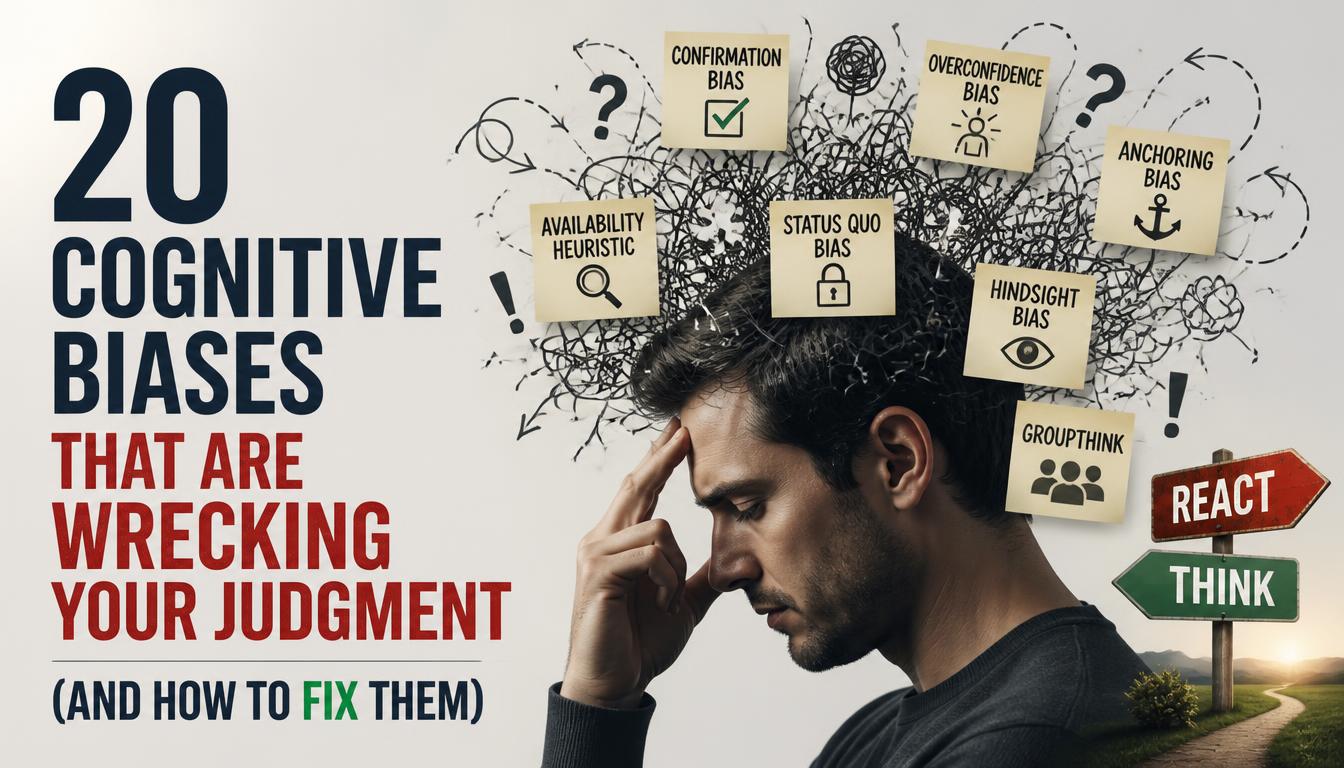
Have you ever made a decision you were completely sure of, only to watch it blow up in your face later? You aren't alone. Every single day, your brain makes thousands of subconscious shortcuts to help you process the overwhelming flood of information coming your way. These mental shortcuts are called heuristics, and while they keep your brain from overheating, they often come with a hidden bug: cognitive biases.
Cognitive biases are systematic errors in thinking that occur when we are processing and interpreting information in the world around us. They warp our perception, cloud our objectivity, and lead us to make poor choices in finance, relationships, career management, and daily life. If you want to make better decisions, you first need to understand the invisible programming working against you.
Here are 20 of the most dangerous cognitive biases quietly wrecking your judgment, and what you can do to outsmart them.
1. Confirmation BiasWhat it is: Confirmation bias is the tendency to search for, interpret, favor, and recall information in a way that confirms or supports your prior beliefs or values. If you believe a certain political candidate is dishonest, your brain will actively hunt for news stories that prove you right while completely ignoring or dismissing scandals involving your preferred candidate.
How to fix it: Actively seek out dissenting opinions. When you form an opinion, ask yourself, "What evidence would it take to prove me wrong?" and then go looking for that exact evidence.
2. The Dunning-Kruger EffectWhat it is: First identified by psychologists David Dunning and Justin Kruger, this bias occurs when people with low ability, expertise, or experience regarding a certain type of task or area of knowledge tend to overestimate their ability or knowledge. In short: you don't know enough to realize how much you don't know.
How to fix it: Practice intellectual humility. Cultivate a mindset of lifelong learning and always assume that experts possess nuanced insights you haven't yet considered.
3. Sunk Cost FallacyWhat it is: This is our tendency to continue an endeavor because we have already invested money, effort, or time in it, even when the current costs outweigh the benefits. You stay in a terrible movie until the end, or you keep pouring money into a failing business venture simply because you've already spent so much.
How to fix it: Ignore past investments that you can never recover. Base your decisions strictly on future costs and future benefits.
4. Availability HeuristicWhat it is: The availability heuristic is a mental shortcut that relies on immediate examples that come to a given person's mind when evaluating a specific topic, concept, method, or decision. Because you recently watched a news report on a plane crash, you might overestimate the statistical danger of flying compared to driving a car.
How to fix it: Don't rely on gut feelings fueled by vivid news stories or recent memories. Look at hard statistics, data, and broad trends before making a risk assessment.
5. The Bandwagon EffectWhat it is: The psychological phenomenon where the rate of adoption of beliefs, ideas, fads, and trends increases the more that they have already been adopted by others. It is the classic "monkey see, monkey do" bias, driven by our deep evolutionary desire to belong to the tribe.
How to fix it: Pause and separate your personal desires from collective momentum. Ask yourself: "Would I still want this, buy this, or believe this if nobody else was doing it?"
6. Loss AversionWhat it is: First coined by Daniel Kahneman and Amos Tversky, loss aversion refers to people's tendency to prefer avoiding losses to acquiring equivalent gains. Psychologically, the pain of losing $100 feels twice as intense as the joy of finding $100. This bias keeps us paralyzed in comfort zones and risk-averse when we should be bold.
How to fix it: Reframe your choices. Instead of focusing on what you might lose, force yourself to calculate the opportunity cost of what you are failing to gain.
7. Fundamental Attribution ErrorWhat it is: This is our tendency to explain someone else's behavior based on their internal characteristics (they are lazy, stupid, or mean) rather than external circumstances (they are going through a personal crisis or dealing with extreme stress). Conversely, when *we* mess up, we blame the situation.
How to fix it: Practice radical empathy. Assume that everyone you meet is fighting a hard battle you know nothing about, and give others the same benefit of the doubt you give yourself.
8. The Halo EffectWhat it is: The halo effect occurs when your overall impression of a person ("She is charismatic and attractive") influences your feelings and thoughts about their character in specific, unrelated areas ("Therefore, she must be brilliant, honest, and an exceptional leader").
How to fix it: Evaluate people and ideas on a granular, attribute-by-attribute basis. Separate someone's likability or physical appearance from their competence.
9. Status Quo BiasWhat it is: Humans are creatures of habit. The status quo bias is an emotional preference for the current state of affairs. The current baseline is taken as a reference point, and any change from that baseline is perceived as a potential loss.
How to fix it: Treat your current habits, software, job, or routines as if you were choosing them for the very first time today. If you wouldn't adopt them today, why are you keeping them?
10. Actor-Observer BiasWhat it is: A cousin of the fundamental attribution error, this is the tendency to attribute your own actions to external causes while attributing other people's behaviors to internal causes. If you cut someone off in traffic, it's because you were rushed and the sun was in your eyes; if someone cuts you off, it's because they are a reckless, selfish driver.
How to fix it: Balance your perspective by consciously imagining the external pressures acting upon others when they make mistakes.
11. Anchoring BiasWhat it is: Anchoring happens when individuals rely too heavily on the *first* piece of information offered (the "anchor") when making decisions. In negotiations, whoever throws out the first price often anchors the rest of the conversation, regardless of objective value.
How to fix it: Do independent market research before entering any negotiation or valuation process. Write down your own target numbers before listening to outside offers.
12. The Overconfidence EffectWhat it is: Excessive confidence in one's own answers, abilities, or forecasts. Studies show that when people are 100% sure of their answers, they are frequently wrong. Overconfidence leads to sloppy risk management and catastrophic blind spots.
How to fix it: Implement a "pre-mortem" before executing any big project. Imagine the project has utterly failed, and list all the reasons why it happened to puncture your overconfidence.
13. Self-Serving BiasWhat it is: The common habit of claiming credit for your successes while blaming external circumstances for your failures. You aced the exam because you're a genius; you failed the next exam because the professor writes unfair questions.
How to fix it: Keep an objective journal of outcomes. Force yourself to accept responsibility when things go wrong and analyze your role in the failure.
14. Recency BiasWhat it is: The tendency to heavily weigh recent events more than older, more representative historical data. If the stock market crashed last week, you might panic and sell everything, ignoring decades of long-term upward trends.
How to fix it: Zoom out. Look at the macro timeline, multi-year trends, and historical data before reacting to the panic or euphoria of the moment.
15. The Planning FallacyWhat it is: Coined by Daniel Kahneman and Amos Tversky, this describes our systematic tendency to underestimate the amount of time, money, and resources needed to complete a future task, even when we have experience with similar projects taking longer than expected.
How to fix it: Use "reference class forecasting." Look at how long similar projects took *other* people to complete, take that number, and multiply it by 1.5.
16. Zero-Risk BiasWhat it is: Psychologists have found that people prefer to eliminate risk entirely rather than reduce it by a much greater fraction that carries higher overall benefits. We intuitively overpay for absolute certainty, even when the residual risk is practically negligible.
How to fix it: Evaluate risks probabilistically. Calculate expected values rather than chasing the psychological comfort of zero risk.
17. The IKEA EffectWhat it is: A cognitive bias in which consumers place a disproportionately high value on products they partially created or assembled themselves. The effort invested creates an emotional attachment that blinds us to objective design flaws or poor quality.
How to fix it: Seek objective, third-party feedback on projects, creations, or strategies where you have poured a massive amount of sweat equity.
18. Hindsight BiasWhat it is: Commonly known as the "I knew it all along" phenomenon. After an event has occurred, we tend to perceive it as being predictable, even if there was no way we could have foreseen it. This bias leads to unfair judgments of others (and ourselves) when unexpected events unfold.
How to fix it: Keep a written log of your predictions and expectations *before* events happen so you can't rewrite history in your mind afterward.
19. Out-Group Homogeneity BiasWhat it is: The tendency for people to view members of their own group (the "in-group") as varied and complex individuals, while stereotyping members of other groups (the "out-group") as generic and uniform ("They are all the same").
How to fix it: Travel, read widely, and talk directly to individuals from different backgrounds to appreciate the rich internal diversity of groups outside your own.
20. The Placebo EffectWhat it is: While most famously known in medicine (where a sugar pill cures a headache because the patient believes it's real medicine), the placebo effect applies psychologically to experiences, products, and brands. If you pay $500 for a bottle of wine, your brain will genuinely convince you it tastes better than a $15 bottle, simply because of the price tag.
How to fix it: Run blind tests whenever possible. Taste-test your wines blindly, or review project data without knowing who created it to eliminate brand and price bias.
Conclusion: Awareness is Your Best DefenseYou can never completely eliminate cognitive biases—they are hardwired into the human operating system after millions of years of evolution. However, by simply knowing they exist, slowing down your decision-making process, and implementing structured checks and balances, you can stop these psychological traps from wrecking your judgment.
Which of these 20 cognitive biases do you catch yourself falling for the most often? Drop a comment below and start building your mental armor today!
20 Cognitive Biases That Are Wrecking Your Judgment (And How to Fix Them)
Discover 20 cognitive biases that quietly sabotage your decision-making and learn practical ways to overcome them for better judgment.