
How to Build a Personal Mental Model Library to Make Smarter Decisions

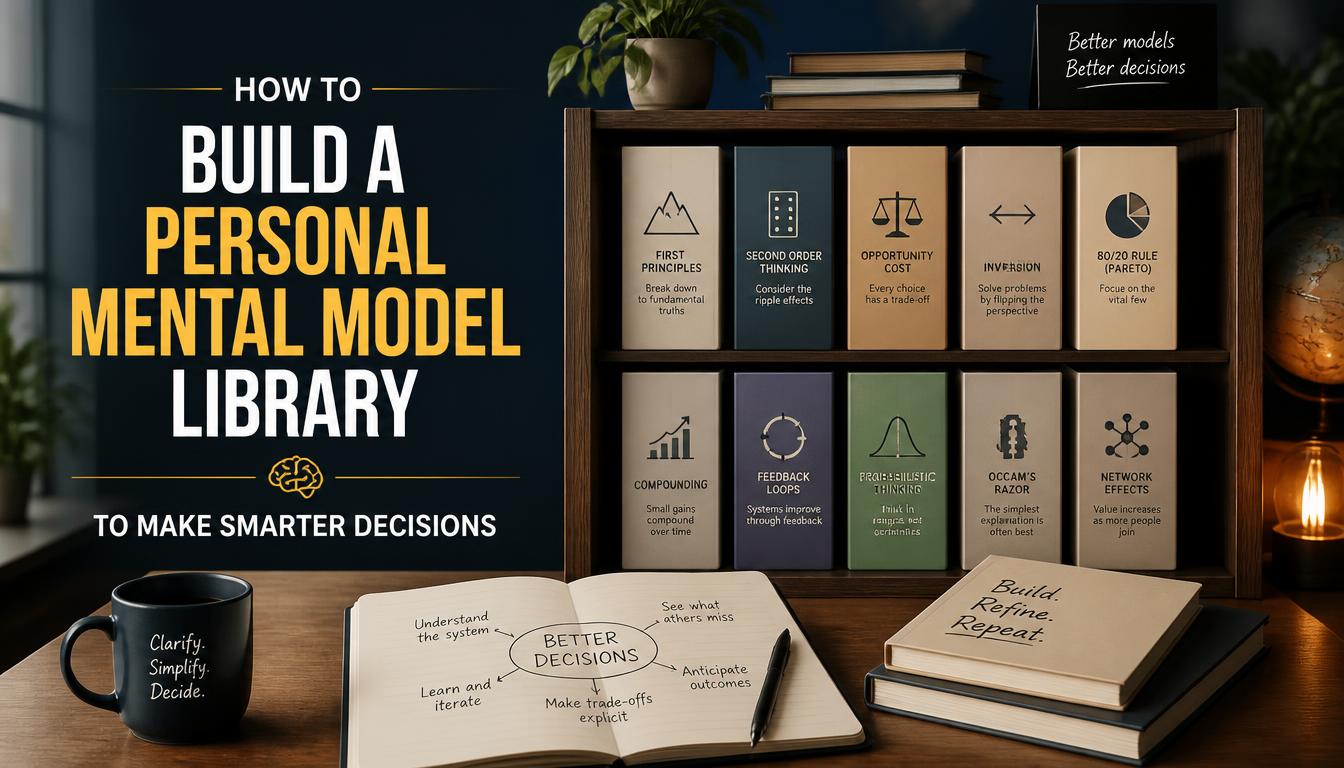
In a world overflowing with data, information, and endless noise, the bottleneck to success is rarely a lack of facts. We have Google in our pockets, AI assistants at our fingertips, and entire libraries accessible via a glowing screen. Yet, despite having access to more information than any generation in human history, many of us still struggle to make good decisions, solve complex problems, and navigate uncertainty. Why? Because information is not the same as understanding.
The secret weapon of history’s greatest polymaths, scientists, investors, and entrepreneurs—from Charlie Munger and Ray Dalio to Richard Feynman and Elon Musk—isn't that they know more facts. It is that they possess a superior toolkit for processing those facts. This toolkit is known as a mental model library.
If you want to upgrade your cognitive operating system, make fewer mistakes, and see the world as it actually is rather than how you wish it to be, you need to build your own personal mental model library. In this comprehensive guide, we will explore what mental models are, why you need them, and step-by-step instructions on how to curate, maintain, and apply them in your daily life.
What is a Mental Model?At its core, a mental model is a framework, concept, or worldview that you carry in your mind to help you understand how the world works. It is a cognitive shortcut that simplifies complexity, allowing you to cut through chaos and identify the underlying dynamics of a situation.
Think of mental models as tools in a physical toolbox. A hammer is great for driving nails, but terrible for turning screws. Similarly, if you only have one way of looking at the world (for example, viewing every business problem purely through a financial lens), you will misdiagnosed problems that require psychological, systemic, or physical interventions.
Charlie Munger, the legendary business partner of Warren Buffett, famously advocated for a "latticework of mental models." He argued that you cannot rely on just one discipline—economics, psychology, physics, biology, or history. Instead, you must snap together models from multiple domains to form a multidisciplinary lattice of understanding.
Why You Need a Personal Mental Model LibraryMost people operate on autopilot, relying on gut instinct, emotional reactions, or superficial biases to make choices. Building a conscious mental model library changes this dynamic in several profound ways:
- Better Decision-Making Under Uncertainty: Mental models give you a structured way to evaluate risks, weigh probabilities, and anticipate unintended consequences.
- Faster Problem Solving: Instead of reinventing the wheel every time you face a challenge, you can match the problem to an existing framework and adapt the solution.
- Reduced Cognitive Biases: Models act as guardrails against emotional thinking, confirmation bias, and the Dunning-Kruger effect.
- Enhanced Lifelong Learning: New information isn't stored as isolated trivia; it attaches to existing mental frameworks, making it easier to remember and apply.
To build a robust library, you shouldn't just collect random aphorisms. You need a structured approach that spans the fundamental sciences and humanities. When starting out, aim to pull models from these foundational pillars:
1. Physics and Hard SciencesPhysics deals with absolute laws of nature. Even when applied metaphorically, these models help us understand friction, momentum, leverage, and entropy. Concepts like Activation Energy or First Principles Thinking originate here.
2. Biology and EcologyLife is messy, adaptive, and interconnected. Biological models help us understand evolution, adaptation, feedback loops, and complex ecosystems. A business or career is often best understood not as a machine, but as an ecosystem.
3. Psychology and Behavioral EconomicsHumans are notoriously irrational. Understanding how our brains trick us—through models like Incentive-Caused Bias, Loss Aversion, and Social Proof—is essential for leadership, sales, and self-improvement.
4. Systems Thinking and MathematicsMathematics and systems theory teach us about probability, compounding, scaling limits, and feedback loops. Understanding Exponential Growth or Bottlenecks changes how you approach goals and constraints.
Step 2: Curate Your Essential Starter ModelsYou don't need hundreds of models to get started. In fact, trying to memorize 500 models at once will lead to cognitive overload. Instead, start with a core curriculum of 10 to 15 versatile, high-leverage mental models. Here are five essential models to add to your library immediately:
1. First Principles ThinkingPopularized by Aristotle and championed by Elon Musk, first principles thinking involves boiling a problem down to its most fundamental truths that you *know* are true, and reasoning up from there, rather than reasoning by analogy. When someone says, "We've always done it this way," they are reasoning by analogy. First principles strip away the assumptions.
2. Second-Order ThinkingAnyone can think about first-order consequences: "If I eat this donut, it will taste good." Second-order thinking asks: "And then what?" It forces you to look down the timeline. "If I eat this donut every day for a year, my health will degrade." Failing to consider second-order effects is the root cause of most policy blunders, bad investments, and lifestyle mistakes.
3. The Map is Not the TerritoryThis model, derived from Alfred Korzybski, reminds us that a description of a thing is not the thing itself. A financial spreadsheet is not the business; a syllabus is not an education; a political poll is not the election. The map is always a simplified abstraction of reality. Never confuse the two, or you will mistake models for absolute truth.
4. Circle of CompetenceDerived from Warren Buffett, this model states that you don't have to be an expert on everything; you just need to know the boundaries of what you understand. Operating within your circle of competence leads to clarity and success; stepping outside it without rigorous study leads to unmitigated disaster.
5. Pareto Principle (The 80/20 Rule)Originally observed by Vilfredo Pareto regarding wealth distribution, this model states that roughly 80% of effects come from 20% of the causes. In business, 80% of sales come from 20% of clients. In life, 80% of your happiness often comes from 20% of your activities. Identifying and doubling down on your vital few inputs is a game-changer.
Step 3: Establish a Personal Knowledge Management (PKM) SystemA model unrecorded is a model forgotten. To build a true library, you need an external storage system where you can capture, organize, and retrieve your mental models. You can use digital tools like Obsidian, Notion, Roam Research, or even a classic physical Zettelkasten card index.
Your mental model vault should follow a specific structure for each entry:
- Name of the Model: Clear, recognizable title (e.g., *Goodhart's Law*).
- Definition: A concise, one-sentence description of what the model means.
- Origin / Source: Where does this model come from? (e.g., Economics, evolutionary biology).
- Real-World Examples: At least two distinct examples of how this model plays out in the real world (one in business, one in personal life).
- Anti-Patterns / Caveats: When does this model *not* apply? Understanding the limitations of a tool prevents misapplication.
Collecting mental models like Pokémon cards is useless if you never use them. True mastery comes from regular, deliberate application. Here is how to operationalize your library:
1. Post-Mortem AnalysisWhen a project fails, a relationship hits a rough patch, or an investment goes south, don't just brush it off. Open your mental model library and ask: *Which model did I violate?* Was it Confirmation Bias? Did I ignore Second-Order Thinking? This turns failures into permanent education.
Conversely, when you succeed, ask which model accounted for your success so you can deliberately replicate it.
2. Weekly Review and PromptingPick one mental model each week and actively look for it in the wild. If your model of the week is *Incentive Structures*, analyze your company’s compensation plan, your local government’s tax policies, and your own personal habits through that specific lens.
3. Interdisciplinary JournalingWhen writing in your journal or working through a thorny problem, force yourself to write down the problem statement, and then brainstorm potential solutions using at least three completely different models from different domains.
Common Pitfalls to AvoidAs you build and utilize your personal mental model library, watch out for these cognitive traps:
- Over-Intellectualizing: Don't use mental models as an excuse for paralysis by analysis. Sometimes, you need to take imperfect action rather than calculating every probabilistic outcome.
- The "Golden Hammer" Fallacy: Just because you learned a brilliant new model (like Game Theory or First Principles) doesn't mean it applies to *every* situation. Stay humble and match the tool to the task.
- Static Library Syndrome: Your library should evolve. As you encounter new anomalies and data points, update your models, discard outdated frameworks, and refine your definitions.
Building a personal mental model library is not a weekend project; it is a lifelong pursuit of wisdom. By shifting your focus from collecting isolated facts to mastering powerful cognitive frameworks, you fundamentally change how you interact with reality.
You will start to see patterns where others see chaos. You will spot risks before they materialize. You will make decisions with greater calm, clarity, and confidence. Begin today: pick three models from this article, write down their definitions and real-world applications in a dedicated notebook or digital vault, and take your first step toward building a truly world-class mind.
How to Build a Personal Mental Model Library to Make Smarter Decisions
Learn how to build a personal mental model library to make smarter decisions, solve complex problems, and upgrade your cognitive framework.