
First Principles Thinking: Elon Musk's Secret Weapon for Radical Innovation

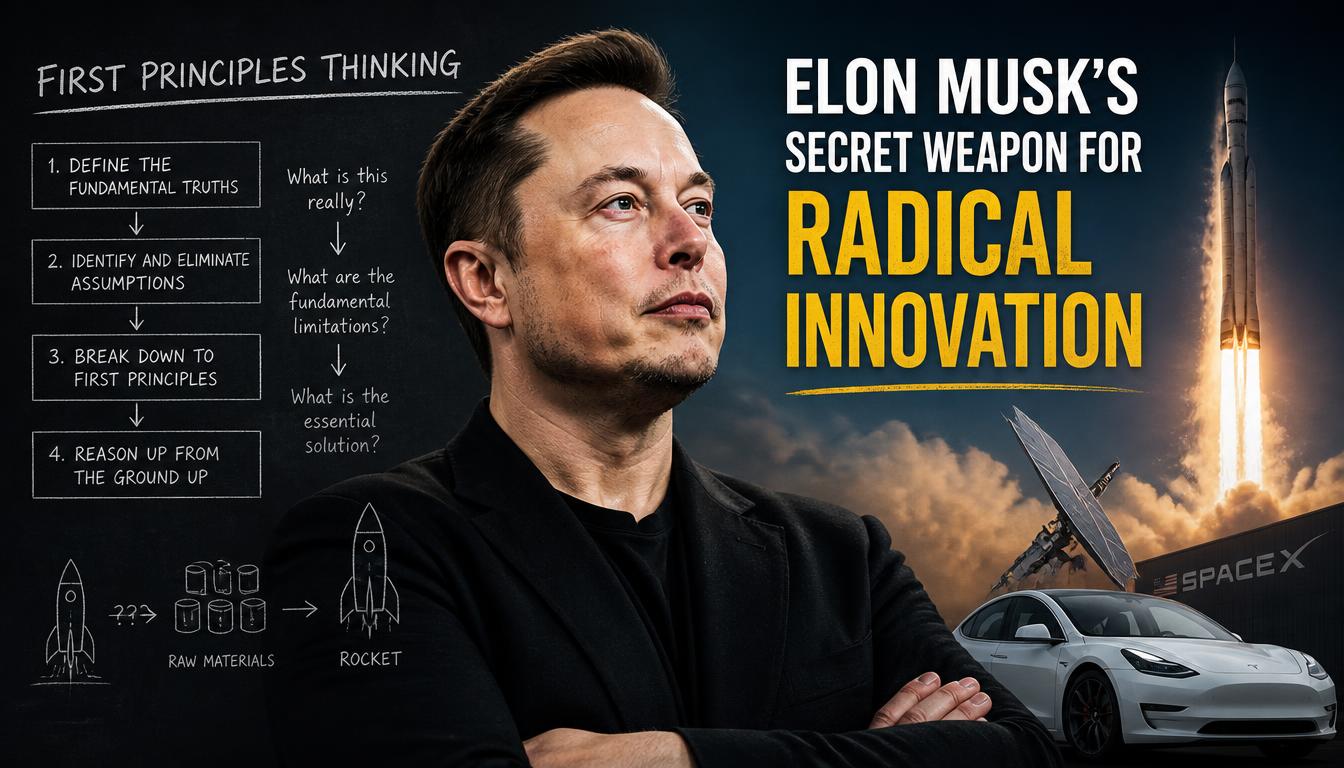
In a world obsessed with doing things the way they’ve always been done, true innovation is rare. Most people and organizations operate on autopilot, relying on industry best practices, established norms, and conventional wisdom. We look at what our competitors are doing, make a few incremental tweaks, and call it progress. But incremental progress is not how you change the world. It is not how you build electric cars that rival luxury vehicles, reusable rockets that land themselves upright, or brain-computer interfaces.
For visionary entrepreneur Elon Musk, the secret to defying the impossible isn't native genius alone; it is a mental model as ancient as philosophy itself: First Principles Thinking. Whether he is founding SpaceX, Tesla, Neuralink, or The Boring Company, Musk applies this razor-sharp cognitive framework to strip away the noise of the status quo and reconstruct reality from the ground up.
If you want to solve complex problems, shatter personal limits, and build breakthrough products or ideas, mastering First Principles Thinking is the ultimate intellectual leverage. In this deep dive, we will explore what first principles thinking is, why Elon Musk swears by it, how it differs from reasoning by analogy, and how you can apply it to your own life and career.
What Are First Principles?To understand the concept, we have to travel back more than two thousand years to ancient Greece. Aristotle, one of history’s greatest minds, defined a first principle as the foundational proposition or assumption that cannot be deduced from any other proposition. In plain English, a first principle is the absolute bedrock truth of a situation—the irreducible building blocks of a specific domain.
Imagine you are looking at a brick house. Reasoning from analogy (the opposite of first principles), you might say, "A house is made of walls, and walls are made of bricks, so I must buy bricks to build a house."
Reasoning from first principles, however, forces you to ask: What is a brick actually made of? Mud, clay, sand, and water. What are those elements? Minerals and compounds. What are those at an atomic level? When you break down the house to its most fundamental physical components, you realize you are dealing with raw elements that can potentially be rearranged in entirely new, cheaper, and more efficient ways.
First principles thinking is the act of boiling a problem down to its fundamental truths and reasoning upward from there, rather than adopting beliefs, habits, or structures handed down by others.
The Musk Masterclass: How Elon Applies the FrameworkElon Musk is perhaps the most vocal and successful modern practitioner of this philosophy. He frequently references first principles in interviews, most notably during an interview with filmmaker Kevin Rose, where he explained his worldview:
"I think it’s important to reason from first principles rather than by analogy. The normal way we conduct our lives is we reason by analogy. We are doing this because it’s like something else that was done, or it’s like what other people are doing... First principles is kind of a physics way of looking at the world. You boil things down to the most fundamental truths... and then you reason up from there."
To see this in action, we only need to look at the genesis of SpaceX.
In the early 2000s, Musk wanted to send a greenhouse to Mars (a mission later known as Mars Oasis) to spark public interest in space exploration. When he looked at the cost of buying a rocket from existing aerospace providers in the United States and Russia, he was shocked. The prices were exorbitant—tens of millions, sometimes hundreds of millions of dollars per launch.
Conventional wisdom dictated that space travel was inherently expensive because that's just how much rockets cost. Most entrepreneurs would have accepted this industry standard and pivoted. Musk, however, applied first principles thinking.
He asked: What is a rocket actually made of?
- Aerospace-grade aluminum alloys
- Titanium
- Copper
- Carbon fiber
Next, he asked: What is the raw material cost of these aerospace metals on commodity markets?
The answer stunned him. The cost of the physical materials required to build a rocket was roughly 2 percent of the typical price of a finished rocket. The traditional aerospace industry had marked up materials by 5,000% due to inefficient supply chains, bureaucratic bloat, and legacy manufacturing processes.
Instead of accepting that he couldn't afford to go to space, Musk realized he could build his own rockets from scratch. He founded SpaceX in 2002, bypassed the inflated supplier market, built a vertically integrated manufacturing facility, and dramatically disrupted an entire multi-billion-dollar industry by asking basic physics questions.
Reasoning by Analogy vs. First Principles ThinkingTo truly master this mindset, you must understand the cognitive trap it replaces: Reasoning by Analogy.
Human beings are lazy thinkers by evolutionary design. Our brains consume roughly 20% of our daily energy, so they constantly look for shortcuts. Reasoning by analogy is our primary shortcut. It is the act of copying what other people are doing with minor iterations. It sounds like:
- "Everyone in our industry charges monthly subscription fees, so we should too."
- "People have always gone to college at age 18, so that's what my child should do."
- "That startup failed because their marketing sucked, so our marketing must be better."
Reasoning by analogy is fine for routine tasks. You don’t need first principles thinking to brush your teeth or drive to the grocery store. But when you are facing an ambiguous challenge, trying to solve a creative problem, or attempting to build something radically new, analogy will trap you inside the boundaries of what already exists.
First principles thinking, on the other hand, ignores what everyone else is doing. It starts with a blank slate. It asks:
- What do we know to be absolutely true?
- What are the laws of physics, mathematics, or human nature at play?
- If we threw out every rule, precedent, and best practice, how would we solve this problem today?
Analogy asks: What are others doing? First principles asks: What are the foundational truths here?
The Tesla Battery Pack BreakthroughAnother brilliant example of Musk deploying first principles thinking occurred during the development of Tesla’s electric vehicles. In the early days of Tesla, battery packs were prohibitively expensive. Industry experts argued that electric cars would never achieve mass-market adoption because lithium-ion battery cells cost around $600 per kilowatt-hour (kWh), and the price floor was allegedly fixed.
Analogy-driven executives threw their hands up and said, "Batteries cost $600/kWh, therefore long-range EVs are financially unviable."
Musk broke the battery down to its first principles. He asked: What are the material components of a battery pack? What is the spot market value of those materials?
- Carbon
- Nickel
- Aluminum
- Silicon
- Polymers
- A cell can
He calculated that on a London Metal Exchange basis, the raw materials for a battery consisted of cobalt, nickel, aluminum, carbon, and some polymers wrapped in a steel can. If you bought those materials on the open market, the cost was mere fractions of the finished battery pack price.
Musk realized that the high cost wasn't because the materials were rare or expensive; it was because the manufacturing process was inefficient—assembling cells in a suboptimal sequence, paying middlemen markups, and lacking economies of scale.
Tesla decided to design their own batteries, build the massive Gigafactories, and innovate on the chemistry and manufacturing process. Today, battery costs have plummeted toward the $100/kWh threshold, making affordable, long-range electric vehicles a global reality.
How to Apply First Principles Thinking in Your Own LifeYou don't need to be building rockets or electric cars to use Elon Musk's secret weapon. Whether you are an entrepreneur, software developer, manager, artist, or student, first principles thinking can supercharge your decision-making. Here is a step-by-step framework to apply it:
Step 1: Identify and Define Your Current AssumptionPick a problem you are facing or a goal you want to achieve. Write down what you currently believe about it. For example, suppose you want to grow your business's revenue. You might think, "We need to double our digital ad spend because that's how customer acquisition works."
Step 2: Breakdown the Problem to Its Core TruthsInterrogate your assumption. Strip away all cultural habits, industry standards, and personal biases. Ask: What are the absolute indisputable facts here?
In the marketing example:
- Fact: People buy products when they understand their value and trust the brand.
- Fact: Ad spend buys impressions and clicks, not necessarily trust or understanding.
- Fact: Word-of-mouth and organic virality cost zero ad dollars but require an exceptional product.
Now that you have isolated the foundational truths, rebuild your strategy without looking at what your competitors are doing. If you didn't have a marketing budget at all, how would you make people love and talk about your product? Could you create a referral loop? Could you build educational content that solves your customer's deepest pain points for free?
The Psychological Challenge of First PrinciplesWhile first principles thinking sounds logical and straightforward on paper, it is psychologically exhausting. There is a reason most people don't use it.
First, it requires immense cognitive effort. Our brains prefer cognitive ease. Questioning deeply held beliefs creates cognitive dissonance and discomfort.
Second, it invites social friction. When you use first principles, you are often challenging the experts, the elders, the industry veterans, and the "way it has always been done." You will hear phrases like:
- "That's not how things work in this industry."
- "If it were possible, someone else would have already done it."
- "You're overcomplicating things."
Being a first principles thinker means being comfortable looking foolish, challenging consensus, and being wrong until you are radically, undeniably right.
Conclusion: Build Your World from ScratchElon Musk’s success is not an accident of birth or a stroke of blind luck. It is the natural output of a rigorous mental framework. By stripping away conventional wisdom and returning to the foundational laws of physics, economics, and human nature, Musk has repeatedly achieved feats that the world deemed impossible.
The next time you face a seemingly insurmountable challenge—whether in business, personal finance, career development, or creative work—resist the urge to copy what everyone else is doing. Pause, peel back the layers of dogma, tradition, and assumption, and ask yourself: What do I know to be absolutely true?
Stop borrowing other people's blueprints. Start building your reality from the ground up.
First Principles Thinking: Elon Musk's Secret Weapon for Radical Innovation
Discover how Elon Musk uses First Principles Thinking to disrupt industries like space travel and EVs. Learn how to apply this mental model to your own life.