
E-book vs. Course vs. Template: Which Digital Product Should You Actually Build First?

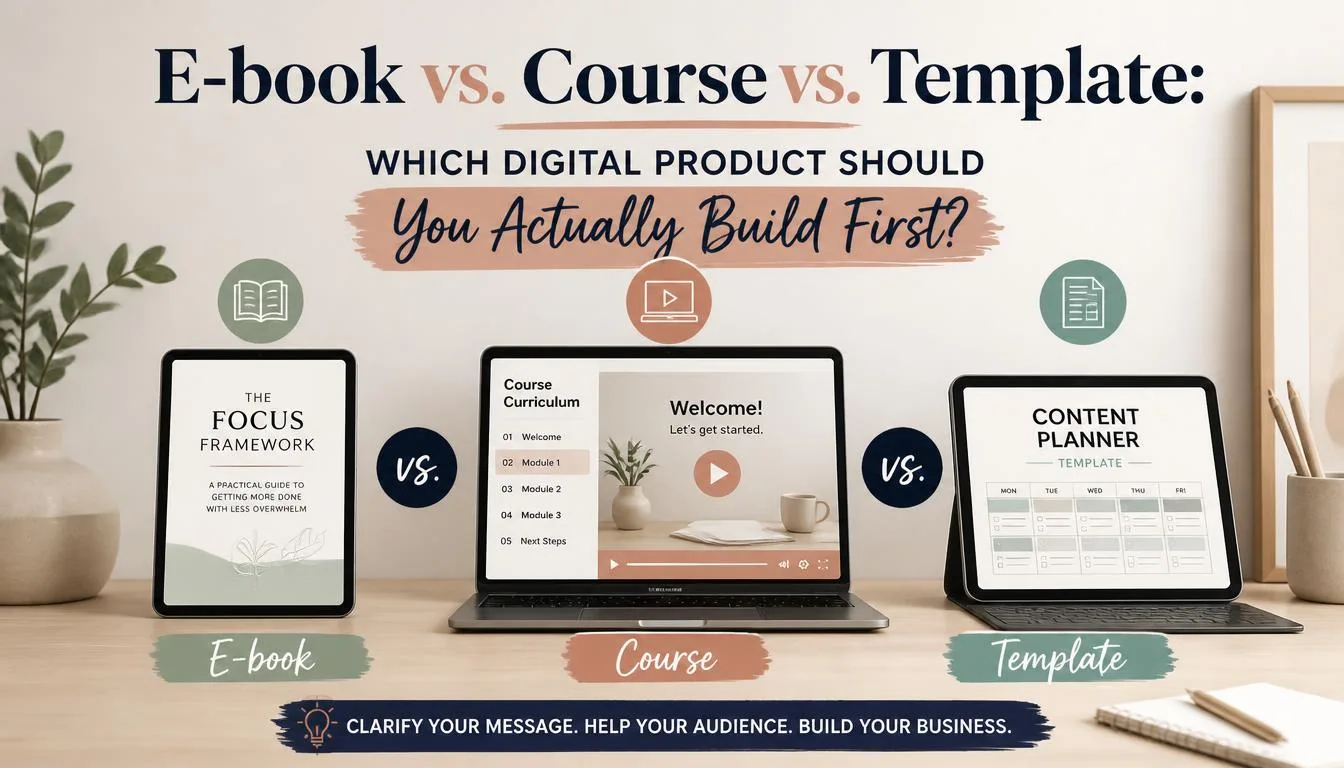
Most creators fail in the digital product space because they build what they want to teach, rather than what the market is structurally prepared to buy. They spend six months filming a 40-module masterclass, only to launch to absolute silence. Or they write a 150-page e-book packed with nuance, completely ignoring the fact that modern consumers don't want more information—they want speed and transformation.
Choosing your first digital product isn't a creative decision; it's a logistics and validation strategy. As someone who has audited over a hundred creator funnels and scaled multiple digital product suites past the seven-figure mark, I see the same foundational errors repeated daily. Let's break down the mechanics, profit margins, consumption rates, and operational overhead of e-books, online courses, and templates so you can deploy the right asset for your exact stage of business.
The E-Book: The High-Friction Information ProductFor a long time, the e-book was the undisputed entry point for digital entrepreneurs. Write a PDF, slap a nice cover on Canva, set up a Stripe link, and watch the passive income roll in. Except, the market has matured.
An e-book is a linear information product. It relies entirely on the buyer's self-discipline to read, digest, and implement the concepts. Because of this, completion rates for standalone e-books hover below 10%. When customers don't finish your product, they don't get results. When they don't get results, they don't buy your next offer.
When You Should Build an E-BookDespite its low completion rate, the e-book still holds a vital place in a modern ecosystem if deployed correctly:
- You are establishing a rigorous thought-leadership thesis: If your business relies on a novel philosophy, a unique framework, or a counter-intuitive industry critique, a short, high-density manifesto works exceptionally well.
- Your price point is sub-$30: E-books serve as premier impulse buys. They lower the barrier to entry for cold traffic, effectively funding your initial ad spend or list-building efforts.
- The content is strictly theoretical or historical: If execution isn't the primary goal—such as an industry trend analysis or a conceptual history—text is the superior medium.The Hidden Traps of E-Books
Perceived value is plummeting. With AI tools capable of generating 50-page guides in seconds, consumers view traditional PDFs with skepticism. Furthermore, text-based products suffer from rampant piracy. If your e-book is your flagship and only offer, your revenue ceiling is fiercely limited.
The Online Course: The Transformation TrapThe online course is the holy grail of creator status. Charging $497, $997, or $2,000 for a structured video curriculum feels like building a real business. But building a course before you have audience validation is the fastest way to burn out.
Courses are not information products; they are behavioral transformation products. They require high production values, robust student management, community infrastructure, and—most importantly—continuous student success management to prevent refund requests.
The Economics of Course CreationConsider the actual resource allocation required for a viable course:
- Time-to-Market: 2 to 6 months of scripting, recording, editing, and platform setup.
- Tech Stack Overhead: Kajabi, Teachable, or Circle, plus email automation and video hosting (Wistia/Vimeo).
- Support Burden: An influx of student questions requiring a community manager or your direct intervention.
Do not touch a course until you have met two strict criteria: you have successfully solved the exact same problem for at least 10 people 1-on-1, and you have documented their transformation in real-time. A course is simply the systematization of a manual process that already works.
The Template: The Ultimate Leverage AssetTemplates, Notion dashboards, swipe files, spreadsheets, and design systems are the unsung heroes of the digital economy. While creators obsess over video modules, templates quietly generate massive profit margins with near-zero customer support overhead.
A template is an execution engine. It bypasses the learning phase entirely and drops the user straight into the implementation phase. Instead of teaching someone how to write a cold email over a 3-hour video module, you hand them the exact, field-tested template with fill-in-the-blank brackets.
Why Templates Outperform Courses for BeginnersFrom a first-principles perspective, templates win on consumer psychology:
- Instant Gratification: The time-to-value is measured in seconds, not weeks.
- Zero Churn: There are no modules to watch, meaning zero buyers remorse regarding time commitment.
- Viral Potential: Useful templates (especially in workspace tools like Notion, Figma, or Excel) are naturally shareable within teams and professional networks.
Last year, we worked with a B2B marketing consultant who spent four months building a $600 course on client acquisition. Launch revenue was $4,200. We advised her to scrap the video modules and repackage the underlying frameworks into a Notion CRM and a swipe file of 50 proven outreach scripts, priced at $97. Within 30 days, she generated $31,000. Why? Because clients didn't want to learn marketing; they wanted to copy-paste her system and get clients by Friday afternoon.
Comparative Breakdown: E-Book vs. Course vs. TemplateTo make an objective decision, evaluate your options across these core vectors:
- Production Complexity: E-Book (Medium) | Course (Very High) | Template (Low to Medium)
- Perceived Value: E-Book (Low) | Course (Very High) | Template (High)
- Customer Support Load: E-Book (Low) | Course (High) | Template (Very Low)
- Ideal Price Point: E-Book ($19 - $49) | Course ($297 - $2,000+) | Template ($47 - $197)
- Time to First Dollar: E-Book (Fast) | Course (Slow) | Template (Very Fast)
You do not have to choose just one forever. Master builders use a sequencing model. Start with a template to validate that people will pay to solve a specific micro-problem. Use the revenue and feedback from that template to build out your e-book or mini-workshop. Once you have a proven track record of student success stories and hundreds of data points on where people get stuck, build the comprehensive online course.
Stop building what feels good to create. Build the asset that gives your buyer the fastest, most frictionless path to an outcome. That is how you build a resilient, high-margin digital product business in 2026 and beyond.
E-book vs. Course vs. Template: Which Digital Product Should You Actually Build First?
Stuck choosing between an e-book, online course, or template? Discover which digital product to build first to maximize revenue and save time.