
How Much Time It *Really* Takes to Create Your First Digital Product (No Fluff)

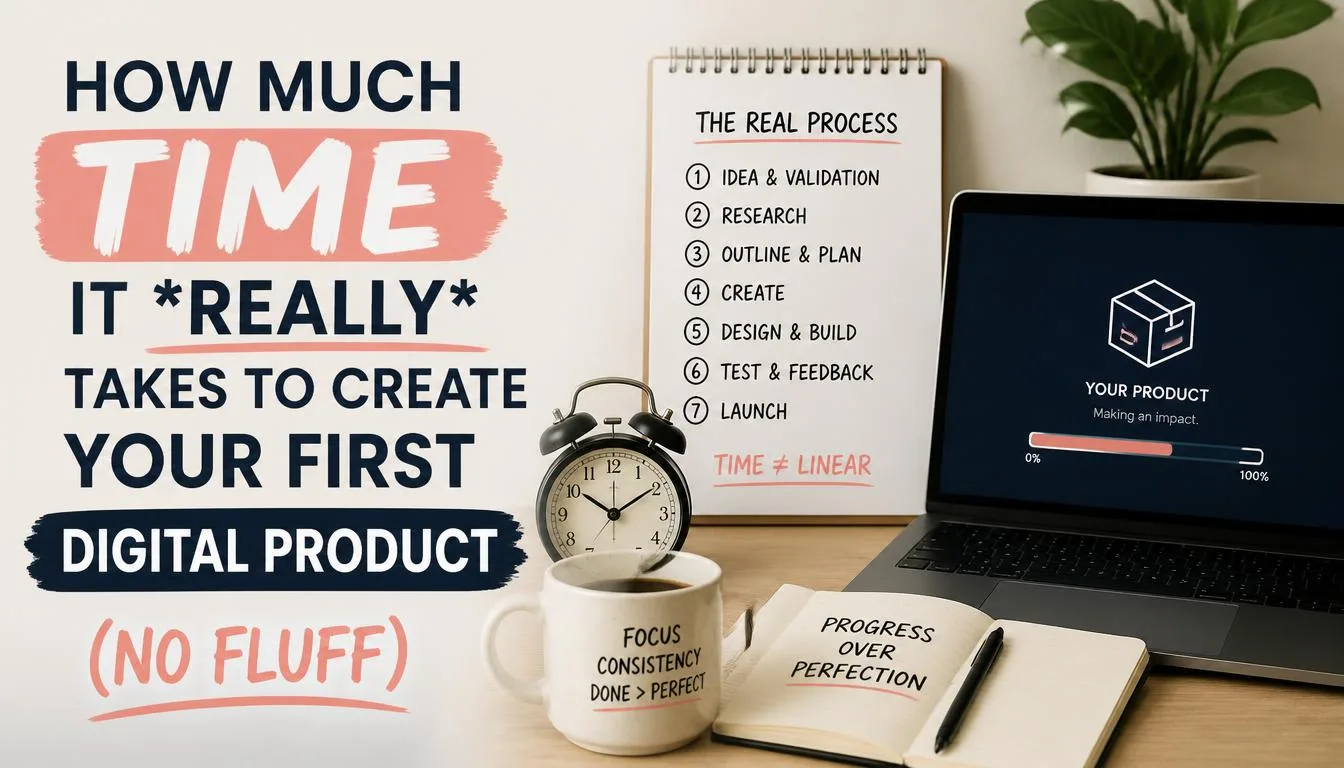
Most creators fail before they launch because they buy into a massive industry lie: "Build a digital product over a weekend!"
As someone who has audited, launched, and scaled over 40 digital products—ranging from $19 notion templates to $2,000 cohort-based masterclasses—I can tell you that the weekend-build myth is designed to sell you courses, not to help you build a sustainable asset. If you try to rush your first digital product into 48 hours, you will end up with a fragmented, low-value asset that nobody wants to buy, let alone finish.
So, how much time does it really take? The brutal, unvarnished truth is that building your first high-converting, professionally viable digital product takes between 40 to 120 hours spread across 4 to 8 weeks.
Let’s break down where those hours actually go so you can stop guessing and start executing.
The Anatomy of Digital Product TimelinesTime blindness is the silent killer of creator projects. When beginners estimate how long a project will take, they calculate only the active creation phase—the writing, the recording, or the designing. They completely omit audience validation, system configuration, asset staging, and post-launch refinement.
Here is the reality of time allocation for a first-time creator launching a mid-tier digital product (such as an intensive video course, a robust software template, or a comprehensive resource library):
- Audience Validation & Market Research: 10–15 hours
- Curriculum & Asset Architecture: 15–20 hours
- Production & Creation: 25–50 hours
- Tech Stack & Funnel Setup: 10–15 hours
- Pre-Launch & Marketing Asset Creation: 15–25 hours
Total time investment? Approximately 75 to 125 hours. If you are working a full-time job and can dedicate 10 hours a week to your business, you are looking at a realistic timeline of 8 to 12 weeks.
Phase 1: Validation and Architecture (15–35 Hours)Skipping this phase is why 90% of digital products make zero sales. Creators spend 60 hours building a product in a vacuum, launch it to crickets, and blame the algorithm.
Market Validation (10–15 Hours)Before you record a single video or write a single line of copy, you must prove that people are actively spending money to solve the specific problem your product targets.
Actionable Insight: Do not run surveys asking, "Would you buy this?" People lie to be polite. Instead, look for historical behavior. Are people buying books on this topic? Are they complaining about existing software in Reddit threads?Time Sink Warning: Do not spend three months doing market research. Talk to 5 to 10 prospective buyers via DM or email, validate their pain points, and move on.Curriculum Architecture (15–20 Hours)Your product must deliver a transformation, not information. Information is free on YouTube; transformation is what people pay for.
Map out the exact sequence of steps your customer needs to take to get from Point A (their current painful reality) to Point B (the desired outcome). If your product is a Notion workspace, architecture means mapping out the database relations. If it's a workshop, it means writing out the module outlines and slide frameworks.
Phase 2: Production and Asset Creation (25–50 Hours)This is the heavy lifting. This phase requires deep work blocks of at least 2 to 3 uninterrupted hours. If you try to record modules or write guides in 20-minute increments between checking Slack, your quality will plummet and your time investment will double.
The Scope Creep TrapFirst-time creators almost always fall victim to scope creep. You start building a simple PDF guide, and suddenly you feel insecure about the price, so you add three video modules, a private community, and weekly coaching calls.
Stop. For your first digital product, embrace the "Minimum Viable Product" (MVP) philosophy.
- Good: A laser-focused 90-minute workshop that solves one specific problem brilliantly.
- Bad: A sprawling 40-hour masterclass that overwhelms the user and takes you six months to finish.
High completion rates lead to testimonials and word-of-mouth referrals. If your product is too big, your buyers won't finish it, and they will never buy from you again.
Phase 3: The Infrastructure Tax (10–15 Hours)Many creators forget that delivering a digital product requires plumbing. You need a way to host the files, process payments, deliver automated emails, and issue receipts for tax compliance.
Setting up your tech stack for the first time always takes longer than you think. Even with modern, user-friendly tools like Gumroad, Lemon Squeezy, or Podia, you will burn hours on:
- Connecting your custom domain to your checkout page.
- Writing and testing automated welcome sequences.
- Setting up tax collection and VAT compliance rules.
- Testing the user checkout experience from a dummy account to ensure the product actually delivers upon purchase.
Do not underestimate the infrastructure tax. Budget at least a full weekend just for testing your tech stack.
Phase 4: Marketing Assets and Launch Prep (15–25 Hours)If building the product is 50% of the battle, marketing it is the other 90% (yes, that math is intentionally unbalanced). You can have the greatest digital product in the world, but if your landing page copy is weak, your conversion rate will flatline at 0.1%.
You need to allocate time to build:
- A high-converting sales page with clear outcome-driven headlines.
- Social proof, case studies, or beta-tester testimonials.
- A launch content calendar (emails, social posts, short-form video scripts).
Building anticipation via behind-the-scenes content during the creation phase dramatically shortens the time it takes to secure your first sales once you hit publish.
Case Study: The 60-Hour Blueprint vs. The 200-Hour TrapLet's look at two hypothetical creators:
Creator A (The Minimalist): Spends 5 hours talking to past clients to find a recurring pain point. Spends 35 hours putting together a concise, high-value asset library and template system. Spends 10 hours setting up a simple landing page on Lemon Squeezy. Spends 10 hours writing a 5-part launch email sequence. Total time: 60 hours. Result: Launched in 6 weeks, generated $3,500 in the first month, and built a foundation for scale.
Creator B (The Perfectionist): Spends 120 hours building a massive video course with 4K cameras and custom animations. Spends 40 hours redesigning their website for the third time. Spends 40 hours rewriting modules because they felt "imposter syndrome." Total time: 200+ hours. Result: Burnout, delayed launch by six months, and ultimate abandonment of the project out of exhaustion.
Perfectionism is rarely a commitment to high standards; it is almost always a disguised form of procrastination.
Summary: Your Realistic Timeline ChecklistIf you are serious about launching your first digital product without burning out, use this strict timeframe:
- Weeks 1–2: Validation, research, and outlining (15 hours)
- Weeks 3–5: Core creation and asset production (30 hours)
- Week 6: Tech stack, hosting, and checkout testing (10 hours)
- Weeks 7–8: Copywriting, sales page design, and launch prep (20 hours)
By protecting your scope, focusing on transformation over information, and accepting that your first product will not be your last, you can successfully ship your first digital asset in under two months while maintaining your sanity and your day job.
How Much Time It *Really* Takes to Create Your First Digital Product (No Fluff)
Stop guessing. Discover the realistic timeline to build, validate, and launch your first digital product without burning out. Read the guide.