
The AI Billable Hour Paradox: How Smart Lawyers Cut Research Time in Half and Increase Revenue

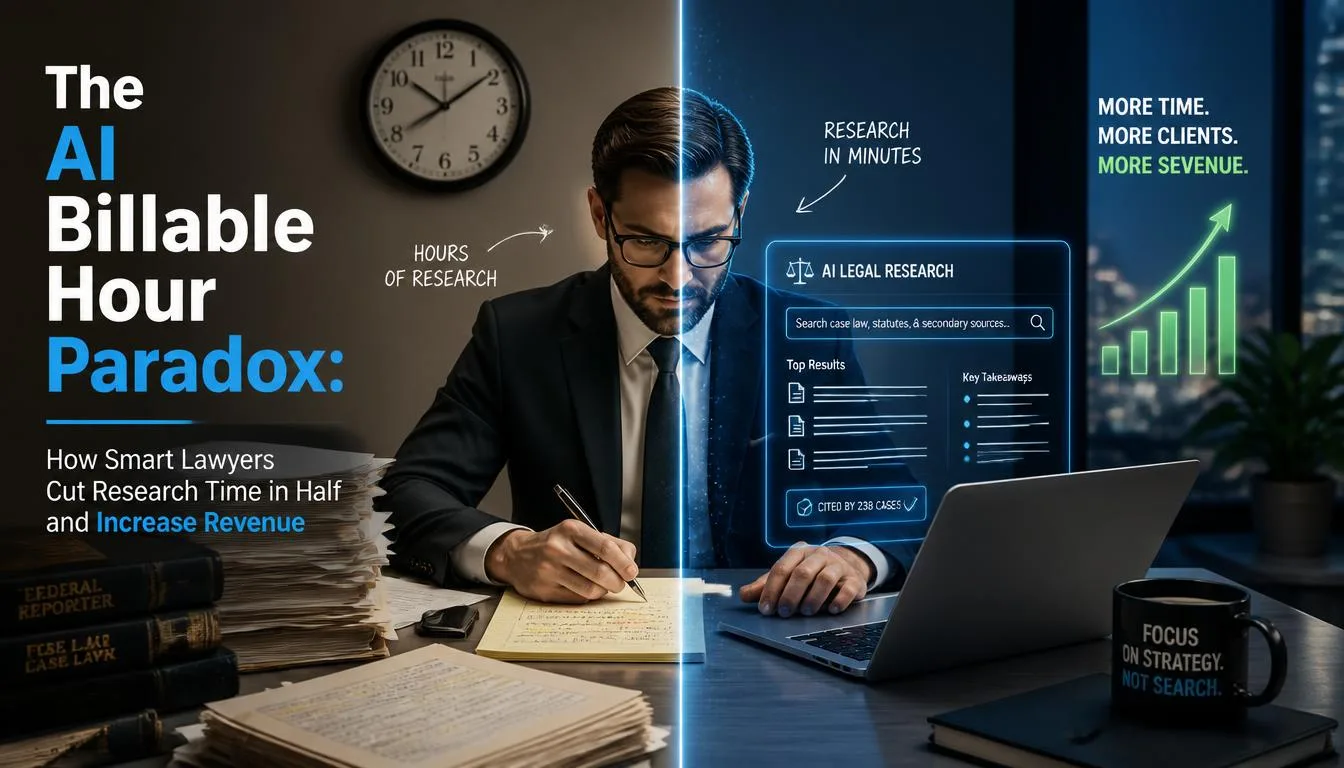
For decades, the legal profession has lived and died by the billable hour. It is a metric of survival, a badge of exhaustion, and, increasingly, a broken economic model. When generative artificial intelligence entered the legal tech space, panicked boardrooms predicted the death of the billable hour entirely. If a brief that once took eight hours of manual Shepardizing and drafting can now be generated in forty-five seconds, how do associates justify their billing?
The reality on the ground—observed firsthand across Am Law 200 firms and elite boutique practices—is vastly different from the doomsday prophecies. Lawyers aren't billing fewer hours; they are shifting the composition of those hours. They are shedding low-value, unbillable administrative drag and replacing it with high-margin, strategic advisory work. Artificial intelligence is not eroding billable revenue; it is acting as a force multiplier for billing capacity.
The Anatomy of Legal Inefficiency: Where Hours Actually DisappearBefore examining how AI transforms billing, we must confront the traditional time sink. In a standard litigation or corporate practice, a significant percentage of the working day is spent on tasks that clients are increasingly reluctant to pay for:
- Cross-jurisdictional statute and case law comparisons.
- First-pass document review and privilege log generation.
- Formatting, citation checking, and local rules compliance.
- Synthesizing hundreds of pages of deposition transcripts into coherent timelines.
Clients have grown wise to this. Alternative fee arrangements (AFAs), fixed-fee caps, and aggressive guideline enforcement mean that associates spending three hours manually checking Bluebook citations are essentially writing off firm revenue. The hours are worked, but they cannot be billed. AI changes this dynamic by compressing the time required for foundational work, allowing attorneys to either capture that time more efficiently or pivot immediately to billable analysis.
How AI Slashes Legal Research Time Without Sacrificing PrecisionGeneric large language models hallucinate case citations; enterprise-grade legal AI platforms do not. Modern retrieval-augmented generation (RAG) systems trained on verified court dockets, state statutes, and proprietary firm knowledge bases have fundamentally changed how research is conducted.
Moving Beyond Boolean SearchesTraditional legal research relied on precise Boolean strings and keyword matching. If an associate missed a specific term of art, relevant binding precedent remained hidden in the database. AI-driven research tools utilize semantic search. An attorney can input a complex factual narrative—such as "Liability of a cloud service provider under the CCPA when a third-party vendor suffers a zero-day ransomware attack"—and receive an immediate synthesis of relevant holdings, dissenting opinions, and statutory gaps.
Case Study: The 14-Hour Motion in LimineConsider a recent mid-market commercial litigation matter handled by a boutique firm we consulted with. Historically, drafting a complex motion in limine required approximately fourteen hours of associate time:
- Hours 1–4: Jurisdictional research and locating conflicting district court rulings.
- Hours 5–9: Drafting the argument and integrating evidentiary rules.
- Hours 10–14: Citation validation, Bluebooking, and partner review revisions.
By integrating a specialized legal AI assistant, the timeline shifted dramatically:
- Hours 1–0.5: Semantic query execution and preliminary source retrieval.
- Hours 0.5–2.5: Strategic argument refinement and incorporation of unique case facts.
- Hours 2.5–3.5: Automated citation checking and human structural review.
The total time dropped from fourteen hours to less than four. Crucially, the quality of the final product improved because the attorney spent 80% of their time on persuasive rhetoric and strategic positioning rather than mechanical information retrieval.
The Economics of the AI-Enhanced Billable HourCritics argue that if a task takes 75% less time, billable revenue must drop by 75%. This zero-sum thinking ignores the economic reality of firm capacity constraints and client expectations.
The Fixed-Fee AdvantageSophisticated firms are moving away from hourly billing toward value-based pricing, particularly in transactional and compliance work. If a firm charges a flat fee of $10,000 for an M&A due diligence review, and AI reduces the labor cost from fifty hours to ten hours, the firm's effective hourly rate skyrockets. The client gets their deliverable faster and at a predictable cost, while the firm dramatically expands its profit margin.
Reallocating Hours to High-Value WorkUnder an hourly model, efficiency does not mean billing fewer hours; it means billing better hours. When an associate is no longer buried under mountains of discovery documents, those freed-up hours are redirected toward billable advisory tasks that clients happily pay for, such as proactive risk mitigation, strategic negotiation prep, and regulatory counseling.
Implementation Pitfalls: What Can Go WrongAdopting legal AI is not a plug-and-play exercise. Firms that rush into deployment without governance frameworks often face severe professional and financial risks.
The Dangers of Consumer-Grade ToolsUsing public LLMs for client work violates privilege and confidentiality protocols. Lawyers must utilize enterprise solutions hosted in secure, SOC 2-compliant environments where data is never used to train public models.
The Oversight ImperativeAI is a draft engine, not a licensed practitioner. Under Model Rule 1.1 (Competency), attorneys have a non-delegable duty to verify the accuracy of any work product submitted to a court or client. Failing to check AI-generated citations—as several high-profile sanctioned attorneys discovered—leads directly to professional liability.
Best Practices for Law Firms Scaling with AITo maximize the billing and research benefits of artificial intelligence while mitigating risk, managing partners should implement a structured playbook:
- Audit the Workflow: Map out exactly where associates spend non-billable or low-margin hours before purchasing software.
- Mandate Verification Protocols: Establish firm-wide rules requiring human review for every piece of AI-generated legal text or citation.
- Redefine Performance Metrics: Shift associate evaluation criteria away from raw billable hours toward leverage, output quality, and efficiency metrics.
- Invest in Prompt Engineering Training: The quality of an AI output is directly proportional to the precision of the prompt. Train your attorneys to think like legal prompt engineers.
Artificial intelligence is separating the legal industry into two camps: firms that leverage technology to scale their intellectual output, and firms that drown in manual inefficiency. By reclaiming hundreds of hours previously lost to research friction and administrative drag, modern lawyers are discovering that AI is not the end of the billable hour—it is its most profitable evolution.
The AI Billable Hour Paradox: How Smart Lawyers Cut Research Time in Half and Increase Revenue
Discover how top law firms use legal AI to slash research time by 75%, optimize billable hours, and maximize firm profit margins safely.