
Inside the Judicial Mind: How Judges Are Actually Trained to Eradicate Bias

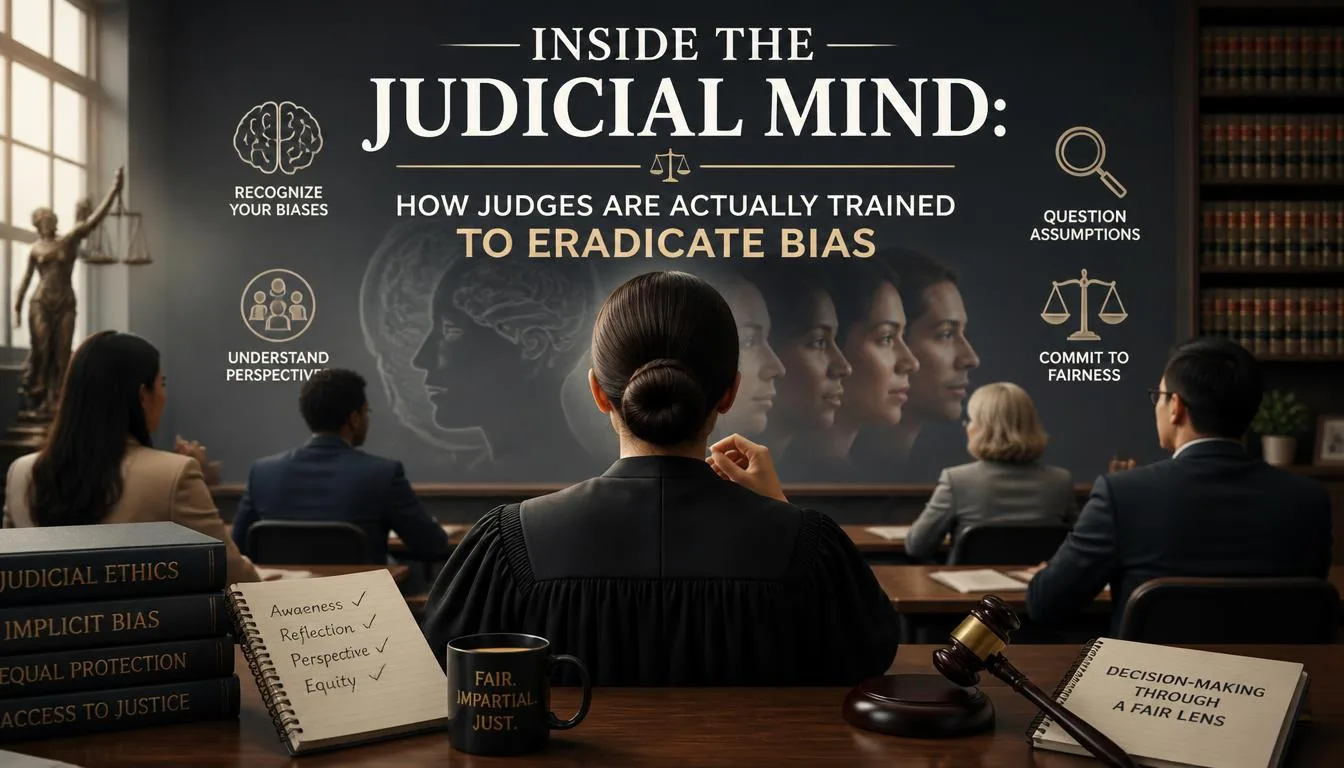
When a litigant steps into a courtroom, they operate on a fundamental assumption: the person wearing the black robe is a neutral arbiter. But human beings are inherently wired for bias. Our brains rely on cognitive shortcuts, heuristics, and pattern recognition to navigate a complex world—mechanisms that are lethal to the fair administration of justice. So, how do legal systems bridge the chasm between human fallibility and the mandate of absolute impartiality?
As someone who has spent decades analyzing judicial education programs, consulting on courtroom psychology, and reviewing judicial conduct protocols, I can tell you that judicial neutrality is not a personality trait. It is an acquired, rigorously maintained cognitive skill. Judges are not born unbiased; they are systematically engineered through intensive, continuous metacognitive training to recognize, isolate, and override their own mental blind spots.
The Anatomy of Judicial Cognition: System 1 vs. System 2 ThinkingTo understand judicial bias training, we must first look at cognitive psychology. Psychologist Daniel Kahneman's framework of human thought—dividing it into System 1 (fast, automatic, emotional) and System 2 (slow, deliberate, analytical)—forms the bedrock of modern judicial education.
Untrained individuals rely heavily on System 1 thinking. In a high-stakes courtroom environment, relying on System 1 is catastrophic. If a judge sees a defendant who matches a statistical profile, an untrained brain instantly triggers a heuristic shortcut, assuming guilt or dangerousness before a single piece of evidence is weighed.
Judicial training academies worldwide—from the National Judicial College in the United States to the Federal Judicial Center and international equivalents—focus almost exclusively on forcing judges to transition from System 1 to System 2 thinking. This is achieved through specific interventions:
- Cognitive Interrupters: Teaching judges to pause and identify the exact moment an emotional or instinctive reaction occurs.
- Counter-Stereotypic Imaging: Deliberately exposing jurists to scenarios that challenge their baseline assumptions about demographics, socio-economic status, and criminality.
- Premortem Analysis: Requiring judges to write down their tentative ruling, and then aggressively argue against it before finalizing the judgment.
For a long time, legal systems labored under the delusion that telling a judge to 'be fair' was sufficient. We now know that explicit bias is only a fraction of the problem. Implicit bias—subconscious attitudes and stereotypes that affect our understanding, actions, and decisions—presents a far greater threat because it operates entirely below the threshold of conscious awareness.
Modern judicial training programs do not pretend that judges are immune to implicit bias. Instead, they operate on a harm-reduction and management model. Judges are regularly subjected to modified Implicit Association Tests (IATs) not as a punitive measure, but to map their personal cognitive vulnerabilities.
Real-World Case Study: The Bail and Sentencing AuditConsider a multi-jurisdictional study conducted across three federal districts, where judges were given identical hypothetical case files regarding bail determinations. The only variables altered were the defendant's perceived race and socioeconomic markers. The initial baseline showed statistically significant disparities in pre-trial detention recommendations.
Following a targeted, mandatory workshop on implicit bias mitigation—which forced judges to articulate three explicit, non-race-based legal reasons for every detention decision—the disparity in the subsequent testing round dropped by over 64%. The intervention did not change the judges' inner psychology; it changed their process by imposing a mandatory structural hurdle that starved the implicit bias of its execution path.
Metacognition in Action: The Structural Safeguards of the BenchHow does this psychological training manifest in daily courtroom practice? It looks like hyper-structured procedural discipline. Judges are trained to utilize specific operational frameworks to keep their cognitive biases in check.
1. Structured Decision-Making MatricesDiscretion is the breeding ground for bias. When a judge has wide latitude to hand down a sentence or rule on an objection based on 'gut feeling,' bias floods the vacuum. Modern judicial training aggressively restricts unguided discretion through sentencing guidelines, evidentiary balancing tests, and multi-factor analytical frameworks (such as the *Lemon* test or the *Babcock* factors).
By breaking a decision down into an algorithmic checklist—Step 1, Step 2, Step 3—the law forces the judge to justify their ruling incrementally, leaving a paper trail that appellate courts can scrutinize for hidden prejudice.
2. Active Adversarial RelianceJudges are trained to distrust their own first impressions of witness credibility. A common training exercise involves video-analyzing witnesses who display nervous tics, poor eye contact, or aggressive body language. Trainees are taught that nervousness correlates just as strongly with being an innocent, terrified citizen in an intimidating courtroom as it does with lying on the stand.
To combat confirmation bias—the tendency to search for, interpret, and recall information in a way that confirms one's preexisting beliefs—judges are trained to act as active devil's advocates against their own developing theories of a case.
The Pros and Limits of Judicial Bias TrainingWhile the architecture of judicial training has evolved dramatically over the last two decades, it is not a silver bullet. An objective appraisal requires looking at both its profound strengths and its inherent limitations.
- The Pros
- Standardized Accountability: Establishes a shared language and framework for identifying prejudice across diverse benches.
- Appellate Resilience: Judgments rooted in rigorous, step-by-step cognitive protocols are structurally superior and far harder to overturn or expose as arbitrary.
- Public Trust: Demonstrates an institutional commitment to self-correction and systemic equity.The Limits
- The 'Compliance' Trap: Merely sitting through a seminar does not rewrite decades of lived experience; training must be continuous and experiential to work.
- Structural Constraints: No amount of cognitive training can fully insulate a judge working under crushing dockets, underfunded systems, and extreme burnout—conditions that actively trigger System 1 fatigue.
- Diversity Deficit: Cognitive training is a supplement to, not a replacement for, diversifying the bench. True institutional equity requires lived experiences from multiple backgrounds represented at the decision-making table.
As we look toward the future of jurisprudence, the frontier of bias mitigation is shifting toward technological augmentation. We are beginning to see experimental pilots where anonymized transcripts and rulings are run through natural language processing tools to detect linguistic anomalies—such as a judge using more adjectives when describing minority litigants or spending more time questioning specific demographics.
However, technology is not a panacea; algorithms inherit the biases of their creators. The ultimate burden remains on the human jurist.
Judges are not gods; they are human beings holding extraordinary power over the lives of others. The triumph of modern judicial education is not that it strips away human nature, but that it builds a fortress of metacognition around it. By acknowledging our flaws, weaponizing structure against instinct, and turning self-doubt into a professional discipline, the modern judiciary attempts the impossible: teaching the human mind to judge itself.
Inside the Judicial Mind: How Judges Are Actually Trained to Eradicate Bias
Discover the rigorous cognitive training, psychological frameworks, and structural safeguards judges use to eradicate bias and ensure absolute impartiality.