
How to Learn Prompt Engineering in 30 Days Without a Course (The Direct-Execution Method)

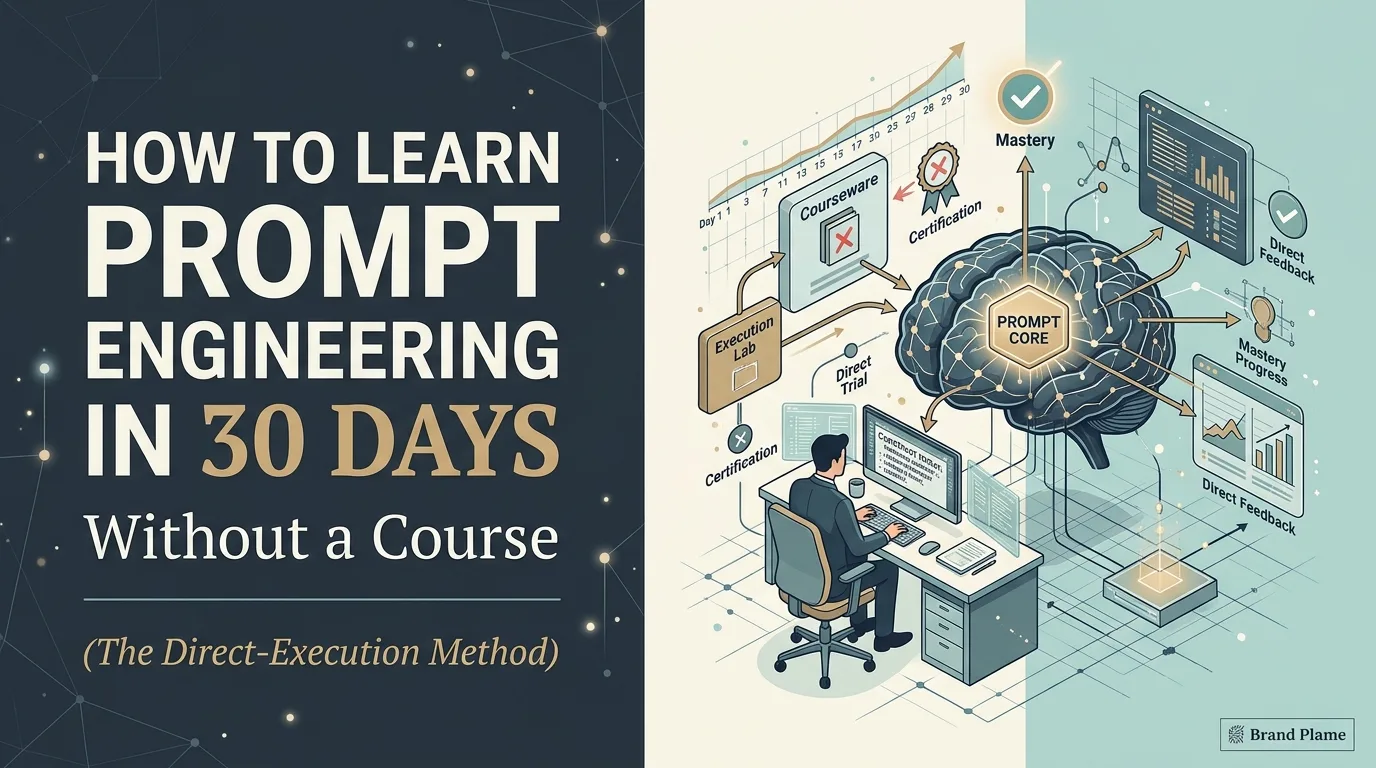
Most prompt engineering courses are obsolete before they finish rendering on your screen. They spend the first week explaining what a Large Language Model is, the second week on basic zero-shot prompting, and by week four, you're paying for certificate templates that carry zero weight in a technical hiring loop. If you want to master prompting in 30 days, cancel your subscriptions, close the cohort-based learning tabs, and adopt a direct-execution model. You don't need a curriculum; you need a blank terminal, an API key, and a systematic framework for breaking down language models.
Prompt engineering is not creative writing. It is applied systems engineering using natural language as the control interface. Over the next 30 days, we are going to treat LLMs less like conversational oracles and more like stochastic execution engines that require strict constraint satisfaction.
The 30-Day Philosophy: Context Windows Are Programming EnvironmentsTo master prompt engineering without a course, you must unlearn the habit of talking to AI like a human assistant. When you prompt a frontier model like GPT-4o, Claude 3.5 Sonnet, or Llama 3.1 405B, you are compiling instructions into a dynamic execution graph. The prompt is your codebase. Every word is a token of operational overhead. Every system instruction is a compilation flag.
We divide our 30-day sprint into four distinct operational phases:
- Days 1–7: Token-Level Mechanics and Context Physics
- Days 8–14: Structural Frameworks (Chain-of-Thought, ReAct, and Tree-of-Thought)
- Days 15–21: Guardrails, Fallbacks, and Output Determinism (JSON/YAML forcing)
- Days 22–30: Production Pipeline Integration and Automated Evaluation
You cannot optimize what you do not measure. Most bad prompts fail because the author does not understand how models parse subword tokens, allocate attention, or process instruction hierarchy.
Day 1–3: The Tokenizer Deep DiveSpend three days exclusively inside tokenization visualization tools (like OpenAI's Tiktokenizer). Write text paragraphs, code snippets, and structured data, then observe how they split into tokens. You will quickly discover why prompts fail:
- Spelling errors radically change token IDs, shifting semantic meaning.
- Non-standard indentation in code prompts wastes thousands of context tokens on invisible whitespace.
- Languages other than English consume significantly more tokens per semantic unit, degrading reasoning depth in smaller models.
Build a 2,000-word document filled with noise, instructions, and hidden needles (specific constraints). Test how different models handle instruction retrieval when instructions are placed at the beginning versus the middle versus the end of the context window. You will prove to yourself why the industry moved toward putting critical system prompts and reference materials at the absolute bottom of the prompt—right before the generation token—to combat 'lost in the middle' phenomena.
Phase 2: Structural Frameworks for Advanced Reasoning (Days 8–14)Stop asking models to 'think step by step' blindly. That is amateur hour. By week two, you will build, test, and break advanced prompting frameworks.
Day 8–10: Systemizing Chain-of-Thought (CoT) and Least-to-Most PromptingTake a complex logic or coding problem. Instead of asking for the solution directly, construct a prompt that forces the model to deconstruct the problem into sub-problems sequentially. Write a multi-turn prompt template where the model validates its own intermediate outputs before proceeding to the next logical step.
Day 11–14: Implementing ReAct (Reason + Act) LoopsSimulate a programmatic agent loop manually. Write a prompt that forces the LLM to output a strict JSON structure containing thought, action, and action_input. You manually run the action (e.g., a mock database query or a math calculation) and feed the observation back into the next prompt iteration. This teaches you how foundational framework builders design LangChain and LlamaIndex agents under the hood.
The single greatest point of failure in production LLM systems is output drift—when a model suddenly decides to chat, wrap its response in markdown code blocks when you asked for raw JSON, or drop crucial keys from a schema.
Day 15–17: Schema Enforcement Without API HandlersLearn to force structural compliance purely through prompt architecture before relying on native JSON mode features. Use XML tags (e.g., <schema>, <rules>, <output>) to isolate directives. Test how models react when you provide negative constraints: 'Do not include conversational filler. Return only the raw JSON object beginning with { and ending with }.'
Stop guessing how many examples to provide. Build a regression test suite with 20 edge-case inputs. Systematically add 1, 3, and 5 few-shot examples to your prompt and measure accuracy delta. You will discover the exact inflection point where additional examples stop improving performance and start causing catastrophic overfitting to the examples provided.
Phase 4: Production Pipelines and Automated Evaluation (Days 22–30)A prompt is not finished until it is automated. The final third of your 30 days is spent turning your static prompts into programmatic assets.
Day 22–25: Writing Automated Evals (Promptfoo or Custom Python Scripts)Manual testing is dead. Write a Python script using the OpenAI or Anthropic SDK that runs your prompt against a test dataset of 50 varied inputs. Use a secondary 'LLM-as-a-Judge' prompt to score the outputs for accuracy, tone, and constraint adherence automatically.
Day 26–30: Prompt Refactoring and CompressionTake your most complex, high-performing 1,000-word prompt. Spend five days aggressively refactoring it. Can you cut it down to 400 words without losing accuracy? Optimize for lower latency, lower token costs, and higher semantic density. This is what separates hobbyists from enterprise prompt engineers.
The Self-Taught Engineer’s ChecklistTo ensure you stay on track during this 30-day sprint, evaluate your progress against these non-negotiable milestones:
- Can you debug a failing prompt? When a model hallucinates, do you know whether to adjust temperature, modify the system prompt, add a few-shot example, or rewrite the schema constraint?
- Do you understand model divergence? Can you explain why a prompt that performs brilliantly on Claude 3.5 Sonnet completely collapses on Llama 3 8B?
- Are you code-adjacent? Can you wrap your prompts in a clean Python script using environment variables and structured error handling?
You do not need a certification to prove you can engineer prompts. You need a GitHub repository filled with robust, evaluated, production-grade prompt templates. Open your editor, set your timer for 30 days, and start building.
How to Learn Prompt Engineering in 30 Days Without a Course (The Direct-Execution Method)
Master prompt engineering in 30 days without paid courses. Use this hands-on direct-execution blueprint to build LLM systems, evals, and architecture.