
Why Generalist Freelancing is Dead: The 2026 AI Playbook for Niche Domination

Let’s address the elephant in the room: if your freelance business model relies on writing standard blog posts, whipping up basic UI wireframes, or translating introductory copy, you are currently bidding against an army of infinitely patient, zero-cost silicon workers. The barrier to entry for broad, generalized execution has effectively plummeted to zero. Clients no longer pay top dollar for execution alone because a prompt can generate eighty percent of a baseline deliverable in under ten seconds.
Yet, premium freelancers are charging more than ever. The market hasn't shrunk; it has polarized. At the bottom, automated tools have commoditized generalist output. At the top, companies are desperately hunting for hyper-specialized human intervention to untangle complex, context-laden business problems. Survival in the current landscape demands a hard pivot away from broad service offerings. You cannot out-volume an LLM, but you can radically out-contextualize it.
Defining the Modern Niche: Beyond 'Industries'Most freelancers get niching wrong. They think a niche is an industry vertical, such as “healthcare marketing” or “SaaS copywriting.” In a post-AI landscape, vertical specialization alone is a trap. An enterprise-grade AI model can ingest a company's brand guidelines, competitor data, and industry whitepapers to produce passable healthcare SaaS content in minutes.
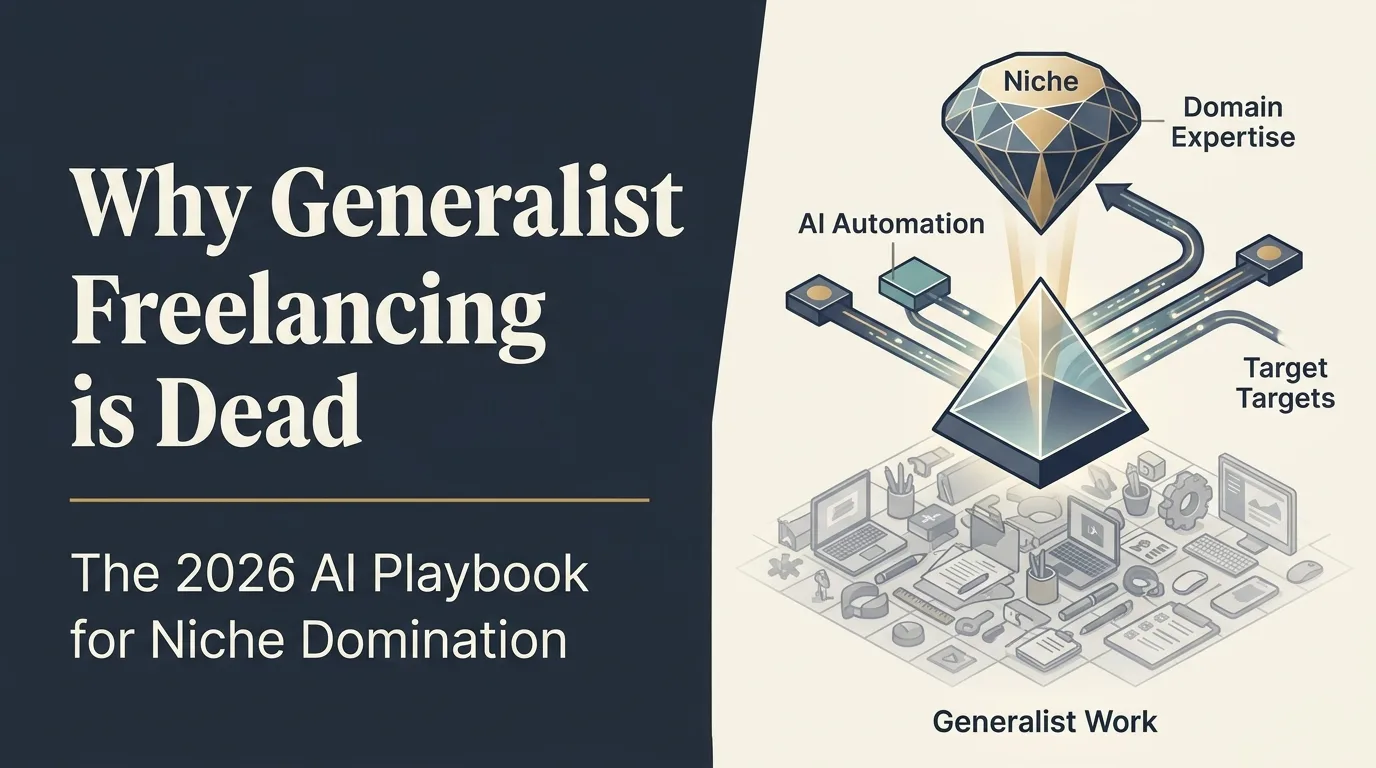
A true, AI-proof niche is defined by the intersection of three specific vectors: Proprietary Methodology, High-Stakes Tangibility, and Cross-Disciplinary Friction.
1. Proprietary Methodology Over Generic DeliverablesClients don't actually want a deliverable; they want a guaranteed transformation. If you sell “email newsletters,” you are a commodity. If you sell the Lifecycle Retention Framework for Bootstrapped B2B Fintechs Scaling Past $5M ARR, you are an indispensable strategist. Your niche must be anchored by a proprietary process—a repeatable, distinct framework that turns chaos into order.
2. High-Stakes TangibilityAI excels in low-stakes environments where an error results in a minor revision. It falters catastrophically in high-stakes zones where mistakes trigger legal liabilities, massive financial losses, or reputational self-immolation. Position yourself where the cost of failure is astronomical. When a single compliance error costs a crypto exchange millions, they won't trust an unverified prompt. They will hire the specialist who understands edge-case regulatory architecture.
3. Cross-Disciplinary FrictionAI operates within siloed domains based on training data. The real magic—and the highest-paying freelance work—happens at the jagged edges where disciplines collide. Think of the intersection between legacy industrial supply chain logistics and modern headless e-commerce UX, or medical device clinical trial data translation and interactive product design. Bridging these distinct worlds requires human empathy, political savvy, and mental agility that machines cannot replicate.
The 4-Step Framework for Narrowing Your Scope Without Shrinking Your MarketSpecialization feels terrifying because of scarcity mindset. Freelancers worry that by narrowing their focus, they will miss out on potential revenue. The opposite is true. The narrower your aperture, the more visible you become to the buyers who matter.
Step 1: Audit Your Revenue-to-Cognition RatioPull your last twenty invoices. Map out which projects required deep, agonizing human problem-solving versus those where you felt like a glorified prompt engineer.
- Which projects commanded the highest margins relative to your active hours?
- Where did your clients express the deepest relief upon receiving your work?
- What problems did the client try and fail to solve using AI before calling you?
Stop looking at existing job titles on freelance marketplaces. Instead, combine your weirdest, most disparate professional experiences into a single category of one.
Example:
Generalist: "I design mobile apps."
Niche Generalist: "I design fintech mobile apps."
AI-Proof Specialist: "I design offline-first mobile authentication workflows for fintech companies expanding into emerging markets with intermittent connectivity."
The latter example commands a $15,000 project minimum because no off-the-shelf design system or AI generator accounts for localized infrastructure constraints.
In a world flooded with AI-generated noise, proof of thought leadership is your ultimate currency. Generalists write about broad trends. Specialists deconstruct specific anomalies.
- Publish teardowns of broken systems within your niche.
- Share anonymized case studies detailing how you solved a problem that cost a company six figures.
- Build open-source templates, calculators, or audits that prospective clients can use to diagnose their own operational bottlenecks.
When you niche down effectively, your pricing model must evolve. Hourly rates and flat-fee deliverables for minor tasks invite comparison against automated tools. Premium niches demand value-based pricing and fractional arrangements. Position yourself as a Fractional Systems Architect, a Strategic Advisor, or a Specialized Fixer. You aren't writing code or drafting copy; you are steering the ship through treacherous, unfamiliar waters.
Case Study: The Evolution of a CopywriterConsider Sarah, a freelance copywriter who spent years writing generic landing page copy for startups. When generative AI arrived, her income dropped by 40% in six months as clients opted for automated drafts.
Instead of fighting the tide, Sarah audited her past work and realized her highest-performing projects always involved highly technical SaaS products targeting enterprise security teams—buyers who traditionally hated marketing fluff and demanded rigorous technical accuracy.
Sarah rebranded. She dropped the title "Copywriter" entirely. She positioned herself as a Technical Narrative Architect for Enterprise Cybersecurity Compliance Tools. She learned the nuances of SOC 2 compliance, zero-trust architecture, and CISSP frameworks. She stopped selling "landing pages" and started selling "messaging frameworks that pass CISSP-level scrutiny and convert Fortune 500 CISOs."
Her client volume dropped by 80%, but her average project fee increased by 450%. Today, she works with a handful of elite clients who view her as irreplaceable.
Before you completely overhaul your freelance business, it is vital to understand the tactical trade-offs of extreme niching.
The Advantages:- Pricing Power: You escape the race to the bottom and command premium rates because alternatives do not exist.
- Referral Velocity: Your clients operate in tight-knit industries; when you solve a massive problem for one, word spreads rapidly across the sector.
- Reduced Workload: You make more money working with three deeply targeted clients than you ever did chasing thirty low-margin gigs.
- AI-Immunity: Your work requires deep human context, strategic alignment, and stakeholder management that automation cannot touch.
- Market Ceiling: Your total addressable market is smaller, requiring proactive, highly targeted outbound prospecting.
- Continuous Learning: You must stay on the cutting edge of your chosen niche; resting on your laurels leads to rapid obsolescence.
- Psychological Friction: Turning down lucrative, out-of-niche projects requires immense discipline during dry spells.
Theory is useless without execution. If you are ready to future-proof your freelance business against the AI wave, execute this 30-day roadmap:
Days 1–10: The Audit. Review your project history. Isolate the tasks where AI failed to replicate your value, and identify the clients who paid the most happily.
Days 11–20: The Positioning Shift. Rewrite your website, LinkedIn profile, and portfolio. Erase all broad terminology. Frame your services around a high-stakes business outcome supported by a proprietary framework.
Days 21–30: The Outbound Assault. Identify 50 dream clients who fit your new hyper-specific criteria. Reach out not to pitch services, but to share a proprietary insight, audit, or teardown that highlights a blind spot in their current operations.
The era of the generalist freelancer is over. The era of the hyper-specialized human strategist has begun. Choose your corner of the market, build your moat, and let the algorithms fight over the scraps.
Why Generalist Freelancing is Dead: The 2026 AI Playbook for Niche Domination
Stop competing with algorithms. Discover the 2026 AI playbook for freelancers to niche down, command higher rates, and achieve market dominance.